

Lithium Battery Fire Insurance: Waste Sector Risk
UK recycling operators face severe disruption as damaged lithium-ion cells cause blazes across transfer stations and recovery facilities. Securing viable lithium battery fire insurance now demands rigorous proof of operational discipline rather than routine placement submissions. Concealed power packs in municipal waste streams spark violent thermal runaway incidents that generate massive underwriter losses. Consequently, insurers scrutinise every site risk profile before offering terms to modern waste operations. Facilities must prove robust containment to secure terms.
Commercial property capacity has contracted dramatically, forcing operators to adapt to severe warranties and elevated deductibles. Facilities must prove their physical resilience through rapid detection and active suppression systems to secure commercial cover. How can recycling businesses satisfy underwriting standards, implement containment protocols, and protect operations against losses from hidden rechargeable devices?
Key Takeaways
- Undetected lithium-ion cells in waste streams trigger thermal runaway events that ignite surrounding combustible refuse within seconds during processing.
- Specialist insurers now demand thermal monitoring, reduced stockpile volumes and physical separation zones across permitted recycling facilities.
- Adherence to WISH WASTE 28 guidance sets the operational benchmark underwriters expect before issuing property and business interruption cover.
- Severe fires create significant pollution clean-up costs, making environmental liability insurance critical for protecting local watercourses and land.
- Early mechanical screening, quarantine bays and automated deluge equipment preserve insurability whilst limiting premium increases at renewal.
Core Drivers of Waste Sector Fire Exposures
Lithium battery incidents present a catastrophic threat to waste and recycling facilities across the United Kingdom. Standard collection processes fail to intercept hidden power packs within mixed dry recyclables. These concealed units enter shredders and compactors alongside paper, card, and plastics. The resulting thermal runaways spark intense blazes that destroy processing plant.
Insurers respond to these elevated fire losses by demanding compliance with technical risk controls. Facilities that fail to prove containment procedures face policy exclusions and excessive deductibles. Some operators face complete withdrawal of commercial coverage. The table below outlines how specific battery hazards translate into operational vulnerabilities, regulatory exposures, and direct commercial insurance consequences.
| Hazard Trigger | Operational Impact | Insurance and Regulatory Exposure |
|---|---|---|
| Hazard TriggerCrushed cells in compactors | Operational ImpactRapid thermal runaway in high-density material | Insurance and Regulatory ExposureMaterial damage claims, property deductible increases |
| Hazard TriggerShredder puncture events | Operational ImpactInstantaneous ignition of dust and light fraction waste | Insurance and Regulatory ExposurePlant breakdown claims, engineering warranty enforcement |
| Hazard TriggerThermal propagation in bulk storage | Operational ImpactDeep-seated bunker fires requiring protracted firefighting | Insurance and Regulatory ExposureBusiness interruption losses, extended indemnity periods |
| Hazard TriggerContaminated firewater runoff | Operational ImpactDischarge into surface drains and local groundwater | Insurance and Regulatory ExposureEnvironmental liability claims, Environment Agency enforcement |
Thermal Runaway Mechanics in Municipal and Commercial Waste Streams
Mechanics of Battery Failure Under Mechanical Stress
Lithium-ion cells fail violently when mechanical compaction, shredding, or external impact ruptures their internal separator plates. This internal short circuit initiates rapid exothermic chemical decomposition, releasing volatile gases and heat above seven hundred degrees Celsius. Surrounding combustible materials ignite within seconds, overwhelming site staff before manual suppression equipment can deploy.
Compact electronic devices and power tools present extreme hazards when mixed into commercial skip loads or household refuse. When heavy mobile plant or fixed industrial shredders crush these concealed units, the cell casing splits instantly. The flammable organic solvent electrolyte aerosolises, creating an energetic flame jet that resists standard powder or water fire extinguishers.
Propagation Risks in Dense Combustible Stockpiles
Thermal runaway spreads rapidly through loose refuse, shredded paper, card, and recycled plastics stored in processing bays. High ambient temperatures, dense compaction, and ample oxygen turn minor battery ignitions into deep-seated industrial fires. Extinguishing these multi-point core blazes requires protracted water application and mechanical pile dismantling by site teams.
Processing yards often accumulate significant bulk volumes before sorting, creating heavy combustible fuel loads. Once heat penetrates an unmanaged stockpile, surface monitoring can miss it. Thermal imaging cameras may detect sub-surface smouldering only after temperatures exceed dangerous self-heating thresholds. Swift containment depends upon enforcing strict stock volume ceilings and maintaining access routes for heavy machinery to break down piles.
Did You Know?
The Environmental Services Association reported that its members recorded 1,518 fires in the year to March 2026. At least 541 were directly attributed to lithium-ion batteries, with a further 216 battery fires in bin lorries.
Underwriter Retraction and Hardening in the Waste Market
Capacity Contraction and Premium Escalation Across Property Portfolios
Commercial insurers have drastically reduced available underwriting capacity for UK recycling facilities following years of severe sector losses. Numerous syndicates and corporate insurers now decline waste transfer stations outright due to unquantifiable battery ignition frequencies. Surviving markets impose substantial rate hardening, escalating annual premiums significantly whilst restricting baseline coverage across processing infrastructure.
Underwriters evaluate waste risks through forensic technical reviews, examining loss history, material throughput, and equipment age. Operations relying on standard property covers without documented risk controls often encounter punitive pricing or notice of non-renewal. Businesses must treat their waste management insurance placements as detailed risk presentations. In practice, we find the strongest submissions prove that physical mitigations isolate combustible loads from volatile electronics.
Restrictive Fire Warranties and Heightened Deductibles
Insurers enforce exacting policy warranties to mitigate their exposure to lithium battery fires across processing yards. Policies frequently stipulate mandatory thermal imaging patrols, rigid stock-height limitations, and continuous monitored fire detection systems. Any breach of these warranties allows underwriters to reject claims entirely after a major site fire. Operators are then left fully exposed.
Deductibles for material damage have climbed from nominal amounts to substantial six-figure retentions on high-hazard sites. In addition, underwriters introduce co-insurance clauses and specific sub-limits on combustible waste stock stored outside approved bays. Compliance requires continuous management oversight to ensure daily site practices conform precisely to schedule endorsements and agreed operational parameters.
Cover Built for Demanding Businesses
Across high risk industries, the cover we arrange most often includes:
Public liability
Employers' liability
Motor fleet
Contractors' all risks
Freight liability
Professional indemnity
Environmental liability
Business interruption
Most businesses need a combination, rather than a single focus policy, and we build cover around your contracts, your workforce and your operational activities.
Regulatory Obligations Under Environmental Permitting Regimes
Fire Prevention Plan Requirements Under Environment Agency Rules
The Environment Agency requires permitted waste storage and processing sites across England to maintain an approved Fire Prevention Plan. This permit-linked document establishes strict operational controls to prevent fires, extinguish blazes within four hours, and contain contaminated runoff. Operating without an approved plan risks permit suspension, enforcement notices, and policy cancellation by insurers.
Under the Environmental Permitting (England and Wales) Regulations 2016, regulators examine site infrastructure before granting or varying operational permits. Devolved authorities including Natural Resources Wales, SEPA in Scotland, and DAERA in Northern Ireland enforce corresponding regimes. Insurers inspect these plans closely. They check that pile dimensions, separation distances and water supplies mirror the risk representations in policy documents.
Statutory Duty of Care and Contamination Prevention
Section 34 of the Environmental Protection Act 1990 imposes a Duty of Care on everyone handling waste. Facilities must take all reasonable measures to prevent illegal disposal and contain hazardous contaminants such as commercial batteries. Failure to segregate volatile electronics exposes operators to statutory penalties and criminal prosecution by regulators.
Waste transfer notes and electronic consignment documentation must record waste origins accurately under UK environmental rules. Commercial customers sometimes dispose of bulk lithium-ion packs within mixed dry recyclables. Processors then need documented audit trails to establish liability. Transparent intake screening protects environmental permits and demonstrates operational diligence during post-loss regulatory investigations.
Technical Standards Established by WISH Guidance
Separation Distances and Stockpile Limits Under WISH WASTE 28
The Waste Industry Safety and Health Forum produces definitive technical guidance for reducing fire risks across UK recycling operations. WISH WASTE 28 sets maximum stack sizes and separation distances, informed by full-scale burn trials. Underwriters routinely adopt these engineering parameters as binding conditions within commercial insurance schedules.
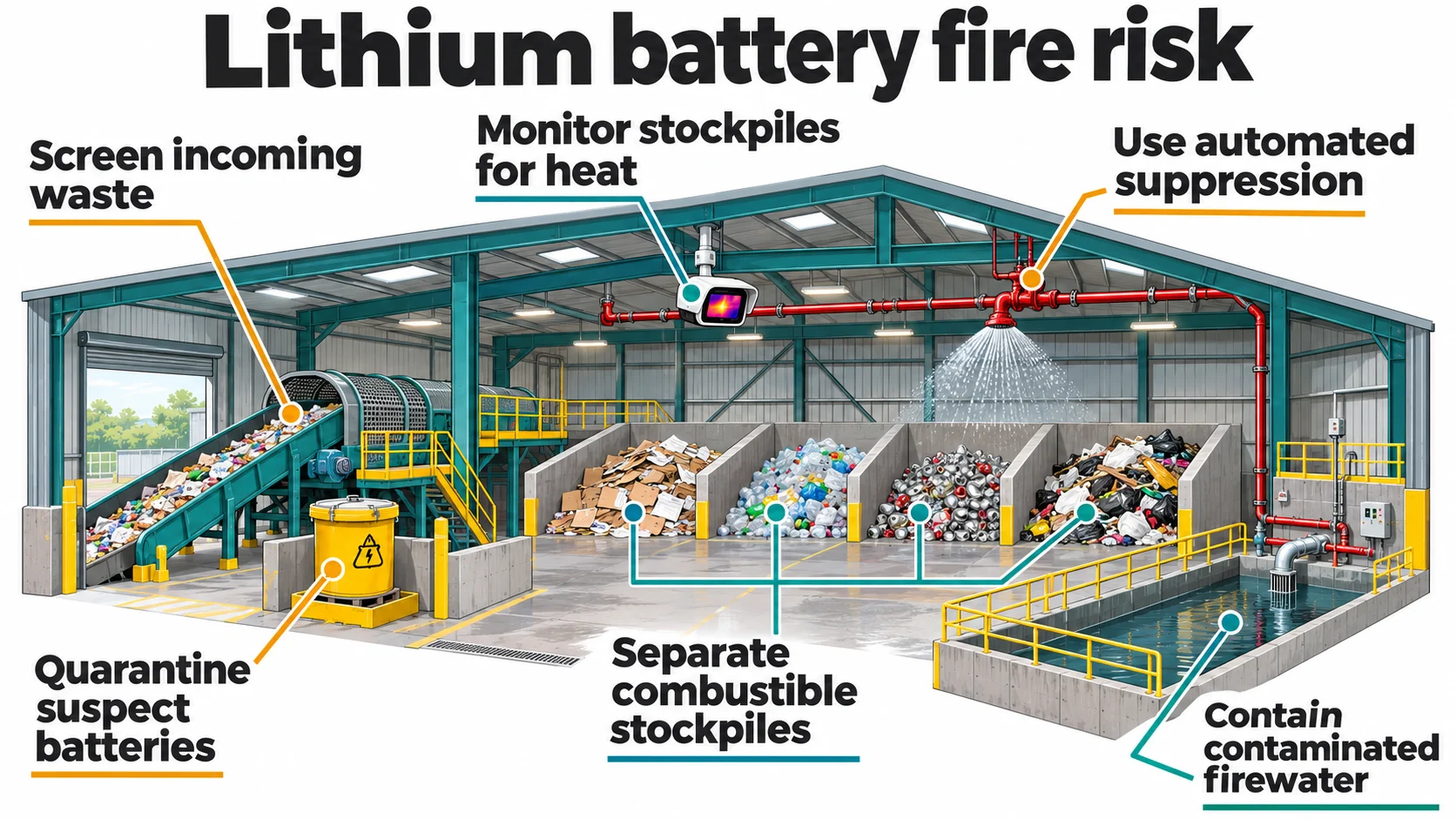
Its separation distances scale with stack width and length rather than applying one fixed gap. Engineered firewalls offer an alternative where space is limited. In England, the Environment Agency’s Fire Prevention Plan guidance sets a simpler baseline of four-metre pile heights and six-metre separation. Insurers inspect site layouts against both benchmarks and refuse cover where excessive material sits without adequate fire separation.
Active Detection Regimes and Continuous Thermal Monitoring
Early ignition detection remains critical for preventing catastrophic battery fires within high-throughput materials recovery facilities. WISH guidance supports automated smoke detectors, flame sensors and fixed thermal imaging cameras across tipping floors and shredder feeds. These continuous systems identify anomalous surface heat signatures long before visible smoke or open flames emerge across processing bays.
Modern radiometric thermal cameras continuously monitor bunker surfaces. They send instant alerts to on-site control rooms and remote monitoring centres when temperatures breach pre-set thresholds. Handheld thermal cameras used during shift changes provide essential secondary verification for deep-seated hotspots. Underwriters reward these integrated surveillance networks with broader policy terms and improved risk acceptance.
Operational Defences to Preserve Site Insurability
Front-End Sorting and Manual Quarantine Protocols
Effective battery risk management begins at the weighbridge and reception floor before incoming waste reaches mechanical processing lines. Operators must conduct visual inspections of tipped loads, train picking-line staff to intercept electrical items, and maintain fire-resistant quarantine drums. Prompt physical removal of intact batteries prevents violent cell rupture during shredding and compacting.
Dedicated quarantine stations hold vermiculite or specialist fire-retardant granules. Operatives use them to isolate damaged, swollen or hot battery units safely. Facilities should log every intercepted battery unit to track contamination trends across commercial supplier accounts. From experience across the sector, insurers examine these logs during annual risk audits to verify that staff actively control hazardous components.
Automated Suppression Infrastructure and Deluge Systems
Automated fire suppression systems represent a decisive technical defence against fast-moving thermal runaway blazes in waste environments. High-volume deluge systems, targeted water cannons, and fast-acting foam installations can extinguish emerging hotspots across machinery within seconds. Installing these capital-intensive systems significantly enhances site insurability, allowing facilities to maintain comprehensive property damage protection.
Automated monitors linked to thermal sensors deliver thousands of litres of water per minute. They target the focal point of an ignition directly. Fixed foam suppression inside shredder chambers rapidly smothers the oxygen supply. It suppresses primary flash fires before flames spread into adjacent conveyor ducts. Insurers often require independent certification and regular maintenance logs for these installations before confirming coverage.
Environmental Liabilities Arising from Severe Fire Events
Contaminated Firewater and Statutory Remediation Demands
Large-scale recycling fires generate vast quantities of toxic runoff containing dissolved heavy metals, chemical combustion residues, and hazardous foam agents. Operators remain liable for any containment breach that pollutes adjacent rivers, public drains or underlying aquifers. Immediate containment requires dedicated shut-off valves, retention bunds, and temporary lagoon capacity.
The Environmental Damage (Prevention and Remediation) (England) Regulations 2015 require operators to remediate environmental harm and restore damaged habitats. Tankering off hundreds of thousands of litres of contaminated firewater after a multi-day fire costs hundreds of thousands of pounds. Regulators can initiate immediate enforcement proceedings and issue clean-up notices that mandate long-term groundwater and soil decontamination.
Gaps in Standard Public Liability Policies
Standard public liability policies provide inadequate financial protection against major environmental disasters caused by site fires. General third-party wordings typically cover only sudden and accidental pollution. They exclude statutory clean-up costs, biodiversity restoration and on-site remediation expenses. Stand-alone environmental liability insurance fills these gaps, shielding operators against catastrophic regulatory remediation claims.
Environmental Impairment Liability policies respond to statutory notices under the Environmental Protection Act 1990 or Water Resources Act 1991. They cover off-site property remediation, legal defence fees during Environment Agency investigations, and mandated biodiversity reparations. Waste operators relying solely on traditional combined liability packages face existential financial exposures when emergency firewater containment measures fail.
Business Interruption Realities Following Catastrophic Plant Losses
Extended Replacement Timelines for Bespoke Processing Machinery
Modern materials recovery plants rely heavily on custom-engineered equipment, including high-speed optical sorters, ballistic separators, and automated shredding systems. Replacing this complex machinery following a catastrophic fire often requires twelve to twenty-four months due to specialist fabrication backlogs. Material damage coverage alone fails to address the severe ongoing operational losses during extended closures.
Supply chain delays for specialist electronic componentry and structural steel prolong facility rebuilding programmes. Furthermore, rebuilding requires structural demolition, contaminated ash removal, and renewed environmental permit validations before commissioning tests can begin. Businesses that understate their machinery replacement timelines risk depleting their insurance reserves long before normal revenue generation can resume.
Revenue Protection and Maximum Indemnity Periods
Selecting an adequate maximum indemnity period for business interruption insurance remains essential for surviving severe waste facility fires. Standard twelve-month periods prove grossly inadequate when planning delays, machinery manufacturing lead times, and environmental site clearances stall reopening. A comprehensive policy structured with a twenty-four or thirty-six-month indemnity period preserves essential operational cash flow.
Business interruption coverage protects gross profit, fixed staff wages, standing plant hire contracts, and increased costs of working. When a site shuts down, operators must divert incoming waste to third-party transfer stations. Emergency diversion agreements keep municipal contracts running. Adequate increased cost of working extensions absorb these punishing diversion and gate fee costs whilst the main plant undergoes reconstruction.
Final Thoughts
Rechargeable batteries in domestic and commercial refuse have permanently reshaped operational risk across the UK recycling sector. Securing robust lithium battery fire insurance is no longer a routine administrative renewal. It is a thorough examination of site engineering and containment capability. Underwriters expect evidence of an approved Fire Prevention Plan, adherence to WISH WASTE 28 and automated thermal detection.
Future commercial viability will separate proactive operators with resilient physical controls from those relying on legacy fire-safety practices. Radiometric thermal imaging, automated water cannons and early mechanical segregation will define best practice across modern facilities. As battery chemistries evolve and throughput volumes climb, robust technical management remains vital. It is the most reliable defence against catastrophic property and environmental losses.
Speak to an Insurance Specialist
Whether you need a new quote, want to discuss your renewal or have a question about an existing policy, our team is here to help.
Frequently Asked Questions
Q: Why do lithium-ion batteries cause such severe fires in waste management facilities?
A: Lithium-ion cells store significant electrochemical energy alongside flammable organic solvent electrolytes. Shredders, compactors and material handlers can crush these batteries during processing. Internal components then short-circuit and trigger rapid thermal runaway. Temperatures quickly surge past seven hundred degrees Celsius, producing intense jet flames and toxic gases. The dense paper, card and plastic refuse surrounding the cell then ignites. The result is often a deep-seated blaze that resists conventional fire-extinguishing methods.
Q: What specific fire warranties do insurers apply to waste and recycling policies?
A: Underwriters routinely impose strict warranties covering stockpile dimensions, separation distances and continuous thermal monitoring. Many endorsements mirror the Environment Agency’s Fire Prevention Plan baseline of six-metre firebreaks and four-metre pile heights. Others require twenty-four-hour automated optical or thermal fire detection. Warranties also frequently demand regular handheld thermal inspections and documented hot-work permit controls. Strict compliance with the site’s approved Fire Prevention Plan is usually a condition of cover. Any breach can entitle an insurer to repudiate claims following a fire.
Q: How does WISH WASTE 28 guidance affect waste facility insurance placement?
A: WISH WASTE 28 is the recognised technical benchmark for fire safety across UK waste and recycling operations. The Waste Industry Safety and Health Forum produced it through a working group that drew on fire services, regulators and insurers. It sets out best practice for fire prevention, stack sizes, separation distances and suppression. Commercial property underwriters cross-reference site surveys directly against its guidance. Facilities that demonstrate rigorous adherence typically secure better terms. They also tend to face lower deductibles and gain access to broader capacity.
Q: Why is standard public liability insurance insufficient for recycling plant fire clean-up?
A: Standard public liability policies focus on third-party bodily injury and property damage. Most restrict pollution cover to sudden and accidental events. They routinely exclude remediation costs imposed under the Environmental Damage (Prevention and Remediation) (England) Regulations 2015. Extinguishing a major recycling blaze can produce vast volumes of contaminated firewater. That runoff can pollute local groundwater and rivers. Stand-alone environmental liability insurance covers mandatory on-site and off-site clean-up. It also funds legal defence expenses and responses to statutory remediation notices.
Q: What indemnity period should a recycling plant select for business interruption insurance?
A: Recycling facilities should select a business interruption indemnity period of at least twenty-four to thirty-six months. Twelve-month periods rarely suffice after a catastrophic fire. Planning reviews, environmental remediation and long lead times for bespoke shredders and optical sorters all delay reopening. A longer indemnity period maintains support for gross profit losses and continuing debt obligations. It also protects staff retention during rebuilding. Crucially, it absorbs the substantial extra cost of diverting contracted waste to third-party transfer stations.
About The Author
Darren Judd
Director, Co-Founder and Co-Owner of Capital Corporate Risks Ltd

Experienced Account Executive with a demonstrated history of working in the insurance industry. Skilled in Account Management, Risk Management, Business Development across all classes of insurance within the Construction Industry,