
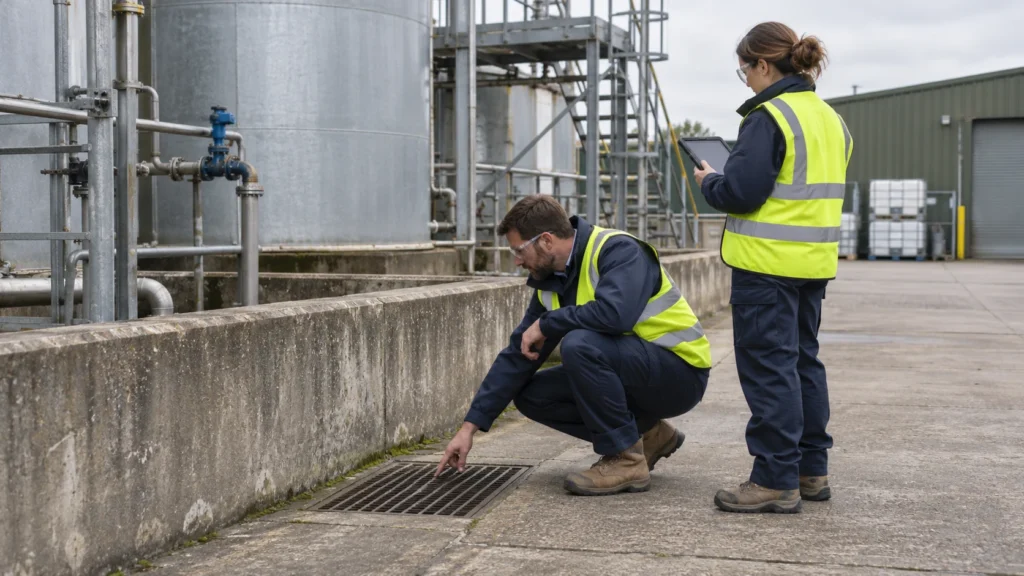
Environmental Liability Insurance: A Buyer's Guide
Commercial operations across the United Kingdom carry strict legal duties for ecological protection, waste control and ground contamination. Standard liability arrangements often leave critical gaps when contamination occurs. Those gaps expose businesses to costly remediation notices from regulators. Dedicated environmental liability insurance funds statutory clean-up, legal defence costs and remediation programmes. Without it, a single incident can place serious strain on the balance sheet.
Many commercial buyers assume their public liability policy covers contamination. They often discover substantial exclusions only after a major pollution incident. Does your business hold the protection it needs against both sudden spills and gradual seepage across its sites?
Key Takeaways
- Standard public liability policies routinely exclude gradual pollution, leaving operations that handle hazardous substances or generate industrial waste with critical exposure gaps.
- The Environmental Damage Regulations 2015 impose strict liability on Schedule 2 activities for damage to protected habitats, species, surface water, groundwater and land.
- Stand-alone environmental impairment policies fund first-party on-site clean-up, whereas standard liability forms generally respond only to third-party off-site damage claims.
- Statutory remediation notices can require extensive ecological restoration work, which routinely exceeds the pollution sub-limits found within standard liability extensions.
- Specialist waste management insurance requires clear alignment between environmental permit conditions, fire prevention plans and policy disclosure conditions to avoid declined claims.
Core Differences Between Commercial Pollution Coverages
Environmental policies operate on different underwriting principles from traditional general liability arrangements. Standard commercial packages usually restrict contamination cover to sudden, unintended and unexpected events. Long-term operational leaks are therefore left uncovered. Specialist policies close this gap by insuring gradual pollution, statutory duties and regulatory clean-up directions.
Evaluating policy terms requires close examination of how triggers, clean-up locations and statutory remediation obligations interact. The table below sets out the main differences between a pollution extension and a stand-alone environmental impairment policy. Exact terms vary by insurer, so wordings should always be compared line by line.
| Coverage Dimension | Public Liability Pollution Extension | Stand-Alone Environmental Impairment Cover |
|---|---|---|
| Coverage DimensionPollution Trigger | Public Liability Pollution ExtensionSudden and accidental only | Stand-Alone Environmental Impairment CoverSudden, accidental and gradual |
| Coverage DimensionClean-Up Location | Public Liability Pollution ExtensionThird-party property off-site | Stand-Alone Environmental Impairment CoverOn-site and off-site land |
| Coverage DimensionStatutory Remediation | Public Liability Pollution ExtensionTypically excluded | Stand-Alone Environmental Impairment CoverTypically included |
| Coverage DimensionBiodiversity Damage | Public Liability Pollution ExtensionGenerally excluded | Stand-Alone Environmental Impairment CoverIncluded for protected habitats and species |
| Coverage DimensionBasis of Contract | Public Liability Pollution ExtensionUsually occurrence basis | Stand-Alone Environmental Impairment CoverUsually claims-made basis |
Statutory Triggers Under UK Environmental Law
The Environmental Damage Regulations 2015
The Environmental Damage (Prevention and Remediation) (England) Regulations 2015 came into force on 19 July 2015. They impose strict liability on operators of activities listed in Schedule 2, such as permitted installations and waste management operations. Operators must prevent imminent damage and remediate actual damage to protected species, habitats, water and land.
For Schedule 2 activities, liability arises without proof of negligence or fault. Other activities fall within scope only for damage to protected species, habitats or Sites of Special Scientific Interest. In those cases, the operator must have acted intentionally or negligently. Enforcing authorities, including the Environment Agency and Natural England, can serve remediation notices requiring restoration to baseline condition. Complementary and compensatory remediation can push the final cost well beyond simple clean-up.
Part 2A of the Environmental Protection Act 1990
Part 2A of the Environmental Protection Act 1990 sets the statutory framework for identifying and remediating contaminated land. Local authorities inspect their areas for land presenting a significant possibility of significant harm to human health. Land where significant pollution of controlled waters is being caused, or is a significant possibility, can also be designated.
Liability falls first on the party who caused or knowingly permitted the contamination. If no such party can be found after reasonable inquiry, liability passes to the current owner or occupier. This creates real balance sheet risk for businesses acquiring freeholds or leaseholds. In practice, we find that buyers who skip historical due diligence can inherit contamination they never caused.
Did You Know?
Schedule 3 of the Environmental Damage (Prevention and Remediation) (England) Regulations 2015 governs compensatory remediation for interim ecological losses. It expressly states that this remediation does not include financial compensation. The operator must deliver real improvements to habitats, species or water instead.
Pollution Trigger Mechanisms and Coverage Variations
Sudden and Accidental Pollution Extensions
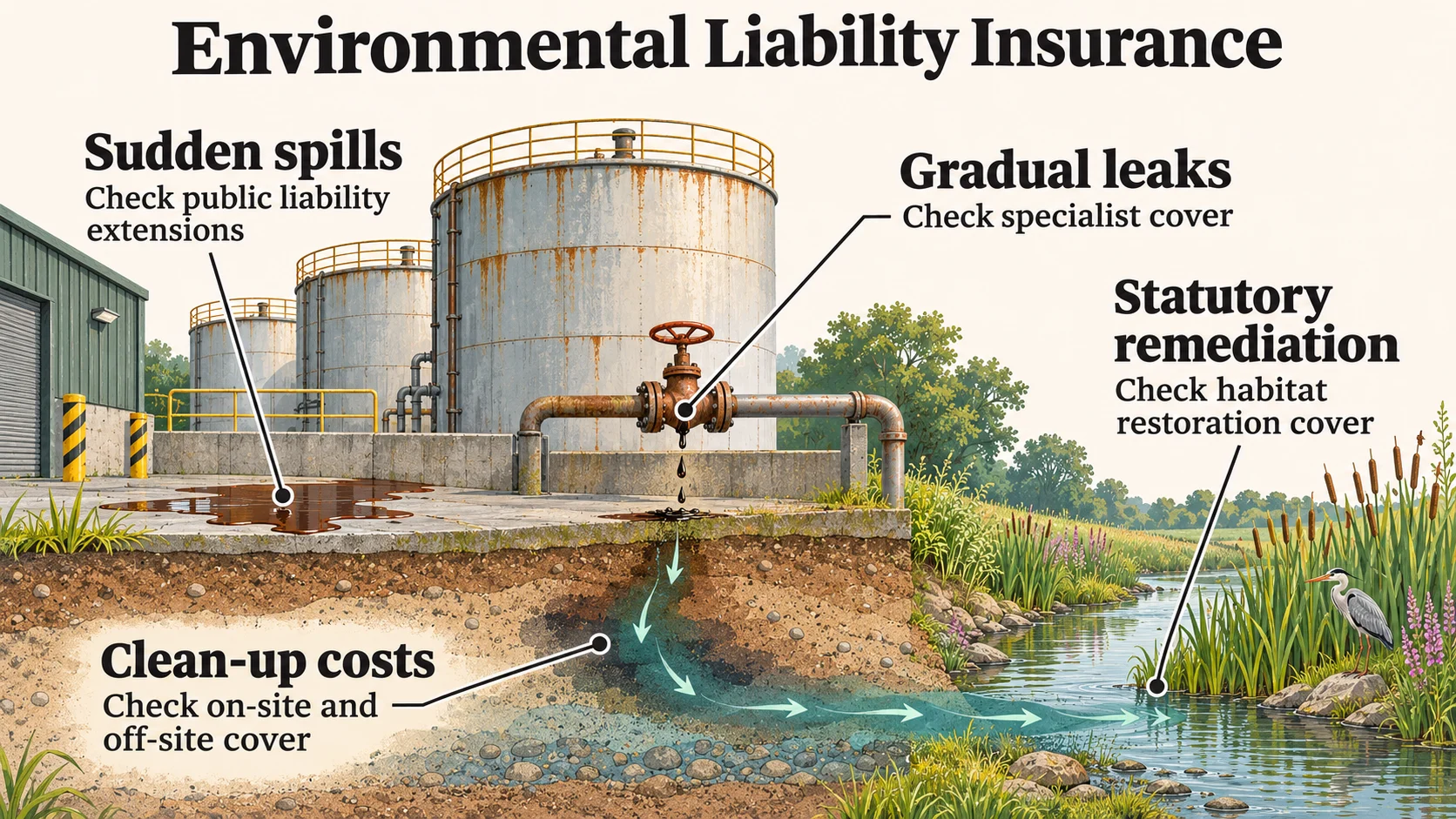
Standard public liability policies typically contain sudden and accidental pollution clauses that severely restrict cover. These clauses require contamination to stem from a specific, identifiable and unintended event. That event must take place entirely at a defined time and location. Anything outside this narrow definition usually falls under the gradual pollution exclusion.
A catastrophic failure of a storage tank valve might qualify under this definition. If that valve wept fluid imperceptibly over six months, however, the insurer would typically rely on the gradual pollution exclusion. This leaves businesses exposed to claims from continuous processes, ageing underground pipework and persistent surface run-off.
Gradual Pollution and Environmental Impairment Cover
Stand-alone environmental impairment liability removes the restrictive sudden and accidental wording. It covers pollution conditions that develop over extended operational periods. Typical examples include slow-drip chemical leaks, solvent migration through concrete slabs and subterranean contamination plumes. These are precisely the events that standard public liability wordings are drafted to exclude.
Dedicated environmental liability insurance responds to these slow-acting contamination events. Beyond defending civil actions, these policies fund technical investigations and long-term monitoring regimes. They also meet the cost of engineered containment required by regulators to address soil and groundwater degradation.
Cover Built for Demanding Businesses
Across high risk industries, the cover we arrange most often includes:
Public liability
Employers' liability
Motor fleet
Contractors' all risks
Freight liability
Professional indemnity
Environmental liability
Business interruption
Most businesses need a combination, rather than a single focus policy, and we build cover around your contracts, your workforce and your operational activities.
Clean-Up Costs and Remediation Mandates
First-Party On-Site Clean-Up Cover
Standard public liability policies provide no indemnity for contamination within the insured’s own site boundary. They respond only to third-party property damage and bodily injury. Remediation work on the policyholder’s own land is excluded entirely. This is a significant limitation, because on-site containment is almost always the first and most pressing expense after a spillage.
Stand-alone policies include first-party clean-up cover for the insured’s own premises. They reimburse soil removal, water treatment and hazardous material extraction on site. Acting quickly also stops contaminants migrating across boundaries and creating third-party claims.
Biodiversity Damage and Habitat Restoration
Environmental legislation compels businesses to repair damaged biodiversity, which traditional property damage policies fail to address. Property damage cover responds to physical harm to tangible property owned by a third party. Wild fauna, unowned aquifers and protected ecosystems lack private ownership status. Their restoration therefore falls outside the scope of a conventional liability wording.
Specialist environmental policies indemnify the cost of primary, complementary and compensatory remediation of natural habitats. If an incident damages a river system or Site of Special Scientific Interest, the policy funds the restoration programme. That can include ecological surveys, restocking and wetland reconstruction required by the enforcing authority.
Incident Response and Emergency Costs
Prevention and Notification Duties
Where there is an imminent threat of environmental damage, the 2015 Regulations require the operator to act straight away. The operator must take all practicable steps to prevent the damage occurring. It must also notify the enforcing authority without delay. These duties apply before any remediation notice is served and carry their own cost.
Where damage has already occurred, the operator must take practicable steps to stop it spreading. From experience across the sector, early mitigation costs are often the hardest to recover under a standard wording. Policies that include emergency response cover close this gap.
Emergency Containment and Mitigation Costs
Many stand-alone environmental policies include emergency response cover for the immediate costs of containing a pollution event. This typically funds spill response contractors, interceptor clearance and temporary barriers. It also covers tankering of contaminated water away from site. Without this cover, the operator funds these urgent measures from working capital.
Policy wordings often require prompt notification to insurers before emergency costs are incurred, except where immediate action is essential. Buyers should confirm how the policy treats costs incurred before insurers are notified. Clear incident response procedures help ensure that early action does not prejudice the claim.
Sector Vulnerabilities and Operational Hazards
Waste and Recycling Facility Exposures
Operators handling commercial recycling and refuse face severe contamination exposures and intense regulatory scrutiny. Stockpiles, sorting areas and effluent collection sumps present ongoing risks of watercourse pollution and odour releases. Robust waste management insurance is therefore critical. It must reflect the specific hazards and permit conditions of each site.
Fires at recycling plants generate heavily contaminated run-off water. If firefighting water escapes retention bunds and enters drains or surface ditches, regulators act quickly. Dedicated sector cover provides adequate limits for fire-water management, controlled waste disposal and emergency interceptor clearance.
Construction and Civil Engineering Risks
Civil engineering contractors and groundworkers frequently encounter subterranean hazards that can trigger major contamination events. Piling, deep excavation and soil remediation works can puncture unknown pipelines. They can also mobilise historical contamination plumes or open new pathways into protected aquifers. A single breach can turn a routine package into a regulatory incident.
Standard third-party cover does not adequately defend contractors against statutory remediation notices. Specialist contractors’ pollution cover protects against unexpected encounters with hazardous materials. It also responds to sediment discharges into watercourses and contaminant migration caused by intrusive groundworks.
Policy Architecture and Underwriting Considerations
Claims-Made Versus Occurrence Policy Forms
Most dedicated environmental insurance contracts are written on a claims-made basis. Standard public liability policies, by contrast, usually operate on an occurrence basis. Under a claims-made form, the policy in force when the claim is first made or notified responds to the loss. The date the pollution began is not the deciding factor.
Policyholders must negotiate an appropriate retroactive date. Ideally, it matches the inception of the business or of previous continuous cover. If a business changes insurers without carrying forward its retroactive date, earlier operations lose their cover. Any claim arising from activity before the new retroactive date will then be uninsured.
Material Disclosures and Policy Warranties
Securing appropriate environmental terms requires an accurate technical presentation of each site. Underwriters review site condition surveys, ground investigations and operational risk controls. They assess underground storage tanks, historical land uses, interceptor maintenance regimes and past regulatory interactions. Incomplete disclosure at this stage can undermine the policy when a claim arises.
Policy schedules frequently include warranties on bund integrity testing, permitted operational volumes and permit compliance. Permits are issued under the Environmental Permitting (England and Wales) Regulations 2016. Failing to meet permit conditions or service pollution interceptors can compromise the policy response during an incident.
Procurement Strategy and Policy Review
Indemnity Limits and Sub-Limits
Commercial buyers must scrutinise internal policy limits against realistic maximum foreseeable loss scenarios. Environmental claims frequently involve prolonged legal disputes and forensic technical investigations. Bio-monitoring programmes and multi-year land remediation works add further cost. Together, these demands can exhaust a modest pollution sub-limit long before the remediation is complete.
In practice, we commonly see public liability pollution sub-limits of £250,000 or £500,000, often aggregated across the policy year. Stand-alone placements provide dedicated limits, commonly in the region of £5,000,000 to £10,000,000 for larger operations. That headroom matters when defence costs and regulatory mandates run concurrently.
Contractual Liability and Tenant Covenants
Commercial property leases and development contracts routinely contain onerous indemnities that transfer environmental responsibility between parties. Tenants often agree to return land in its original condition. In doing so, they can unwittingly absorb historical ground pollution created by predecessor tenants. These obligations frequently sit outside the scope of a standard liability policy.
Brokers must review lease covenants and joint venture agreements to confirm the policy responds to assumed liabilities. Standard contractual liability exclusions may need amending. The policy should then back indemnities given to landlords, funders or local authorities during site transactions.
Final Thoughts
Modern commercial operations cannot rely on standard public liability policies to protect against serious ecological liabilities. Environmental legislation imposes financial responsibility for site remediation, biodiversity restoration and watercourse decontamination. For many activities, that liability applies regardless of fault. Dedicated environmental liability insurance provides a financial firewall when sudden incidents or gradual leaks occur.
Organisations that handle chemicals, generate waste, hold property or undertake groundworks should review their exposures regularly. Aligning policy triggers with statutory obligations keeps protection continuous as environmental liabilities evolve.
Speak to an Insurance Specialist
Whether you need a new quote, want to discuss your renewal or have a question about an existing policy, our team is here to help.
Frequently Asked Questions
Q: Does standard public liability cover on-site pollution clean-up?
A: No. Standard public liability insurance does not cover first-party clean-up costs on your own premises. Traditional liability policies respond to third-party injury or property damage outside the insured boundary. When a spillage occurs on your own property, you must fund soil excavation, groundwater treatment and yard decontamination yourself. The exception is where a dedicated environmental impairment liability policy with first-party clean-up cover is in place.
Q: What is the difference between sudden and gradual pollution?
A: Sudden and accidental pollution arises from a specific, unforeseen event at a distinct moment. Examples include an overturned road tanker or a burst pipe. Gradual pollution involves continuous or repeated emissions, seepages or discharges over days, months or years. An undetected hairline fracture in an underground storage tank is a typical example. Slow chemical percolation through soil is another. Standard public liability pollution extensions typically cover only the first category.
Q: How do the Environmental Damage Regulations 2015 affect corporate liability?
A: The Environmental Damage (Prevention and Remediation) (England) Regulations 2015 cover serious damage to protected species and habitats. They also cover damage to water and land. Operators of Schedule 2 activities, such as permitted installations and waste operations, face strict liability without proof of fault. Operators must take preventive steps, notify the enforcing authority and fund remediation. These duties sit apart from common law negligence. Schedule 2 operators can therefore face substantial restoration costs even where they took reasonable care.
Q: Why do environmental policies use a claims-made basis?
A: Environmental impairment policies use a claims-made structure because pollution often develops unseen over long periods before detection. An occurrence policy responds according to when damage occurs. That date is extremely difficult to pinpoint with gradual underground contamination. A claims-made policy responds according to when the claim is first made or notified. This gives greater legal certainty, provided the business maintains unbroken cover and an appropriate retroactive date.
Q: Can waste management facilities rely on standard property and liability packages?
A: Waste management facilities cannot safely rely on standard packages alone. General liability policies typically exclude gradual run-off, odour and statutory remediation. Waste operations also create distinct exposures, such as contaminated fire-water run-off after a stockpile fire. These risks call for tailored waste management insurance. A dedicated environmental policy, aligned with Environment Agency permit requirements, can cover both off-site ecological damage and on-site emergency containment.
About The Author
Darren Judd
Director, Co-Founder and Co-Owner of Capital Corporate Risks Ltd

Experienced Account Executive with a demonstrated history of working in the insurance industry. Skilled in Account Management, Risk Management, Business Development across all classes of insurance within the Construction Industry,