
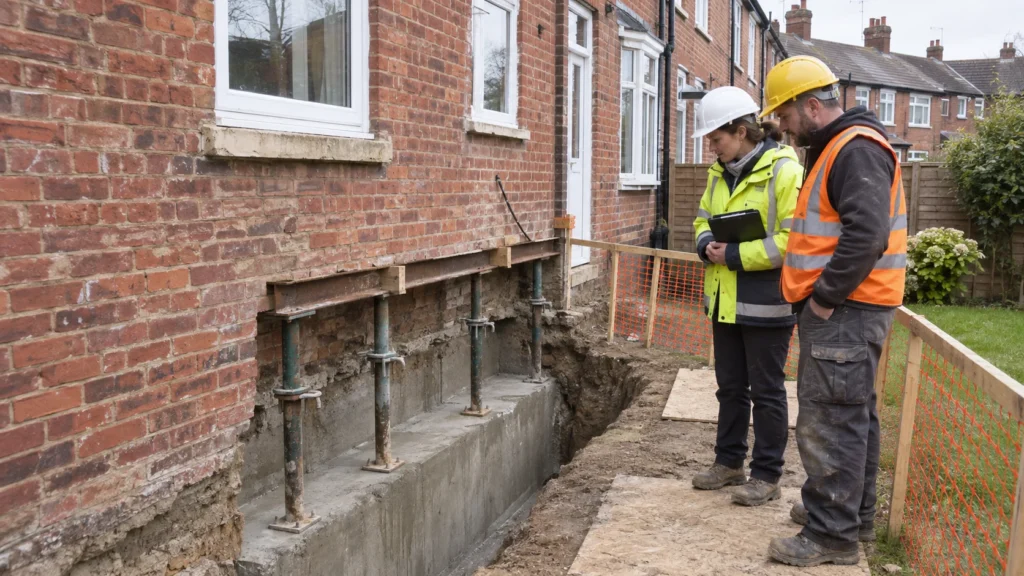
Underpinning Insurance: Cover for Foundations
Foundation stabilisation demands exceptional technical precision. Yet subterranean operations introduce severe structural exposures to existing buildings and neighbouring properties. Specialist underpinning insurance provides the financial safeguard against differential settlement, collapse, and unforeseen ground failure during substructure alterations. Standard public liability policies frequently exclude subsidence, vibration, and removal of support. Without bespoke endorsements, contractors remain dangerously exposed. The right cover allows structural contractors and ground engineering specialists to accept heavy contractual liabilities with confidence.
Subterranean engineering carries third-party property damage risks that can exceed multi-million-pound thresholds when adjacent buildings shift or crack. Generic liability packages ignore the geotechnical mechanics, legal obligations, and party wall frameworks governing underpinning. Why should any contractor risk insolvency by relying on cover that was never designed for foundation works?
Key Takeaways
- Underpinning insurance protects against third-party property damage caused by settlement, ground movement, vibration, and the temporary removal of foundation support.
- Standard commercial liability policies routinely exclude foundation work, so ground engineering contractors need specialist endorsements or dedicated subterranean cover.
- Underwriters assess risk through temporary works designs, geotechnical site investigations, sequenced method statements, and proven operational track records.
- The Party Wall etc. Act 1996 requires formal notices, and pre-commencement schedules of condition defend contractors against disputed adjoining defects.
- A complete insurance programme combines high-limit public liability with contractors all risks, professional indemnity, and hired-in plant cover.
Primary Coverage Pillars for Substructure Contractors
Underpinning contractors operate in an unforgiving risk environment. Minor errors can produce severe structural failure. Mitigating these perils requires an integrated insurance structure spanning property damage, collapse, and design liability. The table below outlines the core policy components and typical indemnity limits. It reflects common underwriting practice for foundation and ground engineering operations across the United Kingdom.
Main contractors and commercial clients routinely demand proof of these covers before granting site access. Subterranean failures frequently escalate into multi-million-pound losses. Adequate primary and excess indemnity layers prevent that exposure from becoming financial devastation. The baseline structure below shows how specialist insurers allocate protection across the distinct exposures of excavation and structural remediation.
| Coverage Component | Market Indemnity Norm | Primary Risk Addressed |
|---|---|---|
| Coverage ComponentPublic Liability (Underpinning Endorsed) | Market Indemnity Norm£5m to £10m | Primary Risk AddressedThird-party property damage, subsidence, and collapse |
| Coverage ComponentContractors All Risks (CAR) | Market Indemnity NormContract value | Primary Risk AddressedMaterial loss or damage to permanent works and materials |
| Coverage ComponentProfessional Indemnity (Design & Build) | Market Indemnity Norm£2m to £5m | Primary Risk AddressedInadequate structural designs, calculations, or specifications |
| Coverage ComponentHired-in Plant & Continuing Hire | Market Indemnity Norm£100k to £500k | Primary Risk AddressedDamage to mini-piling rigs, excavators, and ongoing hire costs |
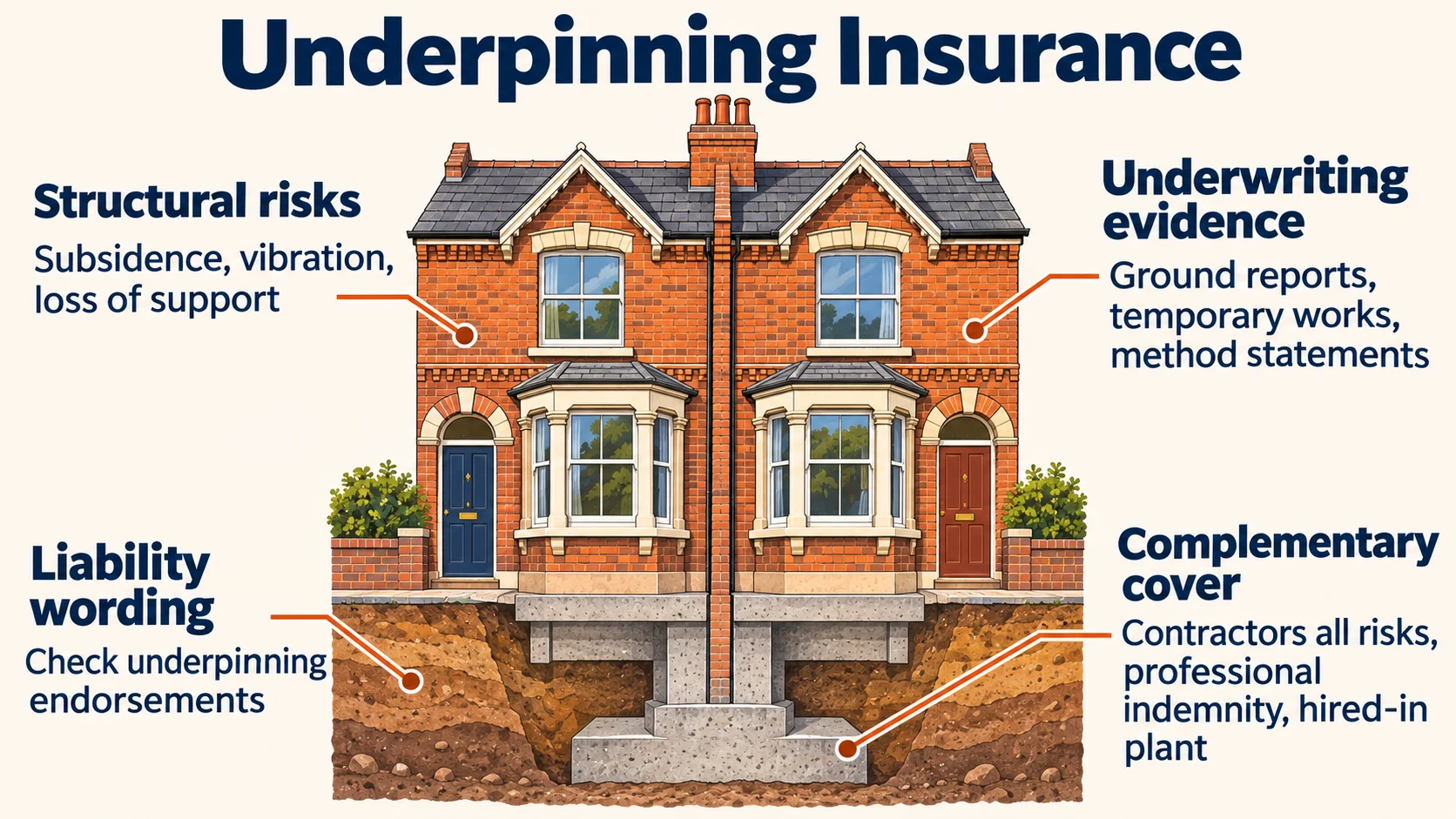
Structural Movement and Adjoining Property Risks
Third-Party Property Damage and Subsidence Exposures
Underpinning alters the load-bearing equilibrium of building foundations. This creates immediate risks of differential settlement and cracking in adjoining structures. Insurers must explicitly remove standard subsidence and collapse exclusions from public liability schedules. Without tailored wording, claims involving neighbouring boundary walls, chimneys, or shared structural elements face prompt declinature.
When contractors excavate beneath existing strip footings or rubblestone walls, the surrounding subsoil shifts under load transfer. Even minor lateral displacement can misalign door frames and shear underground utilities. It can also introduce diagonal masonry cracking across several connected properties. A policy without foundation endorsements treats this movement as an uninsurable gradual occurrence. Insurers do not see it as an acute, contractor-caused loss. The policy wording must therefore state that subsidence, heave, vibration, and weakening of support are covered during operations.
Vibration Damage and Temporary Support Failure
Mechanical excavation, hydraulic jacking, and soil compaction emit vibrations capable of destabilising fragile neighbouring brickwork and plaster. Temporary propping and needle beams must carry substantial loads throughout excavation. Insurers require strict adherence to temporary works designs. That adherence keeps cover intact if propping systems yield under unexpected loads.
The sudden failure of a temporary needle beam or acrow prop can trigger progressive collapse. In dense urban terraces, transferring dead and live loads onto temporary needles demands meticulous calculation. If inadequate bracing allows lateral deflection, the supported structure drops rapidly. That threatens site operatives and adjacent occupants alike. Underwriters treat vibration and support removal as high-hazard triggers. They apply higher excesses and strict warranty clauses to manage the exposure.
Did You Know?
The Party Wall etc. Act 1996 requires excavation notices at least one month before work starts. If the adjoining owner does not consent within 14 days, the Act deems a dispute to have arisen. Surveyors must then be appointed to settle it by award.
Technical Documentation Required by Underwriters
Geotechnical Reports and Temporary Works Designs
Underwriters require geotechnical desktop studies and intrusive borehole data before evaluating any subterranean foundation risk. Soil composition, groundwater tables, and historical mining records dictate the likelihood of heave or settlement. Incomplete ground investigation documentation routinely leads underwriters to decline cover. Alternatively, they impose unworkable commercial exclusions.
Foundation specialists cannot safely design mass concrete pins or beam-and-base solutions without ground data. They need to know soil plasticity, gravel densities, and perched water tables. Underwriters expect structural calculations from chartered engineers confirming load-bearing capacity. These submissions show that the underpinning sequence accounts for local soil mechanics. They also help satisfy the duty of fair presentation under the Insurance Act 2015.
Method Statements and Sequential Excavation Protocols
Detailed method statements setting out hit-and-miss excavation sequencing form the bedrock of any underpinning risk presentation. Underwriters expect contractors to excavate alternating pins, typically numbered one to three or one to four, to prevent collapse. Deviating from approved sequencing during works can compromise liability cover when a structural claim follows.
Underwriters scrutinise how long excavations remain open before contractors pour concrete. They also check the curing intervals before operatives place dry-pack mortar between pins. Standard protocols bar excavation of adjacent pins until the concrete reaches design strength and the dry pack is complete. Method statements must state maximum excavation widths, soil retention measures, and dewatering arrangements. Those details convince underwriters of operational competence.
Cover Built for Demanding Businesses
Across high risk industries, the cover we arrange most often includes:
Public liability
Employers' liability
Motor fleet
Contractors' all risks
Freight liability
Professional indemnity
Environmental liability
Business interruption
Most businesses need a combination, rather than a single focus policy, and we build cover around your contracts, your workforce and your operational activities.
Statutory Duties Under the Party Wall Framework
Party Wall Notice Requirements and Awards
Underpinning works near boundary walls fall within the statutory framework of the Party Wall etc. Act 1996. Contractors must ensure building owners serve Section 6 excavation notices before breaking ground near neighbouring foundations. Operating without valid notices, or an award where one is required, complicates claims and often prejudices the insurer’s defence.
Section 6 requires notice where an excavation within three metres of a neighbouring structure will go deeper than its foundations. It also applies within six metres where the excavation would cut a line drawn downwards at 45 degrees from the bottom of those foundations. Where the adjoining owner dissents, appointed surveyors make a binding award. The award sets working hours, protective measures, and dispute mechanisms. The building owner bears the statutory duty. However, the underpinning contractor carries direct operational responsibility for executing works in line with the award.
Schedules of Condition as Evidential Safeguards
A schedule of condition recorded immediately before work starts establishes a definitive baseline of existing defects in adjoining property. Photographic logs and crack-width monitoring stop neighbours attributing historical settlement to active underpinning. Loss adjusters rely on these impartial surveyor records to reject fraudulent or exaggerated third-party claims.
Adjoining owners often notice hairline cracks for the first time only after work starts next door. Without a pre-construction schedule agreed by surveyors, disproving liability becomes difficult and costly. Detailed photographs and tell-tale crack gauges supply the forensic evidence insurers need. They distinguish historic structural movement from newly induced construction damage.
Integration with Groundworks and Substructure Operations
Coordination with Substructure and Ground Engineering
Underpinning projects rarely occur in isolation and often form part of wider basement digs with their own groundworks insurance requirements. Subterranean contractors must balance earthworks retention, drainage, and slab formation alongside delicate underpinning sequences. Unified cover prevents disputes between insurers over whether bulk excavation or underpinning triggered the movement.
Groundworks involve heavy plant movement, deep trenching, and soil disposal that alter local hydrology. Suppose a contractor holds one policy for excavation and another for underpinning. Establishing the root cause of a wall shift then creates legal gridlock. A unified programme covering the whole substructure phase ensures seamless claims handling. It removes cross-policy disputes over liability boundaries and proximate cause.
Underground Utility Strikes and Site Protection
Excavation beneath existing foundations presents severe strike hazards for adjacent gas, electricity, telecommunications, and foul water networks. Contractors must carry out cable avoidance scanning and review utility drawings before hand digging begins. Underwriters expect full adherence to HSG47 guidance as a condition of valid public liability protection against costly strikes.
Striking a pressurised water main beneath a footing can soften bearing soils within minutes. That undermines the very structure the contractor intends to stabilise. Severing high-voltage ducts or fibre cables also brings substantial reinstatement bills and consequential loss claims. Underwriters frequently check that operatives hold valid plant operator cards. They also look for use of LinesearchbeforeUdig and enforced hand-digging protocols within service safety zones.
Public Liability Exclusions and Subterranean Endorsements
Removal of Support and Weakening of Foundations
Standard public liability policies contain clear exclusions for the removal or weakening of support to land or buildings. Foundation specialists need endorsement wordings that override these limitations to protect against displacement claims. Insurers must confirm indemnity applies to third-party collapse arising from underpinning, propping, shoring, or contiguous piling operations.
A contractor working under unamended standard trade insurance will see any loss from foundation destabilisation rejected under these exclusions. Removal of support clauses exist to shield insurers from unquantifiable structural risk. Specialist brokers negotiate schedules that define underpinning as an approved trade activity. That wording disapplies the standard exclusion and restores essential balance-sheet protection.
Depth Limits and Piling Warranty Restrictions
Commercial policies frequently include depth limit warranties restricting work beyond two or three metres below ground. Basement retrofits and mini-piled underpinning easily exceed these shallow thresholds. Contractors therefore need negotiated depth extensions on their schedules. Breaching a depth warranty can defeat cover for a related loss, leaving the business without indemnity.
Underwriters price subterranean risk in depth bands. Excavations below three metres attract heightened scrutiny and bespoke excess layers. Where stabilisation calls for mini-piles or deep mass concrete pins, contractors must declare maximum working depths in pre-market submissions. Endorsements with elevated or unrestricted depth thresholds prevent coverage denials after an unforeseen incident.
Contractual Risk Transfer and Insurance Options
Contract Works and Joint-Names Property Policies
JCT contracts set distinct insurance mechanisms for alterations and foundation work on existing structures. Under Insurance Option C, the employer maintains joint-names policies for the existing structures and the new works. Contractors must check that their own policies align with these main contract requirements to avoid uninsured cross-claims.
Under Option C, existing structures cover typically responds to the Specified Perils, such as fire, storm, and flood. Collapse and subsidence sit outside that list. Liability to neighbouring third parties also remains with the specialist contractor under common law. Where neighbouring damage occurs without contractor negligence, clause 6.5.1 of the JCT Standard Building Contract provides for non-negligence cover. Contractors should check main contract amendments so subcontractors are not left exposed to subrogation actions.
Alignment with Major Civil Engineering Frameworks
Substructure works frequently sit within public infrastructure schemes governed by civil engineering insurance requirements and NEC4 contracts. Section 8 of the NEC4 Engineering and Construction Subcontract allocates liabilities and sets insurance obligations. Foundation specialists must align primary and excess limits with head-contract requirements before mobilising to site.
Tier 1 contractors and infrastructure clients routinely require public liability limits of £10 million or more. They usually pair this with plant and professional indemnity requirements. Subcontract flow-down terms often require foundation specialists to indemnify the principal contractor against third-party structural damage and consequential delay. Reviewing insurance schedules against the subcontract’s Insurance Table and secondary options prevents uninsured liability gaps.
Claims Mitigation and Underwriting Presentation Strategy
Presentation of Operational Competence to Underwriters
High-hazard underwriting markets demand clear evidence of engineering expertise, staff accreditation, and robust risk management. Structured documentation, including third-party audits, trade body memberships, and five-year claims histories, secures competitive terms. A thorough pre-market presentation separates disciplined foundation specialists from high-risk operators and unlocks wider Lloyd’s and company market capacity.
Specialist underwriters approach underpinning risks with caution and decline submissions that lack technical depth. Continuous employment of qualified site supervisors reassures them. So does demonstrable adherence to CDM 2015 and formal operative training programmes. In practice, we find that clean claims records and proactive risk controls reduce excesses and premiums on high-hazard liability placements.
Post-Incident Investigation and Claims Handling Protocols
Immediate notification of unexpected structural movement or third-party complaints is typically a condition precedent in liability policies. Contractors must halt excavation, stabilise the site, and give forensic structural engineers immediate access. Delayed notification, or admitting liability without insurer consent, jeopardises indemnity and undermines the legal defence.
When cracks appear on an adjoining property, the natural impulse to reassure the neighbour can breach policy conditions. Admitting fault or promising private repairs compromises the insurer’s right to investigate causation. Site protocols should require immediate contact with the claims team. They should also cover prompt installation of calibrated crack-monitoring studs and careful preservation of daily site diaries. Those records substantiate the sequence of underpinning operations.
Final Thoughts
Foundation contractors balance complex structural engineering against demanding legal and contractual frameworks. Comprehensive underpinning insurance is not an administrative checkbox. It is the primary shield against ruinous settlement, collapse, and adjoining property damage claims. Standard policies carry exclusions for subsidence and removal of support. Uninformed businesses can therefore end up carrying catastrophic liabilities alone.
Basement retrofits face growing technical scrutiny as urban density increases. Regulatory frameworks such as the Building Safety Act 2022 will continue to reshape subterranean engineering standards. Contractors who invest in temporary works management, rigorous method statements, and transparent party wall documentation will hold a commercial advantage. An aligned insurance programme ensures that technical competence is matched by financial security.
Speak to an Insurance Specialist
Whether you need a new quote, want to discuss your renewal or have a question about an existing policy, our team is here to help.
Frequently Asked Questions
Q: Why does standard public liability insurance exclude underpinning activities?
A: Standard public liability policies are designed for general trade risks, such as slips, trips, or localised property damage. They exclude subsidence, heave, vibration, and the weakening or removal of support. Underpinning carries catastrophic loss potential because it can compromise an entire building’s stability. It can also cause progressive collapse in neighbouring properties. Insurers therefore require specialist assessment, tailored endorsements, and strict operational warranties before accepting underpinning liabilities.
Q: What is the typical public liability indemnity limit required for underpinning contractors?
A: There is no statutory minimum for public liability insurance in the UK. Market practice suggests underpinning contractors should carry at least £5 million of cover. Tier 1 main contractors, local authorities, and commercial clients commonly require £10 million or more. Those limits reflect adjoining property values and consequential losses in dense urban areas. Where a primary policy provides £5 million, contractors often buy an excess layer to meet contractual requirements.
Q: How does the Party Wall etc. Act 1996 affect underpinning insurance claims?
A: The Party Wall etc. Act 1996 sets a statutory framework for work on or near shared boundaries. It covers excavations within three or six metres of neighbouring structures, depending on depth. A Party Wall Award, supported by a pre-commencement schedule of condition, provides vital baseline evidence. If a neighbour alleges damage, loss adjusters use these surveyor records to establish whether defects are historical or contractor-induced. That allows insurers to defend unjustified or exaggerated claims.
Q: Is professional indemnity insurance necessary if an external engineer designs the underpinning?
A: Yes, contractors often need professional indemnity cover even when an external consulting engineer prepares the design. A contractor assumes professional liability by working under a design-and-build contract or amending the design on site. Selecting temporary works propping or giving technical advice has the same effect. If an engineering failure causes third-party damage, the contractor is often joined as a co-defendant. Professional indemnity insurance covers legal defence costs and claims for breach of professional duty.
Q: What essential information do underwriters evaluate when quoting underpinning insurance?
A: Underwriters carry out a detailed technical assessment of operational competence. They review ground investigation reports, temporary works designs, and sequenced method statements. They also consider maximum working depths, proximity to adjacent structures, claims history, and staff accreditations. Insurers examine the split of work between mass concrete pins, mini-piling, beam-and-base solutions, and basement retrofits. Demonstrating strict adherence to industry best practice secures more favourable terms and excesses.
About The Author
Darren Judd
Director, Co-Founder and Co-Owner of Capital Corporate Risks Ltd

Experienced Account Executive with a demonstrated history of working in the insurance industry. Skilled in Account Management, Risk Management, Business Development across all classes of insurance within the Construction Industry,