
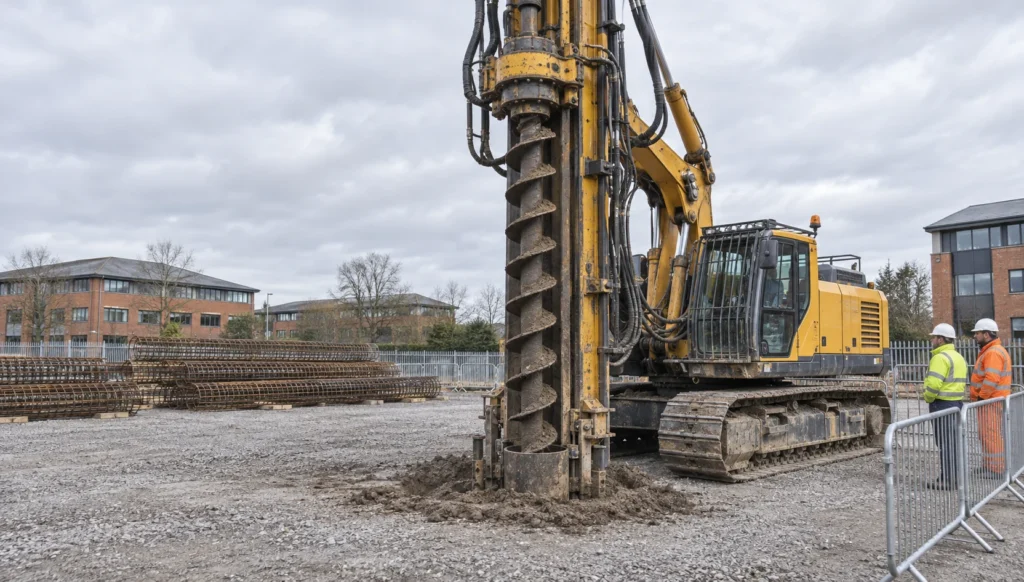
Piling Contractor Insurance: Cover That Holds
Operating heavy ground engineering machinery requires a resilient risk framework that protects balance sheets from catastrophic subsurface events. Specialist piling contractor insurance addresses the distinct operational exposures encountered during deep foundation work, contiguous retaining wall installation, and ground improvement projects. Standard commercial packages consistently fail to accommodate heavy dynamic loads, severe subterranean vibration, and third-party settlement exposures. Securing specialist terms ensures that foundation contractors maintain compliance with Tier 1 engineering mandates and preserve operational stability across demanding commercial schemes.
Can geotechnical specialists afford to rely on generic public liability policies when driving displacement piles adjacent to third-party assets? Standard insurers routinely exclude ground movement, vibration damage, and subterranean utility strikes within their baseline contract wordings. Securing appropriate protection requires an exacting assessment of high-hazard engineering operations, contract values, and heavy plant requirements. How robust is your operational risk profile?
Key Takeaways
- Specialist piling insurance protects deep foundation contractors from catastrophic third-party property damage, severe vibration losses, and complex subterranean utility strikes across civil engineering sites.
- Main contractors routinely demand verified public liability limits between five million and ten million pounds before granting site access for heavy piling operations.
- Underwriters require detailed technical submissions including geotechnical soil reports, rigorous method statements, lift plans, and statutory plant inspection records prior to quoting terms.
- Plant policies must specifically schedule continuous flight auger rigs and rotary equipment against overturn, transit damage, ground collapse, and mechanical breakdown.
- Aligning specialist piling liabilities with surrounding groundworks insurance supports consistent indemnity across complex substructure operations without leaving dangerous gaps between project trades.
Core Insurance Layers for Piling Specialists
Foundation contractors require multiple interconnected insurance policies to protect capital assets, direct employees, and third-party liabilities during heavy groundworks. The table below outlines the primary covers required by deep foundation specialists operating within modern UK commercial contracting frameworks. It also sets out the indemnity norms that principal contractors typically expect to see.
Each policy layer addresses a specific operational exposure governed by UK statutory duties, standard plant hire conditions, or standard construction contracts. Piling contractors must maintain continuous alignment across these core disciplines to satisfy principal contractor vetting procedures. In practice, gaps between layers tend to surface during pre-qualification rather than after a loss.
| Policy Layer | Standard Market Indemnity Norm | Primary Underwriting Trigger |
|---|---|---|
| Policy LayerPublic Liability | Standard Market Indemnity Norm£5m to £10m per occurrence | Primary Underwriting TriggerThird-party structural damage and bodily injury |
| Policy LayerEmployers’ Liability | Standard Market Indemnity Norm£10m standard (£5m statutory minimum) | Primary Underwriting TriggerOperative injury under the Employers’ Liability (Compulsory Insurance) Act 1969 |
| Policy LayerContractors All Risks | Standard Market Indemnity NormFull reinstatement value of the contract works | Primary Underwriting TriggerPhysical loss or damage to uncompleted contract works |
| Policy LayerOwned and Hired Plant | Standard Market Indemnity NormReplacement value plus continuing hire charges | Primary Underwriting TriggerPlant overturn, theft, transit damage, continuing hire |
| Policy LayerProfessional Indemnity | Standard Market Indemnity Norm£2m to £5m limit of indemnity | Primary Underwriting TriggerDesign errors, soil interpretation, pile design |

Third-Party Property Damage and Vibration Exposures
Vibration and Ground Movement Hazards
Driven piling techniques transmit substantial dynamic shock waves through local soil strata directly into adjacent structures. This ground-borne vibration can trigger cosmetic plaster cracking, differential foundation settlement, or structural masonry failure in neighbouring buildings. Underwriters scrutinise proximity distances, ground conditions, and pile driving methods before granting unrestricted vibration indemnity.
Standard liability policies frequently exclude claims arising from vibration, weakening of support, or subterranean movement under standard wording exclusions. Foundation contractors must ensure their broker secures affirmative vibration coverage that removes these harmful restrictions. Continuous vibration monitoring against BS 5228-2 guidance provides verifiable baseline data to defend against unwarranted third-party cracked foundation claims.
Party Wall Disputes and Property Encroachments
Substructure works executed immediately adjacent to existing boundary lines routinely activate statutory procedures under the Party Wall etc. Act 1996. Property owners often submit substantial compensation claims when continuous flight auger operations or sheet piling induce ground heave or lateral soil displacement. Piling specialists must retain exhaustive condition surveys to substantiate baseline structural integrity before commencement.
Without pre-construction photographic condition schedules, defending allegations of structural movement remains exceptionally difficult. Insurers demand that insured contractors strictly adhere to agreed party wall awards and structural engineer parameters. Breaching agreed working limits or failure to maintain agreed monitoring protocols can compromise liability coverage during complex structural disputes.
Did You Know?
Under Health and Safety Executive guidance HSG47, utility drawings provide only an indicative location of buried services, meaning trial holes dug by hand or vacuum excavation are frequently required before heavy piling equipment can penetrate the ground safely.
Subterranean Utility Strikes and Asset Protection
Underground Services and Strike Mitigation
Subsurface foundation operations carry extreme exposure to buried high-voltage electric cables, high-pressure gas mains, and critical telecommunication trunk lines. Striking strategic utility networks triggers immense direct repair costs, emergency response charges, and substantial third-party business interruption claims. Piling teams must demonstrate full adherence to HSE guidance HSG47 during all pre-boring activities.
Underwriters expect contractors to mandate electromagnetic cable avoidance tool scanning, ground-penetrating radar, and hand-dug trial pits before inserting piling augers. Relying exclusively on historic utility drawings represents a critical failure of on-site risk mitigation. Incorporating LinesearchBeforeUDig data into site safety files confirms that operatives verified utility corridors prior to breaking ground.
Service Strike Deductibles and Policy Conditions
Insurers frequently introduce elevated policy excesses for underground service strikes where contractors fail to maintain auditable locating procedures. Baseline deductibles can escalate from nominal sums to ten thousand pounds or more following repeated cable or water main strikes. Maintaining written service location permits on site protects the contractor against policy condition breaches.
Where operations intersect congested city centre infrastructure, secondary damage from severed fibre cables can generate astronomical consequential losses. Specialised high risk liability wordings must accommodate financial loss claims arising from service interruptions without requiring direct physical damage to adjacent third-party premises. Experienced brokers negotiate policy terms that reflect these severe civil engineering exposures.
Cover Built for Demanding Businesses
Across high risk industries, the cover we arrange most often includes:
Public liability
Employers' liability
Motor fleet
Contractors' all risks
Freight liability
Professional indemnity
Environmental liability
Business interruption
Most businesses need a combination, rather than a single focus policy, and we build cover around your contracts, your workforce and your operational activities.
High-Value Plant and Rig Cover Requirements
Capital Plant Protection and Overturn Coverage
Modern hydraulic piling rigs, continuous flight auger units, and rotary drilling platforms can represent individual capital investments exceeding one million pounds. Plant policies must protect owned equipment against catastrophic ground collapse, soft ground overturn, and sudden mechanical breakdown during dynamic operations. Standard property policies rarely address the specialist operational perils encountered by heavy crawler rigs on uncompacted ground.
Piling contractors must verify that working platforms meet rigorous geotechnical standards before tracking heavy machinery across unstable formation layers. Establishing certified working platforms under the Federation of Piling Specialists guidelines provides underwriters with technical evidence of stability control. Policies must include full recovery costs to retrieve overturned rigs from deep excavations.
Hired-in Plant and Continuing Hire Liabilities
Foundation contractors regularly supplement owned fleets by hiring specialised vibratory hammers, silent pilers, bentonite mixing units, and heavy mobile cranes. Hire contracts almost universally operate under Construction Plant-hire Association Model Conditions, which legally transfer full responsibility for loss to the hiring contractor. The contractor remains liable for physical damage and ongoing hire revenue throughout repairs.
Continuing hire charges can swiftly match the capital value of hired equipment whilst replacement components are sourced from overseas manufacturers. Plant insurance schedules must carry adequate indemnity ceilings that cover ongoing rental costs alongside full replacement values. Checking policy terms prevents severe cash flow deficits following major mechanical failures or structural damage on site.
Contractual Indemnity Mandates on Major Schemes
Main Contractor Limits and Flow-Down Clauses
Tier 1 main contractors enforce demanding liability thresholds before permitting foundation subcontractors to commence site work on major commercial developments. Contract particulars under Joint Contracts Tribunal or NEC4 subcontract forms frequently specify ten million pounds public liability limits. These contracts also carry flow-down clauses that can make the piling specialist liable for wider site delays.
Contractors carrying primary limits of five million pounds must purchase excess layer liability policies to bridge contractual indemnity gaps. Excess layers sit directly over primary coverage, providing seamless capacity to satisfy demanding engineering frameworks. Submitting compliant insurance certificates during pre-qualification prevents project delays and maintains commercial standing with national main contractors.
Subcontractor Warranties and Joint-Names Policies
Major infrastructure projects require precise coordination between main contract conditions and specialist trade insurance arrangements. Certain engineering schemes require the specialist trade contractor to be noted as an additional insured on project-wide joint-names insurance policies. Piling specialists must verify whether their standard public liability response conflicts with overarching project insurance packages.
Contractors must also monitor indemnity requirements imposed on their own secondary subcontractors, including test-piling technicians and concrete pumping operators. Piling policies standardly contain bona fide subcontractor conditions requiring verified evidence of equivalent liability limits prior to site entry. Failing to collect current insurance schedules from sub-tier contractors can breach policy conditions and compromise claims defensibility.
Technical Underwriting Submissions for Ground Engineering
Geotechnical Site Investigation Data
Securing competitive insurance terms requires technical underwriting submissions that demonstrate competent geotechnical risk management across all operating environments. Underwriters evaluate phase two ground investigation reports, soil bore logs, and standing groundwater tables to assess settlement risks. Providing comprehensive geological data proves that the contractor selects appropriate piling methodologies for specific subterranean soil profiles.
Incomplete geotechnical data forces underwriters to price contracts defensively or insert restrictive environmental and ground movement exclusions. Submitting rigorous soil analyses alongside historical project performance demonstrates professional risk maturity. Brokers utilise technical reports to secure bespoke terms that accommodate variable ground strata without unworkable operational exclusions.
Method Statements and Statutory Equipment Inspections
Underwriting teams require comprehensive risk assessments and method statements that outline sequential installation procedures, dynamic monitoring, and safety zones. For rotary and crane-mounted piling systems, insurers verify full compliance with the Lifting Operations and Lifting Equipment Regulations 1998. Contractors must produce valid report certificates of thorough examination for every rig, winch, and lifting accessory.
Statutory inspections completed under the Provision and Use of Work Equipment Regulations 1998 further validate rigorous plant maintenance protocols. Underwriters reward disciplined plant operators with broader cover terms and reduced policy deductibles. Maintaining centralised digital maintenance records ensures smooth underwriting negotiations during annual policy renewals.
Piling and Groundworks Liability Alignment
Interface Risks Across Earthworks Packages
Foundation piling rarely takes place in complete isolation from wider bulk excavation, ground remediation, and drainage installation contracts. When distinct contractors manage contiguous piling and bulk earthworks, contractual boundary disputes frequently erupt following unexpected ground settlement. Integrating piling risks alongside broader groundworks insurance arrangements prevents contentious coverage disputes between different commercial insurers.
Disputes frequently emerge over whether settlement resulted from pile installation vibration, substandard dewatering, or improper soil compaction during subsequent excavation. Carrying integrated protection through a single broker ensures consistent legal defence across all substructure disciplines. Seamless cover prevents delays and avoids cross-litigation between separate policy packages on the same civil development.
Environmental Impairment and Subterranean Contamination
Displacement and bored piling through brownfield land carries significant risk of penetrating impermeable clay barriers and contaminating underlying aquifers. Creating vertical pathways allows historic ground contaminants, heavy metals, and hydrocarbons to migrate directly into sensitive drinking water resources. Piling contractors face statutory remediation obligations under the Environmental Damage (Prevention and Remediation) (England) Regulations 2015.
Standard public liability policies provide limited protection, covering only sudden, identifiable, and unintended pollution incidents occurring within specified notification windows. Stand-alone environmental impairment liability policies protect against gradual pollution migration and statutory environmental remediation costs enforced by the Environment Agency. Securing specialised pollution endorsements protects piling contractors operating on complex industrial reclamation sites.
Professional Indemnity for Foundation Design
Design-and-Build Liabilities and Load Calculations
Modern commercial contracts increasingly shift design responsibility directly to specialist piling contractors under design-and-build procurement routes. Pile diameter choices, depth calculations, reinforcement schedules, and safe working load determinations represent pure professional engineering advice. Standard public liability policies completely exclude claims arising from professional design, calculation errors, or technical specification failures.
A catastrophic pile failure caused by incorrect skin friction calculations or defective structural load estimations requires professional indemnity protection. Professional indemnity covers defence costs and rectifying defective substructure designs following third-party financial loss claims. Foundation contractors operating in-house engineering design teams or modifying client engineering specifications must maintain robust professional indemnity programmes.
Collateral Warranties and Duty of Care
Commercial property developers and institutional funders routinely require piling contractors to execute formal collateral warranties on major commercial schemes. These legal agreements establish a direct contractual duty of care between the foundation contractor, future building purchasers, and commercial tenants. Professional indemnity policies must accommodate collateral warranty obligations without restrictive notification conditions.
Failing to verify that professional indemnity wordings support standard contractual collateral warranties leaves the business exposed to uninsured commercial liabilities. Reviewing contractual warranties with a specialist insurance broker ensures policy limits and indemnity periods match leasehold obligations. Maintaining continuous professional indemnity coverage ensures multi-year protection long after foundation rigs demobilise from site.
Final Thoughts
Establishing comprehensive piling contractor insurance demands a technically informed broking approach that accurately reflects heavy geotechnical operations. Subterranean risks, heavy dynamic vibration, high-value mechanical assets, and stringent contractual indemnity levels require specialised underwriting attention. Ground engineering firms cannot rely on off-the-shelf commercial policies that harbour restrictive movement exclusions, inadequate plant cover limits, or rigid service strike deductibles.
As civil engineering specifications demand greater substructure resilience and deeper foundation profiles across congested urban centres, risk profiles will continue to escalate. Progressive piling contractors maintain competitive advantages by compiling meticulous geotechnical documentation, verifying thorough plant maintenance, and implementing stringent utility detection protocols. Aligning specialised foundation policies with wider civil engineering insurance secures durable contractual protection from the bedrock up.
Speak to an Insurance Specialist
Whether you need a new quote, want to discuss your renewal or have a question about an existing policy, our team is here to help.
Frequently Asked Questions
Q: Why do standard public liability policies fail to cover piling contractors adequately?
A: Standard public liability policies routinely contain broad exclusion clauses regarding vibration, weakening of support, and subterranean movement. Piling operations fundamentally generate dynamic ground vibration and alter soil stresses, creating exposures that standard commercial packages specifically reject. Furthermore, standard policies enforce low underground service damage sub-limits that leave contractors exposed to severe financial shortfalls following utility strikes. Piling specialists require non-standard wordings with affirmative endorsements for ground movement and high-hazard civil engineering operations.
Q: What public liability limit is typically required for commercial piling operations?
A: Main contractors and public infrastructure authorities commonly require a minimum public liability limit of ten million pounds for specialist piling works. Whilst smaller domestic underpinning or shallow bored piling projects may accept a five million pound limit, major commercial and civil projects demand substantial coverage. Contractors typically arrange this protection by pairing a primary liability layer of five million pounds with an excess layer policy providing an additional five million pounds of indemnity.
Q: Does contractors all risks insurance cover piling rig overturns on site?
A: A dedicated plant and contractors all risks policy covers piling rig overturns, provided the contractor complies with all policy conditions regarding working platform certification. Insurers expect operators to design and inspect rig platforms strictly in accordance with recognised industry standards before tracking machinery. Cover extends to accidental physical damage, rig recovery expenses, and continuing hire charges, provided the contractor maintains up-to-date statutory equipment inspections under the Lifting Operations and Lifting Equipment Regulations 1998.
Q: Why do piling contractors require professional indemnity insurance if they follow client drawings?
A: Piling contractors frequently assume design liabilities under design-and-build contracts, value engineering adjustments, or temporary works proposals. Modifying pile depths, altering reinforcement cages, or determining safe working loads based on dynamic testing constitutes professional engineering advice. If piles settle or fail to achieve required load capacities due to technical errors, public liability will not respond. Professional indemnity insurance covers the substantial financial losses and remediation costs associated with design failures.
Q: What risk mitigation protocols do insurers expect before drilling near underground services?
A: Underwriters expect contractors to comply fully with Health and Safety Executive guidance document HSG47 when identifying subterranean infrastructure. This requires consulting updated utility drawings through services like LinesearchBeforeUDig, conducting electromagnetic cable avoidance tool surveys, and employing ground-penetrating radar. Insurers also demand that contractors excavate hand-dug trial pits or use vacuum excavation to visually verify service positions before operating continuous flight augers or driving displacement piles.
About The Author
Darren Judd
Director, Co-Founder and Co-Owner of Capital Corporate Risks Ltd

Experienced Account Executive with a demonstrated history of working in the insurance industry. Skilled in Account Management, Risk Management, Business Development across all classes of insurance within the Construction Industry,