

What Does Haulage Insurance Cover? Explained
Commercial freight transport involves substantial capital assets, strict regulatory schedules, and significant contractual liabilities. When operators ask what does haulage insurance cover, they find a specialised suite of protections rather than a single policy. Heavy goods vehicles on domestic and international routes face cargo damage, collision liabilities, and supply chain disruption. Sound protection depends on understanding how separate indemnity layers work together to safeguard the balance sheet.
A typical programme combines road risks with cargo liability, public protection, and legal defence. Without these covers working together, a single collision or spoiled load can trigger severe disruption or insolvency. How can transport managers structure these layers so their fleet stays commercially and legally resilient?
Key Takeaways
- Haulage insurance combines motor fleet, goods in transit, and liability covers to protect transport businesses against road and freight losses.
- Motor fleet policies meet Road Traffic Act obligations and add accidental damage cover for tractor units, rigid vehicles, and trailers.
- Goods in transit cover settles cargo claims under contract terms, such as RHA Conditions of Carriage or CMR Convention limits.
- Public and employers’ liability policies protect hauliers against compensation claims arising from yard operations, cargo handling, and workplace injuries.
- Pollution clean-up, legal expenses, and heavy breakdown extensions stop operational disruption from eroding already tight logistics margins.
Core Pillars of Transport Risk Protection
Haulage insurance works as a modular package that protects transport businesses from heavy balance sheet liabilities. Each programme pairs compulsory vehicle cover with cargo indemnity and liability protection. The table below sets out the core components of a commercial transport programme. It shows the risk each section addresses and typical indemnity levels in the UK logistics market.
The right indemnity thresholds depend on vehicle types, customer contracts, and the commodities carried. Motor policies satisfy statutory road traffic obligations. Hauliers still need wider backing to absorb contract disputes, depot losses, and pollution clean-up costs. In practice, we find that coordinating these covers prevents gaps in complex, multi-party freight claims on domestic and international routes.
| Cover Component | Primary Risk Mitigated | Typical Market Indemnity |
|---|---|---|
| Cover ComponentMotor Fleet Insurance | Primary Risk MitigatedRoad collisions, vehicle fire, theft, and third-party property damage | Typical Market IndemnityUnlimited injury; £1.2m statutory property damage minimum |
| Cover ComponentGoods in Transit (GIT) | Primary Risk MitigatedConsignment theft, impact damage, spoilage, and transit loss | Typical Market IndemnityRHA conditions (£1,300 per tonne) or bespoke limits |
| Cover ComponentPublic Liability | Primary Risk MitigatedNon-motoring third-party injury and property damage | Typical Market Indemnity£2m, £5m, or £10m limits |
| Cover ComponentEmployers’ Liability | Primary Risk MitigatedEmployee injuries, yard accidents, and occupational illness | Typical Market Indemnity£10m standard (£5m statutory minimum) |
| Cover ComponentCommercial Legal Expenses | Primary Risk MitigatedOperator licence inquiries, contract disputes, and driver defences | Typical Market Indemnity£100,000 to £250,000 per claim |
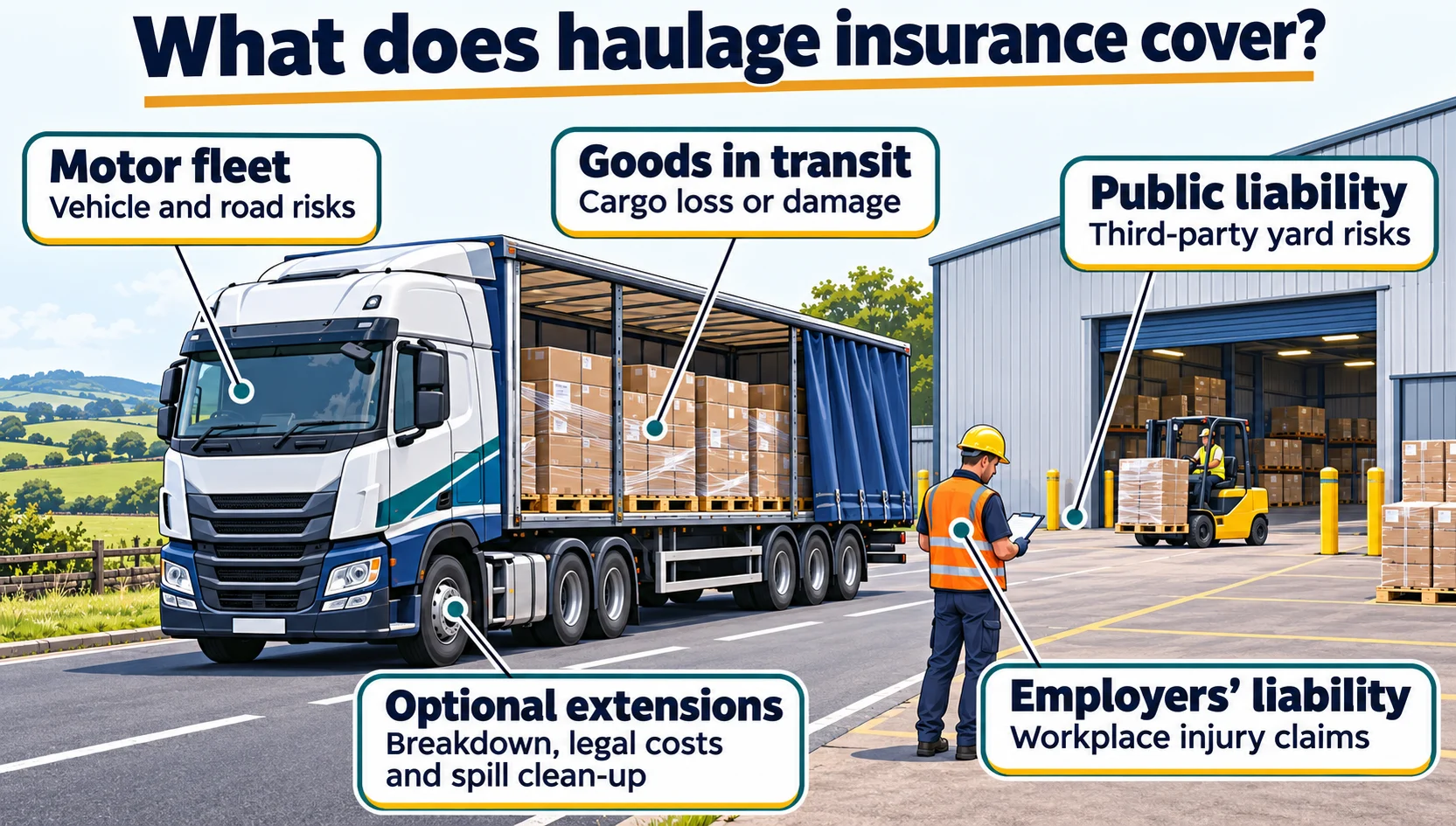
Commercial Motor Fleet Protection
Comprehensive Vehicle and Trailer Protection
Motor fleet insurance forms the compulsory core of any haulage programme. It indemnifies operators against damage to tractor units, rigid vehicles, trailers, and third-party property. The Road Traffic Act 1988 requires third-party cover for every vehicle used on a road. Comprehensive fleet policies add repair costs, windscreen damage, and total loss replacement.
A single fleet schedule brings real administrative simplicity to multi-vehicle operations. Hauliers can arrange any-driver cover for drivers aged 21 or 25 and over with the correct HGV entitlement. This removes the need to notify underwriters each time a driver joins. Fleet-rated premiums reflect aggregate claims performance rather than individual vehicle risk.
Detached Trailer and Equipment Provisions
Trailer cover protects hauliers when trailers are stolen or damaged whilst detached from the tractive unit. Operators routinely swap trailers or drop them at customer distribution centres. A well-structured fleet schedule covers owned trailers and third-party equipment held in custody. It responds to uncoupled impact damage and yard losses.
Many operators pull customer-owned trailers under trailer interchange agreements. Without a detached trailer extension, many motor policies only respond whilst the trailer remains coupled. Dedicated detached cover keeps refrigerated, curtain-sided, and tipping trailers insured when parked unattended. It should extend to vandalism, storm damage, and accidental structural damage.
Did You Know?
A haulage firm without valid employers’ liability insurance can be fined £2,500 for every uninsured day. Failing to display the insurance certificate carries a further fine of up to £1,000.
Goods in Transit and Cargo Liabilities
Domestic Road Haulage Association Terms
Goods in transit cover written on RHA terms indemnifies carriers for cargo loss based on weight rather than retail value. The current RHA Conditions of Carriage cap liability at £1,300 per tonne of gross weight. Hauliers therefore pay contractual compensation rates when freight suffers accidental damage or total loss in transit.
The RHA limit only applies where the conditions are properly incorporated into the customer contract. Carriers working on an all-risks basis take on far greater exposure. If an articulated lorry carrying consumer electronics overturns, an all-risks policy pays the full invoice value of the stock. Operators must align their goods in transit wording with every signed customer contract to avoid uninsured shortfalls.
Cross-Border CMR Convention Requirements
International road freight falls under a statutory regime known as CMR. It takes its name from the Convention on the Contract for the International Carriage of Goods by Road. The Carriage of Goods by Road Act 1965 gives the Convention force in UK law. CMR caps carrier liability at 8.33 Special Drawing Rights per kilogram of gross weight.
CMR applies automatically when collection and delivery points sit in different countries and at least one is a contracting state. The carrier is presumed liable for loss, damage, and delay unless a specific Convention defence applies. Compensation for delay is capped at the carriage charges. Insurers issue dedicated CMR policies so UK hauliers can meet these obligations across Europe and the Republic of Ireland.
Cover Built for Demanding Businesses
Across high risk industries, the cover we arrange most often includes:
Public liability
Employers' liability
Motor fleet
Contractors' all risks
Freight liability
Professional indemnity
Environmental liability
Business interruption
Most businesses need a combination, rather than a single focus policy, and we build cover around your contracts, your workforce and your operational activities.
Public and Employers’ Liability Protections
Summary of Public Protection Across Freight Yards
Public liability insurance protects hauliers when their activities injure third parties or damage property outside road traffic risks. Typical incidents include forklift collisions during loading, pedestrian injuries in yards, and falling cargo striking customer property. Insurers fund the legal defence and any agreed settlement.
Motor policies often limit or exclude liability arising from loading and unloading away from the vehicle. If a pallet slips from a tail lift and crushes a supplier’s car, public liability responds. Major logistics hubs routinely demand public liability limits of £5 million or £10 million. Without that evidence, hubs refuse vehicles access to their loading bays.
Statutory Workforce Injury Compliance
Employers’ liability insurance is compulsory for UK haulage companies under the Employers’ Liability (Compulsory Insurance) Act 1969. The policy pays compensation and legal costs when drivers, mechanics, or warehouse staff suffer work-related injury or illness. Cover must be at least £5 million, and most transport policies provide £10 million.
Freight handling brings constant manual handling hazards, tail-lift work, and falls from trailer beds. If a driver falls whilst securing straps or injures a hand during uncoupling, the policy covers the resulting claim. Operating without valid cover is a criminal offence. Directors who consent to or neglect the failure can also face prosecution.
Heavy Commercial Breakdown and Recovery
Roadside Assistance and Heavy Towing
Commercial breakdown cover ensures an immobilised HGV receives prompt roadside repair or heavy towing. A disabled articulated lorry causes serious logistical disruption and delays every booked delivery behind it. Policies mobilise specialist heavy recovery operators with under-lift equipment. These operators can safely move loaded 44-tonne combinations.
Consumer recovery services cannot handle HGVs because of axle weights and specialist recovery protocols. Dedicated commercial policies include roadside mechanical assistance, tyre replacement networks, and electrical diagnostics. Fast motorway response keeps distribution networks moving. It also cuts the time stranded drivers spend exposed on the hard shoulder.
Load Transfer and Secondary Transport
Transhipment extensions fund the transfer of perishable or time-sensitive freight after a serious breakdown or collision. If an engine seizes or an axle fails, the policy can pay for a relief vehicle and specialist lifting equipment. Swift transfer protects delivery commitments and prevents perishable cargo spoiling at the roadside.
Moving cargo on a busy motorway requires professional traffic management and certified lifting equipment. Recovery insurers cover the labour costs of moving palletised goods between the disabled trailer and the relief vehicle. This protects customer relationships. It also limits secondary losses from contractual late-delivery penalties.
Legal Expenses and Regulatory Defence
Public Inquiries and Traffic Commissioner Hearings
Commercial legal expenses insurance funds specialist representation at Public Inquiries before the Traffic Commissioner. Under the Goods Vehicles (Licensing of Operators) Act 1995, serious breaches can lead to licence curtailment, suspension, or revocation. The policy lets hauliers instruct experienced transport solicitors to defend their licence.
The Driver and Vehicle Standards Agency audits maintenance records, tachograph data, and vehicle weights. Serious mechanical defects or drivers’ hours infringements often lead the Traffic Commissioner to call a Public Inquiry. Specialist representation at that hearing can decide whether the business keeps operating.
Contract Disputes and Driver Prosecution Defence
Legal expenses policies defend transport businesses in contract disputes, unpaid invoice claims, and driver motoring prosecutions. Freight contracts regularly generate disagreements over demurrage, damaged consignments, and cancellation charges. The policy covers solicitors’ fees and court costs. Hauliers can then resolve disputes without draining operating cash reserves.
Policies can also fund the defence of employed drivers facing motoring charges after serious incidents. Where a driver faces allegations of careless driving or drivers’ hours offences, insurer-appointed transport solicitors provide court representation. Defending drivers protects fleet capacity. It also demonstrates a compliance culture to enforcement bodies.
Environmental and Hazardous Cargo Risks
Fuel Spillage and Remediation Liabilities
Environmental liability cover indemnifies transport companies against third-party clean-up costs after a fuel tank rupture or diesel spill. Standard motor policies often sub-limit or exclude remediation ordered by environmental regulators. Standalone pollution extensions fund specialist contractors to clean contaminated watercourses, drainage systems, and soil.
A breached HGV fuel tank can release hundreds of litres of diesel onto a carriageway or into roadside drainage. The Environment Agency applies the polluter-pays principle and can recover remediation costs from the responsible operator. These clean-up operations routinely cost tens of thousands of pounds. Explicit pollution cover is therefore essential for any fleet.
Dangerous Goods and ADR Compliance
Hauliers carrying chemicals, gases, or hazardous waste need explicit dangerous goods endorsements on their policies. In Great Britain, the Carriage of Dangerous Goods and Use of Transportable Pressure Equipment Regulations 2009 give effect to ADR. An ADR extension covers contamination, chemical clean-up, and third-party liability during hazardous transit.
The regulations require most ADR operators to appoint a qualified Dangerous Goods Safety Adviser. Vehicles must also carry the fire extinguishers that ADR specifies. Standard haulage policies exclude explosives, toxic substances, and radioactive materials unless specifically endorsed. A dedicated ADR extension keeps cover valid for hazardous industrial loads.
Policy Exclusions and Operator Warranties
Overnight Parking and Vehicle Security Conditions
Haulage policies contain strict security warranties covering overnight parking and immobiliser use for loaded vehicles. Insurers routinely decline theft claims where drivers leave valuable loads in unmonitored laybys. Compliant operators keep vehicles in locked compounds, secure depots, or recognised attended truck parks.
Warranties often require drivers to remove keys, fit kingpin locks, and arm tracking devices whenever they leave the vehicle. Theft claims involving high-value loads such as alcohol, metals, or electronics face close scrutiny. Underwriters expect evidence of forced entry and full warranty compliance before settling.
Driver Licensing and Roadworthiness Warranties
Insurance contracts require operators to maintain strict roadworthiness regimes and regular driver licence checks. Claims can fail if an unroadworthy vehicle causes a collision through neglected maintenance or defective brakes. Fleet operators must record daily walkaround checks and keep to the inspection intervals declared on their operator’s licence.
Driver warranties require hauliers to check Driver CPC records and confirm every driver holds a valid HGV licence. An undisclosed licence suspension can void own-damage cover, and insurers may recover third-party payments from the operator. Thorough driver files and tachograph monitoring provide the evidence insurers look for after a collision.
Final Thoughts
Transport operators need a clear answer to what does haulage insurance cover on their daily routes. From fleet protection and cargo liability to public claims and pollution clean-up, each cover must work together. Misaligned RHA or CMR terms leave operators exposed to out-of-pocket losses. Those losses can threaten commercial viability.
Proactive risk management, robust maintenance, and thorough driver training build long-term resilience. Customer expectations keep rising and regulatory scrutiny continues to intensify. Hauliers who review their policies against their contracts each year protect their margins, reputations, and operator licences.
Speak to an Insurance Specialist
Whether you need a new quote, want to discuss your renewal or have a question about an existing policy, our team is here to help.
Frequently Asked Questions
Q: What is the difference between courier insurance and haulage insurance?
A: Courier insurance suits multi-drop drivers delivering smaller parcels to homes and businesses within set areas. Haulage insurance covers freight carriers operating heavier vehicles. These operators typically move palletised freight or bulk commodities over regional, national, or international distances. Haulage policies also reflect commercial contract frameworks such as RHA Conditions of Carriage or the CMR Convention. Courier policies focus on parcel values and high delivery volumes rather than weight-based carrier liability.
Q: Does haulage insurance cover subcontractor vehicles and third-party drivers?
A: Standard fleet policies cover the operator’s own vehicles and the drivers described in the schedule. When a haulier subcontracts work, it needs contingent goods in transit cover. This protects the haulier if a subcontractor’s own insurance fails to respond. Hauliers should check subcontractor certificates at least annually. Each subcontractor should hold valid motor, goods in transit, and public liability cover. Their limits should match the principal carrier’s contractual obligations to the customer.
Q: How do RHA Conditions of Carriage affect goods in transit claims?
A: RHA Conditions of Carriage set a contractual ceiling on carrier liability. The current limit is £1,300 per tonne of the gross weight of goods lost, mis-delivered, or damaged. For high-value, low-weight goods, the carrier only owes compensation based on weight. A customer can agree a higher limit in advance, usually for an extra charge. The conditions only protect the carrier if they are properly incorporated into the contract with the customer.
Q: Why is employers’ liability compulsory for haulage operators?
A: The Employers’ Liability (Compulsory Insurance) Act 1969 requires most businesses with employees to hold this cover. For a haulier, that includes drivers, warehouse staff, and maintenance technicians. The law requires at least £5 million of cover from an authorised insurer. Most commercial transport policies provide £10 million. The policy pays compensation and legal costs if an employee is injured or becomes ill because of their work.
Q: Does a standard haulage policy include environmental clean-up for fuel spills?
A: Not always. Standard motor policies cover third-party property damage but often exclude or tightly sub-limit environmental clean-up. A ruptured diesel tank across several lanes can trigger costly decontamination demanded by highway authorities and environmental regulators. Hauliers should secure an explicit pollution or environmental impairment extension. This should cover emergency containment, watercourse decontamination, and road resurfacing costs. Check the wording for any sub-limit and confirm it reflects the fuel capacity of your largest vehicles.
About The Author
Darren Judd
Director, Co-Founder and Co-Owner of Capital Corporate Risks Ltd

Experienced Account Executive with a demonstrated history of working in the insurance industry. Skilled in Account Management, Risk Management, Business Development across all classes of insurance within the Construction Industry,