

Warehouse Insurance: Cover for Stored Goods
Running a commercial storage facility means managing property risk, operational plant and substantial third-party liability at once. Tailored warehouse insurance protects the building, the handling equipment and the inventory clients entrust to you. Standard property policies rarely match the contractual commitments logistics operators accept every day. A properly constructed policy answers structural fire, racking failure, stock deterioration and legal dispute. Clear indemnity boundaries keep the balance sheet intact when a major loss occurs.
Supply chains now run on tight turnaround times, leaving little room for operational error. When stored goods suffer damage in handling or storage, who carries the loss under your trading contracts? Do your current policy conditions actually match the obligations you have given your customers?
Key Takeaways
- Warehouse insurance combines material damage cover for the premises with legal liability for goods stored under third-party contracts.
- Standard commercial property policies exclude customers’ stock unless the schedule adds a bailee liability or customers’ goods extension.
- Recognised trading conditions such as UKWA or BIFA terms cap liability per gross tonne or per gross kilogram.
- Sprinkler maintenance warranties and annual SEMA racking inspections remain mandatory policy conditions for most commercial property underwriters.
- Business interruption extensions fund standing charges and lost gross profit after a catastrophic fire, impact or flood event.
Core Elements of Storage and Facility Protection
Logistics operators must separate protection for their own assets from liability for customers’ property. Modern facilities need layered cover across buildings, mechanical handling plant and goods held in trust. Underwriters assess construction, fire suppression and trading contracts before issuing terms. Each element carries its own conditions and limits.
Misalignment between physical risk controls and contractual liability limits creates severe financial shortfalls. The table below sets out the standard covers within a comprehensive logistics policy. It identifies the exposure each component addresses for third-party logistics providers and dedicated storage operators across Great Britain.
| Cover Component | Primary Operational Exposure | Standard Market Basis |
|---|---|---|
| Cover ComponentBuildings and Racking | Primary Operational ExposureFire, impact, storm and structural collapse | Standard Market BasisReinstatement value |
| Cover ComponentCustomers’ Stored Goods | Primary Operational ExposurePhysical loss or damage to stock held in trust | Standard Market BasisUKWA or BIFA conditions |
| Cover ComponentPublic and Products Liability | Primary Operational ExposureThird-party bodily injury and property damage | Standard Market Basis£5m to £10m indemnity |
| Cover ComponentEmployers’ Liability | Primary Operational ExposureWorkplace injury to warehouse operatives | Standard Market Basis£5m statutory minimum, £10m standard |
| Cover ComponentBusiness Interruption | Primary Operational ExposureFixed costs and lost gross profit after a loss | Standard Market Basis24 to 36 month indemnity period |
| Cover ComponentMechanical Handling Plant | Primary Operational ExposureForklift damage, breakdown and LOLER duties | Standard Market BasisEngineering and theft cover |
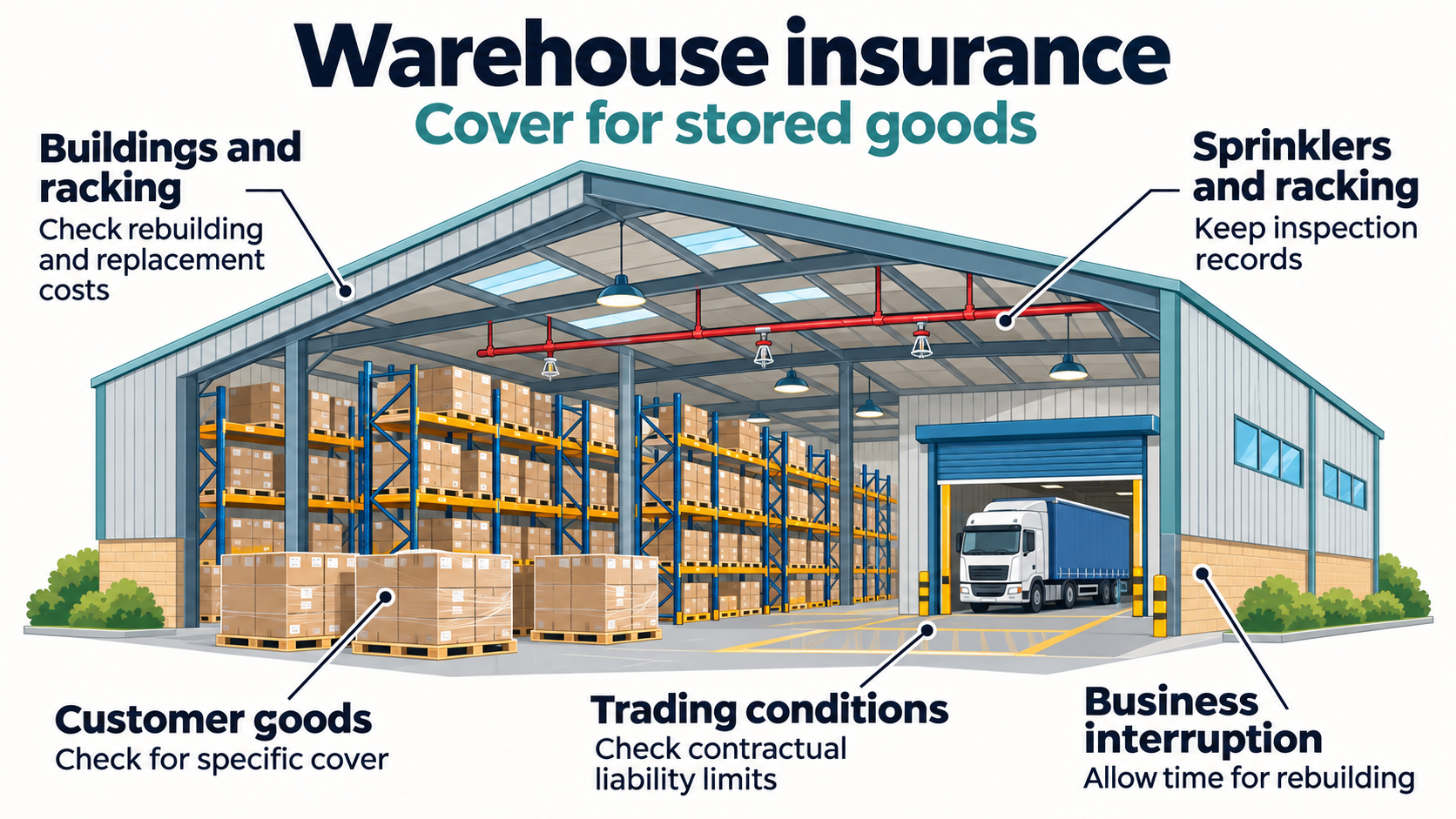
Buildings and Fixed Infrastructure Risks
Physical Premises and Structural Fire Hazards
Warehouse structures carry substantial capital value and face fire, vehicle impact and storm damage. Commercial property cover reimburses the full rebuilding cost, including professional fees and site clearance. Insurers price these risks against construction type. Composite panel buildings demand precise disclosure before underwriters offer competitive terms.
Insurers scrutinise external cladding and internal cold storage partitions in detail. Combustible insulation cores raise fire propagation risk sharply. Underwriters respond with higher excesses or restrictive co-insurance terms. In practice, we find that current reinstatement valuations matter just as much. Up-to-date figures stop average clauses from cutting a major property settlement.
High-Bay Racking Collapse and Impact Damage
High-bay adjustable pallet racking holds heavy static loads across every beam level. A single forklift impact or overloaded bay can trigger progressive collapse. Property schedules must itemise racking as fixed machinery or tenants’ improvements. General contents wordings rarely fund specialist re-erection after a multi-bay failure.
Insurers routinely require compliance with Storage Equipment Manufacturers’ Association inspection codes. Operating teams carry out regular visual checks of every run. A qualified SEMA-approved inspector then completes a formal annual examination. Documented repairs to bent uprights and damaged cross-beams protect policy validity. Without those records, an insurer may question the loss entirely.
Did You Know?
Employers’ liability cover is not discretionary. Under the Employers’ Liability (Compulsory Insurance) Act 1969, a business trading without valid cover faces a fine of up to £2,500 for every day it remains uninsured.
Stored Inventory and Bailee Liabilities
Own Trading Stock Versus Customers’ Goods
Commercial combined insurance covers your own trading stock at cost price. It excludes third-party goods held in custody unless the schedule says otherwise. Storing inventory for clients creates a bailee relationship and a common law duty of care. Protecting those consignments needs a customers’ goods extension or bailee liability clause.
Clients often assume the operator insures stored pallets on an all-risks basis. That assumption rarely matches the contract. Unless agreed in writing, the cargo owner insures their own goods against fire and flood. From experience across the sector, stating this plainly in commercial proposals prevents litigation later. Clear wording also sets expectations before the first pallet arrives.
Temperature-Controlled Stock and Refrigeration Failure
Chilled and frozen operations face heavy exposure when refrigeration plant fails. Spoilage extensions meet the financial loss of deteriorated food, pharmaceutical or chemical stock after sudden breakdown. Underwriters expect continuous temperature monitoring, standby generators and formal maintenance contracts. High spoilage limits follow only when those controls are demonstrably in place.
A temperature excursion can ruin an entire production batch within hours. Disposal costs and regulatory investigation follow quickly. Policies must fund disposal fees and de-branding alongside base stock value. Data logging and documented alarm response drills show genuine operational resilience. Brokers use that evidence to negotiate workable deductibles on cold storage risks.
Cover Built for Demanding Businesses
Across high risk industries, the cover we arrange most often includes:
Public liability
Employers' liability
Motor fleet
Contractors' all risks
Freight liability
Professional indemnity
Environmental liability
Business interruption
Most businesses need a combination, rather than a single focus policy, and we build cover around your contracts, your workforce and your operational activities.
Standard Trading Conditions and Contractual Ceilings
United Kingdom Warehousing Association Contract Terms
Trading under United Kingdom Warehousing Association conditions sets a contractual ceiling on stock claims. The terms cap liability at a fixed sum per gross tonne of affected goods, historically £100 per tonne. That ceiling stops cargo owners from pursuing full retail value. Insurers price bailee cover on exactly that basis.
The protection only works when the conditions genuinely form part of the contract. Operators must issue the terms before accepting any consignment. Written acknowledgement from the customer closes the point. Incorporate them late or not at all, and the business faces unlimited common law negligence claims. Underwriters check this during every renewal survey.
British International Freight Association Standard Conditions
Multimodal operators combining storage with freight forwarding should trade under British International Freight Association conditions. BIFA terms cap liability at two Special Drawing Rights per gross kilogram of affected cargo. Logistics insurance indemnity limits align directly with that standard. The cap applies to loss, damage and misdelivery alike.
BIFA conditions also impose strict time bars for notifying claims and issuing proceedings. Those bars shield operators from historical allegations. Problems arise when a customer insists on its own service level agreement. Contracting outside UKWA or BIFA terms can leave the policy unresponsive. The broker must endorse any higher limit in advance.
Fire Suppression and Sprinkler Warranties
Automatic Sprinkler System Compliance Requirements
High-bay warehouses generate intense fire loads that defeat a fire service response alone. In-rack and roof sprinklers carry the burden. Underwriters require compliance with the LPC Rules for Automatic Sprinkler Installations or BS EN 12845. A breached sprinkler warranty can undermine cover completely if pumps or water supplies fail.
Insurers expect weekly testing of alarm gongs, diesel pump batteries and water pressure. Those records must stay available for underwriter review at any time. Racking layout changes alter sprinkler discharge patterns and demand fresh hydraulic calculation. A qualified engineer should re-evaluate design density before the new configuration goes live. Skipping that step risks a technical breach of the endorsement.
Sprinkler Impairment Protocols and Hot Works Control
Planned maintenance and emergency repairs often require isolating part of the sprinkler network. That isolation creates a severe short-term vulnerability. Impairment warranties demand formal notice to insurers before any system goes offline. Operators must also raise security patrols, suspend hot works and report prolonged isolations immediately.
Hot works remain a leading cause of industrial warehouse fires. Internal welding and roof repairs deserve particular scrutiny. Insurers require a permit regime with a minimum sixty-minute post-work fire watch. Clear separation zones around aerosol cages and lithium-ion battery bays reduce exposure further. In practice, we find contractor supervision is where most permit systems fail.
Mechanical Handling Equipment and Statutory Inspections
Lifting Operations and Lifting Equipment Regulations
Forklift trucks, reach trucks, order pickers and scissor lifts carry statutory inspection duties. The Lifting Operations and Lifting Equipment Regulations 1998 require thorough examination by a competent person at least every twelve months. Engineering insurance bundles those statutory inspections with accidental damage cover. One arrangement then covers compliance and the plant itself.
Lapsed LOLER certification breaches statutory duty and invites Health and Safety Executive enforcement. It also weakens the defence of any injury claim. Insurers may contest a claim where uncertified machinery caused the accident. Comprehensive plant cover should extend to hired-in fleets as well as owned trucks. Lithium-ion battery charging areas need specific declaration too.
Provision and Use of Work Equipment Compliance
Conveyors, automated sortation and dock levellers fall under the Provision and Use of Work Equipment Regulations 1998. Employers must keep all machinery safe, maintained and operated only by trained staff. Commercial combined insurance assumes a robust maintenance regime sits behind that duty. Mechanical failure claims expose any gap quickly.
Dock levellers and loading bay doors absorb high wear and frequent vehicle impact. Hydraulic failure during loading can drop a laden forklift. Regular servicing is the only reliable control. Maintenance logs and training records then form the documentary defence for injury claims. Without them, liability insurers settle rather than contest.
Business Interruption and Revenue Protection
Maximum Indemnity Periods for Warehouse Rebuilds
Major warehouse fires take years to resolve, not months. Planning approval, demolition and specialist construction all extend the timeline. Business interruption insurance replaces lost gross profit and funds continuing fixed overheads throughout. An indemnity period below twenty-four or thirty-six months leaves real insolvency risk before trading resumes.
Local planning consent for a modern distribution hub rarely moves quickly. Traffic and environmental assessments add months to the process. High-bay automated racking and warehouse management systems carry long procurement lead times. A realistic indemnity period keeps wages, loan obligations and overheads funded until handover. Shortening it to save premium is a false economy.
Additional Increased Cost of Working Provisions
Holding customer contracts during a rebuild means relocating operations fast. Increased Cost of Working cover funds that response. It reimburses emergency warehouse leases, temporary plant hire and the transfer of client inventory. Spending that money early often prevents logistics clients from cancelling long-term contracts after a serious loss.
Short-term pallet space commands premium rates when demand is urgent. Sub-contracting an entire operation drains working capital within weeks. Thin ICOW limits therefore undermine the main business interruption cover. Policy wordings should allow flexible economic limits rather than fixed sub-limits. Management can then act without waiting for loss adjuster approval.
Operational Liabilities and Regulatory Duty of Care
Employers’ Liability for Operational Warehouse Staff
Busy storage sites combine moving vehicles, heavy pallet handling and repetitive manual work. The Employers’ Liability (Compulsory Insurance) Act 1969 requires cover for UK warehouse employers. The statutory minimum is £5 million, although £10 million is the standard market placement. The policy funds legal defence costs and compensation awards.
Most warehouse claims arise from slips, manual handling strains and pedestrian collisions with forklifts. Physical barriers around walkways cut frequency sharply. A documented traffic management plan supports that control. Sound safety records give the claims team evidence to defend weak allegations. Thin documentation turns a defensible claim into a settlement.
Public Liability and Third-Party Visitor Safety
Distribution depots see constant traffic from delivery drivers, maintenance engineers and collection couriers. Public liability insurance responds when a visitor suffers injury or property damage on site. Commercial contracts and local authority tenders commonly demand £5 million or £10 million of indemnity. Proof of cover is often a tender condition.
Visiting HGV drivers face rollaway vehicles and falling freight during unloading. Designated waiting areas remove drivers from the hazard. Enforced wheel chocking and trailer locks address the rest. Broad public liability wordings settle legal expenses and third-party property damage promptly. Depot operations then continue whilst the claim runs.
Final Thoughts
Resilient warehouse insurance depends on matching physical property risk to the contractual liability you have accepted. UK logistics providers must ensure the schedule reflects construction materials, racking inspection regimes and agreed trading terms. When those elements align, the business holds real protection against fire, plant failure and third-party claims.
Storage densities keep rising and automation keeps spreading, so risk management standards will continue to set insurance terms. Rigorous compliance with statutory examinations, sprinkler warranties and standard trading conditions protects both operational resilience and balance sheet integrity.
Speak to an Insurance Specialist
Whether you need a new quote, want to discuss your renewal or have a question about an existing policy, our team is here to help.
Frequently Asked Questions
Q: Are customers’ goods automatically covered under commercial combined insurance?
A: No. Standard commercial property wordings insure stock the policyholder owns, not goods held for third parties. Cover for customers’ stock requires a specific bailee liability clause or a customers’ goods extension on the schedule. Warehousekeepers should either arrange that extension or require clients to insure their own cargo. A basic commercial combined policy leaves the business exposed when client stock suffers damage on site through negligence.
Q: How do UKWA trading conditions protect warehouse operators?
A: They impose a contractual limit on claims for lost, damaged or stolen customer stock. Rather than facing the full retail value of high-value inventory, the operator’s liability is capped at a set figure per gross tonne, historically £100 per tonne. That ceiling keeps exposure predictable and allows insurers to price bailee liability sensibly. The conditions must reach the customer before goods arrive, with written acknowledgement on file.
Q: What racking inspection records do insurers expect?
A: Underwriters expect compliance with Storage Equipment Manufacturers’ Association guidance. That means appointing a Person Responsible for Racking Safety to carry out regular visual checks, plus a formal annual inspection by a SEMA-approved inspector. Records should show green, amber and red risk classifications alongside evidence of prompt remedial work. Missing inspection logs can compromise settlement if racking collapses, because the insurer cannot verify the system was maintained.
Q: Why is a twelve-month business interruption indemnity period usually too short?
A: Rebuilding a large distribution facility after a serious fire takes well over a year in the UK. Site clearance, environmental survey, planning consent, design work and procurement of structural steel and automated plant all consume time. If the indemnity period expires mid-construction, payments for lost gross profit and payroll stop immediately. Twenty-four or thirty-six months gives the financial runway needed to restore trading properly.
Q: What happens if the sprinkler system is taken offline temporarily?
A: Most property policies contain a sprinkler impairment warranty setting out exact protocols. The insured must notify the insurer or its risk management team before isolating the water supply, with retrospective notice accepted only in a genuine emergency. Hot works must stop, security must begin continuous fire watches, and contractors must restore the system promptly. Breaching those conditions can lead to claim repudiation if a fire starts during the outage.
About The Author
Darren Judd
Director, Co-Founder and Co-Owner of Capital Corporate Risks Ltd

Experienced Account Executive with a demonstrated history of working in the insurance industry. Skilled in Account Management, Risk Management, Business Development across all classes of insurance within the Construction Industry,