

Working at Height Insurance: Risks and Cover
Operating above ground level creates substantial liability for UK contractors. Robust working at height insurance is therefore an operational necessity, not an optional extra. Standard commercial combined and liability policies rarely cover elevated activity without restriction. Insurers scrutinise fall hazards, falling object exposures and structural integrity before granting terms. Without the right endorsements, a routine task can breach a policy warranty. That breach leaves the business exposed to severe injury and property damage claims.
UK health and safety legislation places strict duties on employers and trade contractors. After an accident, insurers examine whether site teams followed statutory planning, equipment inspection and explicit policy warranties. In practice, we find most disputes turn on paperwork rather than intent. Are your current liability policies arranged to respond when a fall occurs?
Key Takeaways
- Standard liability policies often cap insurable work at three, ten or fifteen metres above ground level.
- The Work at Height Regulations 2005 require risk planning and fall prevention for every elevated task, whatever the height.
- Working above a policy height limit without unrestricted height insurance can void public and employers’ liability indemnity entirely.
- Scaffolders, steel erectors and demolition contractors need tailored wordings to stay covered on high-rise and civil engineering contracts.
- Insurers expect compliance with TG20 and SG4 guidance, plus verified CISRS training, before removing standard elevation restrictions.
Standard Height Limit Bands Across Commercial Policies
Insurers use standard height limit bands to categorise and price elevation hazard across commercial trades. Policies written without bespoke underwriting apply baseline caps as a default. Those caps restrict work to a fixed elevation above ground level. The band chosen directly alters how risk transfers on a typical UK construction contract.
The table below sets out the common thresholds, the underwriting intent behind each, and the trades most likely to exceed them. Reviewing these bands helps contracting firms spot coverage gaps before work begins on site. In practice, most unintentional breaches occur on contracts won after the policy was placed.
| Height Limit | Standard Underwriting Application | Trades Frequently Affected |
|---|---|---|
| 3 metres | Light trade and maintenance policies | Painters, domestic joiners, shopfitters |
| 10 metres | Standard commercial contracting policies | General builders, bricklayers, plumbers |
| 15 metres | Extended commercial trade wordings | Commercial roofers, cladding installers |
| Unrestricted | Specialist high-hazard liability endorsements | Scaffolders, demolition contractors, steeplejacks |
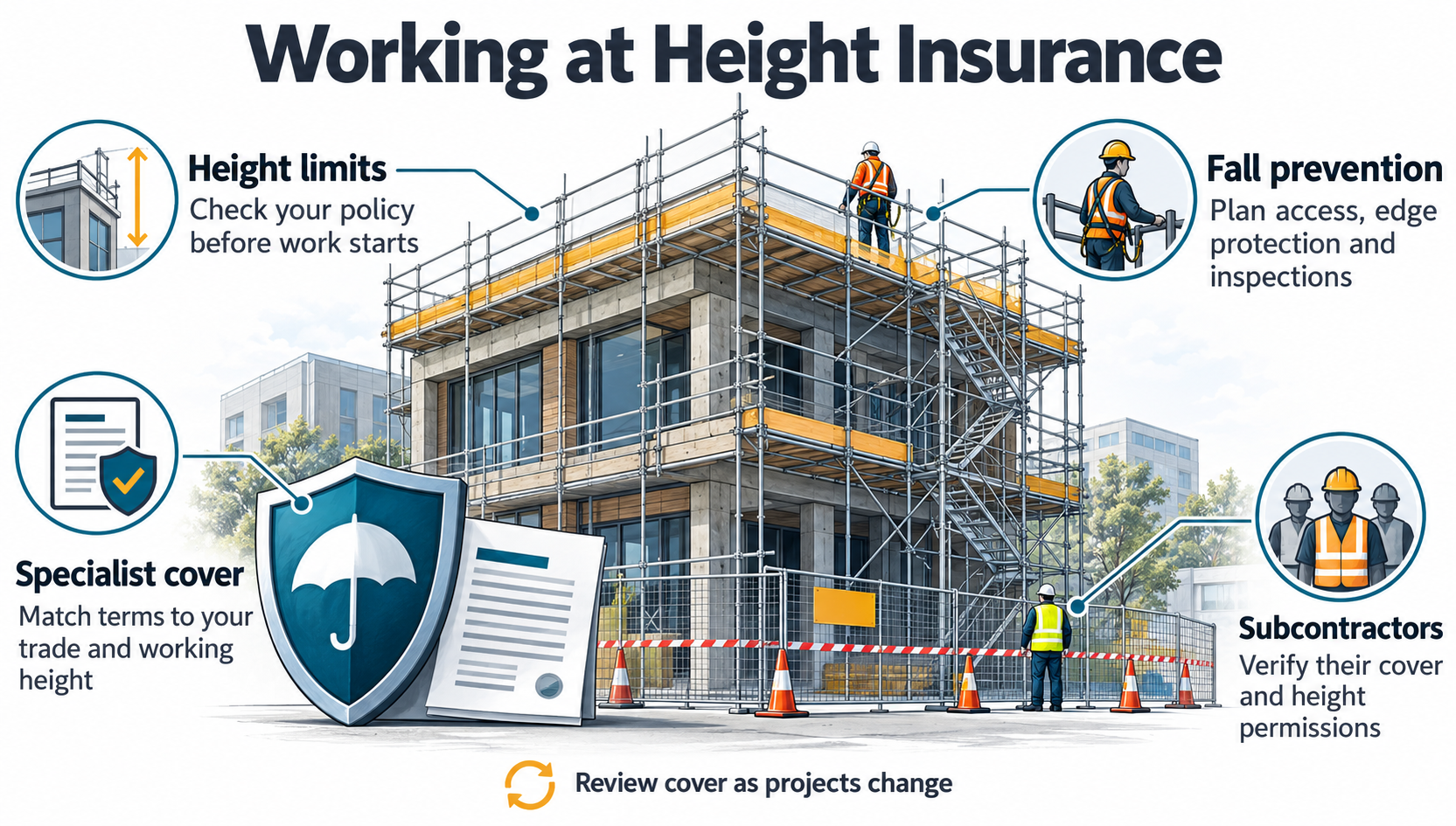
Statutory Controls and Fall Prevention Duties
The Work at Height Regulations 2005 Baseline
The Work at Height Regulations 2005 govern any work where a person could fall and be injured. The statute sets an unambiguous hierarchy of control. Duty holders must avoid work at height where possible. Where it cannot be avoided, they must prevent falls and then minimise the distance and consequences.
Underwriters treat statutory compliance as an implicit condition of risk acceptability. A contractor who bypasses the hierarchy exposes workers to preventable harm. Non-compliance also jeopardises indemnity. Loss adjusters review site risk assessments after any serious injury claim. They check whether supervisors discharged their planning duties before the task started.
Competence Standards and Equipment Inspection
Underwriters expect operatives to hold formal competence under recognised national training schemes. The Construction Industry Scaffolders Record Scheme verifies individual capability for scaffolders. General trades must hold certified training for mobile elevating work platforms and mobile access towers. Insurers will ask for those records when a claim is notified.
The Provision and Use of Work Equipment Regulations 1998 reinforce physical site safety. All work equipment requires routine inspection and documented maintenance. The duty covers fall arrest harnesses, lanyards and safety netting. Insurers frequently request maintenance logbooks after an incident. They use them to establish whether defective equipment contributed to the injury.
Did You Know?
Falls from height remain the single largest cause of fatal injury to workers in Great Britain. Health and Safety Executive statistics attribute roughly a third of all worker deaths each year to falls from height. Construction accounts for the largest share of those fatalities.
Policy Warranties and Operational Restrictions
Height Warranties as Contractual Boundaries
A height warranty is an absolute contractual boundary inside a public and employers’ liability policy. If the schedule specifies a ten-metre limit, the policy will not respond above that measurement. Height is measured from ground level to the working platform. The warranty applies regardless of how competent the operative was.
The Insurance Act 2015 requires policyholders to make a fair presentation of risk. Insurers cannot decline claims for breaches irrelevant to the loss. Working above a height limit is rarely irrelevant. It increases both the likelihood and the severity of a fall. Contractors on multi-storey refurbishment often invalidate cover without realising it.
Subcontractor Vetting and Flow-Down Obligations
Contractors routinely rely on subcontractors for specialist high-level elements. That reliance introduces secondary liability risk when insurance controls lapse. Most commercial wordings contain a bona fide subcontractor warranty. It requires the policyholder to verify external cover. Main contractors must confirm equivalent indemnity limits and matching elevation permissions before work starts.
A subcontractor capped at three metres on a fifteen-metre project is a critical exposure. If that firm drops materials or suffers a fall, its insurer will repudiate the claim. Liability then flows straight to the principal contractor. A single incident can exhaust the primary layer. Vetting certificates at order stage prevents most of these failures.
Cover Built for Demanding Businesses
Across high risk industries, the cover we arrange most often includes:
Public liability
Employers' liability
Motor fleet
Contractors' all risks
Freight liability
Professional indemnity
Environmental liability
Business interruption
Most businesses need a combination, rather than a single focus policy, and we build cover around your contracts, your workforce and your operational activities.
High-Risk Trades Demanding Unrestricted Height Insurance
Scaffolding Contractors and Structural Access Providers
Scaffolding contractors cannot trade viably under a standard height cap. Unrestricted height insurance is their baseline requirement, not an upgrade. Tube-and-fitting and system scaffolds routinely rise well beyond residential rooflines. Access firms serve high-rise towers, civil engineering assets and heavy industrial plants. Each of those contracts breaches a conventional trade wording.
Specialist access providers rely on scaffolding public liability insurance that explicitly accepts high-elevation work. These wordings also manage third-party falling object risk. Insurers assess scaffolders on procedural discipline rather than price alone. They look for TG20 compliant design configurations. They also check SG4 fall prevention practice during erection and dismantling.
Commercial Roofing and Industrial Cladding
Commercial roofers face continuous height exposure across warehouses, distribution hubs and multi-storey developments. Structural decking, membrane replacement and rainscreen cladding rarely sit inside low-level policy allowances. These operations need extended elevation endorsements negotiated with specialist construction underwriters. From experience across the sector, roofing schedules fail more often on hot works than on height.
Placing roofing insurance requires accurate alignment between project heights and policy conditions. Torch-on bitumen membranes introduce severe fire exposure alongside the fall risk. Underwriters demand a permit-to-work system for all hot works. They also require a dedicated fire watch after the final burner is shut down. Both conditions sit alongside the height endorsement.
Third-Party Exposures and Public Liability Interfaces
Falling Object Liability and Edge Protection
Public liability exposure at height extends well beyond workers falling. Dropped tools, debris and fittings create severe third-party liability. Falling objects strike pedestrians, damage parked vehicles and penetrate neighbouring structures. These incidents generate injury and property claims that quickly exceed a baseline indemnity limit. Urban sites carry the sharpest exposure.
Insurers manage this risk through mandated edge protection standards. Debris netting, toe boards and crash decks are standard conditions. Work above a public thoroughfare usually requires a pavement licence and protection fans. Failure to maintain these barriers can amount to negligence. That failure weakens the defence during a contested liability settlement.
Site Demarcation and Structural Security
Insurers require strict site security to keep unauthorised people off temporary access structures. Climbing by trespassers or children is an acute liability hazard. The Occupiers’ Liability Act 1984 imposes a duty of care toward non-permitted visitors. That duty applies on construction sites and commercial properties alike. Underwriters treat ground-level security as a core control.
Policy conditions often require ladders to be secured or removed at the end of each shift. Perimeter fencing and boarding around scaffold bases prevent ground-level intrusion. Ladder traps must be fitted and locked on standing structures. Underwriters scrutinise these measures closely if an unauthorised person falls. Photographic shift records make that scrutiny far easier to satisfy.
Comprehensive High-Hazard Insurance Programmes
Contractors All Risks and Plant Cover
A specialist height programme needs liability and first-party property cover to work together. Contractors All Risks responds when temporary works collapse or suffer wind damage. The loss then involves structural remediation and damaged access machinery. Owned and hired-in plant both sit within that exposure. Gaps between the two policies surface only at claim stage.
Contractors must account for mast climbing work platforms, scissor lifts and tower cranes. Plant policies should reflect the hire contract in force. Construction Plant-hire Association model conditions are the common benchmark. Those terms hold the hirer liable for damage to the equipment. They also hold the hirer liable for continuing hire charges during repair.
Indemnity Limits for Infrastructure Contracts
Major infrastructure and Tier 1 commercial contracts demand indemnity limits well above entry-level policies. Main contractors commonly require subcontractors to carry ten million pounds of public liability cover. Some frameworks now ask for more. Meeting that figure usually requires an excess layer sitting above the primary policy. The two layers must be underwritten consistently.
Excess capacity depends on a clear presentation of the underlying primary policy. Underwriters need proof that the primary wording carries the correct height terms. An unendorsed fifteen-metre cap below will not support losses above that line. The excess layer simply follows the primary and declines. Seamless integration prevents a dispute after a high-rise incident.
Risk Presentation and Underwriting Requirements
Evidence of Operational Risk Controls
Brokers presenting high-hazard risk must evidence robust operational management. Insurers look past standard proposal forms. They request full risk assessments and method statements for the most challenging tasks. They also review inspection regimes for personal fall equipment and collective fall barriers. Weak documentation usually produces loaded terms or a declinature.
Underwriting confidence rises when a firm shows clear handover procedures. Scaffold tagging systems that prohibit use before sign-off are a strong signal. Weekly inspections and post-weather checks should sit in a documented safety log. Those logs prove active management of elevated hazard zones. In practice, we find they also shorten the claims investigation.
Claims Advocacy and Proactive Policy Reviews
Valid cover requires active management through the year, not a passive annual renewal. Expansion into commercial or industrial contracts pushes operations beyond the original policy parameters. Trade descriptions and operational limits then sit out of date. That mismatch creates a hazardous gap mid-term. A short review at contract award stage closes it.
Contractors need continuous reviews that track evolving contractual demands. When an incident occurs, proactive claims advocacy matters immediately. Insurers should receive prompt notice and detailed mitigation records. Experienced handling demonstrates statutory compliance and isolates the causative factors. It also shields the business from unjustified third-party claims.
Building Safety Act Implications for Working at Height
Higher-Risk Building Definitions and Gateways
The Building Safety Act 2022 introduced rigorous oversight for higher-risk buildings. The definition covers structures at least eighteen metres tall or seven storeys. Contractors on these properties face strict competence requirements and procedural sign-offs. The Building Safety Regulator administers the gateway regime. Underwriters now inspect those compliance measures before agreeing terms.
Work on higher-risk structures requires demonstrable compliance with the gateway regime. Golden thread documentation must account for external building works and access installations. Structural maintenance records fall within the same duty. Insurers increasingly request evidence of gateway approvals before granting unrestricted height endorsements. That evidence is now routine on qualifying high-rise residential schemes.
Competence Declarations and Contractor Duties
Secondary legislation under the Building Safety Act 2022 imposes duty-holder competence requirements. Those duties fall on principal contractors and specialist trade subcontractors. Firms must verify the skills, knowledge, experience and behaviours of everyone working at height. Insurers assess these internal competence frameworks when underwriting elevated risk. A verbal assurance will not satisfy them.
Failure to meet competence standards can compromise policy response after an incident. If an unqualified operative causes a fall or structural failure, underwriters examine the verification records. Gaps in those records weaken the contractor’s position immediately. Aligning workforce qualifications with regulatory requirements protects site safety. It also protects the policy when a claim arrives.
Final Thoughts
Managing elevated construction exposure demands working at height insurance matched to your operational profile. Restrictive height limits in standard market wordings leave contractors facing catastrophic loss. Audit the warranties in your current schedule. Verify every subcontractor certificate before work starts. Remove artificial height thresholds that no longer reflect the contracts you win.
UK construction continues to move toward multi-storey and modular methods. Insurer scrutiny of elevated risk will intensify rather than ease. Firms that present risk thoroughly and maintain certified competence will keep access to competitive capacity. Those that rely on an unreviewed trade policy will not. The gap between the two groups is widening.
Speak to an Insurance Specialist
Whether you need a new quote, want to discuss your renewal or have a question about an existing policy, our team is here to help.
Frequently Asked Questions
Q: What is unrestricted height insurance?
A: Unrestricted height insurance is an endorsement on a commercial liability policy. It removes the standard height caps of three, ten or fifteen metres. Most trade policies limit how high an operative may work above ground level. The endorsement keeps public and employers’ liability protection active at any elevation. High-rise, industrial and infrastructure contractors rely on it to avoid breaching a warranty. Without it, a single lift above the capped height can leave a claim uninsured.
Q: How do insurers calculate working height limits?
A: Insurers measure working height as the vertical distance from ground level to the point where the operative works. Equipment position is measured the same way. An operative on a platform twelve metres above ground falls into the twelve-metre bracket. Contractors should never measure from an internal floor slab or an intermediate flat roof. The only exception is where the wording expressly defines height from the immediate supporting surface. Check the schedule definition before relying on any assumption.
Q: Does employers’ liability insurance cover falls from height?
A: Employers’ liability insurance responds to compensation claims from employees injured whilst working at height. The Employers’ Liability (Compulsory Insurance) Act 1969 governs that cover. The statute protects an injured worker’s right to compensation for employer negligence. The insurer must therefore pay the employee. However, it may seek recovery from the contractor afterwards. It may also decline non-statutory sections where the business breached explicit warranties, safety regulations or declared operational limits.
Q: What happens if a contractor breaches a policy height warranty?
A: A breach gives the insurer grounds to repudiate indemnity for claims connected to the elevated activity. The Insurance Act 2015 is the governing framework. If the breach is relevant to the loss, the insurer can refuse cover. A worker falling from an unapproved height is a clear example. The firm then funds third-party damages and legal defence costs itself. Those sums regularly exceed the net assets of a small contracting business.
Q: Why do scaffolders require specialist public liability terms?
A: Scaffolding work involves extreme elevations, complex structural loads and heavy third-party property risk from falling components. Standard construction wordings contain warranties that a scaffolder would breach during normal trading. Specialist policies remove the artificial height boundary altogether. They accommodate tube-and-fitting and system assembly. They also incorporate dropped-object cover. Insurers expect strict adherence to National Access and Scaffolding Confederation guidance as a condition of those terms.
About The Author
Darren Judd
Director, Co-Founder and Co-Owner of Capital Corporate Risks Ltd

Experienced Account Executive with a demonstrated history of working in the insurance industry. Skilled in Account Management, Risk Management, Business Development across all classes of insurance within the Construction Industry,