

High Risk Business Insurance: How Cover Works
Hazardous trades sit well outside the appetite of mainstream composite insurers. Demolition, work at height, hot works and contaminated land all breach standard underwriting models. High risk business insurance exists to close that gap. It protects firms whose exposures are rare, severe and expensive. Get the structure wrong and the balance sheet carries the loss instead.
Most operators discover the limits of their cover only after an incident. Restrictive warranties, sub-limits and pollution exclusions sit quietly in the schedule until a claim tests them. So how should a hazardous trading business build a programme that satisfies contractual demands without leaving uninsured gaps?
Key Takeaways
- Standard composite insurers decline hazardous operations because severe injury and catastrophic property damage exceed their actuarial risk models.
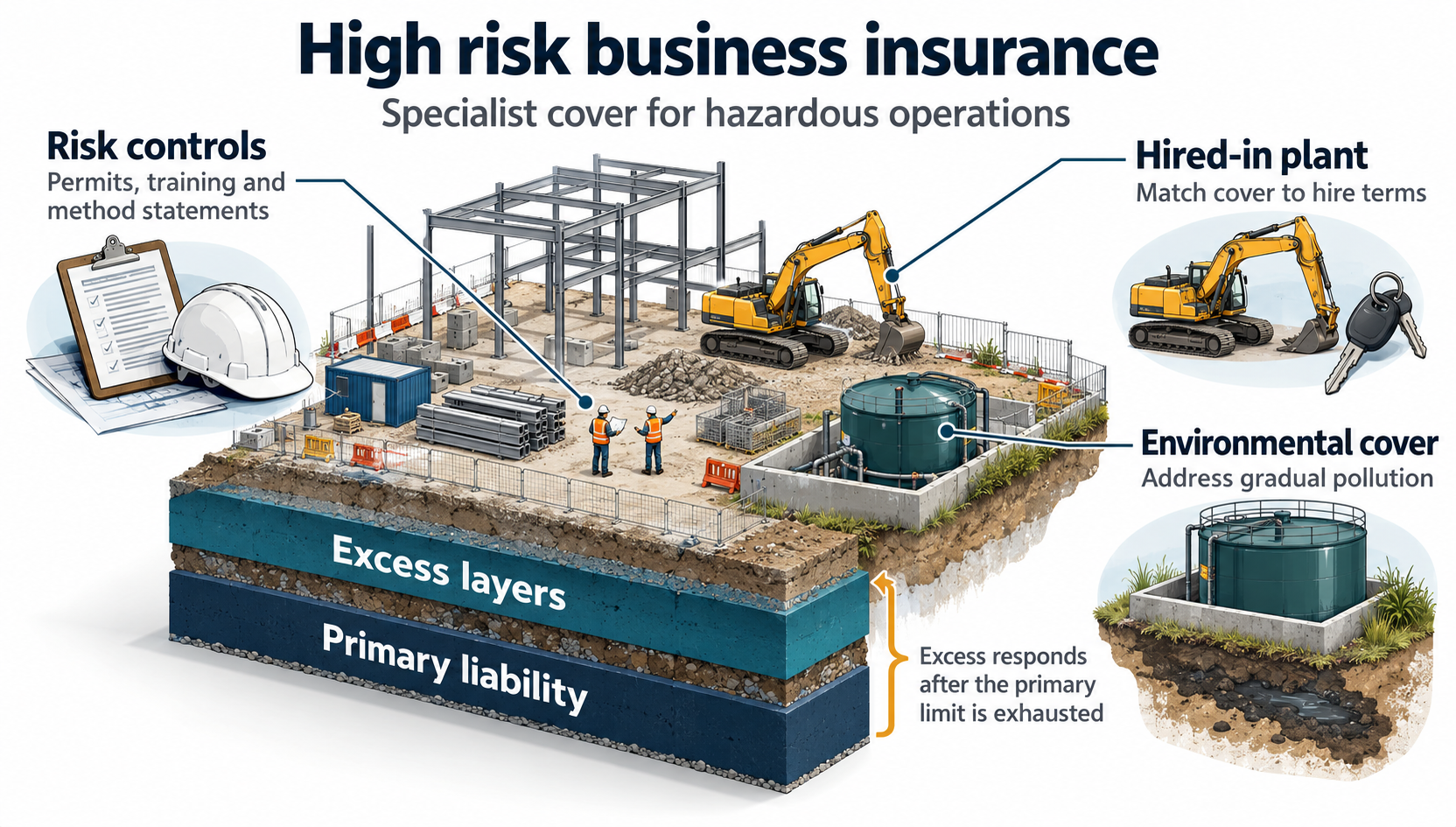
- High risk liability insurance normally pairs a primary limit with excess layers to meet main contractor indemnity requirements.
- Specialist business insurance depends on evidenced controls, including permit-to-work systems, operative certification and site-specific method statements.
- Public liability wordings exclude gradual pollution, so contaminated land exposures require stand-alone environmental impairment liability cover.
- Plant schedules must mirror the hire contract, or continuing hire charges fall directly on the hirer during repairs.
Cover Lines Within a High Risk Programme
A hazardous trading business rarely sits behind one policy. Specialist programmes separate liability, property, plant and pollution into distinct placements. Each line carries its own limit, excess and warranty set. Underwriters price each one against operational controls rather than turnover alone. The table below sets out the cover lines most high-hazard contractors carry.
Many firms assume a commercial combined policy handles everything. In practice, standard wordings apply sub-limits or blanket exclusions to hazardous work. Separating the lines removes that ambiguity. It also allows a broker to match each schedule against the indemnity clauses written into principal contractor agreements. Limits below reflect common UK market practice, not statutory minimum requirements.
| Insurance Line | Typical Market Limit | Primary Risk Driver |
|---|---|---|
| Employers’ Liability | £10m per occurrence | Work at height, heavy plant, toxic exposure |
| Public Liability | £5m to £10m primary | Third-party injury and property damage |
| Excess Layer Liability | £10m to £50m aggregated | Tier-one and infrastructure contracts |
| Contractors All Risks | Full contract value | Damage to the permanent works |
| Owned and Hired-in Plant | Replacement value plus hire | Machinery loss and continuing hire charges |
| Environmental Impairment | £1m to £5m claims-made | Gradual contamination and statutory clean-up |
How Underwriters Assess Hazardous Trades
Severity Beats Frequency in Pricing
Underwriters in hazardous sectors price severity, not frequency. Standard commercial books rely on predictable loss rates across low-risk populations. Hazardous trades behave differently. They produce rare events with catastrophic costs. Insurers therefore examine technical controls, workforce competence and contractual terms before quoting. Payroll and turnover alone tell them very little.
Consider a demolition contractor or an asbestos removal firm. The underwriter is not modelling slips and trips. They are modelling a fatality, a structural collapse or an uncontrolled fibre release. From experience across the sector, the premium follows the quality of the paperwork. Training matrices, plant inspection records and permit systems move rates more than headcount does.
Market Appetite and Capacity Limits
Composite insurers decline high-hazard accounts because their treaty capacity will not absorb the volatility. These risks move to Lloyd’s syndicates, managing general agents and niche mutuals. Those markets write bespoke wordings. They apply higher excesses, technical warranties and tighter activity definitions to keep aggregated exposure within tolerance.
Capacity also limits what a single insurer will put on one schedule. A specialist market may offer £5 million primary and refuse to go further. Larger contracts then need layering. Brokers syndicate the exposure across several balance sheets. That spread keeps the market stable after a major sector loss and keeps terms available the following year.
Did You Know?
The Employers’ Liability (Compulsory Insurance) Act 1969 requires UK employers to hold at least £5 million of employers’ liability cover. The HSE can fine a business up to £2,500 for each day it trades without valid cover. Most insurers issue £10 million as standard, and hazardous trades are routinely asked for more.
Primary and Excess Liability Layers
Contractual Demands for Primary Limits
Tier-one contractors and public authorities set minimum liability limits before granting site access. Five million pounds remains the common entry point. Major infrastructure schemes routinely specify ten million on the primary schedule. High risk liability insurance meets those obligations. It funds defence costs alongside third-party injury and property damage indemnities.
The primary layer absorbs everyday claims and moderate site incidents. It also sets the governing terms for everything above it. Deductibles, territorial limits and activity definitions all sit in that schedule. If excavation damages an adjoining structure, the primary public liability section responds first. A weak primary wording undermines every layer placed on top of it.
How Excess Layers Stack Above Primary Cover
Excess layer policies sit directly above the primary limit. They respond only once the underlying indemnity is exhausted by a valid claim. Brokers align the excess wording with the primary wording to prevent coverage disputes mid-claim. Misaligned definitions create gaps that surface at the worst possible moment.
Civil engineering and petrochemical maintenance contracts often demand £20 million to £50 million of third-party cover. Primary insurers will not write those limits alone. Excess layers supply the balance. Most follow the form of the underlying policy, which keeps the vertical structure seamless. Each layer is still a separate contract with its own insurer and its own notification duties.
Cover Built for Demanding Businesses
Across high risk industries, the cover we arrange most often includes:
Public liability
Employers' liability
Motor fleet
Contractors' all risks
Freight liability
Professional indemnity
Environmental liability
Business interruption
Most businesses need a combination, rather than a single focus policy, and we build cover around your contracts, your workforce and your operational activities.
Restrictive Warranties and Policy Conditions
Height and Depth Warranties
Standard liability wordings cap working height at three or ten metres and depth at one metre. Work beyond those limits falls outside cover unless the schedule carries an endorsement. The result is a voided claim at the point of greatest need. Specialist business insurance replaces arbitrary caps with evidenced competence and documented risk assessment.
A scaffolding firm working at twelve metres under an unendorsed ten-metre warranty has no protection. The insurer will decline. Specialist underwriters remove the cap, then attach conditions instead. They ask for CISRS cards, inspection records and demonstrable compliance with the Work at Height Regulations 2005. The obligation shifts from an artificial number to verifiable site practice.
Hot Work Permits and Fire Watch Rules
Thermal cutting, welding and torch-on roofing drive some of the largest commercial fire losses. Underwriters control that exposure through warranties rather than pricing. Most schedules demand a written permit-to-work system. They also require extinguishers within reach and a continuous fire watch for sixty minutes after work stops.
These are warranties, not recommendations. Breach one and the insurer can repudiate the resulting property damage claim entirely. In practice, the weak point is the post-work inspection log. Operatives clear combustibles and complete the permit, then leave site without recording the final check. That missing signature is the first thing a loss adjuster looks for.
Plant and Equipment Protections
Owned and Hired-in Plant Liabilities
Excavators, piling rigs and mobile cranes face overturning, accidental damage and theft. Commercial property policies do not follow mobile plant away from the yard. Specialist plant cover does. It insures owned machinery on an agreed or indemnity basis. It also picks up the liability a hirer accepts under standard hire conditions.
Plant theft remains a persistent problem across UK construction sites. Insurers respond with security warranties covering immobilisers, tracking devices and overnight storage. Owned plant cover meets repair costs, malicious damage and total loss. Hired-in cover responds to the contractual indemnity owed to the rental company. The two operate differently and should never be assumed interchangeable.
Continuing Hire Charges Under CPA Terms
Construction Plant-hire Association model conditions make the hirer responsible for hire charges while damaged machinery is repaired or replaced. The clock does not stop at the point of loss. Charges accrue until the owner is reimbursed or the plant returns to service. Cover must include an explicit continuing hire extension.
Take a thirty-tonne excavator that overturns on soft ground. The hire account keeps running while the loss adjuster investigates. Weeks can pass before settlement. Without the extension, those charges fall on the contractor directly. Brokers should check the indemnity period and the weekly limit, because both are commonly set too low for larger machines.
Environmental and Pollution Liabilities
Sudden Contamination Versus Gradual Pollution
Public liability wordings limit pollution cover to sudden, unintended and identifiable incidents at a specific time and place. Gradual seepage, slow leaks and progressive ground contamination fall outside that definition. Operators handling fuels, chemicals or waste need a separate environmental policy. Without one, a significant exposure sits entirely uninsured.
A ruptured fuel line emptying within minutes is a sudden event. A hairline crack leaking oil into groundwater over eighteen months is not. Standard policies decline the second scenario consistently. Environmental impairment liability cover bridges the gap. It funds investigation, clean-up and third-party damages arising from both acute and progressive contamination.
Statutory Remediation Duties Under UK Law
The Environmental Damage (Prevention and Remediation) (England) Regulations 2015 impose clean-up duties on operators causing environmental harm. The Environment Agency can compel off-site remediation, land decontamination and habitat restoration. These are statutory obligations, not civil claims. Public liability cover does not respond to them, which surprises many operators.
Part 2A of the Environmental Protection Act 1990 gives regulators further powers to serve remediation notices. Those notices can require removal of contaminated subsoil and treatment of affected water. Costs escalate quickly on brownfield sites. Environmental impairment policies indemnify the operator against those statutory costs. They typically operate on a claims-made basis, so continuous cover matters.
Commercial Vehicle and Fleet Exposures
Fleet Rating and Telematics Evidence
Heavy haulage, muckaway and waste fleets need motor cover built around their actual operation. Standard motor underwriting struggles with specialist vehicles and congested site access. Specialist insurers price from evidence instead. They examine telematics data, driver vetting, maintenance schedules and five years of claims experience before offering terms.
Forward-facing cameras now carry real weight in fleet negotiations. They defend drivers against exaggerated third-party claims and shorten settlement times. Digital tachographs and tracking demonstrate control over driver hours. Operators who present this evidence properly secure better rates. Those who present a bare claims summary are usually quoted defensively, if at all.
Dangerous Goods Endorsements on Motor Policies
Operators carrying dangerous substances work under the Carriage of Dangerous Goods and Use of Transportable Pressure Equipment Regulations 2009. Motor policies need an explicit hazardous goods endorsement to match that activity. Undisclosed carriage classes give the insurer grounds to avoid cover. Road Traffic Act minimum cover may survive, but everything else falls away.
Chemicals, industrial gases and clinical waste all fall under ADR carriage rules. A spillage on the highway triggers third-party liability and environmental clean-up at the same time. Those costs run far beyond vehicle damage. The endorsement must mirror the operator licence permissions exactly. Any mismatch becomes the central argument in a disputed claim.
Risk Presentation and Claims Support
Fair Presentation Under the Insurance Act 2015
The Insurance Act 2015 requires commercial policyholders to make a fair presentation of the risk. Every material circumstance must be disclosed before inception and at renewal. Hazardous operators should submit safety audits, training matrices and inspection logs. Full disclosure protects enforceability and avoids proportionate claim reductions later.
A generic proposal form rarely satisfies the duty. Underwriters expect clear boundaries on activities, subcontracted work, maximum working heights and substances handled. Deliberate or reckless breaches allow the insurer to avoid the policy outright. Innocent breaches still permit proportionate remedies. Either outcome is severe, so presentation deserves the same rigour as the contract bid itself.
Claims Advocacy and Technical Evidence
Large industrial claims are negotiated, not processed. Insurers instruct forensic engineers and specialist loss adjusters within days of notification. Policyholders need equivalent technical support. A competent claims advocate challenges reserve figures, tests warranty interpretations and keeps the settlement moving. Documentation gathered before the loss decides most of these arguments.
Site diaries, lift plans, permits and statutory inspection certificates carry the case. Without them, a policyholder accepts whatever reading of the warranty the adjuster offers. Contributory negligence arguments also gain traction. When operating in this area, the firms that recover quickly are the ones whose records were already in order before the incident occurred.
Final Thoughts
High risk business insurance is a structure, not a product. Mainstream package policies cannot hold the loss potential in demolition, work at height, heavy haulage or contaminated land. A sound programme layers primary and excess liability, endorses hot works and hired plant, and adds environmental cover where ground conditions demand it.
Contractual indemnity requirements continue to tighten across UK infrastructure and public sector work. Insurability now depends on evidence as much as on loss history. Keep training records, plant inspections and permit systems current. Review the schedule whenever activities change, because a policy written for last year’s work will not answer for this year’s.
Speak to an Insurance Specialist
Whether you need a new quote, want to discuss your renewal or have a question about an existing policy, our team is here to help.
Frequently Asked Questions
Q: Why do standard insurers decline high hazard businesses?
A: Standard composite insurers use automated underwriting built for predictable, low-severity commercial risks. Demolition, asbestos removal, piling and waste processing introduce severe injury and catastrophic property damage exposures. A single claim can breach the portfolio tolerance set for an entire trade sector. Rather than price each case, these insurers apply blanket exclusions. Specialist underwriters take the opposite approach. They assess the individual operation, its controls and its records, then price the risk accordingly.
Q: What indemnity limits do main contractors usually require?
A: Main contractors and public bodies typically ask for £5 million or £10 million of public liability on the primary schedule. Rail, infrastructure and large demolition schemes frequently specify £20 million to £50 million in total. Few primary insurers will write those limits alone. Contractors meet the requirement by adding an excess layer above the primary policy. This tiered structure satisfies the indemnity clause without relying on a single insurer to carry the full exposure.
Q: How does an excess layer policy operate during a claim?
A: An excess layer sits above an underlying primary policy and provides additional indemnity. It responds only after the primary insurer has paid its full limit on a valid claim. Take a £10 million claim against a contractor holding £5 million primary cover and a £5 million excess layer. The primary policy pays the first £5 million. The excess layer then pays the remaining balance, usually following the terms of the underlying wording.
Q: What is the difference between sudden and gradual pollution cover?
A: Public liability policies cover pollution only when it is sudden, unintended and identifiable, such as a fuel tank punctured in a collision. They exclude gradual pollution that develops over time through slow seepage or a leaking pipeline. Progressive soil and groundwater contamination therefore needs stand-alone environmental impairment liability cover. That policy funds investigation, on-site and off-site remediation, statutory clean-up costs and third-party damages. It normally operates on a claims-made basis rather than an occurrence basis.
Q: What documents do specialist underwriters ask for?
A: Expect to provide site-specific risk assessments and method statements, health and safety training matrices, operative certification cards and equipment maintenance logs. Underwriters also want five years of claims experience, a turnover split by work type and your subcontractor vetting procedure. Firms handling hazardous substances should include waste carrier registrations and permit records. Submitting complete, verified evidence satisfies the duty of fair presentation and almost always produces better terms than a bare proposal form.
About The Author
Darren Judd
Director, Co-Founder and Co-Owner of Capital Corporate Risks Ltd

Experienced Account Executive with a demonstrated history of working in the insurance industry. Skilled in Account Management, Risk Management, Business Development across all classes of insurance within the Construction Industry,