
High Risk Liability Insurance: A Specialist View
Operating within high-hazard construction, civil engineering, and environmental sectors exposes contracting businesses to catastrophic third-party risks. Securing robust high risk liability insurance demands an intricate grasp of operational exposures, statutory duties, and specialised policy wordings. Standard commercial packages consistently fail to protect high-consequence activities like demolition, asbestos handling, and deep excavation. Specialist brokers assess operational realities to secure broad terms. This process ensures contracting firms maintain contractual compliance across challenging worksites without confronting unendorsed policy exclusions.
Main contractors, local authorities, and institutional clients enforce rigorous insurance thresholds before permitting trade specialists to enter project sites. How can contracting businesses demonstrate risk mitigation, satisfy escalating indemnity demands, and secure comprehensive terms from UK underwriters?
Key Takeaways
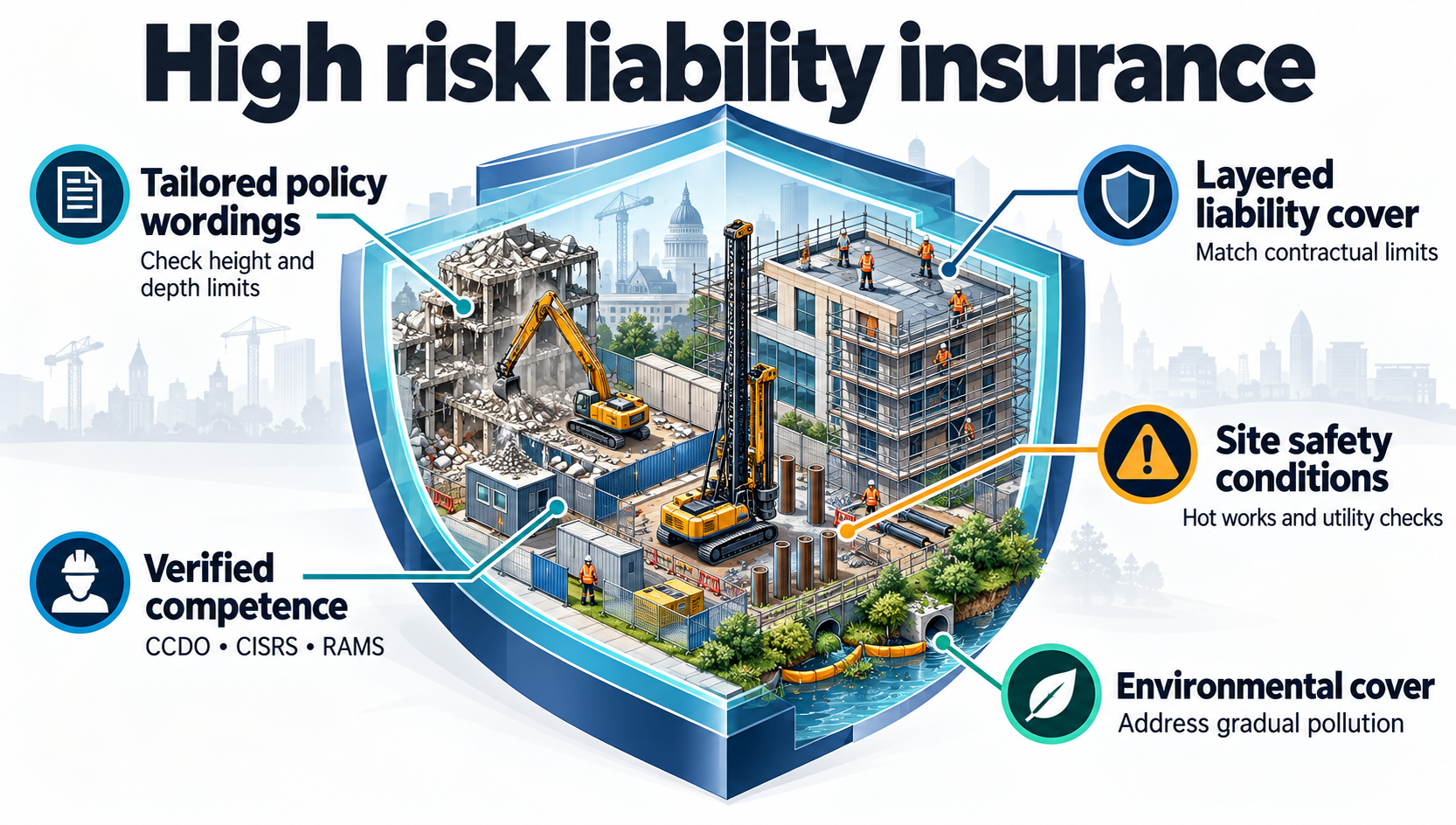
- High-hazard trades require tailored policy wordings to avoid coverage gaps caused by standard market exclusions.
- Main contractors routinely demand public liability indemnity limits between ten million and twenty-five million pounds.
- Underwriters require verified workforce accreditations such as CCDO and CISRS cards before offering hazardous trade terms.
- Hot work warranties and service locating protocols are conditions precedent that policyholders must satisfy exactly.
- Standalone environmental impairment policies cover gradual pollution events that standard public liability contracts expressly exclude.
Sector Risk Baselines and Coverage Requirements
Specialist contractors operating across hazardous sectors must align policy limits with contractual demands and operational risks. The following benchmarks illustrate typical indemnity limits and essential policy endorsements. These standards apply across key high-hazard construction and environmental operations throughout the United Kingdom.
Underwriters evaluate trades based on the severity of potential third-party bodily injury, structural collapse, and environmental damage. Meeting these contractual standards protects corporate cash flow. Furthermore, these arrangements ensure operations satisfy client procurement criteria under standard JCT and NEC contract conditions on major infrastructure schemes.
| Specialist Trade | Typical Indemnity Limit | Core Endorsement Requirements |
|---|---|---|
| Demolition and Strip-Out | £10m to £25m+ | Explosives and mechanical dismantling, pre-demolition surveys, asbestos acceptance |
| Licensed Asbestos Removal | £5m to £10m | Explicit asbestos endorsement, non-standard pollution, claims-made terms |
| RC Frame Construction | £10m to £20m | Formwork collapse cover, crane lifting operations, unrestricted height |
| Piling and Groundworks | £5m to £10m | HSG47 utility service strikes, vibration damage, removal of lateral support |
| Access and Scaffolding | £5m to £10m | Unrestricted working height, NASC TG20 compliance, public drop netting |
| Commercial Roofing | £5m to £10m | Hot work permit warranty, post-torch fire watch, open flame conditions |
Critical High-Hazard Structural Trades
Demolition and Decommissioning Operations
Demolition operations generate immense loss potential through structural collapse, flying debris, excessive vibration, and contamination. Standard commercial liability wordings exclude mechanical demolition, explosive felling, and facade retention. High hazard liability insurance provides tailored cover that recognises high-reach excavators, soft strip tasks, and surrounding party wall risks.
Underwriters require comprehensive evidence of method statements before quoting demolition risks. Contractors must verify adherence to Building Act 1984 section 80 notifications. Firms must also provide detailed structural engineering assessments. Site-specific risk assessments must demonstrate protective arrangements for adjacent highways and occupied adjoining structures. Without these operational controls, insurers decline terms or impose severe indemnity sub-limits.
Reinforced Concrete Frame and Structural Works
Reinforced concrete frame contractors manage substantial height risks, heavy crane movements, temporary formwork integrity, and structural failure exposures. Third-party liability claims often involve falling objects striking pedestrians or catastrophic falsework collapse damaging neighbouring assets. Adequate specialist liability insurance covers contract works, temporary designs, and third-party liabilities concurrently.
Main contractors operating major developments consistently mandate minimum public liability limits of ten million pounds for frame packages. Insurers evaluate crane lifting protocols under the Lifting Operations and Lifting Equipment Regulations 1998 (LOLER). Contractors must maintain rigorous inspection registers. They must also ensure all slingers, signallers, and crane operators hold verified CPCS competency accreditations to satisfy strict policy warranties.
Did You Know?
The Sentencing Council definitive guideline, in force since 1 February 2016, sets fine ranges reaching £10 million for large organisations convicted of health and safety offences. Corporate manslaughter fines reach £20 million. Criminal fines cannot be insured under English law, so these penalties fall directly on the balance sheet.
Groundworks and Subterranean Hazards
Underground Utility Risks in Groundworks
Groundwork operations face constant financial exposure from striking buried electricity cables, gas mains, fibre networks, and water infrastructure. Striking a critical utility causes catastrophic business interruption for surrounding commercial properties, alongside severe third-party injury. Policies must include explicit coverage for utility strikes without punitive excesses or onerous service location warranties.
Underwriters mandate strict compliance with Health and Safety Executive guidance HSG47, Avoiding danger from underground services. Groundworkers must demonstrate the standard use of electromagnetic location tools. They must also deploy up-to-date utility plans sourced via services like LinesearchBeforeUDig. Operatives must prove they conducted systematic scanning before mechanical breaking. Otherwise insurers can repudiate property damage claims.
Piling and Underpinning Structural Liabilities
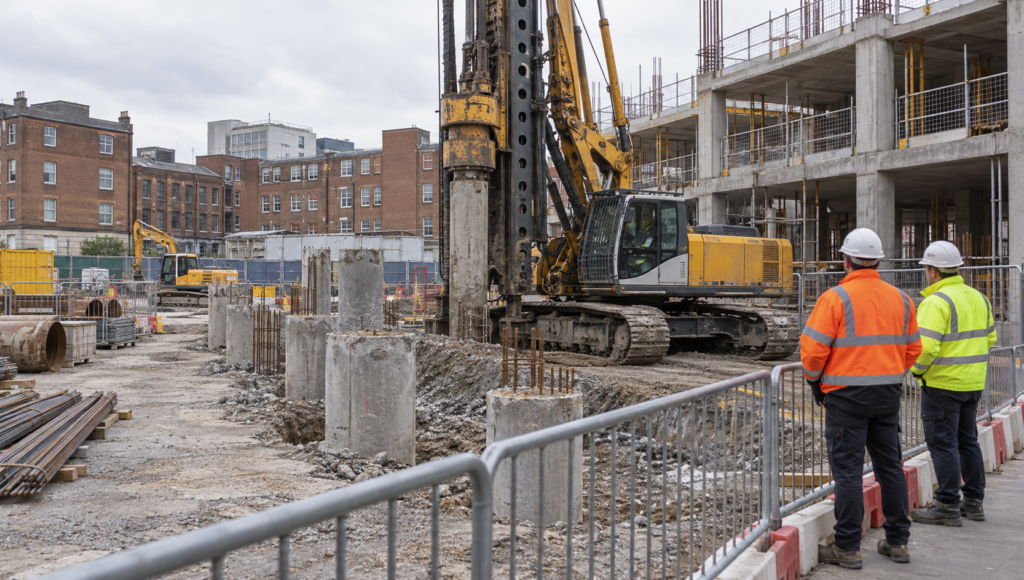
Piling and underpinning projects introduce critical liabilities regarding soil movement, ground heave, loss of lateral support, and structural cracking. Standard public liability policies routinely exclude damage caused by vibration, weakening of supports, or groundwater alteration. High-hazard liability wordings must explicitly reinstate cover for vibration and removal of support via specialist endorsements.
The Party Wall etc. Act 1996 sets statutory frameworks that heavily influence third-party property damage disputes during underpinning. Underwriters scrutinise pre-commencement condition surveys of adjacent buildings, geotechnical soil reports, and piling rig maintenance schedules. Piling specialists accredited by the Federation of Piling Specialists gain broader insurer acceptance. Membership proves adherence to recognised structural engineering standards.
Cover Built for Demanding Businesses
Across high risk industries, the cover we arrange most often includes:
Public liability
Employers' liability
Motor fleet
Contractors' all risks
Freight liability
Professional indemnity
Environmental liability
Business interruption
Most businesses need a combination, rather than a single focus policy, and we build cover around your contracts, your workforce and your operational activities.
Work at Height Risk Profiles
Scaffolding Erection and Access Solutions
Scaffolding contractors face continuous exposure to catastrophic falls, material drops, and structural framework collapses during erection and dismantling phases. Standard liability policies generally impose strict height limits of ten or fifteen metres. Specialist scaffolding policies must provide unrestricted height allowances and explicitly accommodate street-level public protection.
Insurers assess compliance with the Work at Height Regulations 2005. They also examine National Access and Scaffolding Confederation guidance documents TG20 and SG4. Contractors must prove that all working operatives hold valid Construction Industry Scaffolders Record Scheme (CISRS) cards. Furthermore, scaffolders must maintain documented handover certificates and display visible tagging systems. They must also record weekly statutory safety inspections to preserve liability coverage.
Commercial Roofing and Hot Works Exposures
Commercial roofing contractors introduce severe property fire hazards whenever deploying gas torches, bitumen boilers, or heat guns. Torch-on felt and single-ply membrane installations represent the primary source of multi-million-pound industrial fire losses. Securing valid roofing liability requires explicit hot work endorsements accompanied by practical, achievable warranty conditions.
Insurers enforce strict conditions precedent regarding hot works operations on roofs. These warranties mandate continuous fire watches, usually lasting sixty minutes after crews extinguish naked flames. They also require dedicated fire extinguishers stationed immediately adjacent to the work area. A failure to execute documented fire watch sign-offs represents the leading cause of insurer claim repudiation following commercial roof fires.
Hazardous Materials and Environmental Exposure
Licensed and Non-Licensed Asbestos Removal
Asbestos abatement activities require specialist underwriting due to catastrophic bodily injury liabilities linked to airborne fibre inhalation. Under the Control of Asbestos Regulations 2012, contractors handling high-risk materials must hold a formal Health and Safety Executive licence. Standard public liability policies exclude asbestos risks entirely, demanding dedicated asbestos liability wordings.
Asbestos policies must incorporate precise wording regarding occurrence versus claims-made triggers and retroactive dates. Underwriters expect active membership in trade associations such as the Asbestos Removal Contractors Association (ARCA). Contractors must demonstrate airtight enclosure protocols, negative pressure air extraction, and medical surveillance records. Traceability for hazardous waste disposal using licensed carriers under the Hazardous Waste Regulations 2005 remains mandatory.
Contamination and Gradual Pollution Triggers
Standard public liability insurance only responds to sudden and accidental pollution incidents. Gradual contamination remains entirely uninsured. Civil engineering, demolition, and waste processing contractors face immense clean-up liabilities. The Environmental Damage (Prevention and Remediation) (England) Regulations 2015 impose these duties. Standalone environmental impairment liability policies bridge this perilous coverage gap.
Gradual fuel leaks, chemical runoff into watercourses, or historic contaminant mobilisation trigger Environment Agency enforcement. Standalone environmental insurance covers statutory remediation costs, biodiversity damage, off-site clean-up, and associated legal defence fees. Without this cover, contractors remain directly liable for environmental remediation notices served under the Environmental Protection Act 1990.
Indemnity Limits and Layered Placements
Baseline Main Contractor Indemnity Demands
Tier 1 contractors, infrastructure operators, and public sector procurement bodies regularly impose liability minimums that exceed standard market limits. High-hazard trades frequently face mandatory ten-million or twenty-million-pound requirements. Failing to meet these indemnities automatically disqualifies contractors from participating in major tenders across the United Kingdom commercial construction sector.
Standard contracts drive these indemnities, including JCT Design and Build and NEC4 Engineering and Construction Contracts. Subcontract agreements pass down liabilities from the main contract via strict flow-down provisions. Contractors must ensure their liability coverage precisely reflects these contractual obligations. This alignment prevents costly contract breaches or sudden demands for project-specific collateral warranties.
Excess Layer Placements for Catastrophic Loss
Primary commercial insurers rarely write single liability lines exceeding ten million pounds for high-consequence hazardous activities. To achieve higher contractual limits, brokers structure excess layer liability programmes. This structure places secondary and tertiary policies with separate underwriters, sitting directly above the underlying primary layer.
An excess layer policy responds only when a third-party injury or property damage claim breaches the primary policy threshold. Underwriters construct these layers on a strict following-form basis. This discipline ensures the excess terms replicate the terms, warranties, and endorsements of the underlying policy. This layered arrangement provides contractors with cost-effective access to total limits exceeding fifty million pounds.
Underwriting Scrutiny and Risk Presentation
Competency Schemes and Workforce Certification
Underwriters pricing high-hazard trades evaluate workforce competency and vocational training as primary indicators of operational risk quality. Companies that deploy uncertified labour or lack formal supervisory frameworks face punitive premiums, restrictive exclusions, or complete market refusal. Maintaining third-party audited competence schemes demonstrates risk management discipline, expanding insurer appetite.
Demolition underwriters examine the proportion of operatives holding Certificate of Competence of Demolition Operatives (CCDO) cards. Access underwriters inspect CISRS registrations. Plant operators must hold valid CPCS or NPORS certification for the specific machinery classes deployed. Insurers also look favourably upon active memberships in recognised trade bodies. The National Federation of Demolition Contractors and the Scaffolding Association both carry weight.
Detailed RAMS and Geotechnical Surveys
Securing competitive terms for ground engineering, structural alteration, and dismantling demands high-quality underwriting presentations supported by site-specific technical documentation. Generic risk assessments undermine underwriter confidence and signal poor operational controls. Presentations must provide granular risk assessments and method statements (RAMS) detailing specific risk mitigation measures.
Underwriters pricing groundworks and structural trades closely examine third-party site investigations, geotechnical borehole logs, and temporary works designs. Providing documented management systems, accredited to ISO 9001 and ISO 45001 standards, proves operational diligence. Transparent presentation of historical health and safety performance also matters. Clean claims records directly influence an underwriter’s willingness to grant broader terms.
Restrictive Warranties and Policy Conditions
Height Limitations and Depth Warranties
Insurers managing high-hazard risks incorporate restrictive warranties into policy schedules to limit their exposure to severe structural and fall losses. Unwary contractors often discover that standard policies include strict height limits capping work at ten metres. Standard contracts also feature depth limits restricting excavations beyond two metres.
Contractors working on multi-storey developments, deep drainage, or piling schemes must negotiate explicit endorsements. These remove arbitrary height and depth caps. Where full removal is unavailable, policies must specify realistic operational boundaries matching project requirements. Clear site records protect policy validity during complex claim investigations. They demonstrate that excavations and access towers remained within agreed limits.
Hot Work Permits and Site Fire Watch Protocols
Hot work warranties represent rigorously enforced conditions precedent within high-risk construction and commercial roofing liability policies. Insurers require strict compliance with formal hot work permit systems whenever grinding, cutting, welding, or bitumen-torching takes place. Any deviation from specified safety distances or equipment checks provides insurers with legal grounds to repudiate fire claims.
Standard hot work warranties require clearing combustible materials within a ten-metre radius. Fireproof blankets may shield items that cannot be moved. Operatives must keep suitable, inspected fire extinguishers immediately adjacent to the work area. Critically, personnel must maintain a continuous, documented fire watch across the affected area. This lasts at least sixty minutes after work ceases, detecting smouldering materials.
Final Thoughts
Procuring robust high risk liability insurance requires a technical understanding of high-hazard construction, demolition, and civil engineering operations. Standard commercial policies frequently incorporate restrictive warranties, inner limits, and blanket exclusions that leave businesses exposed to catastrophic uninsured losses. Contracting firms must align policy wordings with the operational realities of their specific trades. This rigorous alignment ensures continuous contractual compliance across demanding commercial projects.
Main contractors enforce increasingly stringent flow-down conditions across modern supply chains. Concurrently, regulatory bodies maintain rigorous scrutiny over hazardous working environments. Presenting detailed technical submissions, accredited workforce schemes, and verified safety management procedures ensures sustainable market capacity. Structuring resilient liability programmes protects corporate solvency, preserves balance sheets, and provides commercial stability across demanding UK construction markets.
Speak to an Insurance Specialist
Whether you need a new quote, want to discuss your renewal or have a question about an existing policy, our team is here to help.
Frequently Asked Questions
Q: Why do standard public liability policies fail to cover high-hazard contracting activities?
A: Standard public liability policies are written for low-to-medium risk commercial businesses. They carry blanket exclusions for hazardous activities. General wordings routinely exclude work above ten metres and excavations deeper than two metres. They also exclude hot works, structural demolition, vibration, and hazardous materials. High-hazard trades need specialist liability wordings from underwriters who understand these environments. Specialist policies add dedicated endorsements that preserve cover for severe third-party property damage and bodily injury claims.
Q: What is the primary difference between primary liability and excess layer insurance?
A: A primary liability policy provides the first line of financial defence against third-party claims. Limits typically run to five or ten million pounds. Many commercial contracts require higher thresholds, such as twenty million pounds. An excess layer policy then sits directly above the primary cover. The excess underwriter pays only after the primary limit is exhausted. This structure delivers substantial protection at a lower cost per million pounds of cover.
Q: How does a hot work warranty operate within commercial roofing and fabrication policies?
A: A hot work warranty is a strict condition precedent to liability. It applies to policies covering open flames, welding equipment, or gas torches. The warranty mandates formal hot work permits. It requires combustible materials to be cleared within a specified radius. Appropriate fire extinguishers must stand immediately adjacent to the work area. A post-work fire watch must run for at least sixty minutes. Any breach allows insurers to repudiate the resulting fire damage claim entirely.
Q: Are underground utility strikes covered under standard groundworks liability insurance?
A: Cover applies only where the groundworks policy avoids restrictive service strike exclusions or onerous conditions precedent. Specialist underwriters mandate strict compliance with HSE guidance note HSG47. Contractors must prove they obtained current utility plans. They must show operatives used calibrated cable avoidance tools. Hand-dug trial holes must precede any mechanical plant. Non-compliance with these verification steps frequently results in insurers declining third-party repair claims.
Q: Why is standalone environmental impairment liability necessary alongside public liability?
A: Standard public liability insurance covers third-party pollution only from sudden, accidental, and identifiable incidents. It excludes gradual pollution, historic ground contamination, and off-site remediation costs. It also excludes statutory liabilities under the Environmental Damage Regulations 2015. Standalone environmental impairment policies cover gradual leaks and Environment Agency clean-up notices. They also respond to third-party diminution of property value and biodiversity remediation costs.
About The Author
Darren Judd
Director, Co-Founder and Co-Owner of Capital Corporate Risks Ltd

Experienced Account Executive with a demonstrated history of working in the insurance industry. Skilled in Account Management, Risk Management, Business Development across all classes of insurance within the Construction Industry,