
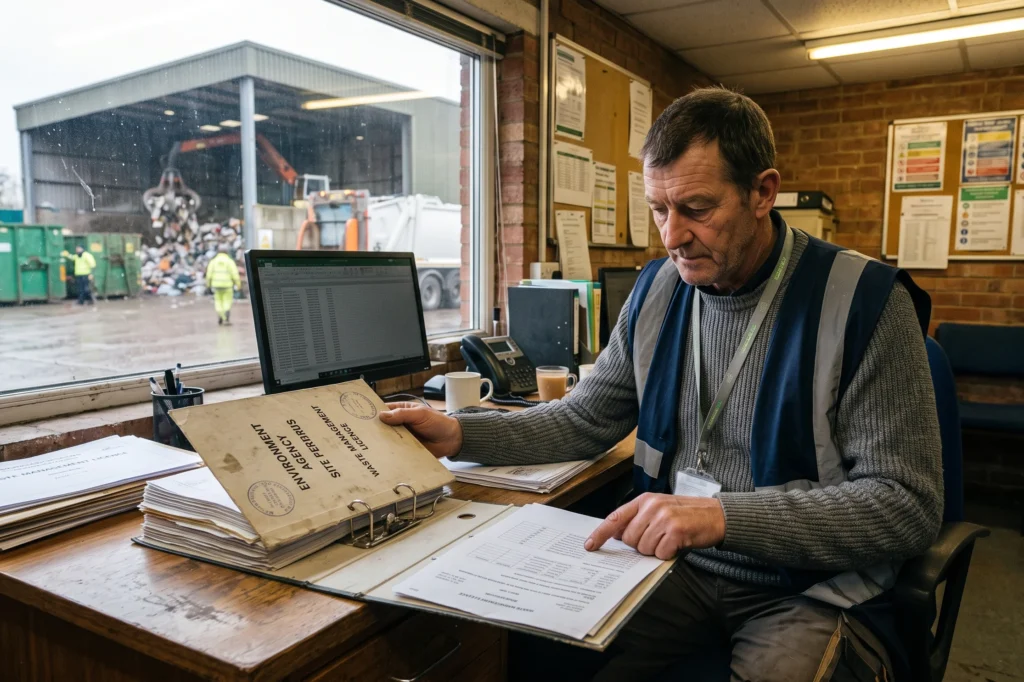
Waste Transfer Station Insurance: Permits and Risk
Securing comprehensive waste transfer station insurance requires a detailed understanding of site permits, material handling risks, and operational compliance. Regulators and insurers assess waste facilities under strict statutory rules. Operational errors directly jeopardise policy coverage. A robust risk transfer strategy protects site assets, limits third-party liabilities, and supports continuity across complex waste streams.
Waste operators face increasing regulatory scrutiny, elevated fire risks, and tightening insurance market capacity across the UK resource management sector. Underwriters scrutinise Environmental Permitting Regulation compliance and site containment controls before offering terms. How can permitted waste facilities build an insurable operational profile while satisfying statutory compliance requirements?
Key Takeaways
- Waste transfer station insurance policies require full compliance with Environmental Permitting Regulations 2016 to ensure claim validity.
- Approved Fire Prevention Plans represent a mandatory baseline for underwriters providing property and business interruption cover.
- Environmental liability insurance protects against gradual contamination and statutory remediation liabilities excluded by standard policies.
- Standard public liability policies usually exclude gradual pollution events, creating critical coverage gaps for waste operations.
- Maintaining rigorous waste transfer notes and consignment tracking preserves licences and supports defensible insurance claim positions.
The Permitted Waste Site Insurance Stack
A robust insurance stack for permitted waste management insurance needs a multi-layered approach across several exposure areas. Standard commercial policies often exclude specific industry hazards. This leaves transfer stations vulnerable to statutory clean-up actions and plant failure losses. Structuring correct indemnity limits protects operators against catastrophic events.
The table below sets out the core cover types a permitted waste transfer station typically carries, the exposure each cover addresses, and the underwriting basis insurers apply. Employers’ and public liability sit alongside environmental liability, property, and engineering breakdown cover. Together they form the minimum insurance stack most brokers recommend for permitted sites.
| Cover Type | Primary Exposure Protected | Typical Underwriting Trigger / Basis |
|---|---|---|
| Employers’ Liability | Workplace injury, airborne particulate exposure, plant accidents | Statutory £5m minimum; £10m market norm under 1969 Act |
| Public Liability | Sudden third-party injury or off-site property damage | £5m to £10m limit; sudden and accidental pollution sub-limits |
| Environmental Liability | Gradual land or water contamination, biodiversity damage, clean-up | Stand-alone policy under 2015 Damage Regulations |
| Property & Business Interruption | Structural fire loss, stock damage, extended operational downtime | Strict compliance with Fire Prevention Plan warranties |
| Engineering Breakdown | Shredder, baler, or conveyor mechanical failure | Statutory LOLER and PSSR inspections and maintenance logs |

Permit Conditions Under the Environmental Permitting Regulations 2016
Permit Parameters and Insurer Underwriting Assessments
The Environmental Permitting (England and Wales) Regulations 2016 form the primary legal foundation for operating a waste transfer station. Regulators such as the Environment Agency set permit conditions covering stack heights, material throughput, and storage durations. Operating outside these parameters breaches statutory law and compromises insurance cover.
Insurers review regulatory compliance closely during underwriting assessments. Unannounced site inspections generate compliance ratings that directly influence premium levels. A breach of permit conditions often triggers policy warranties, potentially voiding indemnity during a loss event.
Waste Transfer Notes and Statutory Duty of Care
Operators must keep detailed waste transfer notes under Section 34 of the Environmental Protection Act 1990. Proper documentation proves the chain of custody for incoming and outgoing loads at every stage. This paperwork protects operators during regulatory audits and third-party contamination claims.
In practice, we find that insurers treat transfer note discipline as a proxy for wider operational control. Gaps in the paper trail slow claims settlement and can weaken an operator’s position when a regulator disputes liability for a specific load.
Fire Prevention Plans and Underwriting Requirements
Fire Prevention Plan Compliance
An approved Fire Prevention Plan serves as a primary underwriting document for waste transfer station insurance. Underwriters inspect stack measurements, separation distances, and continuous thermal monitoring systems. Facilities failing to maintain these physical standards face restricted market capacity, elevated excesses, or refusal of property cover.
Guidance from the Waste Industry Safety and Health Forum, specifically WISH WASTE 28, sets clear operational benchmarks. Automated fire suppression and continuous heat detection reduce catastrophic fire risk across combustible stockpiles.
Lithium-Ion Battery Contamination Controls
Lithium-ion battery contamination is the fastest-growing fire hazard in waste streams entering transfer facilities. Unchecked batteries cause sudden thermal runaway when crushed by heavy machinery or shredders. Insurers increasingly demand robust incoming waste screening and staff training to control this severe ignition source.
Facilities with quarantine zones for damaged batteries demonstrate proactive risk management. Thermal imaging cameras above tipping bays identify hot spots before fires ignite, satisfying stringent underwriter warranties.
Did You Know?
Under Section 34 of the Environmental Protection Act 1990, waste transfer station operators hold a statutory Duty of Care that extends throughout the waste chain. Breaching permit conditions or failing to maintain proper waste transfer notes can result in unlimited fines and immediate permit suspension by the Environment Agency.
Environmental Liability Exposure and Clean-Up Obligations
Statutory Liability for Environmental Harm
Environmental impairment extends well beyond standard property damage into long-term statutory liabilities enforced by regulators. The Environmental Damage (Prevention and Remediation) (England) Regulations 2015 hold operators financially liable for environmental harm regardless of fault. Standard public liability policies apply strict pollution exclusions throughout.
Dedicated environmental liability insurance closes this gap for site operators. From experience across the sector, insurers price this cover against site geology, drainage design, and the volume and type of waste handled on site.
Common Sources of Environmental Damage Claims
Four recurring exposures generate most environmental damage claims at permitted waste sites. Off-site leachate migration can damage local watercourses or adjacent soil structures. Firewater run-off can enter public storm drains during emergency suppression efforts. Gradual airborne particulate emissions can affect neighbouring properties.
Regulators can also issue statutory remediation orders requiring extensive soil excavation and testing. Each of these exposures sits outside standard public liability cover, which is why a stand-alone environmental liability policy remains essential for permitted operators.
Cover Built for Demanding Businesses
Across high risk industries, the cover we arrange most often includes:
Public liability
Employers' liability
Motor fleet
Contractors' all risks
Freight liability
Professional indemnity
Environmental liability
Business interruption
Most businesses need a combination, rather than a single focus policy, and we build cover around your contracts, your workforce and your operational activities.
Employers’ and Public Liability Cover for Waste Operations
Workplace Injury and Employers’ Liability Limits
Employers’ liability cover responds to workplace injury, airborne particulate exposure, and plant accidents on site. UK law sets a statutory minimum of £5 million under the Employers’ Liability (Compulsory Insurance) Act 1969. Most waste operators carry £10 million as the accepted market norm.
Waste transfer sites carry elevated employers’ liability risk because of heavy plant, manual handling, and exposure to airborne dust and fibres. Underwriters look for documented safe systems of work before confirming terms at this higher limit.
Third-Party Injury and Public Liability Exposure
Public liability cover responds to sudden third-party injury or off-site property damage caused by site operations. Limits typically run from £5 million to £10 million, with sub-limits set for sudden and accidental pollution. Gradual pollution always stays outside this cover entirely.
Visitors, neighbouring occupiers, and passing traffic all sit within the scope of public liability exposure. A dropped load, a vehicle collision at the site gate, or a falling stack can each trigger a claim under this policy.
Property, Business Interruption, and Engineering Breakdown Cover
Fixed and Mobile Plant Inspections
Heavy plant such as loading shovels, excavators, balers, and shredders operates under harsh conditions within waste transfer facilities. Underwriters require evidence of regular preventive maintenance alongside statutory inspections under the Lifting Operations and Lifting Equipment Regulations 1998. Failing to maintain mechanical integrity leads to sudden breakdowns.
Engineering breakdown cover typically responds to shredder, baler, or conveyor mechanical failure. Statutory LOLER and PSSR inspection records and maintenance logs form the underwriting basis insurers expect to see before agreeing terms.
Business Interruption Indemnity Periods
Selecting an adequate business interruption indemnity period remains critical for waste transfer station insurance programmes. Rebuilding a destroyed waste facility and obtaining revised environmental permits frequently takes longer than twenty-four months. Shorter periods leave operators exposed during this rebuild window.
Shorter indemnity periods leave operators without revenue protection whilst waiting for regulatory sign-off to resume operations. Property and business interruption cover for permitted sites is tied directly to strict compliance with Fire Prevention Plan warranties.
Hired Plant and Contractual Liability Considerations
Hired-In Plant Insurance Requirements
Standard premises or property insurance usually excludes hired-in plant and machinery unless specific extensions are added. Waste transfer station operators frequently rely on hired excavators or shredders to manage peak throughput. Dedicated hired-in plant insurance covers physical damage, theft, and continuing hire charges.
Continuing hire charges remain payable to the hire company during repairs, even when the equipment sits idle on site. Operators who overlook this extension often discover the gap only after a breakdown claim is declined.
Contractual Liability Under Hire Conditions
Hired excavators and shredders carry contractual liability under Construction Plant-hire Association or similar hire conditions. These conditions set out who bears responsibility for damage, loss, and third-party injury while the equipment remains on hire. Operators should review these terms before signing.
When operating in this area, we find that hire conditions rarely align automatically with an operator’s existing liability programme. A short broker review of the hire agreement before equipment arrives on site avoids uninsured gaps later.
Renewal Positioning and Insurer Risk Assessment
Risk Management Evidence for Underwriters
Securing favourable insurance terms requires presenting a detailed operational risk profile to the commercial market. Insurers reward operators who go beyond basic compliance by evidencing strict inventory controls, separation distances, and thermal monitoring regimes. Documented staff training for hazardous waste streams reinforces underwriter confidence.
Underwriters increasingly ask for this evidence before renewal terms are quoted, not after. Operators who assemble it proactively tend to secure broader cover and fewer restrictive warranties than those who respond only when asked.
Quarterly Risk Reviews and Audit Trails
Quarterly risk reviews help identify emerging hazards before renewal negotiations begin. Maintaining clear audit trails for equipment servicing, fire drills, and permit compliance positions a waste business favourably within a cautious insurance market. Consistent record-keeping shortens the underwriting process at renewal.
Operators who demonstrate strict compliance with permit conditions, implement Fire Prevention Plans, and maintain detailed waste tracking build resilient operational profiles. These profiles attract more competitive waste transfer station insurance terms at each renewal cycle.
Final Thoughts
Maintaining comprehensive waste transfer station insurance requires aligning operational practices with environmental permitting obligations and robust fire risk controls. Operators who demonstrate strict compliance with permit conditions, implement Fire Prevention Plans, and maintain detailed waste tracking build resilient operational profiles that attract competitive insurance terms.
Proactive risk management and continuous oversight of material handling procedures remain essential as environmental regulations and market expectations evolve. Reviewing indemnity structures and containment measures at each renewal cycle keeps a permitted site’s insurance stack aligned with its actual operational risk.
Speak to an Insurance Specialist
Whether you need a new quote, want to discuss your renewal or have a question about an existing policy, our team is here to help.
Frequently Asked Questions
Q: Why do standard public liability policies exclude gradual pollution for waste transfer stations?
A: Standard public liability policies are designed to cover sudden, unintended, and accidental incidents, such as an immediate spill caused by an impact. Gradual pollution, such as long-term leachate seepage or slow chemical contamination into subsoil, develops over extended periods and requires specialised environmental liability insurance. Insurers separate these risks to ensure gradual environmental damage is underwritten with specific site assessments, environmental surveys, and tailored remediation indemnity limits.
Q: How does a Fire Prevention Plan affect waste transfer station insurance applications?
A: An approved Fire Prevention Plan shows insurers that a waste transfer facility has implemented mandatory physical risk controls. Underwriters review stack heights, waste pile separation distances, thermal monitoring systems, and quarantine areas specified within the plan. Compliance with these measures is typically written into policy terms as strict warranties. Operating without an approved plan can lead to declined cover or unpaid property claims.
Q: What legal requirements govern waste carrier and transfer operations in England?
A: Operations in England are governed primarily by the Environmental Permitting (England and Wales) Regulations 2016 and Section 34 of the Environmental Protection Act 1990. Operators must hold a valid Environmental Permit or registered exemption issued by the Environment Agency. Businesses transporting or handling controlled waste must also maintain an Upper Tier Waste Carrier registration and complete waste transfer notes for every load entering or leaving the facility.
Q: What indemnity period is recommended for business interruption cover at a waste site?
A: Most specialist brokers recommend a minimum business interruption indemnity period of 24 to 36 months for permitted waste facilities. Rebuilding a damaged transfer station involves complex site clean-up, structural works, and regulatory re-permitting by environmental authorities, which often exceeds 12 or 18 months. A longer indemnity period ensures the business receives ongoing financial support for lost gross profit and standing charges until full operational throughput returns.
Q: Are hired-in plant and machinery covered automatically under general premises insurance?
A: Standard premises or property insurance policies usually exclude hired-in plant and machinery unless specific extensions are added. Waste transfer station operators frequently rely on hired excavators or shredders, which carry contractual liability under Construction Plant-hire Association or similar hire conditions. Operators must arrange dedicated hired-in plant insurance to cover physical damage, theft, and continuing hire charges payable to the hire company during repairs.
About The Author
Darren Judd
Director, Co-Founder and Co-Owner of Capital Corporate Risks Ltd

Experienced Account Executive with a demonstrated history of working in the insurance industry. Skilled in Account Management, Risk Management, Business Development across all classes of insurance within the Construction Industry,