
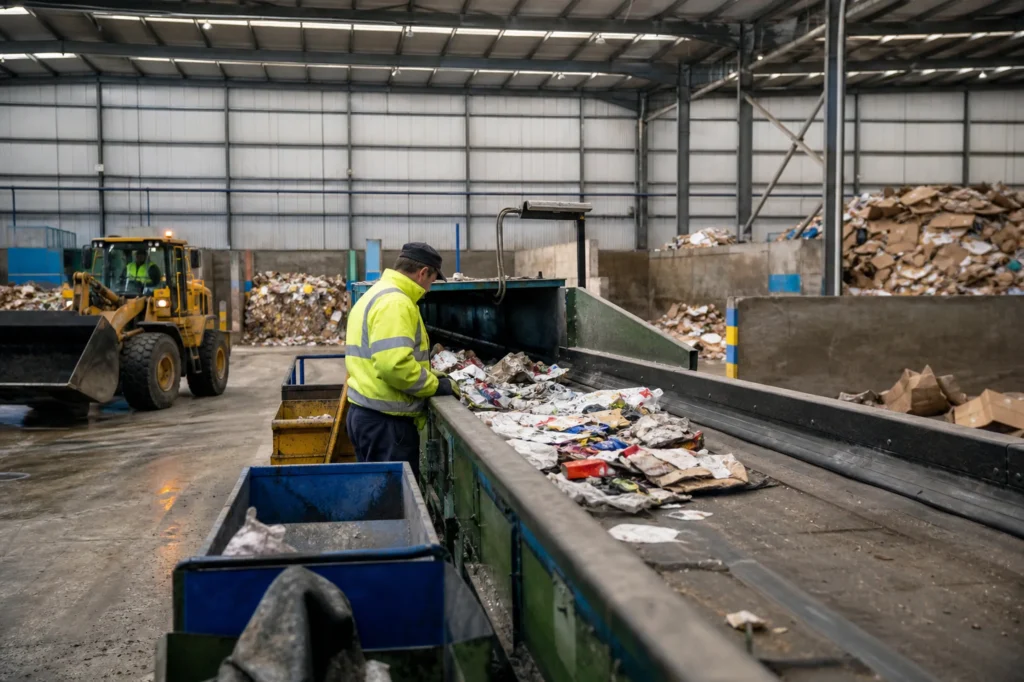
Waste Recycling Insurance UK: Sector Specialism.
Securing comprehensive waste recycling insurance UK operators can rely on has become increasingly complex due to stringent fire regulations and restrictive underwriting standards. Modern resource recovery operations handle diverse feedstock, including combustible materials and volatile lithium-ion batteries. Consequently, insurers scrutinise site management, operational controls, and statutory compliance far more rigorously than ever before. Without robust risk management and expert broker advocacy, recycling businesses face severe capacity caps, escalating premiums, or unworkable policy conditions that threaten ongoing operational viability.
This article outlines how UK waste and recycling facilities can construct robust risk presentations that satisfy strict market demands. We examine how four-nation regulatory frameworks, environmental permits, and active fire prevention strategies influence available policy terms. How can waste processing operations secure essential property, liability, and business interruption cover that truly reflects their daily risk profile?
Key Takeaways
- UK waste management operators must navigate specific environmental permitting regimes enforced separately by environmental regulators across England, Scotland, Wales, and Northern Ireland.
- Combustible material storage standards and Fire Prevention Plans represent the principal factors determining underwriter appetite for UK materials recovery facilities.
- Lithium-ion battery contamination drives a significant proportion of modern waste site fires, requiring strict feedstock screening and thermal imaging protocols.
- Public liability policies typically restrict pollution coverage to sudden and accidental events, necessitating standalone environmental impairment liability insurance for gradual contamination risks.
- Selecting an appropriate business interruption indemnity period remains vital for recycling plant insurance because rebuild permissions and specialised equipment sourcing take considerable time.
Essential Waste Management Regulatory Frameworks and Risk Profiles
Operating a waste or recycling facility in the United Kingdom requires strict adherence to distinct jurisdictional authorities and environmental statutory frameworks. Regulatory bodies enforce environmental permitting conditions to minimise environmental pollution and fire hazards across waste transfer stations and processing plants. Understanding these regulatory structures is fundamental when arranging commercial insurance coverages.
The table below outlines key regulatory regimes across the four UK nations, highlighting primary enforcement bodies, core governing legislation, and critical underwriting considerations. Managing these legal parameters effectively helps operators maintain statutory compliance whilst presenting a favourable risk profile to commercial insurance underwriters.
| Jurisdiction | Regulatory Body | Primary Legislation | Underwriting Significance |
|---|---|---|---|
| England | Environment Agency (EA) | Environmental Permitting Regulations 2016 | Requires strict Fire Prevention Plan adherence and stockpile limits. |
| Scotland | Scottish Environment Protection Agency (SEPA) | Pollution Prevention and Control Regulations 2012 | Enforces site management plans and environmental risk assessments. |
| Wales | Natural Resources Wales (NRW) | Environmental Permitting Regulations 2016 | Mandates clear waste hierarchy compliance and fire risk controls. |
| Northern Ireland | Northern Ireland Environment Agency (DAERA) | Waste Management Licensing Regulations 2003 | Requires robust site containment and consignment documentation. |

Devolved Regulatory Regimes Across UK Jurisdictions
Environmental Enforcement Bodies in England and Wales
The Environment Agency in England and Natural Resources Wales enforce environmental standards under the Environmental Permitting Regulations 2016. These regulatory bodies oversee site authorisations, conduct routine operational inspections, and mandate strict compliance with approved Fire Prevention Plans. Failure to satisfy statutory requirements can result in immediate permit suspension, stopping site operations.
Underwriters evaluate whether site operators maintain clean compliance records with their respective regulatory authority. Enforcement notices or regulatory breaches signal heightened risk, which directly affects available policy terms and premium rates. Insurers demand evidence that site operations strictly align with environmental permit conditions before granting liability or property cover.
Devolved Governance in Scotland and Northern Ireland
The Scottish Environment Protection Agency and Northern Ireland Environment Agency govern waste operations under separate devolved legislative frameworks. SEPA regulates sites using the Pollution Prevention and Control Regulations 2012, whereas DAERA enforces the Waste Management Licensing Regulations 2003. Both authorities enforce strict environmental containment guidelines and carrier duty of care obligations.
Insurance markets require waste businesses operating across multiple UK jurisdictions to demonstrate compliance with each local regulator. Carriers operating under the Environmental Protection Act 1990 must hold Upper Tier registration when collecting controlled waste. Underwriters review waste transfer notes and consignment documentation to verify that material movements comply with local statutory standards.
Environmental Permitting Regulations and Compliance Standards
Statutory Permitting Requirements for Waste Facilities
The Environmental Permitting Regulations 2016 require waste processing plants and transfer stations to hold valid operational permits. Permits mandate strict controls regarding acceptable waste types, maximum storage volumes, and environmental mitigation measures. Operating outside permit parameters breaches statutory law, automatically invalidating standard commercial property and liability insurance policies.
Underwriters mandate that policyholders maintain full permit compliance as an express condition precedent to cover. Insurers frequently perform risk site surveys to ensure actual processing volumes and material types match permitted limits. Should an unpermitted activity cause a loss, insurers can decline indemnification, leaving the operator exposed to severe financial loss.
Hazardous Waste Handling and Documentation Protocols
Operators handling dangerous materials must adhere strictly to the Hazardous Waste Regulations 2005 across their supply chain. Facilities must maintain detailed consignment notes recording waste movement from origin to final disposal site. Commercial insurers evaluate consignment procedures during underwriting to ensure hazardous material handling meets required statutory standards.
Inadequate tracking of hazardous substances elevates environmental liability risks, particularly regarding accidental spillage or illegal dumping. Proper waste documentation serves as evidence of due diligence if statutory investigation occurs. Robust chain of custody controls reassure insurers, enabling broader cover terms and reduced policy deductibles.
Did You Know?
Under the Environmental Permitting Regulations 2016, operating a regulated waste activity without or in breach of an environmental permit is a strict liability criminal offence that can lead to unlimited financial fines or up to five years’ imprisonment.
Fire Risk Management in Waste Processing Facilities
Fire Prevention Plans and Waste Industry Safety Guidance
Fire Prevention Plans established under Environment Agency guidance set strict operational boundaries for combustible waste storage. Facilities must observe defined stockpile dimensions, minimum separation distances, and maximum retention times to limit fire spread. Adherence to WISH WASTE 28 standards represents a baseline requirement for securing commercial property cover.
Insurers enforce strict policy warranties reflecting these guidance documents, requiring physical separation bays and automated suppression systems. Breaching stack height restrictions or bay capacity limits can breach policy terms, invalidating fire coverage entirely. Maintaining comprehensive site logs and thermal monitoring records provides essential evidence during post-loss investigations.
Lithium-Ion Battery Contamination Hazards
Lithium-ion battery contamination in general waste streams poses an unprecedented fire hazard for modern materials recovery facilities. Unintentional crushing during sorting releases volatile thermal runaway events that ignite surrounding combustible stock instantly. Insurers require processing plants to implement active screening, thermal imaging, and continuous site surveillance protocols.
Underwriters increasingly attach battery exclusions or specific fire warranties to commercial policies. Installing infrared camera networks that detect hot spots before open flaming occurs significantly enhances market placement options. Demonstrating rigorous inbound waste inspection procedures reassures underwriters that battery ignition risks are actively mitigated.
Cover Built for Demanding Businesses
Across high risk industries, the cover we arrange most often includes:
Public liability
Employers' liability
Motor fleet
Contractors' all risks
Freight liability
Professional indemnity
Environmental liability
Business interruption
Most businesses need a combination, rather than a single focus policy, and we build cover around your contracts, your workforce and your operational activities.
Essential Insurance Coverages for Waste and Recycling Sites
Core Public and Employers’ Liability Coverages
Waste processing operations require robust public and employers’ liability insurance to cover operational third-party and workplace hazards. The Employers’ Liability (Compulsory Insurance) Act 1969 mandates minimum cover for employee injuries. Public liability responds to third-party injury and property damage, with market norms requiring five or ten million pounds indemnity.
Employers’ liability claims within waste facilities frequently involve heavy machinery, manual handling, or dust exposure. Underwriters examine Health and Safety at Work etc. Act 1974 compliance alongside operational training records. Ensuring comprehensive risk assessment protocols protects workforce welfare and maintains favourable policy rating structures.
Commercial Property and Stock Insurance Placement
Protecting physical infrastructure, processing machinery, and stored materials requires tailored commercial property insurance schedules. Standard policies cover buildings, fixed machinery, and stored stock against major perils like fire, storm, and impact damage. Underwriters set specific stock pile limits and clearance conditions to manage overall property loss exposures effectively.
Valuation of recyclables can fluctuate significantly based on commodity market shifts. Insurers require declared stock values to accurately reflect peak storage capacity rather than average volumes. Failing to declare adequate sums insured risks the application of average clauses, reducing claim payouts proportionately following a total loss.
Environmental Impairment Liability and Pollution Protections
Limitations of Standard Public Liability Pollution Endorsements
Standard public liability insurance policies typically limit pollution cover to sudden, identifiable, unintended, and accidental incidents. Standard extensions exclude gradual environmental contamination, leachate seepage, and historic ground pollution entirely. Relying solely on public liability leaves waste operations severely exposed to substantial statutory environmental remediation liabilities.
Under the Environmental Protection Act 1990 Part IIA, site owners and operators bear strict legal accountability for contamination clean-up. A minor spill or gradual leachate leak migrating off-site can trigger catastrophic remediation orders. Standard commercial combined policies fail to address these complex environmental statutory liabilities.
Comprehensive Environmental Impairment Liability Coverage
Standalone environmental impairment liability policies provide vital coverage for both sudden and gradual pollution occurrences. These specialist contracts cover mandatory on-site clean-up expenses, off-site environmental remediation costs, legal defence fees, and biodiversity damage statutory obligations. Coverage ensures full protection under the Environmental Damage Prevention and Remediation Regulations 2015.
Environmental impairment liability wording incorporates retroactive dates to cover undetected historic pollution emerging during the active policy term. Broker guidance ensures site baseline surveys and environmental monitoring reports are submitted correctly to underwriter teams. Structuring cover on a claims-made basis secures comprehensive legal protection against third-party statutory claims.
Underwriting Criteria for Recycling Plant Machinery
Engineering Breakdown and Statutory Inspection Obligations
Heavy machinery including shredders, balers, and mechanical screeners requires dedicated engineering breakdown cover. Standard property insurance excludes internal mechanical or electrical breakdown losses caused by operational wear or sudden jams. Furthermore, operators must complete statutory engineering inspections under LOLER 1998 and PSSR 2000 regulations on a regular basis.
Lifting equipment and pressure vessels present severe operational failure hazards if unmaintained. Approved engineering inspections ensure compliance with the Provision and Use of Work Equipment Regulations 1998 (PUWER). Combining statutory inspections with breakdown insurance maintains operational continuity and satisfies compulsory health and safety requirements.
Mobile Plant and Machinery Protections
Mobile equipment like loading shovels, telehandlers, and excavators requires specialised plant cover across working yards. Policies protect owned and hired-in plant against accidental damage, overturning, fire, and malicious theft. Insurers enforce strict site security conditions, including perimeter fencing, immobilisers, and approved tracking devices on high-value machinery.
Hired-in plant policies must account for continuing hire charges owed to plant hire firms during repairs. Standard hire terms under CPA or HAE conditions transfer full responsibility for machinery damage to the hirer. Brokers structure policy limits to ensure both physical plant replacement and ongoing hire charges are fully indemnified.
Business Interruption and Valuation Strategies
Appropriate Indemnity Periods for Site Recovery
Waste processing facilities face extended recovery timelines following major loss events like site fires. Replacing specialised recycling machinery, obtaining revised environmental permits, and rebuilding infrastructure frequently exceeds twelve months. Business interruption insurance requires indemnity periods of twenty-four to thirty-six months to ensure full long-term operational business recovery.
Selecting an inadequate twelve-month indemnity period represents a major vulnerability for materials recovery facilities. Regulatory re-permitting alone by the Environment Agency or SEPA following a major incident can take over a year. Extended indemnity periods protect gross profit margins and ongoing fixed costs throughout complex reinstatement processes.
Accurate Sums Insured and Gross Profit Calculations
Calculating gross profit for insurance purposes differs fundamentally from standard accounting definitions. Business interruption schedules must declare gross profit without deducting payroll or utility expenses unless specifically agreed. Underdeclaring sums insured triggers average clauses, reducing claim payouts in proportion to the underinsurance percentage during loss settlement.
Additional cost of working extensions provide crucial financial support for hiring temporary processing machinery or diverting waste to alternative sites. Maintaining operational continuity protects commercial contracts and customer relationships whilst main site repairs progress. Specialist broker guidance ensures declaration calculations account for business growth and market volatility.
Final Thoughts
Navigating the complexities of waste recycling insurance UK requires detailed operational planning, rigorous regulatory compliance, and active fire prevention management. Facilities that align their daily operating procedures with environmental permit obligations and industry safety guidelines maintain far superior positioning when negotiating policy terms. Comprehensive coverage schedules protecting property, machinery, liabilities, and business interruption ensure long-term resilience against catastrophic loss events.
As regulatory scrutiny intensifies and market capacity shifts, waste management operators must continuously audit their site risks and policy conditions. Implementing proactive risk control measures, maintaining thorough documentation, and reviewing indemnity limits regularly empowers processing facilities to secure stable commercial protection. Proactive risk management remains the single most effective strategy for safeguarding resource recovery operations across the United Kingdom.
Speak to an Insurance Specialist
Whether you need a new quote, want to discuss your renewal or have a question about an existing policy, our team is here to help.
Frequently Asked Questions
Q: What regulatory bodies govern waste facilities in the UK?
A: Waste facilities in the United Kingdom are regulated under devolved environmental regimes across the four nations. In England, the Environment Agency oversees site operations, whereas Natural Resources Wales manages Welsh sites under the Environmental Permitting Regulations 2016. In Scotland, the Scottish Environment Protection Agency regulates operations under the Pollution Prevention and Control Regulations 2012. Northern Ireland sites fall under the Northern Ireland Environment Agency within DAERA under the Waste Management Licensing Regulations 2003. Operators must maintain strict compliance with their respective authority to avoid permit suspension and preserve insurance validity.
Q: Why are fire prevention plans critical for recycling insurance?
A: Fire Prevention Plans set strict statutory operational boundaries for storing combustible materials, defining maximum stockpile sizes, separation distances, and storage durations. Insurers view Fire Prevention Plan compliance as a fundamental baseline when assessing site insurability. Failing to adhere to approved plans or WISH WASTE 28 guidance can lead to regulatory enforcement action and policy warranty breaches. Where a fire occurs on a non-compliant site, underwriters may decline claims or void property coverage entirely, making strict adherence essential for financial protection.
Q: How does public liability differ from environmental impairment liability?
A: Standard public liability policies usually cover third-party personal injury or property damage resulting from sudden, accidental pollution events. However, public liability standard extensions explicitly exclude gradual contamination, leachate seepage, historic ground pollution, and statutory clean-up orders. Standalone environmental impairment liability policies fill this critical gap by covering both sudden and gradual pollution, on-site and off-site remediation costs, legal defence fees, and statutory obligations under the Environmental Damage Prevention and Remediation Regulations 2015.
Q: What business interruption indemnity period should recycling plants choose?
A: Recycling plants should typically select a business interruption indemnity period of twenty-four to thirty-six months. Major loss events such as site fires involve lengthy recovery timelines due to site decontamination, specialised machinery procurement, and complex rebuilding works. Furthermore, obtaining revised environmental permits from regulatory bodies like the Environment Agency or SEPA can easily take over twelve months. A twelve-month indemnity period is usually insufficient, leaving operations financially exposed before normal processing capacity and revenue streams are fully restored.
Q: Are lithium-ion battery fires covered under standard property insurance?
A: Whilst standard commercial property policies cover fire damage, underwriters frequently attach specific warranties, exclusions, or higher deductibles regarding lithium-ion battery hazards. Because battery contamination in general waste streams causes severe thermal runaway fires, insurers demand proof of active risk mitigation. Facilities must demonstrate robust feedstock screening, automated thermal imaging monitoring, and designated quarantine procedures to secure full fire coverage. Failing to meet insurer-mandated battery management warranties can invalidate coverage if a battery-related fire occurs.
About The Author
Darren Judd
Director, Co-Founder and Co-Owner of Capital Corporate Risks Ltd

Experienced Account Executive with a demonstrated history of working in the insurance industry. Skilled in Account Management, Risk Management, Business Development across all classes of insurance within the Construction Industry,