
Waste Management Insurance: A UK Sector Guide
Effective waste management insurance sits on top of complex statutory duties, severe fire exposures and highly varied site operations. Your business may run domestic skip hire. It may operate a materials recovery facility. It may haul hazardous industrial residues. Underwriters price each activity differently. Standard commercial policies rarely respond to gradual pollution or catastrophic material fires. Matching policy structure to actual yard activity protects capital and keeps the business trading after a loss.
Operating without targeted protection leaves transfer stations, reprocessors and hauliers exposed. Clean-up costs, statutory fines and unrecoverable property losses all follow quickly. So how should a modern waste site operator structure an insurance programme that survives regulatory scrutiny whilst satisfying insurer demands on risk control?
Key Takeaways
- Waste operators face distinct liabilities depending on whether activities involve collection, transfer, sorting, treatment, reprocessing, or final landfill disposal.
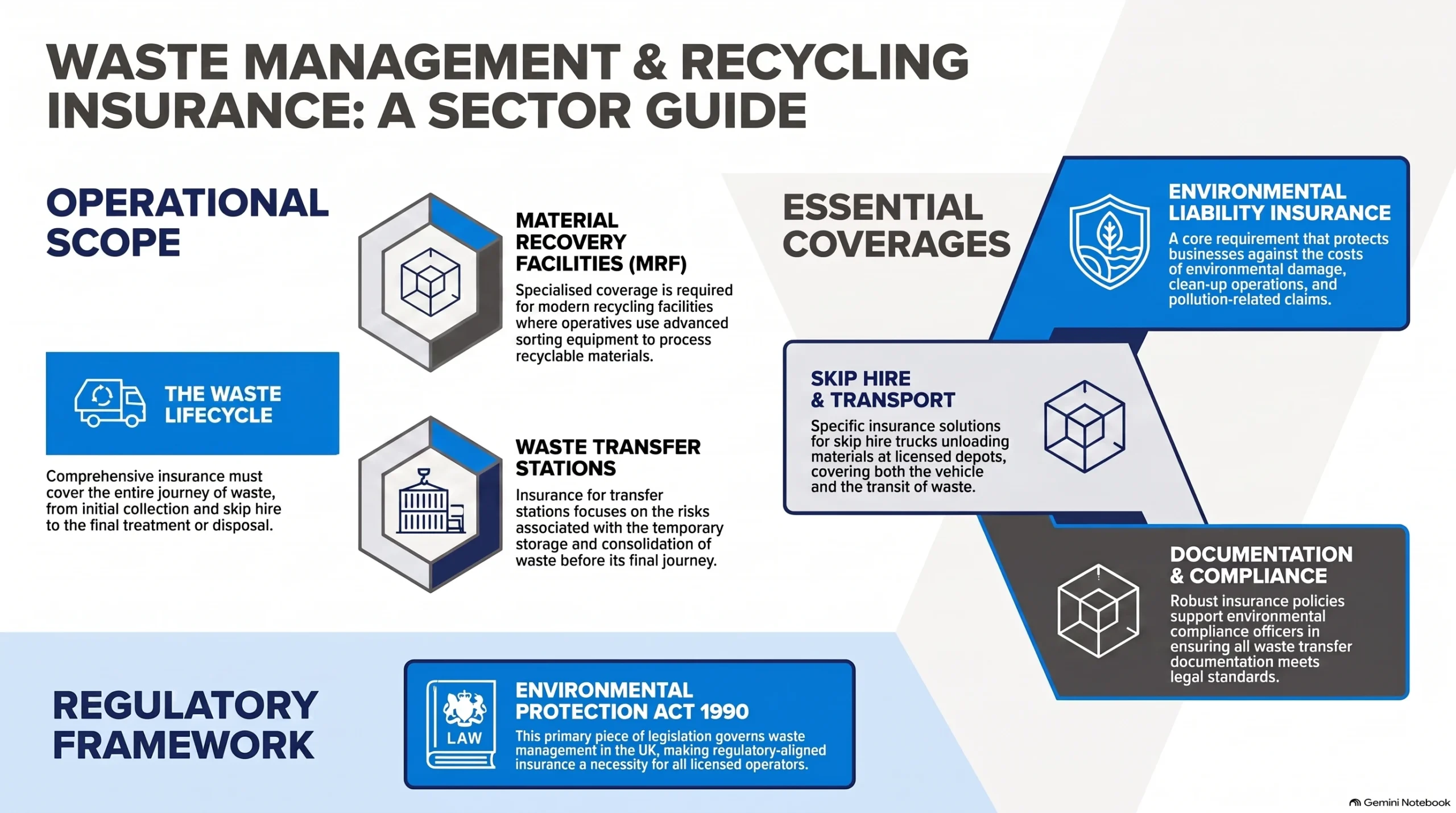
- Section 34 of the Environmental Protection Act 1990 establishes a statutory Duty of Care requiring documented waste tracking across the complete chain.
- Fire remains the primary driver of market capacity restrictions, requiring strict adherence to Waste Industry Safety and Health Forum guidelines on site.
- Standard public liability policies typically restrict pollution cover to sudden events, making dedicated environmental liability insurance essential for gradual contamination exposures.
- Business interruption indemnity periods must reflect the extensive timeframe required to clear contaminated sites, secure fresh permits, and rebuild destroyed processing infrastructure.
Operational Profile Risk Comparison Matrix
Insurers categorise waste operations by activity, not by company name. Every stage of the chain carries its own physical exposures and liability triggers. Those differences drive underwriting appetite, excess levels and warranty wording. In practice, we find that operators holding several permits often buy cover suited to only one of them.
The matrix below sets out the core hazard drivers and the policy sections that respond to them. It also flags the underwriting requirements attached to each activity type across the resource recovery sector. Comparing your own operations against these categories is the fastest way to expose indemnity gaps before renewal.
| Activity Type | Primary Hazard Drivers | Essential Policy Considerations |
|---|---|---|
| Waste Collection and Skip Hire | Road traffic accidents, third-party property damage, highway obstruction | Motor fleet, public liability with unhooking clauses, container third-party risks |
| Waste Transfer Stations (WTS) | Combustible stock accumulation, dust, vehicle movements, leachate runoff | Fire prevention warranties, high excess structures, environmental liability |
| Materials Recovery Facilities (MRF) | Lithium battery fires, high-value machinery breakdown, dust explosion | Engineering breakdown, thermal imaging requirements, extended BI periods |
| Hazardous Waste Treatment | Acute chemical spills, soil contamination, toxic fume emissions, worker exposure | Environmental impairment liability, specialised ADR transport cover |
| Landfill and Final Disposal | Leachate migration, landfill gas, long-tail ground contamination | Aftercare liabilities, financial provision, gradual pollution cover |
Operational Classification and Risk Profiles
Collection and skip hire exposures
Collection operators carry heavy public liability and fleet risk. Vehicles work on public highways and on private commercial premises every day. Dropped containers, highway spillage and cracked driveways make up the bulk of routine claims. Underwriters examine driver vetting, vehicle safety technology and container maintenance before settling terms.
Beyond vehicle risk, collection businesses must check how loading incidents are treated. Motor policies cover transit. Loading onto private ground often falls to public liability instead. Where the two policies do not meet cleanly, a gap opens. That gap tends to surface only after a disputed claim.
Transfer station and MRF risk profiles
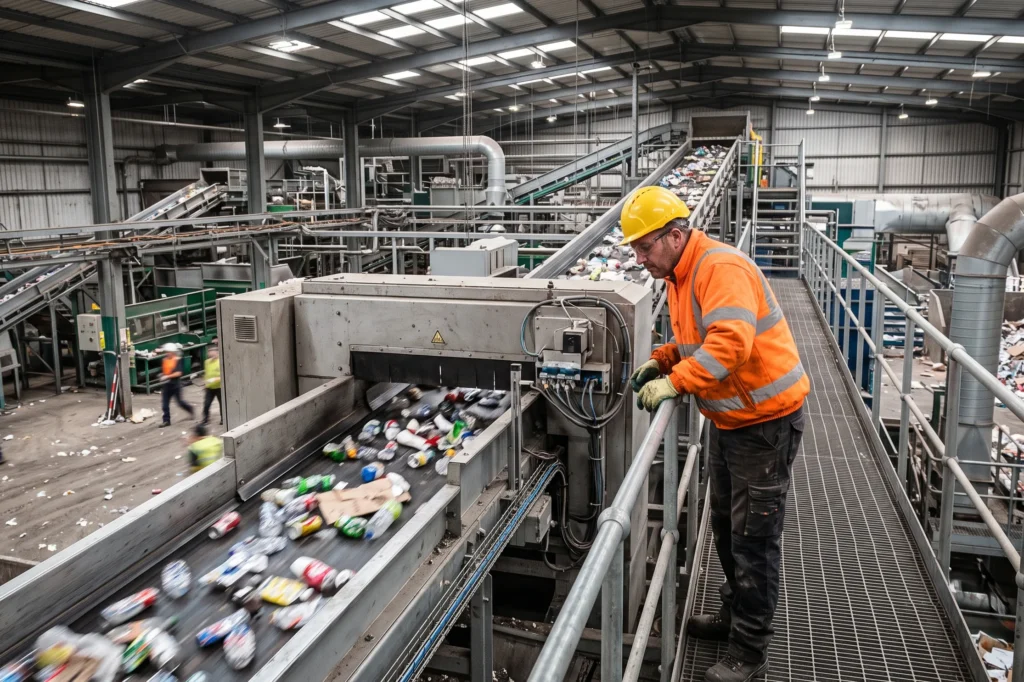
Transfer stations and materials recovery facilities concentrate risk into a small footprint. Large volumes of sorted material sit under one roof. Mechanised sorting lines, shredders and balers add serious breakdown exposure. Fire risk runs alongside it. Underwriters check pile dimensions, separation distances and site security before quoting buildings or contents cover.
Property insurers treat mixed waste processing as a high-hazard trade. Paper, cardboard, plastics and refuse-derived fuel create a continuous fire load. Policies therefore carry firm site warranties. These usually govern pile management, indoor storage durations and daily housekeeping checks.
Statutory Duties Under the Environmental Protection Act 1990
Duty of Care compliance across the waste chain
Section 34 of the Environmental Protection Act 1990 imposes a strict Duty of Care. It binds anyone producing, carrying, treating or disposing of controlled waste. Waste may pass only to an authorised person. Fully completed transfer notes must be retained. Breach can compromise liability cover and trigger regulatory penalties.
The framework also requires operators to check downstream reprocessors. Each must hold a valid environmental permit. If waste reaches an illegal site, the original holder may still face clean-up costs. Insurers expect full regulatory compliance. Deliberate breaches of statutory duty usually void third-party indemnity.
Carrier registration and consignment record obligations
Commercial hauliers must hold valid upper-tier waste carrier registration with their environmental regulator. Hazardous loads bring further duties under the Hazardous Waste Regulations 2005. Every movement needs a detailed consignment note. Insurers read compliance history closely. It remains one of the clearest indicators of operational discipline.
Lapsed registration or inaccurate consignment records invalidate standard transport and liability protections. Regulators audit this paperwork rigorously. Missing documentation after a spill can lead to criminal prosecution. The insurance claim is frequently declined at the same time.
Did You Know?
Under Section 34 of the Environmental Protection Act 1990, waste producers and handlers hold a non-delegable Duty of Care. Written waste transfer notes for non-hazardous waste must be retained for at least two years. Hazardous waste consignment notes must be kept for three years.
Fire Prevention and Insurability Challenges
Fire Prevention Plans and WISH guidance alignment
Fire causes the largest losses in the recycling sector by a wide margin. Underwriters have responded by demanding rigorous controls. Permitted sites in England must hold an approved Fire Prevention Plan. It must follow Environment Agency guidance and WISH Forum standards. Documented compliance now decides whether property cover is available at all.
WISH guidance, specifically WISH WASTE 28, sets out best practice for combustible waste storage. Insurers routinely convert those recommendations into binding policy warranties. Typical conditions cover maximum bay sizes, quarantine areas, automated thermal detection and monitored fire alarms.
Contamination controls for lithium-ion batteries
Lithium-ion batteries now appear throughout municipal and commercial waste streams. Thermal ignition incidents at sorting facilities have risen sharply as a result. A hidden battery crushed during processing can ignite surrounding material within seconds. Underwriters increasingly demand screening protocols, operative training and specialised suppression equipment before placing high-hazard processing risks.
Battery detection technology at receiving hoppers cuts fire frequency. Manual sorting lines should extract electrical items before mechanical shredding. From experience across the sector, evidence of robust battery isolation helps preserve policy limits. It also keeps fire excesses on plant and buildings within a workable range.
Cover Built for Demanding Businesses
Across high risk industries, the cover we arrange most often includes:
Public liability
Employers' liability
Motor fleet
Contractors' all risks
Freight liability
Professional indemnity
Environmental liability
Business interruption
Most businesses need a combination, rather than a single focus policy, and we build cover around your contracts, your workforce and your operational activities.
Core Liability Cover Structures
Public and employers’ liability requirements
Waste operations need substantial public liability cover alongside compulsory employers’ liability. The first protects against third-party injury and property damage. The second is statutory under the Employers’ Liability (Compulsory Insurance) Act 1969. Heavy machinery and manual handling dominate the risk. Underwriters assess site safety standards, operative training and protective equipment protocols.
Public liability limits for waste operations often start at £5 million. Municipal and commercial contracts routinely demand £10 million or more. Combined liability policies simplify administration. They also keep third-party damage and employee injury risks on consistent terms, which closes gaps between separate contracts.
Environmental liability insurance against standard PL endorsements
Standard public liability wordings restrict pollution cover to sudden, identifiable and unintended incidents. Gradual contamination falls outside. A complete waste and recycling insurance programme therefore needs dedicated environmental liability insurance. That cover responds to gradual seepage, land remediation and statutory clean-up orders under the Environmental Damage Regulations 2015.
Regulators can compel remediation of historical or operational contamination regardless of fault. Standalone environmental policies answer orders from the Environment Agency, SEPA and local authorities. They meet on-site clean-up costs. They also fund off-site third-party claims that sit outside a general liability contract.
Property, Machinery, and Business Interruption
Material damage cover for fixed plant and mobile assets
Recycling sites depend on high-value processing machinery. Trommels, optical sorters, balers and loading shovels all carry significant replacement values. Property and engineering policies protect them against accidental damage, fire, impact and mechanical breakdown. Insurers expect statutory inspections under PUWER and LOLER to remain current throughout the policy year.
Plant breakdown insurance fills a specific gap. Standard property cover excludes internal mechanical failure. Adding breakdown protection means electric motor burnouts and hydraulic pump failures are repaired quickly. Operational budgets absorb far less disruption as a result.
Indemnity periods for business interruption claims
Business interruption insurance restores lost gross profit after an insured fire or property loss. It also meets ongoing operating costs. Waste sites face long planning timescales, permit re-issuance and extended equipment lead times. A standard twelve-month indemnity period is dangerously short here. Most operators need twenty-four to thirty-six months.
Clearing a contaminated site after a major fire is slow work. Hazardous waste removal, soil testing and regulatory sign-off all come first. Rebuilding starts only afterwards. Short indemnity periods expire well before the replacement facility reaches full capacity, leaving owners financially exposed.
Motor Fleet and Transport Insurance
Operator licensing and fleet policy arrangements
Hauliers running vehicles above 3.5 tonnes gross weight need a valid Operator’s Licence. The requirement sits in the Goods Vehicles (Licensing of Operators) Act 1995. Motor fleet policies cover hook loaders, skip vehicles and tippers. Premiums track DVSA compliance scores, driver hours management and telematics adoption closely.
Fleet underwriters study claims history and maintenance schedules in detail. Membership of FORS or DVSA Harned Recognition signals high operational standards. That evidence supports competitive premiums. It also makes flexible any-driver policy structures far easier to secure.
Environmental spillages during waste transit
Accidents involving waste transporters create immediate environmental hazards. Fuel, hydraulic fluid or liquid loads can reach highways and watercourses within minutes. Standard motor policies cover third-party vehicle damage. They frequently sub-limit environmental clean-up costs, so transit extensions matter for operators carrying liquid or hazardous wastes.
When a tipper or tanker overturns, highway agencies and environmental bodies act fast. They contain the pollutants and bill the vehicle owner directly. Dedicated transit clean-up endorsements reimburse emergency response teams. They also fund specialised remediation contractors immediately after the incident.
Underwriting Expectations and Risk Presentation
Operational documentation required by insurers
A waste risk presented without documentation will attract poor terms. Underwriters want proof of proactive control across every operational area. Broking submissions should carry current site permits, approved Fire Prevention Plans and health and safety risk assessments. Trade effluent consents, training logs and five years of claims history complete the file.
Incomplete submissions produce restricted terms or declined quotes. Clear evidence of staff training and daily equipment inspections changes that picture. So does documented pest control. Together they show underwriters a business that manages exposure systematically, which earns better pricing and broader cover.
Policy warranties and ongoing condition management
Waste policies carry strict conditions and warranties. Each must hold continuously for claims to be paid. Common warranties govern pile dimensions, clear perimeter boundaries, hot work permits, thermal imaging routines and overnight gate security. A single breach can allow underwriters to reject liability after a major loss.
Daily operational checklists are the practical answer. Suppose a policy requires a six-metre clear space around combustible stockpiles. Yard supervisors must hold that boundary at all times. Recording each check builds a verifiable audit trail, which becomes decisive evidence when a claim is investigated.
Final Thoughts
An effective waste management insurance programme balances statutory compliance with targeted risk transfer. Skip hire fleets, municipal transfer stations and complex recovery facilities all demand different wordings. Policy terms must track actual yard operations. That alignment protects the balance sheet against fire loss, liability claims and regulatory clean-up enforcement.
Environmental regulation continues to tighten. Processing technology keeps changing. Operators should review risk protocols and policy warranties on a fixed schedule rather than at renewal alone. Rigorous site standards and regular cover reviews keep a waste business resilient, compliant and insurable in a restricted market.
Speak to an Insurance Specialist
Whether you need a new quote, want to discuss your renewal or have a question about an existing policy, our team is here to help.
Frequently Asked Questions
Q: Why do standard public liability policies fail to protect waste management operations adequately?
A: Standard public liability wordings carry restrictive pollution exclusions. They respond only to sudden and accidental events, so gradual contamination is left uninsured. These policies also lack terms built for waste operations. Cover for dropped skip loads is often absent. Hot work warranties are rarely tailored to yard conditions. Statutory clean-up liabilities enforced under the Environmental Damage Regulations 2015 usually fall outside the contract entirely. A dedicated environmental section closes those gaps and should be arranged alongside the main liability programme.
Q: What is the significance of a Fire Prevention Plan for site insurability?
A: A Fire Prevention Plan is a regulatory requirement for permitted waste sites in England. It has also become the cornerstone of property insurance placement. Insurers examine the plan to verify stack sizes, separation distances, quarantine areas and thermal monitoring systems. Evidence of strict day-to-day compliance reassures underwriters that the written plan reflects reality on site. Operators who can demonstrate this consistently find it far easier to secure property and business interruption cover in a market with restricted capacity.
Q: How does the Duty of Care under the Environmental Protection Act 1990 affect policy claims?
A: Section 34 requires waste handlers to transfer waste only to authorised parties, supported by proper documentation. A breach of that statutory duty carries insurance consequences as well as regulatory ones. Transferring waste to an unlicensed site is a clear example. Insurers may treat the breach as non-compliance with policy conditions. Indemnity for any resulting pollution claim or clean-up order can then be jeopardised. Accurate transfer notes and permit checks therefore protect both regulatory standing and claims position.
Q: Why are extended business interruption indemnity periods necessary for recycling facilities?
A: Rebuilding a transfer station or reprocessing plant after a major fire is rarely quick. Site decontamination comes first. Environmental permitting follows, often with public consultation attached. Specialised sorting machinery then carries long procurement lead times. A standard twelve-month indemnity period frequently expires before operations restart, which leaves the business funding its own recovery. Twenty-four to thirty-six months is the realistic range for full financial recovery, and underwriters generally accept the reasoning behind it.
Q: What steps can operators take to manage growing lithium-ion battery fire risks?
A: Start with strict waste acceptance screening at the weighbridge and tipping floor. Add dedicated manual sorting lines that isolate waste electrical equipment before it reaches mechanical processing. Thermal imaging cameras above storage bays give early warning of a developing hot spot. Operative training matters just as much as equipment, because staff spot damaged batteries first. Presenting evidence of these controls to insurers helps hold policy excesses at a reasonable level and keeps cover available at renewal.
About The Author
Darren Judd
Director, Co-Founder and Co-Owner of Capital Corporate Risks Ltd

Experienced Account Executive with a demonstrated history of working in the insurance industry. Skilled in Account Management, Risk Management, Business Development across all classes of insurance within the Construction Industry,