
Logistics Insurance: Movement and Storage Cover
Logistics insurance provides essential commercial protection for UK transport operators, warehouse owners, and freight forwarders managing modern supply chains. Transit and storage networks carry severe material risks. Cargo theft, racking collapses, and contractual liabilities under trade association terms all threaten the balance sheet. Without robust cover, one incident can halt haulage fleets and destroy stored inventory. Comprehensive cover supports operational continuity across every stage of movement and distribution.
Contractual liability regimes and complex storage requirements frequently create dangerous gaps between statutory protections and actual commercial exposure. Freight forwarders and third-party logistics providers must balance regulatory duties, transit conventions, and property risks across multiple premises. How can logistics businesses construct an effective insurance structure that protects physical assets, managed goods, and contractual commitments simultaneously?
Key Takeaways
- Logistics insurance structures must combine public liability, employers liability, goods in transit, motor fleet, and professional indemnity into one coordinated commercial programme.
- Standard trading conditions from industry bodies establish specific monetary liability limits per tonne for physical cargo loss during storage and transit.
- Warehouse property policies require strict compliance with racking maintenance standards, sprinkler maintenance schedules, and clear stock valuation frameworks.
- Freight forwarders face distinct legal exposures from customs documentation errors, requiring dedicated professional indemnity cover alongside traditional liability policies.
- Business interruption insurance protects gross profit levels when property damage halts distribution operations or damages mission-critical warehouse infrastructure.
Essential Policy Layers for Logistics Operators
Modern supply chains require multi-layered policy frameworks to address diverse operational risks across static sites and active transit routes. Structuring appropriate indemnity limits prevents severe underinsurance across physical property, third-party goods, and third-party liabilities. The table below outlines the core policy layers required for full operational protection.
Each policy component targets specific financial exposures encountered during material storage, freight movement, and administrative handling. Operators must evaluate their risk profile against statutory duties and trade association conditions. Client contract demands then dictate the limits selected. Reviewing these key policy layers ensures clear coverage across all operations.
| Policy Layer | Primary Exposure Covered | Standard Market Limits |
|---|---|---|
| Employers Liability | Injury or illness sustained by staff under the Employers Liability (Compulsory Insurance) Act 1969 | £10m per occurrence |
| Public Liability | Third-party injury or property damage caused during site or transit operations | £5m to £10m per occurrence |
| Goods in Transit | Loss, theft, or damage to cargo in transit under RHA or CMR conditions | Vehicle and load specific limits |
| Warehouse Property & Stock | Damage to owned buildings, handling equipment, and client goods held in trust | Reinstatement and indemnity values |
| Freight Forwarders PI | Financial loss caused by documentation errors, duty errors, or missed routing schedules | £1m to £5m indemnity limits |
| Motor Fleet Insurance | Third-party damage and vehicle loss required under the Road Traffic Act 1988 | Unlimited injury, £1.2m property minimum |
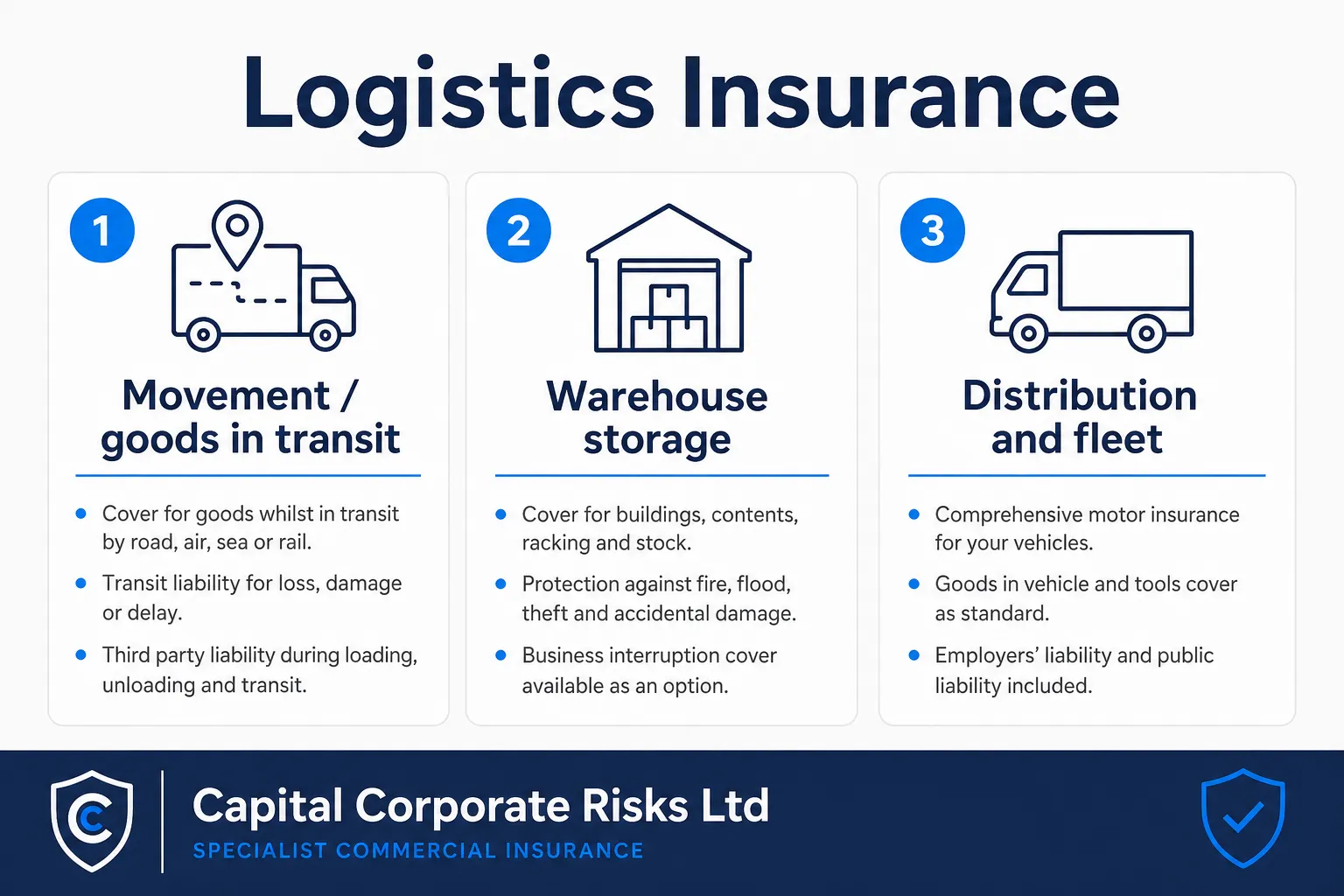
Core Protection for Supply Chain Operations
Employers and Public Liability Baseline
Employers liability is compulsory under the Employers Liability (Compulsory Insurance) Act 1969 for logistics firms employing staff. Public liability covers third-party injury and property damage resulting from distribution operations. Together, these policies protect firms against substantial legal compensation claims and defence expenses arising from workplace accidents.
Third-party logistics providers handle heavy machinery, fork-truck traffic, and intensive vehicle movements daily. Site visitors, sub-contract drivers, and client representatives face potential injury risks within loading bays. Main contractors and commercial clients set firm insurance thresholds. They frequently require a public liability limit of £5 million or £10 million before awarding distribution contracts.
Commercial Property and Warehouse Structures
Commercial property insurance safeguards warehouse buildings, fixtures, and material handling equipment against fire, storm, and flood damage. Policies must account for full rebuilding costs, specialised sorting automation, and high-density storage infrastructure. Accurate building and equipment valuations prevent applying average clauses during claim settlements following major property losses.
Logistics facilities often house expensive automated picking systems, conveyor networks, and specialised IT hardware. Insurers inspect site construction materials, including composite panel compositions, to evaluate fire risks. Operators must also maintain statutory inspection compliance for overhead cranes and loading equipment. Both the Pressure Systems Safety Regulations 2000 and the Lifting Operations and Lifting Equipment Regulations 1998 apply.
Standard Trading Conditions and Contractual Limits
British International Freight Association Terms
Freight forwarders operating under British International Freight Association conditions limit their liability for lost or damaged goods. The standard trading conditions set financial liability at two Special Drawing Rights per kilogram. That cap applies to goods lost or damaged in transit. Insurers align policy schedules with these terms to maintain clear contractual protection.
Incorporating standard conditions into every customer agreement requires consistent administrative procedures. Forwarders must issue trading terms prior to accepting bookings to ensure legal enforceability. When forwarders fail to incorporate BIFA terms correctly, common law liability applies. This exposes the firm to unmonitored full-value cargo claims from owners.
Road Haulage Association Carriage Conditions
UK road hauliers contracting under Road Haulage Association terms establish liability caps of £1,300 per tonne on domestic routes. Carriers liability policy extensions cover financial claims calculated precisely under these industry conditions. Validating conditions protects hauliers from exposed full-value claims when cargo suffers accidental destruction in transit.
International road carriage falls under the Convention on the Contract for the International Carriage of Goods by Road. The convention applies higher liability limits set at 8.33 Special Drawing Rights per kilogram. Brokers must establish whether hauliers operate domestically or across European borders. Policy indemnity limits then reflect the correct statutory and contractual standards.
Did You Know?
The Health and Safety Executive can fine an employer up to £2,500 for every day traded without valid employers liability insurance. A further fine of up to £1,000 applies where the certificate is not displayed or produced on request. The statutory minimum indemnity limit remains £5 million.
Goods in Transit Risk Mechanics
Carriers Liability Versus All-Risks Cover
Carriers liability insurance pays compensation strictly based on established legal liability under contract terms or transit conventions. All-risks goods in transit insurance provides broader financial protection, covering cargo loss or damage regardless of contract liability limits. Logistics operators must choose between these bases depending on specific client contractual requirements.
Contract logistics providers handling high-value commercial consignments often agree to bespoke client contracts. These contracts can override standard trade association terms, imposing full replacement value liability. Insurers must endorse transit schedules to reflect extended contractual liabilities, preventing unhedged financial losses during transit incidents.
High-Value Cargo and Unattended Vehicle Warranties
Policy schedules covering high-risk commodities like electronics, alcohol, or pharmaceuticals enforce strict security warranties. Insurers require operational vehicle alarms, tracking units, and secure overnight parking arrangements to maintain coverage. Breaching these vehicle security warranties can void policy cover entirely following a major cargo theft incident.
Unattended vehicle clauses require drivers to activate immobilisers and secure cabs during rest stops. Unapproved route deviations or unmonitored layovers violate underwriter terms. Hauliers moving hazardous materials carry a further duty. The Carriage of Dangerous Goods and Use of Transportable Pressure Equipment Regulations 2009 govern those consignments.
Cover Built for Demanding Businesses
Across high risk industries, the cover we arrange most often includes:
Public liability
Employers' liability
Motor fleet
Contractors' all risks
Freight liability
Professional indemnity
Environmental liability
Business interruption
Most businesses need a combination, rather than a single focus policy, and we build cover around your contracts, your workforce and your operational activities.
Warehouse and Storage Facility Exposures
Racking Safety Standards and Fire Hazards
Warehouse insurance requires strict compliance with racking installation and maintenance guidelines set by industry bodies. Storage facilities must undergo regular inspections by qualified personnel to ensure structural integrity and prevent collapse. Insurers evaluate pallet loading limits and aisle spacing to assess physical damage risks across distribution sites.
Fire represents the largest single loss threat within distribution centres. High-bay storage creates severe fire loading, prompting underwriters to mandate automatic sprinkler protection and thermal imaging. Policies routinely include sprinkler impairment warranties requiring immediate notification and temporary fire watches during system maintenance.
Third-Party Goods and Stock Valuation Models
Warehouse owners storing customer goods must clarify stock valuation bases within their commercial policy conditions. Storing items on a cost-price, market-value, or contractual liability basis dictates policy premium structures and settlement calculations. Underinsurance occurs quickly if seasonal inventory spikes exceed established policy declaration limits during peak trading.
Third-party goods are typically stored under UK Warehousing Association contract conditions, setting default liability at £100 per tonne. Where warehouse contracts specify full replacement cover, operators must secure goods-in-trust extensions. Clear stock management systems help verify inventory records following a major fire or flood loss.
Freight Forwarding and Professional Liabilities
Documentation Errors and Customs Compliance
Freight forwarders face professional indemnity claims originating from administrative errors, incorrect customs declarations, and misrouted shipments. Professional indemnity insurance covers legal defence expenses and client financial losses caused by professional negligence or clerical omissions. These errors can trigger heavy regulatory fines and delay critical supply chain schedules.
Post-Brexit border controls have increased administrative complexity surrounding import and export documentation. Errors on customs documentation can cause border delays, demurrage charges, and inventory spoilage. Standard liability policies exclude financial loss without property damage, making professional indemnity cover indispensable for forwarding specialists.
Sub-Contractor Management and Flow-Down Terms
Freight forwarders regularly subcontract transport legs to third-party hauliers, creating vicarious liability exposures. Forwarders must verify that subcontracted hauliers maintain valid goods in transit policies and matching liability limits. Failing to check subcontractor insurance certificates leaves forwarders exposed if claims exceed the subcontractor’s actual policy limits.
Underwriters enforce subcontractor warranties requiring logisticians to maintain written subcontractor approval procedures. Forwarders must hold current insurance certificates on file for every active haulier. If a sub-contractor’s insurer repudiates a claim, the primary forwarder’s policy must respond to cover client liabilities.
Transport Fleets and Haulage Operations
Hire and Reward Fleet Coverage Requirements
Commercial vehicle fleets operating for hire and reward require specialised motor fleet policies compliant with the Road Traffic Act 1988. Statutory cover mandates unlimited indemnity for third-party personal injury and £1.2 million for third-party property damage. Comprehensive fleet insurance extends protection to cover vehicle repair or replacement costs.
Logistics fleets face constant risk on UK road networks. Operators must comply with the Goods Vehicles (Licensing of Operators) Act 1995. Traffic Commissioners oversee strict vehicle maintenance schedules under that licensing regime. Demonstrating robust fleet management standards helps maintain favourable underwriter terms and manageable excess levels.
Telematics Integration and Driver Vetting
Fleet underwriters reward logistics operators that integrate telematics data and driver monitoring systems into daily risk management. Tracking driving style, speed compliance, and braking patterns reduces collision frequency across heavy vehicle fleets. Formal driver induction and regular DVLA licence verification further protect hauliers against uninsurable motor liability breaches.
Participation in accreditation programmes like the Fleet Operator Recognition Scheme demonstrates enhanced operational standards. Insurers recognise FORS Bronze, Silver, and Gold accreditations when evaluating fleet risk. Improved safety records directly lower loss ratios, securing reduced annual fleet premiums and lower compulsory excesses.
Business Interruption and Supply Chain Resilience
Gross Profit Calculation Methods
Business interruption insurance protects logistics providers against lost gross profit following insured property damage at core facilities. Calculating gross profit for insurance differs from standard accounting definitions by adjusting for variable working costs. Setting an adequate indemnity period ensures financial recovery during extended rebuilds or equipment replacement cycles.
Standard twelve-month indemnity periods are often insufficient for modern distribution centres. Rebuilding specialised warehouse structures, obtaining planning consent, and installing automated sorting equipment can take up to twenty-four months. Selecting extended indemnity periods prevents premature policy expiry whilst rebuilding operations.
Prolonged Interruption and Re-Routing Costs
Distribution insurance policies can include increased cost of working clauses to fund emergency facility hire and vehicle rerouting. If a major hub suffers destruction, spending on alternative storage preserves key client contracts during operational restoration. Cover extends to pay additional transport expenses required to fulfil customer service level agreements.
Dependence on cloud-based warehouse management systems introduces severe cyber risks. System outages caused by cyber incidents halt picking schedules, inventory tracking, and carrier notifications. Adding cyber liability extensions protects operators against financial losses and third-party liabilities stemming from digital infrastructure failures.
Final Thoughts
A well-structured logistics insurance programme protects businesses against transit risks, contractual liabilities, and warehouse property exposures. Combining employers liability, public liability, transit cover, motor fleet, and professional indemnity into an integrated schedule prevents catastrophic financial gaps. Validating trade conditions like BIFA or RHA terms keeps operational liability controlled across every supply chain link.
Aligning commercial policy terms with real-world operational profiles keeps distribution networks resilient against fires, cargo losses, and documentation claims. Regularly reviewing stock valuation bases, racking safety protocols, and sub-contractor warranties establishes robust risk management across static and mobile assets. Proactive cover structures support business expansion whilst safeguarding long-term commercial stability.
Speak to an Insurance Specialist
Whether you need a new quote, want to discuss your renewal or have a question about an existing policy, our team is here to help.
Frequently Asked Questions
Q: What is the difference between carriers liability and all-risks goods in transit insurance?
A: Carriers liability insurance pays compensation only where the transport operator is legally liable. Liability arises under specific contract conditions, such as RHA or BIFA terms. These terms set strict financial caps based on load weight. All-risks goods in transit insurance works differently. It covers the full financial value of damaged or lost cargo, regardless of legal liability caps, subject to policy exclusions. Selecting the correct basis depends on customer contract requirements and cargo values.
Q: Why do freight forwarders require professional indemnity insurance alongside liability cover?
A: Standard public and employers liability policies cover physical injury or property damage. They exclude pure financial loss caused by clerical or administrative errors. Freight forwarders regularly handle complex customs documentation, booking routing, and duty calculations. A clerical mistake on customs declarations or misrouted freight can cause severe financial losses and regulatory penalties for clients. Professional indemnity insurance covers legal defence costs and financial compensation claims arising from these professional errors.
Q: How do standard trading conditions protect UK transport and warehousing companies?
A: Trade association terms, such as RHA, BIFA, or UKWA conditions, establish contractual limits on legal liability for lost or damaged goods. For example, RHA conditions limit domestic transit liability to £1,300 per tonne. BIFA conditions limit liability to two Special Drawing Rights per kilogram. UKWA contract conditions default to £100 per tonne. Incorporating these terms correctly into client contracts caps potential compensation claims and prevents exposed full replacement value liabilities.
Q: What security conditions usually apply to unattended vehicles carrying high-value freight?
A: Insurers enforce strict unattended vehicle warranties when policies cover high-risk goods like electronics, alcohol, or pharmaceuticals. Common conditions require operational vehicle alarms, immobilisers, and approved GPS tracking devices. Policy schedules often mandate secure overnight parking in locked, monitored yards during driver rest breaks. Failing to comply with these security requirements can prove costly. Insurers may repudiate cargo theft claims entirely where vehicles are left unlocked or off-route.
Q: How does business interruption insurance calculate lost gross profit for logistics firms?
A: Business interruption insurance calculates gross profit by taking total turnover and deducting variable costs. Those costs decrease directly during operational stoppages, such as fuel and packing materials. This insurance definition differs from standard accounting practices. The policy pays lost net profit plus continuing fixed costs, such as staff salaries and property leases. Choosing an adequate indemnity period ensures ongoing financial support whilst facilities are rebuilt.
About The Author
Darren Judd
Director, Co-Founder and Co-Owner of Capital Corporate Risks Ltd

Experienced Account Executive with a demonstrated history of working in the insurance industry. Skilled in Account Management, Risk Management, Business Development across all classes of insurance within the Construction Industry,