

Tradesman Insurance: Cover for Your Trade
Every UK trade business faces the same three threats. Third-party damage claims, tool theft, and workplace injury can each halt a job overnight. The right tradesman insurance absorbs those losses before they reach your bank account. Off-the-shelf policies rarely do that job properly. They carry height caps, hot work exclusions, and storage warranties that quietly void cover at the worst possible moment.
Most owners buy on price alone. Few read the warranties, indemnity limits, or trade descriptions printed in the schedule. That gap is where claims get repudiated. So how should a UK trade firm structure its cover so every policy responds when a serious site incident occurs?
Key Takeaways
- Employers’ liability cover is compulsory for firms with staff, carrying a statutory minimum indemnity limit of five million pounds.
- Standard trade policies often impose height, depth, and hot work exclusions that void claims for high-hazard contractors.
- Contractors All Risks cover protects works in progress, owned plant, and hired-in equipment against damage and site theft.
- Roofing, scaffolding, demolition, and asbestos work demand specialist underwriting rather than generic commercial trade policy wordings.
- Site security, tool storage, and permit-to-work warranties must be met consistently, or insurers may refuse to settle.
Core Insurance Modules for UK Trade Operations
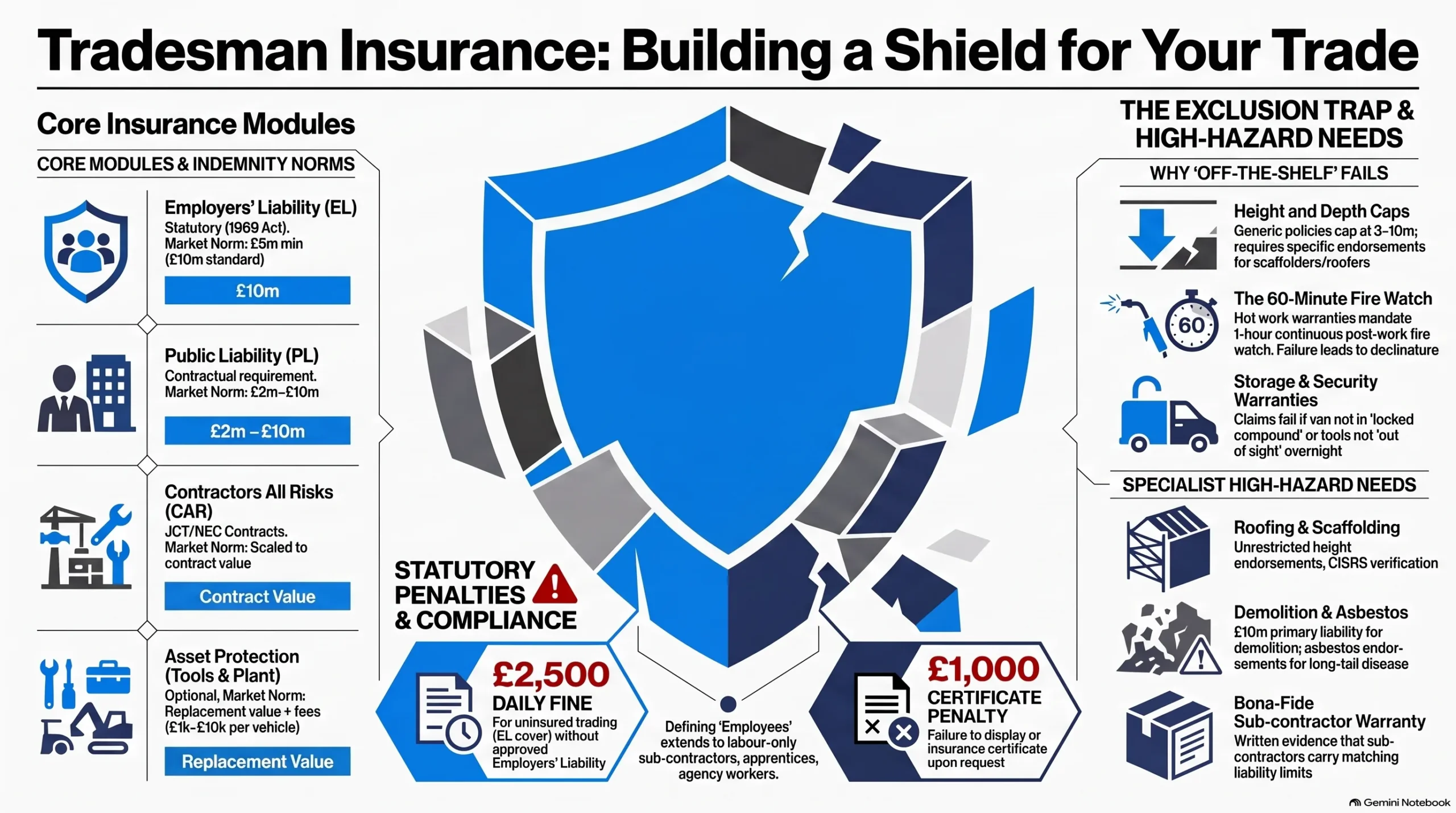
Trade firms rarely need one policy. They need a stack of modules, each answering a different exposure. The right combination depends on staffing, trade activity, and the contracts you sign. The table below sets out the core modules used across UK trade placements. It shows the legal or contractual driver behind each one, alongside typical market indemnity levels.
Main contractors set their own minimum limits before letting anyone on site. Some covers are compulsory by statute. Others, such as hired-in plant protection, are driven purely by contract terms. Check these thresholds against your policy schedule before you tender. Discovering a shortfall after mobilisation usually means paying the difference out of your own margin.
| Insurance Module | Legal / Contractual Requirement | Common Market Indemnity Norms |
|---|---|---|
| Employers’ Liability | Statutory under Employers’ Liability Act 1969 | £5m statutory minimum (£10m standard market norm) |
| Public Liability | Contractually required by main contractors | £2m to £10m depending on project tier |
| Contractors All Risks | Contractually required under JCT / NEC contracts | Scaled to maximum contract value and works on site |
| Plant & Equipment | Contractually required under CPA / HAE hire terms | Scaled to replacement value and continuing hire fees |
| Tools & Equipment | Optional commercial asset protection | £1,000 to £10,000 per vehicle with storage conditions |
Public and Employers’ Liability Foundations
Statutory Requirements for Employer Protection
Employers’ liability cover is compulsory under the Employers’ Liability (Compulsory Insurance) Act 1969. It applies to almost every UK business that employs staff. The statutory minimum indemnity limit is five million pounds. In practice, ten million pounds is the standard market norm. Serious injury and occupational disease claims routinely exceed the legal floor.
The duty reaches further than direct employees. Labour-only sub-contractors, apprentices, and agency workers all fall within scope. The Health and Safety Executive can fine an employer up to £2,500 for each day trading without approved cover. A further penalty applies where the certificate is not produced on request. Compensation awards remain the greater risk. An uninsured award for a catastrophic accident will close most trade firms.
Third-Party Property Damage and Injury Cover
Public liability insurance responds to third-party injury and property damage arising from your trade operations. It is not compulsory in law. Contracts make it compulsory in practice. Main contractors and accreditation bodies want proof before you set foot on site. Limits usually sit between two million and ten million pounds.
The everyday losses are mundane. A struck utility cable during groundworks. A dropped tool through a neighbouring windscreen. Builders insurance normally bundles public liability with products liability. Products cover picks up damage caused by defective materials or poor workmanship after handover. From experience across the sector, that second element is the one most firms overlook. It is also the one that bites years later.
Essential Asset Protection for Plant and Tools
Portable Hand and Power Tool Cover
Tools and equipment cover indemnifies you against theft, loss, or accidental destruction of hand tools and power equipment. Cover is written subject to storage conditions. Insurers specify alarms, deadlocks, and concealed tool compartments. They also define overnight hours precisely. Breach the storage condition and the claim fails, whatever the value lost.
Tool theft is the most common loss in this class. It stops work immediately and hits income the same week. Typical warranties require tools kept out of sight in a locked van. The van must sit in a locked compound or carry an accredited immobiliser. Keep purchase receipts and serial numbers. Without them, insurers will settle at their own valuation rather than yours.
Owned and Hired Plant Machinery Cover
Plant insurance covers excavators, mixers, and access towers against damage, fire, and site theft. The policy must distinguish owned machinery from hired-in machinery. Hire agreements transfer full financial responsibility to the hirer. That includes the replacement cost of the item. It also includes continuing hire charges while the machine is off the road.
Construction Plant-hire Association terms are the usual basis of hire in the UK. Under those terms, you pay hire fees throughout the repair period. Contractors All Risks policies bundle works in progress with hired-in plant cover. That combination removes most of the exposure. Statutory inspections under the Lifting Operations and Lifting Equipment Regulations 1998 must be kept current. A lapsed inspection gives the underwriter grounds to decline.
Did You Know?
The Employers’ Liability (Compulsory Insurance) Act 1969 carries a fine of up to £2,500 for every day a UK employer trades uninsured. A further £1,000 penalty applies for failing to display or produce the certificate of insurance on request.
Where Standard Off-the-Shelf Policies Fail
Height and Depth Exclusions in General Wording
Generic commercial wordings impose height and depth restrictions as standard. Most cap working activity between three and ten metres above ground level. Excavation depth limits follow the same pattern. Work outside those boundaries falls outside the policy. The contractor then carries third-party injury and property claims personally.
Work at Height Regulations 2005 duties do not change the policy wording. Only an endorsement does that. Unrestricted height cover is essential for scaffolders, roofers, and cladding contractors. High-rise commercial work makes the standard cap meaningless. When operating in this area, we negotiate the height and depth endorsement first. The schedule must match what the firm actually does on site.
Hot Work Warranties and Fire Protocol Risks
Policies covering hot works impose strict conditions inside the schedule. Torch-on roofing, welding, and soldering all trigger them. Typical warranties require a formal permit-to-work system. Suitable extinguishers must sit adjacent to the work area. A continuous fire watch must follow every hot work operation carried out on site.
The documented 60-minute post-work fire watch causes more repudiated claims than any other condition. Insurers treat hot work warranties as conditions precedent to liability. Any procedural lapse allows a full declinature. The fire itself does not need to be your fault. The breach alone is enough. Firms using thermal tools should audit their permit records quarterly.
Cover Built for Demanding Businesses
Across high risk industries, the cover we arrange most often includes:
Public liability
Employers' liability
Motor fleet
Contractors' all risks
Freight liability
Professional indemnity
Environmental liability
Business interruption
Most businesses need a combination, rather than a single focus policy, and we build cover around your contracts, your workforce and your operational activities.
Specialist Placement Needs for High-Hazard Trades
Scaffolding and Roofing Cover at Height
Scaffolding and roofing sit at the top of the hazard scale. Standard commercial markets will not write them. Placement requires unrestricted height endorsements and falling object extensions. Underwriters also verify operative qualifications before quoting. Construction Industry Scaffolders Record Scheme cards are checked as a matter of course.
Roofing terms turn on the materials used. Cold-applied liquid membranes rate very differently from torch-on bitumen. Scaffolding firms need robust public liability extensions. Dropped tube incidents and structural tie failures drive the claims record. Align the policy with National Access and Scaffolding Confederation guidance. Underwriters read that alignment as evidence of controlled operations.
Demolition and Asbestos Liability Requirements
Demolition and asbestos work carry environmental and structural hazards under close statutory oversight. Demolition placements normally require at least ten million pounds of primary liability cover. Environmental impairment cover sits alongside it. Licensed asbestos removal needs an explicit asbestos endorsement. Without one, long-tail disease liabilities remain entirely uninsured.
The Control of Asbestos Regulations 2012 govern this work. Disease claims can surface decades after the original exposure. Insurers examine risk assessments and method statements in detail. They also check Certificate of Competence of Demolition Operatives credentials. Excess layer policies provide the upper tier of cover. Major infrastructure and site clearance contracts usually require that structure.
Contractual Obligations Under Standard Frameworks
Sub-contractor Flow-Down Provisions
Main contractors write minimum liability limits and indemnities directly into subcontract terms. Those clauses flow down to every specialist trade on the project. Your policy must mirror them exactly. A limit set below the contract requirement is a breach of contract. It also leaves the shortfall completely uninsured.
Flow-down clauses often carry more than a limit. They can require joint-names policies or a waiver of subrogation. Neither is automatic on a standard trade policy. Both need an endorsement. Review the insurance clauses before signing, not after mobilisation. Firms that check early keep access to high-value commercial tenders.
JCT and NEC Contract Insurance Clauses
Joint Contracts Tribunal and New Engineering Contract suites dictate how contract works are insured. JCT Options A, B, and C allocate responsibility between employer and contractor. The split covers works in progress, existing structures, and temporary site buildings. Each option produces a different insurance requirement. Reading the wrong option is a common and costly error.
NEC4 uses the clause 80 insurance table to set liability boundaries and minimum cover. Infrastructure clients rarely negotiate on those figures. JCT Option C applies to refurbishment work. It mandates joint-names cover for the existing structure as well as the new works. A specialist contract review before commencement avoids the endorsement gap. Retrofitting cover after works start is rarely possible.
Policy Endorsements and Condition Warranties
Sub-contractor Insurance Verification Protocols
Most trade policies carry a bona-fide sub-contractor warranty. It obliges you to check that any firm you engage holds matching liability cover. Written evidence must be held on file. The indemnity limits must be equivalent to your own. Allowing an uninsured operative on site breaches that condition.
The distinction between labour-only and bona-fide sub-contractors drives the rating. Labour-only operatives work under your supervision. They must be declared under the employers’ liability schedule. Bona-fide firms carry their own cover and rate separately. Collect certificates annually and diarise the renewal dates. Missing certificates lead to higher excesses or a rejected subrogated claim.
Vehicle Storage and Unattended Plant Warranties
Motor fleet and tool policies impose rigorous security warranties. Commercial vehicles carrying equipment must be locked at all times. Insurers commonly require approved tracking devices as well. Overnight parking must take place inside locked premises during defined hours. The definition of those hours sits in the schedule, not the brochure.
Plant left unattended on site attracts its own conditions. Mechanical immobilisers, ground anchors, and tracking software are the usual requirements. Breach the unattended warranty and theft cover falls away completely. Recovery on a high-value machine then depends entirely on the police. Written site security procedures protect both the asset and the cover.
Risk Management Strategies to Control Premiums
Operative Card Records and Training Evidence
Documented risk management changes how an underwriter prices your account. Verified training records carry real weight at renewal. Construction Skills Certification Scheme cards, induction records, and equipment training logs all count. Firms that present them consistently secure better rates. Firms that cannot produce them pay a loading instead.
Compliance with the Construction (Design and Management) Regulations 2015 supports the same case. Documented risk assessments and method statements evidence controlled site governance. That documentation also reduces accident frequency over time. In practice, we find a clean three-year record moves terms more than any presentation. Broader wordings and reduced excesses follow the loss ratio.
Incident Logging and Formal Claims Management
A structured incident log captures near misses and minor property damage as they happen. Early notification stops a small matter becoming a contested legal dispute. It also protects the long-term claims history. Underwriters price on that history at every renewal. Late notification is treated as a breach under many wordings.
Quarterly loss reviews expose recurring causes before they reach the premium. A broker adds value at the negotiation stage with loss adjusters. Internal claims protocols also protect commercial reputation on live sites. Clients notice how a firm handles an incident. Stable insurance costs follow disciplined claims handling, not luck.
Final Thoughts
Structuring tradesman insurance is an exercise in matching cover to actual operations. Statutory duties set the floor. Client contracts set the limits. Site hazard profiles set the endorsements. Basic commercial policies leave gaps around height, hot works, and sub-contractor liability. Closing those gaps protects both compliance and cash flow.
Contract values rise faster than most insurance schedules get reviewed. An annual policy audit keeps the two aligned. Enforce site security warranties, keep training records current, and check every new contract’s insurance clauses before signing. Firms that do this hold sustainable premiums as they grow.
Speak to an Insurance Specialist
Whether you need a new quote, want to discuss your renewal or have a question about an existing policy, our team is here to help.
Frequently Asked Questions
Q: What is the difference between public liability and employers’ liability insurance?
A: Employers’ liability insurance is compulsory under UK law for businesses with staff. It covers claims from employees who suffer injury or illness through their work. The statutory minimum indemnity limit is five million pounds. Public liability insurance is different. It covers injury to members of the public and damage to third-party property caused by your operations. It is not required by statute. Clients and main contractors almost always insist on it before allowing work to start.
Q: Why do off-the-shelf tradesman insurance policies fail specialist contractors?
A: Standard wordings are priced for low-hazard general trades. They carry blanket restrictions on working height, excavation depth, and hot work. Roofers, scaffolders, demolition firms, and asbestos contractors routinely operate outside those limits. When a claim arises, the insurer relies on the exclusion and declines. Specialist placement solves this with bespoke endorsements. That usually means unrestricted height allowances, defined hot work conditions, and a trade description matching the work actually carried out.
Q: What overnight vehicle storage conditions apply to tool insurance policies?
A: Most tool policies require tools to be kept out of sight in a locked vehicle. That vehicle must carry a working alarm, deadlocks, or an approved security device. Overnight conditions are stricter. Insurers typically require parking inside locked premises, a private garage, or an off-street driveway with security lighting. The schedule defines the overnight hours precisely. Leaving tools in a van outside those approved conditions can invalidate a theft claim in full.
Q: What is hired-in plant insurance and why is it necessary?
A: Hired-in plant insurance covers machinery you hire against accidental damage, vandalism, fire, and theft during the hire period. Most UK plant hire runs on Construction Plant-hire Association conditions. Those conditions make the hirer financially responsible for physical loss of the machine. They also make the hirer liable for continuing hire charges while the item is repaired or replaced. Without this cover, both costs fall directly on the contractor after an incident.
Q: How do hot work warranties affect roofing and metalwork contractors?
A: Hot work warranties set out mandatory procedures for work involving open flames, torches, angle grinders, or welding equipment. Standard conditions require a formal permit-to-work, removal of combustible debris, and suitable fire extinguishers kept immediately to hand. A documented fire watch of at least 60 minutes must follow the work. These are conditions precedent to liability. If the procedure is not followed and a fire starts, the insurer can decline the claim entirely.
About The Author
Darren Judd
Director, Co-Founder and Co-Owner of Capital Corporate Risks Ltd

Experienced Account Executive with a demonstrated history of working in the insurance industry. Skilled in Account Management, Risk Management, Business Development across all classes of insurance within the Construction Industry,