

Waste and Recycling Insurance: Sector Overview
Securing waste and recycling insurance protects operators against the sector’s most severe financial exposures. Waste transfer stations, materials recovery facilities and skip hire fleets carry elevated risk profiles. Fire, pollution and equipment exposures sit well beyond standard commercial cover. Insurers examine every operational detail before quoting terms. Robust protection depends on matching policy structure to the specific hazards each site presents.
Standard commercial property policies routinely exclude waste activities because of their elevated fire risk. Underwriting capacity in this sector remains tight, and insurers now expect clear evidence of risk management before quoting. What must a waste operator demonstrate to secure a resilient, fully compliant insurance programme?
Key Takeaways
- A resilient waste and recycling insurance programme combines liability, property, business interruption, plant and environmental impairment cover into one unified stack.
- Fire remains the dominant risk for recycling operators, making Environment Agency Fire Prevention Plan compliance essential for competitive property cover.
- Standard public liability policies exclude gradual pollution, so permitted waste sites need stand-alone environmental impairment liability insurance for legal protection.
- Detailed record-keeping, thermal imaging monitoring and battery screening protocols significantly improve underwriter appetite and help secure favourable premium terms.
- Business interruption indemnity periods should run for twenty-four to thirty-six months to cover lengthy post-fire rebuilding and permit re-application timescales.
Waste and Recycling Insurance at a Glance
Waste and recycling insurance combines several core policy types into one programme, each addressing a distinct operational exposure. The table below summarises the principal covers a waste transfer station, materials recovery facility or skip hire operation typically needs. It also sets out the statutory minimum or market-standard requirement attached to each. Operators should treat this as a starting reference rather than a complete specification.
Every waste management insurance programme should reflect the operator’s actual site activities, throughput volumes and material types. A generic template rarely captures this properly. Underwriters price risk according to fire load, pollution potential and vehicle exposure. Limits shown here often rise for larger or higher-risk sites. A broker experienced in the waste sector can align cover precisely to each licence condition.
| Policy Cover | Operational Scope | Statutory or Market Requirement |
|---|---|---|
| Public Liability | Third-party injury or property damage from site operations or off-site activities | Typically £5m or £10m, often set by contracts and local authorities |
| Employers’ Liability | Employee injury or illness from site work, sorting or vehicle operation | Statutory minimum £5m under the Employers’ Liability (Compulsory Insurance) Act 1969 |
| Property and Contents | Buildings, processing bays and stored recyclables against fire and storm | Set by lender requirements, landlord leases and asset protection needs |
| Business Interruption | Lost gross profit and increased costs of working after an insured loss | Indemnity periods of 24 to 36 months are typically recommended |
| Motor Fleet | Cover for skip loaders, hook lifts, HGVs and support vehicles | Compulsory third-party cover under the Road Traffic Act 1988 |
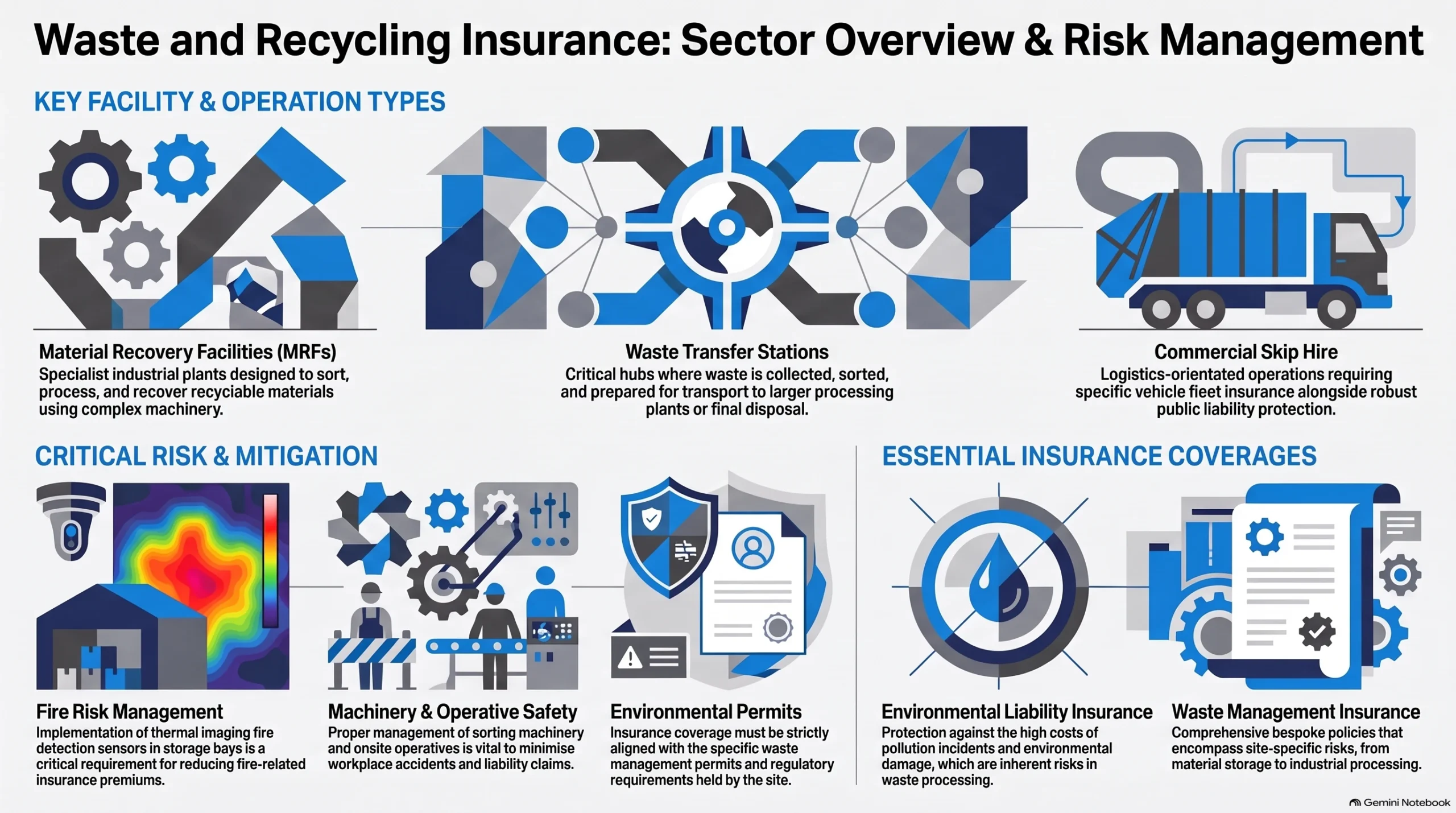
The Operational Risk Profile Across Waste and Recycling Facilities
Waste Transfer Stations and Materials Recovery Facilities
Waste transfer stations face high material throughput and rapid fire accumulation risk from stockpiled combustible waste. Materials recovery facilities add further exposure through complex mechanical sorting equipment that processes mixed paper, plastics and metals continuously. Both site types need tailored risk controls addressing storage limits, fire detection and equipment breakdown before insurers offer competitive terms.
Throughput volume drives much of the underwriting assessment. Sites processing higher tonnages face proportionally greater fire load and business interruption exposure, so insurers request detailed operational data before quoting.
Skip Hire, Landfill and Hazardous Waste Handling
Skip hire operators carry heavy road transport risk alongside customer loading liabilities from mixed and sometimes contaminated waste streams. Landfill sites manage long-term gas and leachate exposures that persist for decades after closure. Hazardous waste handlers face toxic spillage and chemical reaction risks that require specialist containment measures.
Underwriters treat these activities as higher-risk than general waste handling. Clear segregation between waste streams, verified maintenance logs and strict housekeeping standards all influence the terms an insurer offers.
Core Insurance Policies for the Waste Management Sector
Public Liability and Employers’ Liability Cover
Public liability insurance protects waste operators against third-party injury or property damage claims arising from site operations or off-site activities. Employers’ liability cover addresses employee injury or illness from sorting work, vehicle operation or plant use. Commercial contracts and local authorities typically require £5m or £10m in public liability limits before awarding waste management work.
Employers’ liability carries a statutory minimum of £5m under the Employers’ Liability (Compulsory Insurance) Act 1969, though most waste operators carry £10m as standard.
Property, Business Interruption and Motor Fleet Cover
Property and contents insurance covers buildings, processing bays and stored recyclables against fire, storm and other insured perils. Business interruption cover replaces lost gross profit and increased costs of working following a covered loss. Motor fleet insurance provides comprehensive protection for skip loaders, hook lifts, HGVs and other support vehicles used across daily operations.
These three policies work together to protect both physical assets and ongoing revenue. Without an adequate indemnity period, a single major fire can threaten the survival of the business.
Did You Know?
Under Environment Agency Fire Prevention Plan guidance, combustible waste piles must not exceed four metres in height or twenty metres in length, with a minimum six-metre separation distance between stacks.
Statutory Duty of Care and Environmental Permitting
Environmental Protection Act 1990 and Waste Tracking
Section 34 of the Environmental Protection Act 1990 places a continuous Duty of Care on every business handling controlled waste. This covers anyone who produces, carries, treats or disposes of it. This duty requires accurate tracking, transferring and documentation of waste streams from collection through to final disposal. Breaching these obligations creates direct financial and legal exposure for the operator.
Insurers expect to see robust waste transfer documentation as part of any renewal submission. Weak record-keeping in this area often signals wider compliance gaps to an underwriter.
Environmental Permitting Regulations 2016 and Site Controls
The Environmental Permitting (England and Wales) Regulations 2016 governs site operational parameters. This includes permitted waste types, storage limits and required emissions controls. Operating outside permit conditions, even temporarily, can trigger enforcement action and invalidate elements of an insurance policy. Permit compliance sits at the centre of every waste management insurance application.
Underwriters routinely request a copy of the current environmental permit alongside any variation history. Sites operating close to their permitted capacity face closer underwriting scrutiny.
Cover Built for Demanding Businesses
Across high risk industries, the cover we arrange most often includes:
Public liability
Employers' liability
Motor fleet
Contractors' all risks
Freight liability
Professional indemnity
Environmental liability
Business interruption
Most businesses need a combination, rather than a single focus policy, and we build cover around your contracts, your workforce and your operational activities.
Environmental Damage Liability and Remediation Obligations
Hazardous Waste Regulations 2005 and Consignment Documentation
The Hazardous Waste Regulations 2005 governs consignment documentation and tracking procedures for hazardous substances and contaminated waste streams. Operators handling hazardous material must maintain accurate consignment notes recording each movement from production through to final treatment. Gaps in this documentation expose the business to enforcement action and complicate any subsequent insurance claim.
Standard public liability policies rarely extend to hazardous waste handling without specific endorsement. Operators in this category should confirm cover applies before relying on a general policy wording.
Environmental Damage Remediation and Statutory Liability
The Environmental Damage (Prevention and Remediation) Regulations 2015 imposes strict liability for environmental damage and ecosystem harm. Operators face mandatory habitat remediation duties regardless of fault. Standard public liability policies contain restrictive pollution exclusions that leave gradual contamination largely uninsured. Stand-alone environmental impairment liability insurance bridges this gap by covering statutory clean-up and remediation costs.
Gradual pollution claims can run for years and involve substantial legal and technical costs. Environmental impairment cover typically extends to legal defence costs alongside the physical remediation work itself.
Fire Risk Mitigation and Insurability in Recycling Plants
Fire Prevention Plan Compliance and WISH Standards
Fire Prevention Plan compliance is a fundamental requirement for securing property insurance across permitted recycling facilities. Environment Agency guidance sets maximum pile heights, separation distances and quarterly stack turnover regimes that operators must follow. Integrating recommendations from the Waste Industry Safety and Health Forum further improves risk presentation and maintains underwriter interest.
Insurers increasingly request evidence of compliance before renewal rather than accepting a general assurance. A documented, auditable Fire Prevention Plan carries real weight in underwriting discussions.
Lithium-Ion Battery Contamination and Thermal Surveillance
Undetected lithium-ion batteries within commercial and municipal waste streams represent the fastest-growing trigger for thermal events inside processing bays. Recycling operators need automatic thermal-imaging detection systems alongside strict inbound screening protocols to catch contamination early. Early suppression prevents small ignition events from spreading into bulk combustible material.
Battery-related fires have driven a marked hardening in underwriting appetite across the sector. Sites without visible screening measures increasingly struggle to secure competitive property terms.
Plant, Machinery and Engineering Protection Requirements
Machinery Breakdown and Theft Cover for Processing Equipment
Processing equipment represents a substantial capital investment for most waste management businesses. High-reach excavators, shredders, screeners and balers operate under demanding conditions daily, and mechanical breakdown halts facility throughput immediately. Specialist plant and machinery policies protect owned and hired equipment against sudden physical damage, breakdown and theft.
Theft of mobile plant remains a persistent risk on sites with limited overnight security. Tracking devices and secure compounds both influence the terms an insurer offers.
LOLER and PSSR Statutory Inspection Requirements
Lifting plant used across waste sites falls under the Lifting Operations and Lifting Equipment Regulations 1998. This requires thorough examination by a competent person at set intervals. Pressure systems, including compressors and boilers, must separately comply with the Pressure Systems Safety Regulations 2000. Insurers make policy validity conditional on holding current statutory inspection certificates.
Engineering inspection contracts combined with machinery breakdown cover keep processing lines compliant and operational. Lapsed certification is one of the most common reasons a claim is later disputed.
Renewal Evidence and Risk Presentation Standards
Compliance Records Insurers Review at Renewal
Underwriters thoroughly review Environment Agency inspection reports, waste transfer notes and Fire Prevention Plan compliance audits during every renewal cycle. Thermal imaging maintenance logs, staff training records and vehicle maintenance files all feed into the same assessment. Consistent, well-organised documentation shortens the renewal process and often improves the terms on offer.
Operators who treat renewal as a continuous process rather than an annual scramble tend to secure more stable pricing. Gaps in the paperwork are far more likely to trigger difficult underwriting questions.
Building a Resilient Cover Stack for the Long Term
A resilient cover stack aligns statutory permits, physical risk controls and financial protection into one coherent programme. It replaces a set of disconnected policies with a single, deliberate structure. Regular reviews ensure the stack adapts as site activities, throughput volumes and material types change over time. Operators who maintain this discipline gain a clear advantage when negotiating renewal terms.
Market capacity for higher-risk waste activities remains limited, so a well-documented risk profile carries real commercial value. Sites that demonstrate ongoing improvement typically retain broader insurer choice at each renewal.
Final Thoughts
Managing risk across the waste sector demands a structured approach to insurance placement. Aligning statutory permits with comprehensive waste and recycling insurance protects assets, revenue and regulatory standing at every stage of operation. Operators who maintain clear documentation and demonstrate proactive fire prevention consistently secure stronger terms at renewal.
Regulatory expectations in this sector continue to tighten, and fire risk shows no sign of easing. Reviewing the full cover stack on a regular basis remains the most reliable way to keep protection aligned with actual site risk.
Speak to an Insurance Specialist
Whether you need a new quote, want to discuss your renewal or have a question about an existing policy, our team is here to help.
Frequently Asked Questions
Q: Why do standard property insurance policies exclude waste management sites?
A: Standard commercial property insurers generally exclude waste management sites. The fire risk linked to bulk stored waste and mixed recyclables is simply too high. General underwriters have little appetite for unmonitored combustible stockpiles or dust exposures of this scale. Specialist waste insurers instead require demonstrable risk management, including a formal Fire Prevention Plan, thermal imaging surveillance and strict pile-size controls, before offering property damage and business interruption cover on workable terms.
Q: Is public liability insurance enough for environmental contamination claims?
A: Standard public liability policies typically cover only sudden and accidental pollution events. They explicitly exclude gradual contamination, historical land damage and on-site clean-up costs. Environmental authorities can require full statutory remediation for gradual leaks, leachate runoff or airborne pollutants regardless of fault. Waste operators need stand-alone environmental impairment liability insurance to cover on-site and off-site remediation, legal defence costs and statutory biodiversity damage obligations under UK environmental law.
Q: What indemnity period suits business interruption cover at a recycling plant?
A: Waste sector brokers generally recommend business interruption indemnity periods of twenty-four to thirty-six months for processing facilities. Rebuilding a permitted recycling plant after a major fire involves lengthy planning approvals, Environment Agency permit re-applications, specialist machinery lead times and rigorous site commissioning. A standard twelve-month indemnity period often expires before operations can legally resume, leaving the business exposed to ongoing overheads and lost profit during the rebuild.
Q: How do statutory inspection rules apply to waste processing machinery?
A: Heavy waste processing equipment falls under the Lifting Operations and Lifting Equipment Regulations 1998. This includes materials handling grabs, loading shovels and overhead cranes. These assets require thorough periodic examination by a certified competent person at set intervals. Pressure vessels, hydraulic systems and compressors must separately comply with the Pressure Systems Safety Regulations 2000. Insurers typically make policy cover conditional on the operator holding up-to-date statutory inspection certificates for all relevant plant.
Q: What records do insurers review during a waste insurance renewal?
A: During renewal, underwriters typically review several categories of evidence. These include Environment Agency inspection reports, waste transfer notes, Fire Prevention Plan compliance audits and thermal imaging maintenance logs. They also examine staff training records, vehicle maintenance files, hot-work permit systems and inbound waste contamination screening procedures. Demonstrating continuous regulatory compliance and proactive battery screening measures significantly improves underwriter confidence and typically secures more favourable terms at renewal.
About The Author
Darren Judd
Director, Co-Founder and Co-Owner of Capital Corporate Risks Ltd

Experienced Account Executive with a demonstrated history of working in the insurance industry. Skilled in Account Management, Risk Management, Business Development across all classes of insurance within the Construction Industry,