

Specialist Commercial Insurance Brokers Explained
High-hazard trades carry exposures that off-the-shelf business policies were never built to cover. Standard wordings ignore onerous contract conditions, strict warranties and statutory duties. Specialist commercial insurance brokers examine the risk properly before approaching the market. They negotiate bespoke wordings with technical underwriters instead of relying on automated systems. The result is balance-sheet protection that holds up when a serious claim lands.
Generalist intermediaries often treat commercial placements as annual transactions. Mid-term changes and subcontract terms go unrecorded. When a large claim arrives, an overlooked exclusion can threaten the firm’s survival. So how does a business confirm that its insurance programme matches its contracts and its daily operations?
Key Takeaways
- Specialist brokers reach technical Lloyd’s and London market underwriters who accept hazardous trades that mainstream automated systems decline outright.
- Detailed contract scrutiny closes coverage gaps created by JCT, NEC and bespoke subcontractor flow-down indemnities on commercial projects.
- A structured onboarding process exposes hidden operational liabilities through detailed risk presentations before any underwriting syndicate sees the account.
- Quarterly check-ins capture fleet, contract and turnover changes, preventing warranty breaches long before a commercial loss event occurs.
- Proactive claims advocacy and legacy claim closure protect the claims record, which lowers future premiums and defends commercial reputation.
Core Operational Distinctions in Commercial Broking
Specialist commercial brokers and retail generalists work to different models. Generalists place volume business through composite portals and automated panels. Specialists handle high-hazard trades by hand. They analyse the technical detail, then place the liability with syndicates that understand the trade. They draft policy endorsements to match statutory duties rather than accept a standard package.
The difference runs through every stage of the policy life cycle. It shows in risk capture, in market submission and in claims settlement. Generalists issue standard packages carrying unvetted exclusions. Specialists align wording with the commercial agreements the client has actually signed. The table below sets out how the two approaches compare across five functional dimensions.
| Functional Dimension | Generalist Broker Approach | Specialist Broker Practice |
|---|---|---|
| Functional DimensionUnderwriter Access | Generalist Broker ApproachStandard composite insurer panels | Specialist Broker PracticeSpecialist London market and niche Lloyd’s syndicates |
| Functional DimensionContract Scrutiny | Generalist Broker ApproachSuperficial check of statutory limits | Specialist Broker PracticeRigorous analysis of JCT, NEC and flow-down terms |
| Functional DimensionRisk Presentation | Generalist Broker ApproachAutomated questionnaires and proposal forms | Specialist Broker PracticeBespoke technical submissions detailing operational controls |
| Functional DimensionPolicy Maintenance | Generalist Broker ApproachAnnual transactional renewal correspondence | Specialist Broker PracticeStructured quarterly reviews capturing mid-term exposures |
| Functional DimensionClaims Management | Generalist Broker ApproachPassive referral to insurer claims helplines | Specialist Broker PracticeDedicated advocacy and proactive legacy claims resolution |
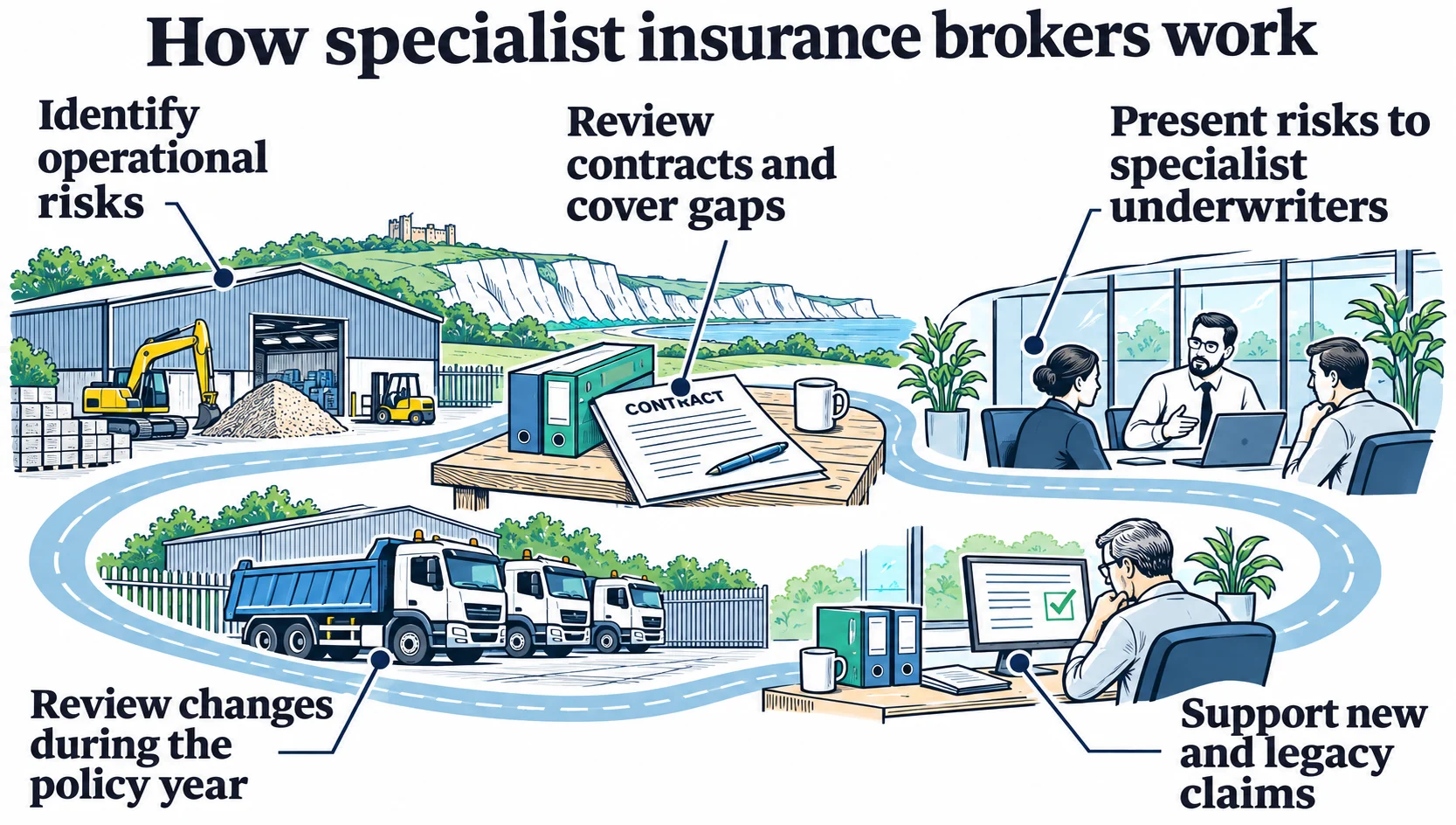
Technical Representation in High-Hazard Sectors
Underwriter Relationships and Niche Market Capacity
Specialist commercial brokers trade directly with Lloyd’s syndicates and niche company markets. These underwriters accept complex industrial risks on their merits. Mainstream composite insurers decline demolition, scaffolding and roofing through automated filters. In practice, we find terms come only from empowered technical underwriters who assess real controls on real sites.
Capital Corporate Risks Ltd uses senior market relationships to reach that capacity. These include Aviva 110 broker status and membership of Bravo Networks. Those channels let us explain safety measures, operative accreditations and risk management protocols directly to the underwriting team. Presented accurately, hazardous trades secure limits that standard panels refuse outright.
How Specialists Interpret Hazardous Operational Risk
High-hazard operations demand precise technical description to satisfy the Insurance Act 2015 duty of fair presentation. Specialist brokers break the work down activity by activity. They identify hot works, structural alteration and work at height. That scrutiny prevents the material misrepresentation that can void cover after a serious third-party loss.
A generalist might describe a demolition contractor simply as a builder. Structural dismantling and plant operation then sit outside the endorsements. Specialist brokers read the risk assessments, method statements and training matrices. We check CCDO certification in demolition and CISRS registration in scaffolding. The presentation then evidences statutory compliance, which builds underwriter confidence and heads off post-loss disputes.
Did You Know?
The Employers’ Liability (Compulsory Insurance) Act 1969 requires most UK employers to hold at least five million pounds of cover. The Health and Safety Executive can fine a business up to 2,500 pounds for each day it trades uninsured.
Contract Analysis and Flow-Down Liabilities
Contract Conditions in Construction and Transport Agreements
Commercial contracts routinely impose liabilities that exceed the cover a standard policy provides. Specialist brokers review the conditions line by line across JCT and NEC agreements. We apply the same scrutiny to RHA and BIFA carriage terms. The insurance programme then answers every liability the business has formally assumed.
Subcontractors sign tier-one agreements without spotting onerous indemnities or joint-names mandates. JCT Option C clauses on refurbishment work demand joint-names all-risks cover for the existing structure. A standard public liability policy excludes that exposure explicitly. We flag the requirement before site mobilisation, then draft an endorsement or negotiate an amendment. The contractual breach never happens.
Indemnity Limits and Workable Policy Warranties
Main contractors commonly demand a ten million pound minimum indemnity limit on subcontract works. They attach restrictive operational warranties alongside it. Specialist brokers arrange excess layer liability cover to meet the threshold without inflating the primary premium. We then negotiate the warranty wording so daily site compliance stays realistic.
Standard wordings carry unworkable conditions. Continuous fire-watch warranties and arbitrary height caps are common examples. Both can invalidate cover on tall structures or hot works. A specialist broker secures realistic terms instead. Examples include a 60-minute fire watch with specified extinguisher provision. Another is an unrestricted height endorsement for scaffolders. The policy then performs as intended during a major loss.
Cover Built for Demanding Businesses
Across high risk industries, the cover we arrange most often includes:
Public liability
Employers' liability
Motor fleet
Contractors' all risks
Freight liability
Professional indemnity
Environmental liability
Business interruption
Most businesses need a combination, rather than a single focus policy, and we build cover around your contracts, your workforce and your operational activities.
Structured Onboarding and Risk Identification
Operational Discovery Through Initial Site Meetings
Every account starts with an in-depth consultation covering daily operations and commercial objectives. Specialist brokers do not issue a generic digital form. We walk the business and question what we see. That groundwork sets an accurate baseline for the insurance programme, and it surfaces exposures the client has never recorded.
At this stage we review premises, yard operations, storage arrangements and fleet composition. We watch how the team sequences work and how it maintains plant. Waste handling and site security get the same attention. From experience across the sector, this immersion is what exposes the hazards a questionnaire will always miss.
Exposure Audits and Cover Gap Analysis
A full audit of the existing schedules reveals coverage deficiencies, hidden sub-limits and restrictive warranties. Specialist brokers compare the policy documents against working practices and live trade contracts. The comparison is forensic rather than cursory. It shows precisely where a previous broker failed to protect the firm’s commercial assets.
Many firms learn that their public liability policy carries a height exclusion. Others find hot works restricted to workshop premises only. Hired-in plant cover frequently falls short of CPA Model Conditions. The client then carries continuing hire charges after a machine theft. Finding these gaps before the market sees the risk prevents an uninsured loss.
Market Presentation and Placement Strategy
Pre-Market Submission Scrutiny with the Client
Specialist brokers send the client a complete copy of the market presentation before any insurer sees it. The client checks how we have described operations, risk management and health and safety procedures. Nothing reaches an underwriter unverified. Client sign-off confirms the submission meets the statutory fair presentation duty in full.
Presentation quality changes how an underwriter prices a high-hazard account. A submission carrying health and safety audits, trade body accreditations and a five-year claims narrative earns preferred terms. A bare proposal form does not. In practice, we find the same risk attracts materially different quotations depending on the documentation.
Broking Execution and Placement Transparency
Clients hear from us throughout negotiations with Lloyd’s syndicates and specialist company markets. Once terms arrive, we set them out side by side. The comparison covers coverage scope, endorsements, deductibles and premium structure. Directors then decide on the commercial insurance programme with the full picture in front of them.
We do not simply recommend the cheapest quotation. Insurer financial strength and the breadth of the wording carry equal weight. We explain how specific extensions change the protection on offer. Sudden and accidental pollution liability is one example. Defective workmanship exclusions are another. The placement decision rests on defensible cover rather than headline price.
Active Mid-Term Policy Management
Quarterly Check-Ins for Mid-Term Adjustments
Commercial operations change constantly through contract wins, fleet purchases, machinery investment and geographic expansion. Specialist brokers run structured quarterly check-ins to capture those adjustments during the policy year. Cover tracks the business rather than the renewal calendar. Each review updates the schedule so the programme reflects current trading reality.
A generalist broker rarely makes contact between renewal dates. Mid-term acquisitions stay uninsured and turnover thresholds quietly breach. A contractor who takes on higher-risk activities without telling the insurer risks a declined claim. The same applies to an expanded vehicle fleet. Scheduled reviews keep the schedule aligned with operational growth.
Ongoing Compliance with Policy Warranties
Policy warranties impose strict operational obligations for the whole policy period. A breach can defeat a claim entirely. Specialist brokers help clients build practical internal systems for waste disposal, site security and hot works permits. That oversight catches drift before a catastrophic property loss turns an administrative slip into an uninsured claim.
Waste and recycling sites must follow Fire Prevention Plans and approved storage separation distances. The Environment Agency sets those standards and insurers police them closely. A specialist broker tracks changes to both. We advise on site layout adjustments and daily inspection logs as expectations shift. The business stays compliant with its own insurance conditions.
Proactive Claims Advocacy and Legacy Management
Quarterly Claims Review Protocols
Claims handling is the real test of any commercial insurance programme. Advocacy matters more than administration. Specialist brokers hold formal quarterly claims reviews with the insurer. We interrogate open reserves, challenge unjustified liability decisions and push outstanding settlements along. That work controls the claims cost that drives the next renewal.
At Capital Corporate Risks Ltd, Operations Director Dan Coleman leads claims advocacy across every account. Insurers often set excessive reserves on open third-party liability files. Those figures inflate the loss ratio and push renewal premiums upward. Quarterly reviews challenge each reserve with documented evidence. Valid claims settle faster and unmerited files close.
Legacy Claims That Distort Experience Ratings
Open claims from earlier policy years distort a company’s claims experience and inflate premiums for years. Specialist brokers take over the legacy file entirely. We liaise with former insurers, adjusters and solicitors to close dormant matters. An accurate loss record restores the true risk profile, which lets underwriters offer preferential terms.
Contractors often discover that claims from expired policies remain open through insurer inertia. The loss record suffers for as long as the file stays live. A specialist broker investigates each legacy claim and demands status updates from the appointed adjuster. Where no liability exists, we press for closure. A clean historical record protects the balance sheet at renewal.
Regional Industry Expertise Across Kent and the South East
Local Market Presence from the Dartford Office
The commercial insurance brokers Dartford businesses use gain a real advantage from proximity and direct contact. Our team works from The Hill Hub in Dartford and visits client premises across the Thames Gateway. Risk assessments happen face to face. That physical presence builds operational understanding no remote broker can match.
Proximity matters when an operational emergency hits or a tender needs urgent contractual advice. A client may want an on-site survey the same week. Another may need a complex subcontract reviewed before a bid deadline. Local brokers answer both quickly. That accessibility is what turns a transaction into a working partnership.
Programme Design for Kent Commercial Risks
Regional enterprises face operational dynamics shaped by major infrastructure work, logistics corridors and industrial redevelopment. Arranging business insurance Kent contractors and transport operators can rely on takes real familiarity with those conditions. Supply chains and environmental factors differ across the county. Specialist brokers build programmes around the regional reality.
Industrial estates along the M25 corridor carry different exposures from the Thames Estuary ports and logistics hubs. Specialist brokers layer the programme accordingly. Public and employers’ liability sit alongside motor fleet, contractors all risks and environmental liability. Terms match the way the business actually trades in the region. Operators gain genuine confidence in the protection they hold.
Final Thoughts
Specialist commercial insurance brokers bring the technical knowledge, market access and claims advocacy that complex trades require. High-hazard and contract-driven businesses cannot rely on a generic package that fails under scrutiny. Contract review, a properly built market presentation and active claims oversight together deliver real balance-sheet protection.
Operational exposures shift as regulation, contracts and trading patterns move. Reviewing them regularly keeps the programme honest. Continuous dialogue with a specialist adviser lets cover grow alongside the fleet, the workforce and the contract book. That discipline is what sustains commercial resilience through every market cycle.
Speak to an Insurance Specialist
Whether you need a new quote, want to discuss your renewal or have a question about an existing policy, our team is here to help.
Frequently Asked Questions
Q: What distinguishes specialist commercial insurance brokers from generalist brokers?
A: Specialist brokers concentrate on complex, high-hazard sectors such as construction, demolition, waste management and haulage. Generalists rely on comparison software and composite insurer packages. Specialists trade directly with Lloyd’s syndicates and niche underwriters instead. They review contracts technically, negotiate bespoke endorsements and run claims advocacy throughout the year. The result is cover shaped around the actual operation. A standard commercial package cannot deliver that level of balance-sheet protection to a hazardous trade.
Q: How does the Insurance Act 2015 affect commercial insurance placement?
A: The Act places a statutory duty of fair presentation on commercial policyholders. A business must disclose every material circumstance it knows or ought to know. It must present that information clearly and accessibly, without misrepresentation. Specialist brokers meet the duty by compiling rigorous risk presentations. These set out operating procedures, training accreditations and safety protocols in detail. Done properly, the submission removes the insurer’s scope to dispute a claim on non-disclosure grounds later.
Q: Why is contract review an essential part of commercial insurance broking?
A: Commercial contracts such as JCT, NEC and standard trade conditions impose insurance obligations beyond ordinary policy terms. Joint-names requirements and unamended flow-down indemnities leave contractors with substantial uninsured exposure. Specialist brokers read both standard and bespoke agreements, then check the policy schedule against them. Where the two diverge, the broker negotiates a specific endorsement or advises on a contract amendment. Early action prevents severe financial loss and avoids a breach of contract dispute.
Q: How do quarterly reviews benefit an active commercial business?
A: Few businesses stay static for twelve months. Firms buy machinery, hire staff, win contracts and change site processes. An annual renewal leaves all of that unrecorded and potentially uninsured. Quarterly reviews let the broker capture operational developments as they happen. The broker verifies warranty compliance, adjusts turnover declarations and adds new assets to the schedule. Cover remains continuous across the whole policy term rather than lagging behind the business.
Q: What role does proactive claims advocacy play in controlling insurance premiums?
A: Premiums follow claims experience and the reserves insurers hold on open files. Insurers frequently set precautionary reserves well above the likely settlement. Those figures inflate the loss ratio and lift the next renewal quotation. Proactive advocacy means challenging each inflated reserve at quarterly review with documented evidence. The broker establishes defensibility and accelerates closure where liability does not stand. Resolving open and legacy claims keeps the record accurate and lowers future commercial insurance costs.
About The Author
Darren Judd
Director, Co-Founder and Co-Owner of Capital Corporate Risks Ltd

Experienced Account Executive with a demonstrated history of working in the insurance industry. Skilled in Account Management, Risk Management, Business Development across all classes of insurance within the Construction Industry,