

Commercial Liability Cover: A Quick Primer
UK businesses face civil claims, statutory enforcement and site hazards on every trading day. Commercial liability cover funds the legal defence and settlement costs that follow. Directors who leave these exposures unhedged put the balance sheet at risk. One accident on a warehouse floor can trigger an injury claim, an enforcement notice and a contract dispute at the same time.
Few organisations face a single isolated risk. Claims arrive in clusters, and each one tests a different part of the policy schedule. The gaps between schedules cost far more than the premiums ever do. So how should commercial leaders analyse their exposures and assemble a liability programme that actually holds?
Key Takeaways
- Commercial liability policies fund legal defence and settlement costs when third parties bring civil negligence claims against a trading business.
- Employers’ liability insurance is compulsory under the 1969 Act, with a five million pound statutory minimum and ten million as market standard.
- Public liability insurance answers third-party injury and property damage claims arising from day-to-day commercial operations and active site work.
- Professional indemnity and environmental impairment policies close the gaps that standard operational liability wordings exclude by deliberate design.
- An integrated liability programme prevents coverage disputes, satisfies contract requirements and keeps indemnity limits aligned across every trading division.
Core Commercial Liability Protections in the UK
Every UK commercial organisation needs a coordinated approach to civil liability. Trading without tailored indemnity exposes the balance sheet to litigation costs and regulatory action. Liability policies draw a financial perimeter around daily operations. In practice, we find that perimeter only holds when each policy answers a specific identifiable exposure rather than a generic one.
The framework sorts risk by statutory duty, working environment and contractual relationship. Matching each policy mechanism to the underlying trade keeps third-party losses insurable under enforceable wording. Brokers then calibrate the indemnity layers to meet client mandates and statutory thresholds. The table below sets out the core covers and the limits the market currently treats as normal.
| Cover Type | Primary Function | Common Market Norm |
|---|---|---|
| Cover TypePublic Liability | Primary FunctionIndemnifies third-party bodily injury and property damage | Common Market Norm£5 million to £10 million |
| Cover TypeEmployers’ Liability | Primary FunctionCompulsory cover for employee injury or illness | Common Market Norm£10 million (£5 million statutory) |
| Cover TypeProducts Liability | Primary FunctionCovers damage caused by supplied or manufactured goods | Common Market Norm£2 million to £5 million |
| Cover TypeProfessional Indemnity | Primary FunctionDefends claims of financial loss from negligent advice or design | Common Market Norm£1 million to £5 million |
| Cover TypeDirectors and Officers | Primary FunctionProtects personal assets of leaders against management liability | Common Market Norm£1 million to £5 million |
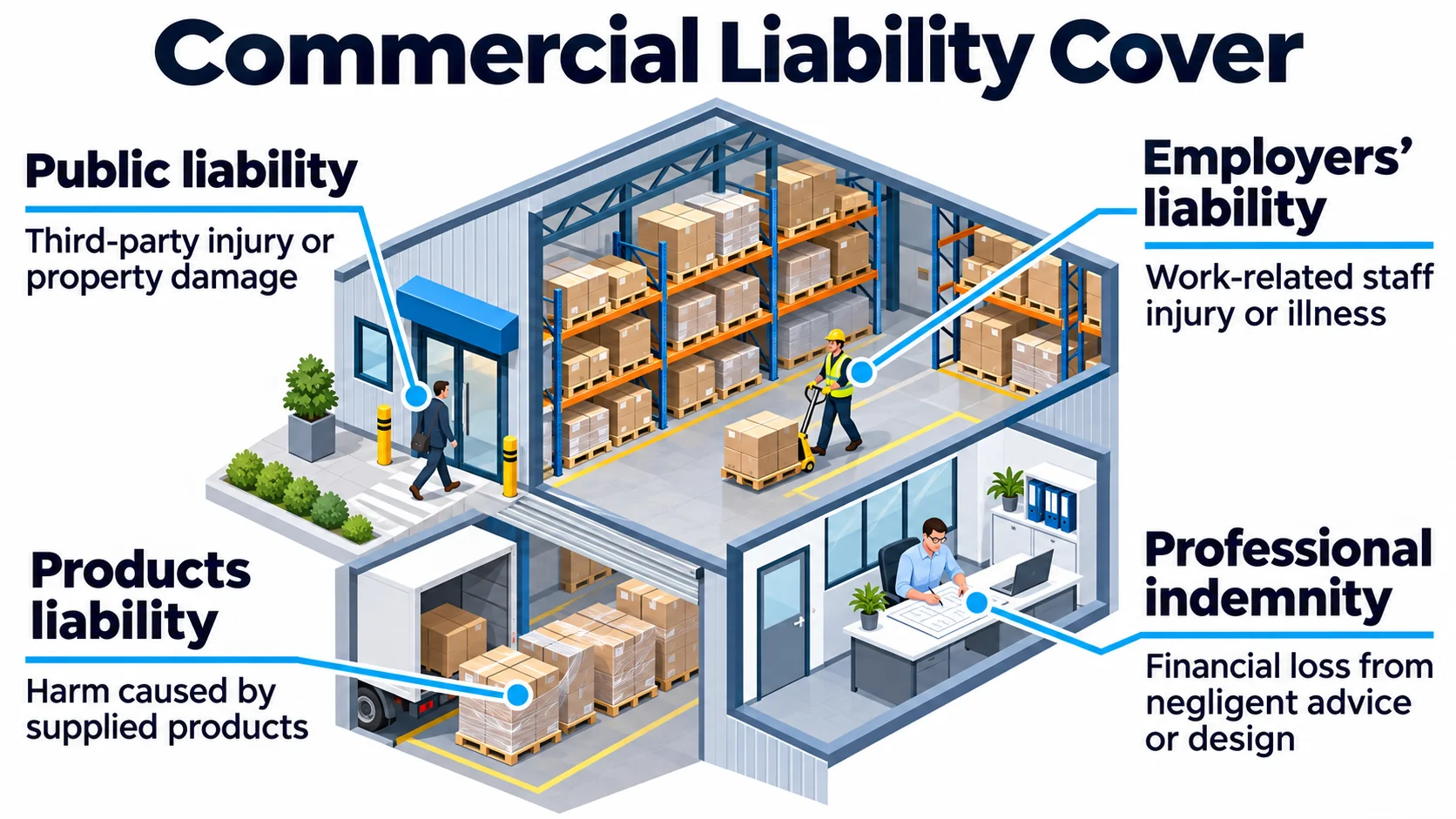
Third-Party Injury and Property Protection
Public Liability Claims in Everyday Operations
Public liability insurance answers civil claims alleging accidental injury or property damage suffered by third parties. The policy pays legal costs, court awards and negotiated settlements. Cover applies to work at client premises, active sites and the organisation’s own facilities. On most standard wordings, defence costs sit inside the indemnity limit.
A visitor slips on a wet warehouse floor. A dropped tool dents a customer vehicle. Both are routine public liability claims. Without cover, the business funds solicitors from retained earnings. A court-ordered award can destabilise an unhedged company within months. Standard policies also fund the defence of claims that prove exaggerated or entirely unfounded.
Contract Requirements and Main Contractor Flow-Downs
Commercial contracts routinely set minimum public liability limits before a contractor reaches site. Public sector frameworks, local authorities and tier-one construction managers commonly demand five or ten million pounds. These thresholds satisfy procurement rules. They also cap the vicarious exposure the client would otherwise carry on its own balance sheet.
Subcontractors who carry thin limits create flow-down risk for the main contractor. From experience across the sector, the breach surfaces during a claim rather than at tender. Read the contract schedule before binding the policy. Excess layer cover bridges the gap between a two million pound primary limit and a ten million pound requirement.
Did You Know?
Under the Employers’ Liability (Compulsory Insurance) Act 1969, a business trading without qualifying cover can be fined up to £2,500 for every day it remains uninsured.
Statutory Protections for the Workplace
Legal Mandates Under the 1969 Act
The Employers’ Liability (Compulsory Insurance) Act 1969 requires UK employers to hold qualifying insurance against employee injury and illness. The statutory minimum limit is five million pounds. Underwriters almost always issue ten million per occurrence as standard. The duty begins with the first employee, not at a turnover threshold.
Trading without valid cover carries criminal penalties enforced by the Health and Safety Executive. Employers must also display the certificate or circulate it digitally for inspection. The legislation protects injured staff first. It stops a company insolvency from blocking rightful compensation for an acute accident or cumulative occupational harm.
Labour Definitions and Subcontractor Exposure
Underwriters decide employee status by operational control, not by PAYE records or tax treatment. Labour-only subcontractors, apprentices, agency staff and volunteers routinely count as employees under standard employers’ liability wordings. The test asks who directs the work. Payroll paperwork rarely settles the question once a serious injury claim lands.
A bona fide subcontractor who insures separately and controls their own method falls outside the statutory requirement. Supply the tools, set the daily routine and dictate the method, and the courts will treat that worker as an employee. Misclassified labour creates an uninsured liability that no later endorsement will repair.
Cover Built for Demanding Businesses
Across high risk industries, the cover we arrange most often includes:
Public liability
Employers' liability
Motor fleet
Contractors' all risks
Freight liability
Professional indemnity
Environmental liability
Business interruption
Most businesses need a combination, rather than a single focus policy, and we build cover around your contracts, your workforce and your operational activities.
Product Defects and Supply Chain Obligations
Product Defect Exposure and Consumer Safety
Products liability insurance covers legal liability for third-party injury or property damage caused by goods sold, supplied or manufactured. Strict liability applies under the Consumer Protection Act 1987. A claimant proves the defect and the resulting harm. They need not prove negligence in design, assembly or fabrication.
Importers bringing goods into the UK from outside the domestic market assume the original manufacturer’s legal responsibilities. If an imported component causes an electrical fire, the UK importer answers the claim directly. Adequate limits absorb recall expenses, property destruction and toxic tort exposure that a trading margin could never fund.
Combined Schedules for Trade Operations
Insurers commonly merge public and products liability into one schedule. Combined liability insurance keeps protection continuous across manufacture, delivery and installation. That continuity matters when an installation error overlaps with a defective fabricated item. A single insurer then adjudicates the claim, rather than two arguing over causation.
Package structures remove contribution disputes where causation stays ambiguous. An installed boiler leaks and floods a plant room. Establishing whether faulty assembly or poor site work caused it can take months. One schedule resolves that question quickly. Faster indemnity protects liquidity and, just as importantly, the customer relationship.
Professional Advice and Design Vulnerabilities
Legal Exposure for Negligent Advice and Design
Professional indemnity insurance covers financial loss claims caused by negligent advice, inaccurate design or flawed specification. Public liability needs tangible injury or physical damage before it responds. Professional indemnity answers pure financial loss. That distinction decides which insurer pays when a client sues over technical guidance alone.
Contractors on design-and-build projects pick up professional exposure without always recognising it. Amending a structural drawing counts. Offering a value-engineering alternative counts. If the revised specification causes deflection or operational inefficiency, the public liability policy stays silent. Dedicated cover funds rectification demands, contractual disputes and arbitration.
Claims-Made Triggers and Retroactive Dates
Professional indemnity operates on a claims-made basis. The policy in force when the claim is notified responds, not the policy in force when the error occurred. Public liability works differently. It responds on an occurrence basis, anchored to the date the physical incident actually happened.
Continuous cover with an agreed retroactive date is essential for consultancies. Change insurer or lapse the policy without run-off protection, and historic project work loses support immediately. Administrative oversight is the usual cause. Claims can surface years after practical completion, long after the fee has been spent.
Personal Governance and Corporate Defence
Executive Exposure Under Company Legislation
Directors and officers liability insurance protects executives against personal civil liability for alleged wrongful acts in managing the business. The Companies Act 2006 sets out statutory directors’ duties. Breach exposes individuals to personal bankruptcy, disqualification and the loss of private assets. The company’s limited status offers no shield here.
Shareholders, creditors, liquidators and regulators can proceed against a named director rather than the corporate entity. Limited liability protects personal wealth from trade debts alone. It gives no immunity against statutory breach or allegations of mismanagement. Executive cover secures independent representation when the company’s interests diverge from the director’s.
Regulatory Inquiries and Criminal Defence Costs
Executive policies fund defence costs during formal regulatory inquiries, including Health and Safety Executive investigations. Public policy prevents insurers from paying criminal fines or punitive sanctions. Legal advocacy remains insurable. Policies therefore meet the cost of representation through lengthy investigations and corporate manslaughter proceedings.
Modern investigations involve extensive document discovery, forensic accounting and interviews under caution. Legal spend often reaches six figures before prosecutors decide whether to charge. Without executive cover, individual managers fund that defence personally. In practice, we find the cost lands at the worst point in a company’s cash cycle.
Environmental Hazards and Clean-Up Orders
Sudden Pollution Versus Gradual Contamination
Standard public liability policies restrict pollution cover to sudden, unintended and identifiable incidents within the policy period. Gradual seepage, chemical leaching and progressive ground contamination fall outside that wording. Industrial operators, waste handlers and civil engineering contractors therefore carry serious unhedged exposure under a standard liability schedule.
A punctured fuel tank spilling across an access yard is a sudden accidental event. A corroded pipe leaking diesel over twelve months is gradual pollution, and the exclusion applies. Organisations handling dangerous substances or working on brownfield land need a bespoke environmental impairment liability policy to close that gap.
Clean-Up Orders and Biodiversity Redress
The Environmental Damage (Prevention and Remediation) (England) Regulations 2015 allow regulators to demand environmental restoration from the responsible operator. Remediation notices can require on-site clean-up, rehabilitation of adjoining land and compensatory biodiversity work. These obligations run to the regulator, not to a private claimant. Standard third-party wordings rarely reach them.
Statutory clean-up costs regularly exceed conventional property damage awards. Remediating a polluted watercourse or halting chemical migration in an aquifer needs specialist engineers and years of monitoring. Environmental impairment liability policies fund that work. Without them, a single enforcement notice can push a solvent business into administration.
Corporate Liability Architecture and Programme Design
Multi-Cover Schedules That Work Together
An effective liability programme removes friction between policies and aligns indemnity limits across operations. Fragmented placements through separate underwriters create gaps, conflicting notification warranties and arguments over which insurer responds first. Those arguments surface during a live claim. By then the business is already funding its own defence.
A unified structure brings public liability, employers’ liability and property extensions into one coordinated portfolio. Conditions match, notification protocols align and premium calculation consolidates. Brokers assess turnover, subcontracting dependency and actual trading activity. Each division then operates inside boundaries the insurer has seen, priced and accepted in writing.
Excess Layer Strategies for High-Risk Contracts
Major infrastructure clients and tier-one contractors often demand limits above standard primary market capacity. Excess layer policies sit above the primary schedule and deliver ten, twenty or fifty million pounds in total. The layering keeps the primary programme intact. It also keeps the premium proportionate to the real exposure.
Excess layers respond only once the underlying primary limit is exhausted by settlements. That structure buys substantial capacity at a competitive rate. Align the triggers and definitions between layers before binding. Mismatched wording between primary and excess insurers reliably produces dispute during high-value litigation.
Final Thoughts
Commercial exposures need a methodical framework, reviewed on a schedule rather than in a renewal scramble. Sound commercial liability cover lets a trading entity absorb legal disputes, workplace injuries and property damage claims without threatening solvency. Enforcement scrutiny is tightening. Contractual indemnity thresholds keep rising.
Review the wording, close the gaps between separate schedules and track how trading activity has actually changed. Alignment between statutory duty and commercial reality builds durable resilience. Adequate limits paired with disciplined safety controls protect enterprise value far more reliably than premium savings ever will.
Speak to an Insurance Specialist
Whether you need a new quote, want to discuss your renewal or have a question about an existing policy, our team is here to help.
Frequently Asked Questions
Q: What is the statutory difference between public liability and employers’ liability?
A: Employers’ liability insurance is compulsory for almost all UK employers under the Employers’ Liability (Compulsory Insurance) Act 1969. The statutory minimum limit is five million pounds, and it covers work-related injury or illness suffered by staff. Public liability insurance is not required by general statute, though clients and contracts frequently demand it. It responds to civil claims brought by third parties, such as members of the public or customers, for accidental injury or property damage caused by business activities.
Q: Why do standard public liability policies exclude professional indemnity claims?
A: Public liability covers tangible bodily injury and physical damage to third-party property arising from operations. Professional indemnity covers financial loss caused by negligent advice, design error or incorrect specification, with no physical damage required. Insurers keep the two apart because professional negligence carries different legal tests, different limitation periods and claims-made underwriting. A standard operational public liability policy is neither priced nor drafted to absorb that exposure, so the exclusion is deliberate rather than accidental.
Q: What does a claims-made policy wording mean in commercial insurance?
A: A claims-made wording means the policy in force when a claim or circumstance is formally notified to the insurer responds, rather than the policy in force when the alleged error occurred. Most professional indemnity and directors and officers policies work this way. Businesses must keep cover continuous and maintain a valid retroactive date, otherwise work completed in earlier years loses protection. If cover ceases entirely, run-off insurance is the only way to preserve that historic position.
Q: How does an excess layer liability policy function during a loss?
A: An excess layer policy sits directly above a primary liability policy and provides further indemnity once the primary limit is fully exhausted. Suppose a business holds five million pounds of primary public liability but a contract demands fifteen million. It buys a ten million pound excess layer above that primary limit. The excess insurer then pays covered losses above five million, up to the layer limit, generally following the primary policy terms.
Q: Does a standard liability schedule cover gradual environmental contamination?
A: No. Standard public liability policies exclude gradual pollution and restrict environmental cover to sudden, unintended and identifiable events within the policy term. Progressive leaks, cumulative contamination and historic ground pollution need dedicated environmental impairment liability insurance. Those stand-alone policies fund statutory clean-up orders under the Environmental Damage Regulations 2015, on-site remediation and long-term ecosystem rehabilitation. Industrial, waste and brownfield operators should treat the cover as essential rather than optional.
About The Author
Darren Judd
Director, Co-Founder and Co-Owner of Capital Corporate Risks Ltd

Experienced Account Executive with a demonstrated history of working in the insurance industry. Skilled in Account Management, Risk Management, Business Development across all classes of insurance within the Construction Industry,