

Insurance Broker with Claims Service Explained
Most commercial policyholders discover the quality of their broker on the day an incident happens. Placement-only intermediaries treat a claim notification as an administrative hand-off. Loss notices go to the insurer untested, with no scrutiny of indemnity position, reserve accuracy or legal exposure. An insurance broker with claims service works differently. It keeps control of the file, interrogates third-party allegations and defends the technical position throughout.
The cost of passive administration lands later. Inflated reserves and drawn-out negotiations push up premiums and tighten terms at renewal. Under a specialist liability insurance programme, that damage can run for years. So how does structured claims representation protect the balance sheet, correct inaccurate claims data and force insurers to resolve liabilities on fair terms?
Key Takeaways
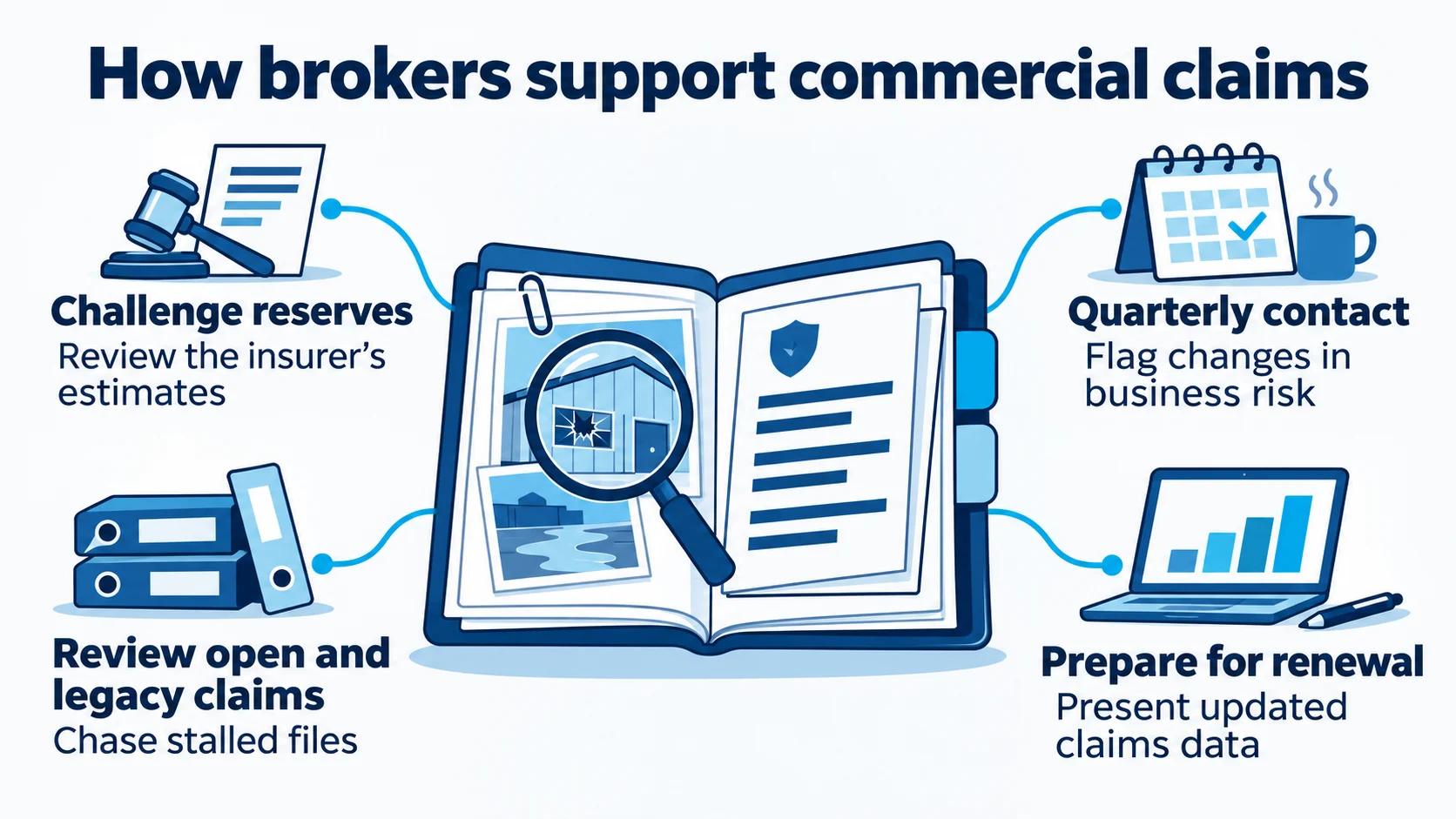
- An insurance broker with claims service challenges excessive insurer reserves throughout the life of every open claim file.
- Unchallenged loss reserves inflate the claims experience, which leads insurers to demand penal premium increases at the annual renewal.
- Quarterly contact ensures operational changes, fleet updates and risk improvements reach underwriters before an incident creates an avoidable coverage dispute.
- Quarterly claims reviews examine third-party notifications, close non-viable files, reduce outstanding reserves and protect commercial renewal terms.
- Legacy claims handling lets appointed specialists take control of unresolved historic files, recover outlay and lower reported loss ratios.
Claims Service Models in Commercial Insurance
Commercial policyholders rarely test their broker until a serious incident lands. The gap between placement-only intermediaries and proactive claims practices then becomes obvious. One forwards paperwork. The other interrogates liability, evidence and reserves. The table below sets out how each model behaves at the five points where claims outcomes are decided.
In practice, the difference shows in who reads the file first. A named claims specialist reviews the incident facts, the contract terms and the third-party allegation. A call centre simply records a loss. Each column below reflects behaviour we see repeatedly across UK commercial accounts, from fleet and liability through to contractors’ programmes.
| Service Attribute | Transactional Intermediary | Proactive Claims Broker |
|---|---|---|
| Service AttributeInitial notification | Transactional IntermediaryAutomated transfer to the insurer call centre | Proactive Claims BrokerTechnical review by a named claims specialist |
| Service AttributeReserve monitoring | Transactional IntermediaryPassive acceptance of insurer estimates | Proactive Claims BrokerQuarterly challenge to excessive reserves |
| Service AttributeIncident investigation | Transactional IntermediaryNo support during evidence capture | Proactive Claims BrokerImmediate guidance on legal defensibility |
| Service AttributeLegacy claims | Transactional IntermediaryIgnored once the policy year ends | Proactive Claims BrokerDedicated handling of expired policy files |
| Service AttributeRenewal integration | Transactional IntermediaryUnadjusted loss history presented | Proactive Claims BrokerLoss ratio cleansing before market presentation |
Transactional Placement Versus Proactive Claims Advocacy
Administrative Forwarding Under Transactional Models
Transactional intermediaries run high-volume placement models. A claim notification triggers automatic routing to the insurer call centre. No one examines the incident facts, the contract conditions or third-party causation first. The insurer registers the loss unchallenged. Initial liability assessments then tilt towards the claimant, and the policyholder inherits that starting position.
That posture carries a cost. Loss adjusters receive uncurated incident reports with no supporting context. Premature liability concessions follow. The broker acts as a postbox, so nobody protects the business from adverse precedent or claims inflation. Renewal pricing then reflects a file that nobody ever defended.
Technical File Management by Claims Specialists
Technical file management starts before the insurer hears about the loss. The claims specialist dissects the incident, assesses statutory duties under UK safety regulation, and reviews site logs. Evidence collection follows immediately. Defensibility comes first, so underwriters set their opening reserve against documented facts rather than assumption.
Advocates then hold the line throughout the inquiry. They maintain direct contact with directors, safety officers and loss adjusters. Teams scrutinise third-party correspondence and instruct forensic experts where causation is disputed. Named senior staff own that process, including Operations Director Dan Coleman. The broker also holds panel solicitors to the agreed defence strategy.
Did You Know?
The Limitation Act 1980 gives most personal injury claimants three years from the date of injury or knowledge. Insurers still hold reserves open on unpursued files well beyond that period unless a broker challenges them formally.
First Notification and Evidence Capture
Incident Reporting and Site Evidence
The first forty-eight hours decide most liability disputes. A claims broker guides the site team through photographs, witness accounts, maintenance records and permit documentation. The team captures that material whilst it still exists. Insurers receive a structured notification rather than a bare loss notice, and the file opens from a defensible position.
Evidence gaps cost money later. Without contemporaneous records, insurers cannot rebut an inflated quantum claim two years on. In practice, we find that well-documented files settle faster and at lower values. Weak files drift, attract higher reserves, and distort the loss run at renewal.
Defensibility Before Insurers Set Reserves
Defensibility means the file can withstand scrutiny from a claimant solicitor. The broker tests causation, checks contractual indemnities, and confirms whether statutory duties were met. The broker identifies any admission risk early. Insurers then open the claim with a realistic reserve, which protects the incurred figure underwriters read at renewal.
Reserve accuracy at notification matters more than most policyholders expect. An opening estimate often survives for years. Correcting it later takes evidence, persistence and formal challenge. Getting the notification right removes that work entirely, and keeps the claims experience clean from day one.
Cover Built for Demanding Businesses
Across high risk industries, the cover we arrange most often includes:
Public liability
Employers' liability
Motor fleet
Contractors' all risks
Freight liability
Professional indemnity
Environmental liability
Business interruption
Most businesses need a combination, rather than a single focus policy, and we build cover around your contracts, your workforce and your operational activities.
Insurer Loss Reserving and Its Financial Effect
Precautionary Reserves and Solvency Rules
Insurers post a precautionary reserve as soon as a loss reaches them. Regulatory solvency rules require it. These opening figures assume a worst-case outcome. They include maximum potential damages, claimant legal costs and handling expenses. Verified loss data rarely features at this stage, because the investigation has barely started.
Actuaries use gross reserving metrics to calculate technical loss ratios. An inflated reserve that crosses a renewal date behaves like money already paid. Underwriters apply rate increases and higher excesses accordingly. Evidence disproving the claim carries no weight unless somebody forces the reserve down.
Reserve Challenges Through Claims Advocacy
A claims advocacy insurance broker attacks static reserve figures with current evidence. Updated medical reports, engineering findings and commercial records all narrow the exposure. Speculative heads of claim come apart under documentary scrutiny. The insurer then recalibrates its financial position, and the incurred total on the loss run falls.
Forcing a reduction takes forensic persistence. It also takes working knowledge of the Judicial College Guidelines and the Civil Procedure Rules. When a claimant valuation lacks documentary support, insurers reduce the recorded liability. That correction cleanses the claims experience and preserves underwriting goodwill.
Quarterly Contact and Mid-Term Risk Maintenance
Mid-Term Operational Changes and Disclosure
Quarterly contact exists to catch undeclared change before a loss exposes it. Industrial businesses buy machinery, alter standard contract terms, add subcontractors and open new sites. Each shift moves the risk profile. Scheduled reviews pick up those changes and update the policy wording whilst cover still responds cleanly.
Non-disclosure of a material alteration breaches the duty of fair presentation under the Insurance Act 2015. Insurers can then apply proportionate remedies, including reduced settlements. Quarterly engagement removes that exposure. It also prevents indemnity arguments and reservation-of-rights correspondence at the worst possible moment.
Emerging Hazards and Process Deficiencies
Routine contact surfaces systemic hazards before they become balance sheet liabilities. The broker reviews minor incidents, near-misses and health and safety trends. Patterns appear quickly across a quarter. Practical adjustments follow, satisfying both policy conditions and statutory duties, and underwriters see a business that manages risk deliberately.
Feedback covers tool security, hot works permits, waste storage distances and plant inspection intervals. Fixing a procedural weakness beforehand removes the insurer’s technical ground for repudiation. From experience across the sector, this governance also strengthens the presentation to competitive underwriting syndicates at renewal.
Quarterly Claims Reviews and Open File Audits
Stalled Negotiations and Open Files
Quarterly claims reviews are formal meetings between the broker, the insured and the insurer’s claims team. Every outstanding notification goes under audit. Static files receive particular attention, especially where third-party solicitors never substantiate damages. Delay suits the other side, because billing continues whilst the file stays open.
Stalled litigation is a real financial threat to contractors. A claimant who never serves proceedings leaves the reserve sitting on the loss run indefinitely. Active brokers impose procedural timetables. They press insurers to make a formal settlement offer or apply to court for strike-out.
File Defensibility and Dormant Records
Reviews also force closure of abandoned third-party claims. Insurers often hold files open for years after an unsubstantiated alert. Those ghost liabilities distort operational metrics and misrepresent the account. The broker presents the accumulated evidence, demonstrates that nothing further is pending, and requires a closure decision.
Limitation is the strongest argument available. Under the Limitation Act 1980, most claims become statute-barred once the relevant period expires. Brokers use that position to compel write-off of dormant reserves. Removing them produces a loss run that reflects actual operational performance rather than administrative backlog.
Renewal Terms, Loss Ratios and Market Standing
Loss Ratio Cleansing Before Market Presentation
Loss ratio cleansing is a forensic audit of claims data before the market sees it. The team removes settled files, corrects misallocated losses and recalculates outstanding reserves. Unavoidable incidents gain context through risk improvement evidence. Underwriters then price the account against accurate history instead of raw insurer output.
Clean data produces measurable savings. Underwriters price perceived control as much as historical cost. Evidence that past incidents closed economically, or represented isolated events, changes the rating conversation. Composite insurers then compete for the account rather than loading it defensively.
Policy Restrictions and Excess Structures
Poor claims histories invite penal terms. Insurers impose height warranties, aggregate pollution limits and sharp excess increases. A claims team defends against each restriction with root-cause analysis and documented corrective action. Where the broker proves the trend has stopped, underwriters withdraw the endorsement and restore standard wording.
Terms matter commercially, not just financially. Broad indemnity wording lets a contractor bid confidently for major infrastructure work. A restrictive warranty can disqualify a tender outright. Holding standard excess levels also protects working capital when small, unavoidable trade losses occur.
Legacy Claims and Subrogation Recoveries
Control of Prior Policy Losses
Legacy claims handling covers unresolved files from expired policies placed by a previous broker. Many organisations carry several. The predecessor stopped managing them once the account moved. Reserves sit untouched, still feeding the loss history that current underwriters review, and nobody pushes the insurer towards resolution.
Specialist brokers audit the historical portfolio, obtain letters of authority and take conduct of the stranded files. They then challenge each reserve and press for settlement or closure. Clearing historic disputes restores clarity and removes a multi-year drag on the account’s rating.
Subrogation Recovery and Deductible Outlay
Subrogation turns a paid loss into a recoverable one. Where a supplier’s equipment failed, or a subcontractor caused the damage, the insurer can pursue that party. Active brokers make sure recovery specialists actually do so. Successful recovery reimburses the policyholder’s deductible and reduces the recorded cost of the claim.
Recovery also changes the classification. A fault claim becomes a non-fault claim once the third party pays. That shift improves the historical claims ratio directly. Diligent subrogation management means the business never carries the financial consequence of another party’s failure.
Final Thoughts
A transactional placement model leaves a commercial organisation exposed the moment a serious liability claim arrives. Appointing an insurance broker with claims service changes that position. The business gains technical advocacy, active reserve scrutiny and procedural discipline across every stage. Statutory compliance improves, and unsubstantiated third-party allegations meet proper resistance.
Disciplined claims advocacy protects the balance sheet and holds terms steady through the renewal cycle. Quarterly contact, formal claims reviews and dedicated legacy file handling together build operational resilience. Commercial leaders who insist on that standard put their organisations in a far stronger position when litigation arrives.
Speak to an Insurance Specialist
Whether you need a new quote, want to discuss your renewal or have a question about an existing policy, our team is here to help.
Frequently Asked Questions
Q: What does an insurance broker with claims service do differently?
A: It provides continuous technical advocacy instead of forwarding claim forms to the insurer. The broker investigates the incident, tests statutory liability, reviews the commercial evidence and challenges precautionary reserves set at notification. It coordinates the legal defence, supervises third-party negotiation and imposes timetables so files resolve rather than drift. The practical difference shows in the loss run, which carries accurate figures instead of untested worst-case estimates.
Q: How do unchallenged reserves affect renewal terms?
A: Insurers set an opening reserve to satisfy solvency requirements, usually on a worst-case basis. Underwriters then price the account on total incurred cost, which combines paid losses and open reserves. If nobody challenges an inflated figure before renewal, it behaves exactly like money already spent. The result is a higher rate, a larger excess and sometimes restrictive endorsements, even whilst the underlying claim remains disputed and unresolved.
Q: Why do commercial policyholders need quarterly claims reviews?
A: A quarterly review puts the policyholder, the broker and the insurer’s claims handlers around the same table. The meeting audits every open file in turn. It identifies stalled negotiations, questions legal spend, challenges speculative quantum and forces closure of dormant records. Doing this four times a year prevents file stagnation and removes phantom liabilities. The loss run presented to the market then reflects genuine performance rather than administrative inertia.
Q: What is legacy claims handling?
A: Legacy claims handling means taking active control of unresolved files that arose under expired policies placed by a previous intermediary. Brokers frequently abandon those claims once the account moves elsewhere. Reserves then sit unmonitored for years whilst continuing to damage current risk pricing. A specialist broker obtains authority, reviews each file, challenges the reserve level and pushes stalled litigation towards settlement, closure or statutory limitation.
Q: How does claims advocacy protect specialist liability insurance?
A: Specialist liability insurance carries detailed warranties, contractual indemnities and substantial limits. Small reporting failures can jeopardise cover. A claims advocate confirms the notification meets policy conditions, assembles the evidence pack and contests unfounded reservation-of-rights positions from underwriters. That work keeps the indemnity intact when the exposure is largest. It also protects the business from bearing third-party property damage or bodily injury costs that the policy was bought to cover.
About The Author
Darren Judd
Director, Co-Founder and Co-Owner of Capital Corporate Risks Ltd

Experienced Account Executive with a demonstrated history of working in the insurance industry. Skilled in Account Management, Risk Management, Business Development across all classes of insurance within the Construction Industry,