
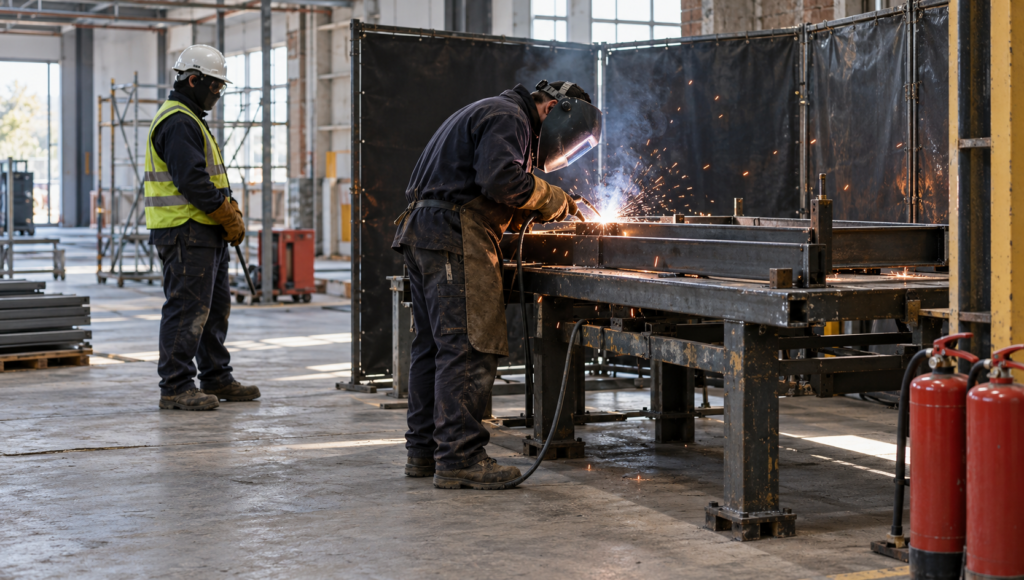
Hot Works Insurance: Heat Risks and Policy Rules
Applying direct heat on a construction site creates one of the sector’s most severe property damage exposures. Hot works insurance protects contractors against that risk, but only where strict conditions are met. Insurers scrutinise open flames, grinding sparks and thermal cutting closely. A single smouldering ember can ignite hours after operatives leave. Without adherence to heat warranties, the policyholder carries the loss alone.
Torch-on roofing, structural welding, pipe brazing and metal cutting all demand rigorous control before an underwriter accepts liability. Combining thermal tools with elevated access multiplies the peril. So how can specialist trade contractors prove their daily procedures satisfy mandatory underwriting terms?
Key Takeaways
- Underwriters require a signed hot work permit before any operative strikes an open flame on site.
- Standard warranties enforce a minimum sixty-minute fire watch and a cleared combustible zone around the work area.
- Open flame work on scaffolds must align heat endorsements with the terms of working at height insurance.
- Contractors using torch-applied systems should confirm their roofing insurance names heat conditions rather than assuming standard commercial cover.
- Missing extinguishers or an unsigned permit close-out can void third-party property damage indemnity after a fire.
Thermal Operations, Hazards and Underwriting Controls
Specialist contractors carry out a wide range of thermal operations. Each one carries a distinct fire profile. Commercial underwriters group these tasks by flame intensity, spark dispersion and the combustible materials nearby. In practice, the control imposed on a job follows that grouping rather than the trade label.
The table below sets out the thermal tasks most often declared to UK insurers. It pairs each one with its primary hazard and the control an underwriter will usually impose. These controls appear as warranties or conditions precedent in the policy schedule. Breaching any of them puts cover for the resulting fire at risk.
| Operation Type | Primary Hazard | Mandatory Underwriting Control |
|---|---|---|
| Torch-on roofing | Bitumen ignition and combustible deck fires | 60-minute fire watch and timber clearance |
| Structural steel welding | Slag drop and concealed cavity sparks | Non-combustible screens and permits |
| Angle grinding and cutting | Long-distance spark spread | Six-metre combustible clearance perimeter |
| Plumbing pipe brazing | Combustible insulation ignition | Heat-shield mats and combustible removal |
| Thermal bitumen boilers | Spillages and uncontrolled boil-overs | Continuous supervision and drip containment |

Contractual Definitions and Operational Scope
Scope of Regulated Thermal Work
Insurers define hot works as any process using naked flames, electric arcs, grinding wheels or other heat-generating equipment. The test is simple. Can the tool ignite nearby combustible material? That definition captures oxy-fuel cutting, arc welding, brazing, soldering, hot-air gun stripping and bituminous felt application by gas torch.
Tradesmen often assume light soldering or disc grinding falls outside the policy definition. It does not. Underwriters apply blanket heat exclusions to standard commercial policies unless a written endorsement exists. Operating without that endorsement strips out third-party property damage indemnity for any fire claim. Contractors must declare every thermal process at the point of disclosure. The Insurance Act 2015 requires a fair presentation of the risk.
Thermal Risk Across Trade Disciplines
Risk varies sharply between trades because the work environment and adjacent materials differ. Structural steel erectors throw high-energy spatter during stick welding. Mechanical services contractors apply direct flame when soldering joints in occupied buildings. Flat roofers run intense heat directly above timber decks and combustible insulation layers.
Underwriters therefore tailor warranty wording to the specific trade. Demolition contractors meet hidden hazards when flame cutting inside derelict structures. Legacy insulation and flammable residue sit behind panels and voids. Workshop fabricators, by contrast, work over concrete with permanent extraction in place. Field-based operations attract higher premiums, larger excess layers and tighter risk assessment requirements.
Did You Know?
The Joint Code of Practice on fire prevention for construction sites requires a permit for all hot work. It also requires the area to be monitored for at least 60 minutes after the heat source is extinguished. A further check must follow before the site is left unattended. Insurers write this requirement into policy warranties as standard.
Permit Protocols and Documentation Standards
Structure of a Hot Work Permit
A permit-to-work system gives verifiable proof that risk was controlled before heat was applied. The permit works as both an operational checklist and an administrative record. It logs the hazards present, the controls applied and any atmospheric testing carried out. It also records emergency provisions and the individuals responsible on the day.
Most underwriters make an operating permit system a condition precedent to liability. The permit must record the exact location, the equipment authorised and the named fire watch personnel. It must also record pre-work atmospheric tests where flammable gas or vapour may be present. A competent person issues and signs the permit before work begins. That signature confirms every physical control is already in place.
Permit Authorisation and Sign-Off
Formal close-out proves the contractor met every post-work monitoring duty before leaving site. The authorised fire safety coordinator inspects the work area in full. That inspection confirms all surfaces have returned to ambient temperature. The coordinator then records the clearance time and signs the permit closed.
An undocumented sign-off time exposes the contractor to a repudiated claim after an overnight fire. Insurers examine permit timestamps closely following any major property loss. If the record shows operatives left before the monitoring window closed, the policyholder has breached a condition precedent. Legible, organised and archived permit records are the only defence against long-tail disputes.
Cover Built for Demanding Businesses
Across high risk industries, the cover we arrange most often includes:
Public liability
Employers' liability
Motor fleet
Contractors' all risks
Freight liability
Professional indemnity
Environmental liability
Business interruption
Most businesses need a combination, rather than a single focus policy, and we build cover around your contracts, your workforce and your operational activities.
Fire Watch Protocols and Site Clearances
Continuous Fire Watch Duties
Policy warranties commonly demand an unbroken fire watch of at least sixty minutes after the last thermal process stops. Where combustible construction materials surround the work, insurers often extend that window to two hours. The designated observer must do nothing else. Fire detection is the sole duty for the full period.
The fire watch operative cannot clear up, pack away tools or take on unrelated tasks. Smouldering combustion inside roofing felt, insulation board and timber battens can develop silently for hours. It then breaks into open flame long after the crew has gone. Many underwriting conditions now encourage thermal imaging cameras during the watch. These handheld units detect subsurface hot spots the eye cannot see.
Physical Clearance and Protection Distances
Heat warranties require all movable combustible material to be cleared within a set radius. Six to ten metres is the usual figure. Where removal is impossible, the material must be shielded completely. Non-combustible coverings, flame-retardant blankets and purpose-made welding curtains are the accepted protections for that purpose.
Gaps in floors, wall penetrations and service ducts must be sealed before work starts. Falling sparks otherwise enter hidden cavities and burn undetected. Sparks from disc grinding travel over nine metres horizontally, bouncing off hard surfaces into adjacent rooms. Adequate clearance is a legal duty as well as a contractual one. The Construction (Design and Management) Regulations 2015 and the Health and Safety at Work Act 1974 both apply.
Equipment Provisions and Extinguishing Safeguards
Fire Extinguisher Positioning and Readiness
Insurers expect serviceable extinguishing appliances within immediate reach of the hot work zone. Standard policy conditions call for at least two approved extinguishers of adequate capacity. Dry powder or foam units are the usual specification. Both must sit directly beside the operative, not at the far end of the floor.
Operatives must check service inspection tags before striking an arc or lighting a burner. Outdated, discharged or uninspected extinguishers breach policy terms outright. The operative and the fire watch observer both need documented training in extinguisher use. Water buckets and domestic hosepipes do not meet commercial underwriting requirements. Neither suppresses burning bitumen or an electrical arc fire.
Gas Cylinder Handling and Isolation
Compressed flammable gas cylinders fall under the Provision and Use of Work Equipment Regulations 1998. Propane, acetylene and oxygen cylinders must stand upright and remain secured at all times. Purpose-built trolleys or rigid restraints prevent accidental tipping during use. Loose cylinders on a roof or scaffold deck will fail any underwriter inspection.
Warranties require fitted flashback arrestors and pressure regulators checked against current British Standards. When thermal work ends, operatives must close cylinder valves and isolate the torches. Policies prohibit leaving pressurised hoses charged during lunch breaks or overnight. Cylinders must come out of confined spaces and off elevated roofing structures at the end of every shift.
Elevated Heat Hazards and Height Alignment
Open Flame Work on Scaffolds and Platforms
Running flames or cutting gear on scaffolding compounds the risk through wind exposure and vertical spark drop. Wind accelerates flame spread across an open deck. It also carries incandescent slag well beyond the work station. That slag lands on unprotected combustible material several storeys below.
Thermal safety protocols must align with the terms of working at height insurance. The Work at Height Regulations 2005 require robust planning to prevent falling materials. Burning debris falls within that duty. Fire-resistant debris netting and solid scaffold boarding catch molten metal before it reaches lower tiers. Insurers examine these layered controls before agreeing high-elevation indemnity terms.
Structural Penetration and Cavity Risks
Elevated work clusters around parapets, eaves, fascias and roof penetrations. These details hide structural cavities that act as direct fire pathways. Natural draft pulls hot gases into roof voids. Combustible dust, felt underlay and timber trusses then ignite without any smoke showing on the exterior.
Roofing insurance must account for these penetration risks through a tailored torch-on extension. Standard liability schedules exclude damage to the property being worked upon. Only an explicit amendment from the broker restores that cover. Near eaves, combustible upstands and timber detailing, roofers should switch to non-flame methods. Self-adhesive underlays and cold-applied liquid systems remove direct flame contact entirely.
Policy Warranties and Repudiation Pitfalls
Strict Interpretation of Insurance Warranties
An insurance warranty is a strict contractual promise to do, or refrain from, something specific. Under the Insurance Act 2015, a breach suspends the insurer’s liability. That suspension lasts until the contractor puts the non-compliance right. Any loss attributable to the breach during that period falls outside the policy entirely.
Consider an operative who extinguishes a torch and leaves the roof after thirty minutes. A fire starts forty minutes later. The breach relates directly to the loss. The insurer then has full legal grounds to decline the claim. The contractor carries sole responsibility for third-party property damage, which routinely runs into millions of pounds.
Gaps in Subcontractor Insurance Flow-Down
Main contractors regularly subcontract thermal work without checking the subcontractor’s endorsements. Standard public liability policies held by labour-only and bona-fide subcontractors often carry strict heat exclusions. That cover becomes worthless the moment an open-flame fire starts. From experience across the sector, this gap surfaces only after the loss.
Principal contractors need a checking procedure before any thermal equipment reaches site. That means inspecting certificates of currency, schedule endorsements and specific hot works limits. The terms must match the duties accepted under the main contract. When a subcontractor’s insurer repudiates, the property owner pursues the principal contractor instead. A principal without contingent cover faces a threat to commercial survival.
Risk Reduction and Cold Process Alternatives
Cold-Applied Alternatives to Open Flame
Removing open flame altogether is the most effective way to control thermal liability. It also lowers insurance expenditure year on year. The construction industry now adopts cold-applied technologies in growing numbers. These systems achieve watertight integrity and structural bonding without any direct heat applied on site.
Liquid polyurethane membranes, cold-applied adhesives and self-adhesive vapour barriers perform well across roofing applications. In mechanical services, press-fit piping and crimped joint systems replace brazing and soldering. Material costs for cold-applied systems sometimes run slightly higher. The trade-off is favourable. Fire watch overheads disappear, permit administration shrinks and annual liability premiums fall.
Site Auditing and Competency Development
Verifiable workforce competency builds underwriting credibility and cuts claims frequency over time. Staff should complete accredited thermal safety courses before working unsupervised. Good courses cover permit administration, gas cylinder handling and combustion dynamics. They also cover correct operation of the fire suppression equipment kept on site.
Management teams should run unannounced site audits to confirm operatives follow declared procedures. Auditors check extinguisher service dates, measure combustible clearance perimeters and read permit logs for accurate times. A clean audit trail proves risk management diligence in a way that paperwork alone cannot. That evidence counts at renewal. It helps contractors secure better rates and higher indemnity limits.
Final Thoughts
Hot works insurance is an operational necessity for any trade applying heat on a UK construction site. Naked flames, grinding sparks and thermal cutting demand procedural discipline from permit clearance through to the final fire watch. Where daily site practice matches the policy warranties, the contractor protects both the client’s property and its own balance sheet.
Cold-applied alternatives and thermal scanning technology continue to reshape the sector. Contractors who adopt them demonstrate higher operational standards. That record opens the door to broader cover and removes catastrophic fire exposure from complex commercial sites.
Speak to an Insurance Specialist
Whether you need a new quote, want to discuss your renewal or have a question about an existing policy, our team is here to help.
Frequently Asked Questions
Q: What is the standard duration for a post-work fire watch under UK insurance policies?
A: Underwriters normally require a continuous fire watch of at least sixty minutes after the last thermal tool is extinguished. Higher-risk structures attract a longer window. Timber frames, combustible cladding and extensive concealed cavities often push the requirement to two hours. The designated observer must focus solely on fire detection throughout. No clearing up, no packing away, no unrelated duties. The final clearance time must then be recorded on the permit before anyone leaves the site.
Q: Does standard public liability insurance automatically cover the use of open flames?
A: No. Standard public liability policies exclude open flames, naked heat and thermal cutting by default. Contractors must request a specific hot works endorsement from their broker. That request means disclosing every relevant thermal process during the risk presentation. The insurer then attaches warranties covering matters such as permit controls and clearance distances. Those warranties must be followed to the letter. A breach can leave the policy ineffective at the exact moment a fire loss occurs.
Q: What happens if an operative fails to clear combustibles to the required distance?
A: That failure breaches a condition precedent in the policy. Sparks may fall and ignite material left inside the clearance perimeter. The insurer can then decline the claim under the Insurance Act 2015. The policyholder loses third-party property indemnity in full. Liability then falls on the contractor directly. That exposure covers rebuilding costs and business interruption losses suffered by the occupier. Legal defence fees arising from the claim follow as well.
Q: Can thermal imaging cameras replace the requirement for a physical fire watch?
A: No. A camera cannot replace the physical presence of a trained observer during the mandatory monitoring period. Insurers do recommend infrared thermal imaging alongside the watch. The technology detects subsurface heat build-up in roof decks, timber joists and wall penetrations that the eye cannot see. Used that way, it genuinely improves detection. The operative must still complete and document the full monitoring window before leaving site.
Q: How do cold-applied roofing systems affect a contractor’s insurance risk profile?
A: Cold-applied liquid systems, single-ply membranes and self-adhesive bitumen felts remove the open-flame hazard completely. Taking direct heat out of roofing work cuts fire loss potential sharply. Insurers view these methods favourably at underwriting. The practical results are lower liability premiums and reduced policy excesses. Procedural warranties also become less onerous than those imposed on traditional torch-applied work. Over a renewal cycle, the saving often offsets the higher material cost.
About The Author
Darren Judd
Director, Co-Founder and Co-Owner of Capital Corporate Risks Ltd

Experienced Account Executive with a demonstrated history of working in the insurance industry. Skilled in Account Management, Risk Management, Business Development across all classes of insurance within the Construction Industry,