

Goods in Transit Insurance: Cargo Cover Basics
Transporting cargo across the United Kingdom exposes hauliers, freight forwarders and courier fleets to serious financial risk. Commercial loads face collisions, handling damage, water ingress and organised theft. Goods in transit insurance protects your balance sheet when a consignment is lost or destroyed. Without it, a single claim can exceed the compensation your trading conditions allow.
Many operators assume their trading conditions and motor policy cover every damaged consignment. In practice, gaps appear whenever the contract and the insurance schedule disagree. Do your current carriage terms and policy limits truly match your real freight exposure?
Key Takeaways
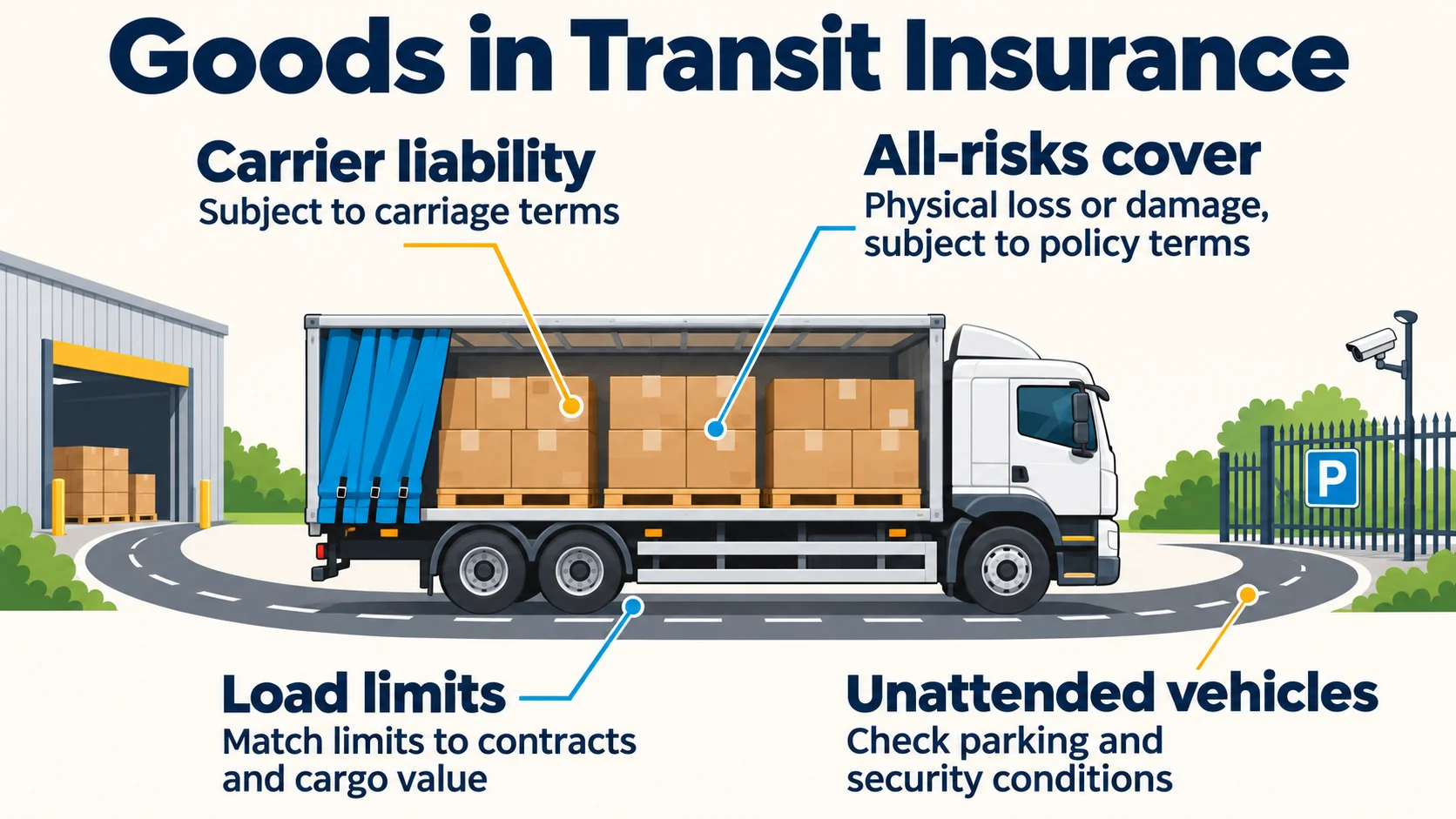
- Carriers liability pays only where your contract makes you liable, whilst all-risks cover responds to physical loss or damage.
- RHA conditions cap liability at £1,300 per gross tonne, which leaves large shortfalls on lightweight, high-value freight.
- Unattended vehicle warranties dictate parking, locking and overnight storage, and any breach lets insurers decline a theft claim.
- Customer contracts must be matched against per-vehicle and per-load limits before you accept liability you cannot insure.
- Specialist work needs bespoke extensions for refrigeration breakdown, hazardous loads, target goods and multi-drop courier deliveries.
Cargo protection frameworks in commercial transport
Commercial freight moves under two broad insurance structures: carriers liability and all-risks goods in transit cover. The boundary between statutory conventions, standard trading conditions and the policy itself decides what a claim actually pays. Transport operators must set limits that satisfy customer contracts and still absorb a total loss.
The table below sets out the main frameworks governing cargo cover on UK domestic and international road movements. Each basis carries its own compensation formula and its own ceiling. Comparing them shows where responsibility sits, how limits behave in practice, and why the basis of indemnity matters.
| Framework / Basis | Typical Liability Limit | Core Application |
|---|---|---|
| Framework / BasisRHA Conditions of Carriage | Typical Liability Limit£1,300 per gross metric tonne | Core ApplicationUK domestic haulage contracts |
| Framework / BasisCMR Convention | Typical Liability Limit8.33 SDR per kilogram | Core ApplicationInternational cross-border road transit |
| Framework / BasisBIFA Standard Trading Conditions | Typical Liability Limit2 SDR per gross kilogram | Core ApplicationFreight forwarding and logistics management |
| Framework / BasisAll-Risks Goods in Transit | Typical Liability LimitAgreed invoice value or policy limit | Core ApplicationHigh-value, fragile or bespoke freight |
| Framework / BasisCourier All-Risks Cover | Typical Liability LimitSpecified limit per parcel or load | Core ApplicationMulti-drop, parcel and express transport |
Carriers liability compared with all-risks cover
How carriers liability responds
Carriers liability insurance indemnifies the operator only for legal liabilities arising under the contract of carriage. If no liability attaches, the policy does not pay. The cargo owner is then left to recover from its own goods insurer. In practice, we find this surprises customers more than any other policy feature.
Under RHA Conditions of Carriage, exposure is measured by weight, not retail value. A haulier is liable for £1,300 per gross metric tonne. Damage caused by an event outside the carrier’s control may create no liability at all. The carriers liability policy will then pay nothing to the cargo owner. That outcome is contractually correct and commercially damaging.
All-risks transit cover provisions
All-risks goods in transit insurance indemnifies physical loss or accidental damage to freight directly. Legal liability is irrelevant to the claim. Settlement follows the commercial value of the consignment, up to the agreed policy limit. This gives shippers and carriers far broader financial security than a liability-only wording.
All-risks cover pays actual property value up to the policy ceiling. It bypasses weight-based formulas entirely. Shippers moving electronics, pharmaceuticals or luxury retail goods routinely insist on it. Settlements then reflect replacement cost rather than tonnage. Claims also settle faster, because fault and negligence need not be argued first.
Did You Know?
Article 29 of the CMR convention removes the carrier’s weight-based liability cap in cases of wilful misconduct. The 8.33 SDR per kilogram limit no longer applies. Liability becomes unlimited.
Contractual frameworks in UK road transport
Road Haulage Association conditions
The Road Haulage Association Conditions of Carriage form the standard contractual baseline for domestic haulage in Great Britain. They cap carrier liability at £1,300 per gross metric tonne. That ceiling protects operators against open-ended claims. It also limits what a customer can recover after a total loss.
Weight-based limits work sensibly for aggregates, timber and other dense, low-value loads. Modern supply chains are different. Consider two hundred kilograms of computing equipment worth fifty thousand pounds. RHA terms cap liability near two hundred and sixty pounds. Haulage insurance must therefore be structured around the contracts actually signed with customers.
CMR convention limits on international movements
The CMR convention governs cross-border road carriage of goods between contracting states. It imposes strict liability on the carrier. Compensation is capped at 8.33 Special Drawing Rights per kilogram of gross weight lost or damaged. Carriers cannot contract out of these rules on an international movement.
Special Drawing Rights are a reserve asset valued by the International Monetary Fund. The rate moves daily, so the sterling ceiling moves with it. Where a UK operator subcontracts a European leg, liability flows down the chain. The policy must carry an explicit CMR endorsement. Without it, strict liability claims from cross-channel work sit uninsured.
Cover Built for Demanding Businesses
Across high risk industries, the cover we arrange most often includes:
Public liability
Employers' liability
Motor fleet
Contractors' all risks
Freight liability
Professional indemnity
Environmental liability
Business interruption
Most businesses need a combination, rather than a single focus policy, and we build cover around your contracts, your workforce and your operational activities.
Vehicle and consignment policy limits
Per-vehicle cover thresholds
Per-vehicle limits fix the maximum an insurer will pay for cargo lost or destroyed on one transport unit. Operators must set that figure against peak accumulation, not average loads. Drawbar rigs, multi-trailer combinations and depot consolidation runs all concentrate value. The limit should reflect the worst realistic day.
An inadequate per-vehicle limit turns the operator into a co-insurer. Picture an artic carrying three consignments worth two hundred thousand pounds. A fifty-thousand-pound vehicle limit leaves one hundred and fifty thousand pounds exposed. Insurers may also apply average where vehicles are underinsured, cutting settlements proportionally. Fleet capacities need a systematic review at least annually.
Single-load exposure calculations
Single-load limits cap recovery for one distinct consignment inside the vehicle. The figure should match the highest invoice value accepted under your trading terms. Precision engineering parts and high-density manufactured goods concentrate value into a small footprint. A modest pallet count can carry a six-figure replacement cost.
Hauliers should require customers to declare consignment values before collection. Booking systems can capture that figure at the point of order. Where a load exceeds the standard threshold, brokers arrange a temporary uplift or a project endorsement. The cost of an uplift is trivial beside an uninsured shortfall. From experience across the sector, undeclared value causes more disputes than damage itself.
Unattended vehicle warranties and theft controls
Key conditions for unattended vehicles
Unattended vehicle clauses require the driver to secure the vehicle whenever the cab is unoccupied. Doors, windows and cargo apertures must be locked. Keys must be removed from the ignition. Alarms and immobilisers must be set, and deadlocks engaged where the policy specifies them.
Freight theft is among the most frequent transit claims in the UK. Insurers enforce these warranties strictly. A driver who stops at a service station without engaging deadlocks can void the whole claim. Written security protocols and periodic audits are the practical defence. In practice, we find rest breaks are where compliance slips first.
Overnight parking restrictions and compound standards
Overnight warranties require loaded vehicles to stand in an approved secure compound during driver rest periods. Approved facilities carry perimeter fencing, lockable gates, active surveillance and adequate lighting. Lay-bys, public roads and unmonitored industrial estates fail that test. Parking there overnight usually breaches the policy outright.
Many wordings exclude theft between 22:00 and 06:00 unless the vehicle is compounded or continuously attended. Long-distance work therefore needs route planning around pre-booked secure parking. Driver discretion is not a substitute for a booking. Operators should keep compound receipts with the delivery paperwork. Insurers ask for that evidence at the first sign of a theft claim.
High-risk goods and cargo sub-limits
Classifications of high-risk cargo
Insurers treat commodities with high resale appeal as target goods. Spirits, tobacco, consumer electronics, branded clothing and pharmaceuticals all fall into that bracket. Each requires explicit notification to the underwriter before carriage. Standard wordings either exclude these items or restrict them with a tight sub-limit.
The Insurance Act 2015 requires a fair presentation of the risk. Carrying target goods without disclosure can invalidate a claim entirely. Underwriters usually price these loads against stated controls. Expect requirements for live tracking, two-driver crews and route restrictions. Those controls are a condition of cover, not a recommendation.
How policy sub-limits cap claims
Sub-limits restrict indemnity for named categories well below the headline vehicle limit. An operator may hold a hundred-thousand-pound vehicle limit. A target goods endorsement might still cap electronics at twenty-five thousand pounds per incident. The shortfall falls on the operator’s own balance sheet.
Policy schedules should be audited against the goods actually carried each week. Many operators discover the mismatch only after a total loss. Where high-risk freight is routine, brokers can negotiate higher sub-limits. Evidence of fleet security is what moves an underwriter. Tracking data, compound contracts and driver vetting records all help the case.
Coverage gaps between contracts and policies
Customer contract discrepancies
Gaps appear when a haulier signs customer terms that exceed standard conditions of carriage. Bespoke service level agreements often impose liability for full invoice value. Delay penalties, consequential loss and contamination clauses frequently follow. None of that is covered by a liability policy written to RHA terms.
Major retailers and manufacturers rarely accept standard trading conditions. Their contracts are drafted to transfer risk to the carrier. Every new agreement should go to the broker before signature. Where the insurer declines the extra exposure, the operator funds it personally. That is a commercial decision, and it should be made deliberately.
Subcontractor verification and flow-down risks
Subcontracting creates exposure whenever the second carrier holds mismatched cover. The primary contractor stays liable to the shipping customer regardless. A subcontractor’s low limit or lapsed policy therefore lands on the primary firm. Verification before the first load is the only reliable control.
Hold a certificate of insurance for every subcontractor on file. Record renewal dates and chase them before expiry. Check that limits match the consignment values you intend to pass down. Confirm the subcontractor trades on the same conditions of carriage. Mismatched terms are where flow-down liability becomes uninsurable.
Specialised transport operations and policy extensions
Temperature-controlled transport requirements
Refrigerated and pharmaceutical work needs endorsements for thermal variation, plant breakdown and contamination. Standard transit wordings exclude spoilage in most circumstances. Cover usually bites only after sudden mechanical failure of the refrigeration unit or a road traffic collision. Everything outside those triggers sits with the operator.
A refrigeration fault on a summer run can destroy a full trailer of food within hours. Insurers expect documented servicing and pre-trip inspection records. Temperature data loggers support both the claim and the customer relationship. Consequential loss extensions cover disposal of contaminated stock. They also fund decontamination of the trailer before the next load.
Courier and parcel delivery exposures
Multi-drop delivery carries risks that bulk haulage does not. Drivers leave the vehicle repeatedly within a single hour. Urban opportunistic theft rises sharply with stop frequency. Courier insurance must reflect that pattern, alongside correct hire-and-reward motor classification for the vehicle. Goods in trust extensions cover parcels lost or misdelivered.
Hire-and-reward classification keeps the motor insurer from repudiating a road traffic claim. Without it, road risk cover can fail on improper business use. Goods in trust wordings respond to misdelivery as well as theft. Many courier policies also restrict value per parcel. Operators running high-value express work should check that figure first.
Final Thoughts
Robust goods in transit insurance is an operational necessity, not a compliance box. Protection depends on matching the cover basis to the contracts you sign. Operators need to know where carriers liability stops and all-risks cover begins. Policy limits must track current consignment values, not last year’s.
Cargo values keep climbing whilst supply chains grow more complex. Contractual exposure deserves a scheduled annual audit. Review security protocols, verify subcontractor cover, and align policy wording with trading terms. Those three steps remove most of the uninsured risk in a road freight operation.
Speak to an Insurance Specialist
Whether you need a new quote, want to discuss your renewal or have a question about an existing policy, our team is here to help.
Frequently Asked Questions
Q: What is the main difference between carriers liability and all-risks transit cover?
A: Carriers liability pays only where the operator is legally liable under the governing contract. That contract is usually RHA conditions domestically or CMR internationally. Both restrict compensation by weight rather than value. All-risks goods in transit insurance works differently. It indemnifies accidental physical loss or damage up to the declared value of the freight. Fault is not the test. For high-value consignments, that distinction decides whether a claim closes the gap or leaves one.
Q: How do RHA Conditions of Carriage limit financial liability for cargo damage?
A: RHA conditions calculate the haulier’s liability by gross weight. The figure is £1,300 per gross metric tonne. For dense, low-value loads such as aggregates, that formula is usually adequate. For lightweight, high-value freight it is not. Two hundred kilograms of electronics attracts a cap near two hundred and sixty pounds, whatever the invoice says. Carriers moving that profile of goods need all-risks cover, or a higher contractual limit agreed with the customer in advance.
Q: Does a standard transit policy cover theft from an unattended vehicle?
A: Only where the driver has complied with the unattended vehicle warranty. Typical wordings require locked doors, closed windows, keys removed and alarms set. Many add deadlocks or an immobiliser. Overnight theft cover usually depends on the vehicle standing in a secure compound with fencing and surveillance. Breach any of these and the insurer may decline the claim in full. Documented driver procedures and compound receipts are the practical way to protect the position.
Q: What happens if cargo value exceeds the per-load limit on the policy schedule?
A: The insurer pays up to the scheduled figure and no further. The balance falls on the carrier. Some wordings also apply the condition of average, which reduces the settlement proportionally because the load was underinsured. That can leave a claim paying well below the policy limit. The fix is procedural. Require customers to declare values at booking, and arrange a short-term uplift or project endorsement before the vehicle is loaded.
Q: Why is standard motor insurance insufficient for courier and haulage operations?
A: Commercial motor insurance covers third-party liability, road risks and damage to the vehicle under the Road Traffic Act 1988. It does not cover the goods in the load space. Professional carriers need separate goods in transit cover alongside the correct hire-and-reward classification. Running without the transit policy leaves freight losses unfunded. Running without hire-and-reward classification can void the motor cover itself, because the vehicle is being used outside the stated purpose.
About The Author
Darren Judd
Director, Co-Founder and Co-Owner of Capital Corporate Risks Ltd

Experienced Account Executive with a demonstrated history of working in the insurance industry. Skilled in Account Management, Risk Management, Business Development across all classes of insurance within the Construction Industry,