
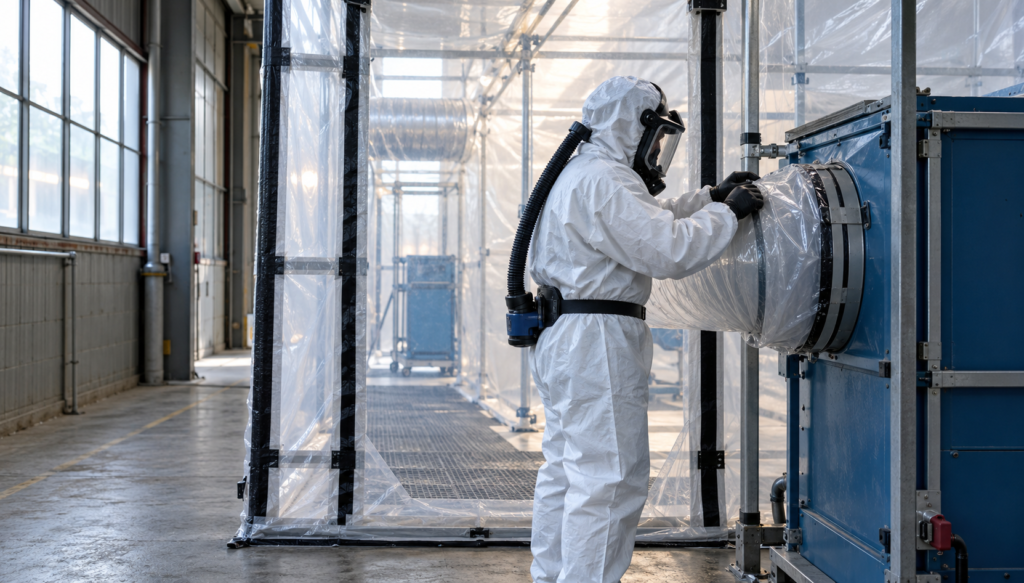
Asbestos Contractor Insurance: A Specialist Field
Arranging robust asbestos contractor insurance requires a precise grasp of regulation, long-tail liability, and operational standards. Standard commercial combined wordings exclude asbestos-related losses as a matter of course. That leaves unspecialised businesses open to catastrophic exposure. Specialist underwriters judge competence through regulatory compliance, statutory licences, and verified risk controls. Without bespoke cover, contractors carry severe gaps across public protection, environmental damage, and employee safety.
Securing appropriate terms demands thorough preparation of operational records, statutory audit documentation, and certified plant maintenance logs. From experience across the sector, underwriters reward firms that can evidence disciplined control. So what operational evidence actually determines your risk profile and your premium?
Key Takeaways
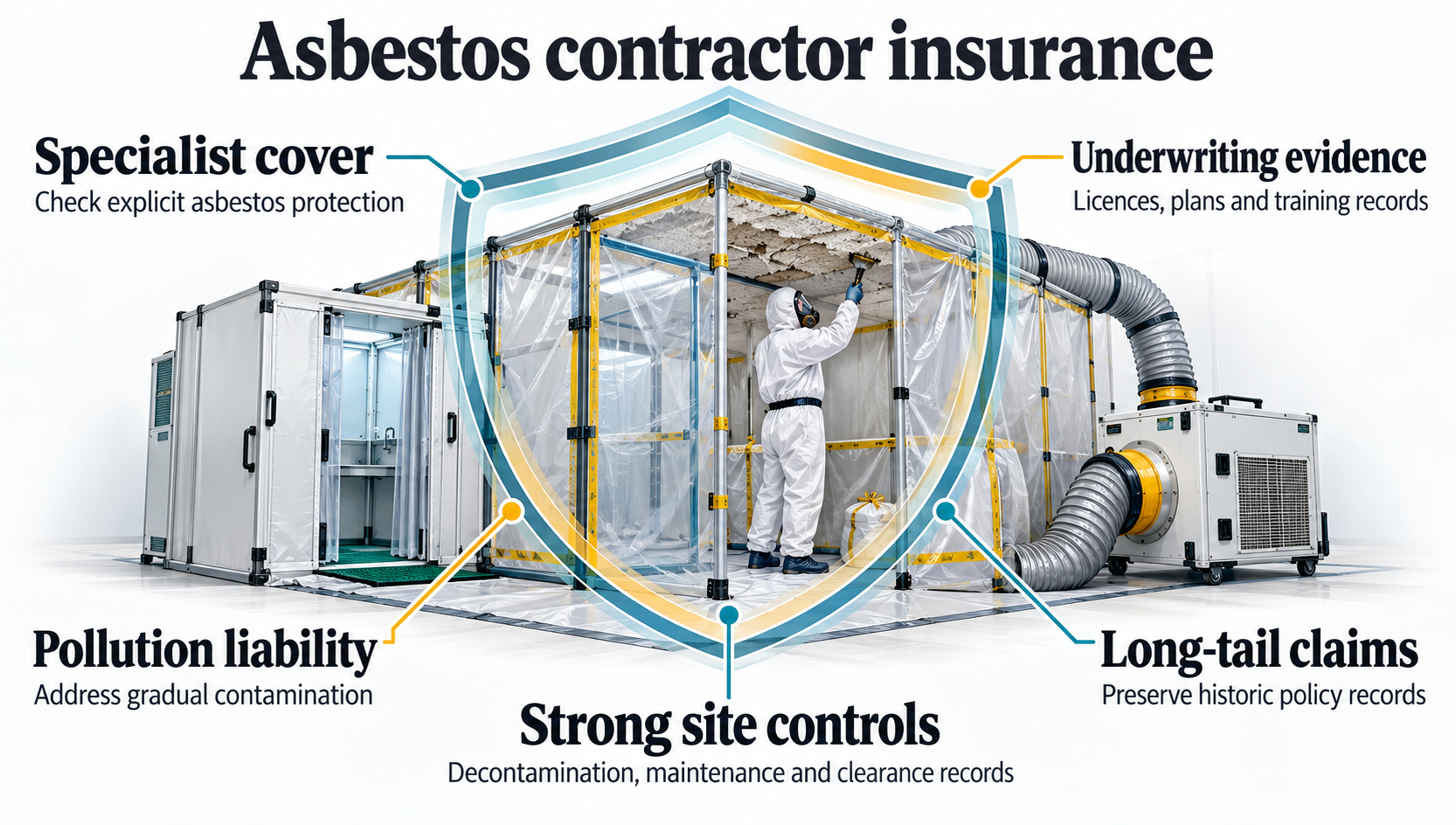
- Specialist policies carry explicit write-backs for asbestos, reversing the blanket exclusions found in standard commercial liability wordings.
- Underwriters want verified Health and Safety Executive licences, plans of work, and operative training records before quoting terms.
- Pollution liability insurance covers gradual contamination, which standard public liability wordings exclude alongside most environmental damage claims.
- Occurrence-based wordings answer long-tail disease claims that surface decades after the original workplace exposure to airborne fibres.
- Decontamination records, equipment maintenance logs, and accredited clearance certificates decide whether third-party contamination claims can be defended.
Specialist Cover Comparison for Licensed Operations
Specialist asbestos operations require distinct insurance layers. Each layer answers a different high-hazard exposure and a different statutory duty. Standard contracting policies fail against toxic fibre release. Bespoke market placements reinstate cover for regulated removal activities. In practice, the stack is assembled layer by layer rather than bought as a single product.
The table below sets out the core protections needed across licensed and non-licensed work. Each mechanism responds to a specific operational risk. Those risks arise on remediation sites, during surveys, and throughout commercial strip-outs. Limits shown reflect common UK market practice rather than a statutory requirement.
| Insurance Layer | Operational Risk Addressed | Typical Market Norm |
|---|---|---|
| Public Liability | Third-party injury, property damage, and accidental fibre release | £5m or £10m indemnity limit |
| Employers’ Liability | Long-tail occupational diseases including mesothelioma and asbestosis | £10m standard placement |
| Pollution Liability | Gradual contamination, site clean-up, and environmental damage | £1m to £5m dedicated limit |
| Professional Indemnity | Surveying errors, incorrect material assessment, and technical consultancy | £1m to £5m claims-made basis |
| Plant and Equipment | Loss, theft, or damage to negative pressure units and decontamination trailers | Scheduled replacement value |
Essential Underwriting Documentation and Compliance
Health and Safety Executive Licences and Authorisations
Underwriters require a valid Health and Safety Executive licence before considering higher-risk asbestos contractor insurance. The licence shows that an independent regulator has audited your management systems. It also confirms operative competence and equipment standards. Without current licensing, specialist markets decline to quote for your operational liabilities.
Work with friable coatings, asbestos insulation board, or loose fill requires an active licence. That duty sits under the Control of Asbestos Regulations 2012. Insurers also track any supervisory conditions attached to the permission. In practice, a clean regulatory record opens direct access to the leading high-hazard underwriters.
Detailed Plans of Work and Method Statements
Underwriters read project-specific plans of work to gauge your control measures before operations begin. These statutory documents set out containment design and negative pressure ventilation calculations. They also record emergency response procedures for the work. Clear method statements show that site managers hold disciplined control over high-hazard environments.
A plan of work must reflect the specific property, whether a commercial plant room or a domestic refurbishment. Insurers examine how you segregate live operational areas from occupied third-party zones. Strong paperwork verifies procedural discipline. It also influences the premium rates applied by specialist casualty underwriters.
Did You Know?
The Health and Safety Executive issues a first asbestos licence for one year only. Renewal licences are normally granted for three years, which is the maximum term available. Underwriters read a shortened renewal as a direct signal about assessed competence.
Personnel Competence and Decontamination Protocols
Operative Training Records and Medical Surveillance
Insurers ask for training matrices confirming that every operative holds valid qualifications from a recognised provider. Operatives must complete refresher modules covering safety protocols, equipment use, and emergency procedures. Those modules keep site clearance valid. Clear records confirm that your workforce understands how to prevent accidental exposure.
Under the Control of Asbestos Regulations 2012, operatives doing licensed work undergo medical surveillance every two years. Insurers want complete records of respiratory health assessments and face-fit testing certificates. These files evidence adherence to employee welfare duties. They also support the defence of future liability claims.
Decontamination Enclosures and Equipment Certification
Underwriters inspect decontamination protocols to confirm that fibres stay inside the designated site perimeter. Purpose-built hygiene facilities and negative pressure units need documented maintenance and air-flow testing. DOP filter test certificates must also be current. Robust practice proves that operatives and plant cannot carry fibres into public areas.
Inadequate decontamination is a severe underwriting exposure and a reliable source of third-party claims. Insurers look for daily logs, water filtration standards, and bag-out procedures in your risk presentation. Consistent servicing records reassure them that your business prevents uncontrolled releases into surrounding workspaces.
Cover Built for Demanding Businesses
Across high risk industries, the cover we arrange most often includes:
Public liability
Employers' liability
Motor fleet
Contractors' all risks
Freight liability
Professional indemnity
Environmental liability
Business interruption
Most businesses need a combination, rather than a single focus policy, and we build cover around your contracts, your workforce and your operational activities.
Core Cover Architecture for Asbestos Operations
Public and Employers’ Liability Structure
Public and employers’ liability form the commercial and statutory baseline for every asbestos removal contractor. Employers’ liability carries a statutory minimum of £5 million under the Employers’ Liability (Compulsory Insurance) Act 1969. Market practice sets £10 million as the working standard. Both covers answer injury claims from workers and the public.
Standard liability wordings carry absolute exclusions for toxic dust. Brokers must therefore secure specific asbestos endorsements that reinstate protection for work involving hazardous fibres. In practice, the two covers only work if they are placed to operate in tandem. That alignment protects the balance sheet against catastrophic bodily injury awards.
Occurrence Versus Claims-Made Policy Wordings
The policy trigger decides whether an insurer answers a claim notified decades after exposure. Occurrence wordings respond to injury caused during the policy period, whenever symptoms appear. Claims-made wordings respond only to claims notified whilst the contract remains in force. That distinction governs every long-tail asbestos exposure.
Mesothelioma latency runs to several decades, so trigger mechanisms demand long-term management. An occurrence-based employers’ liability policy gives enduring protection for historical exposure. Claims-made arrangements are harder work. Contractors must hold unbroken cover or buy extensive run-off provisions to avoid fatal gaps.
Environmental Liabilities and Pollution Considerations
Gradual Contamination Versus Sudden Accidental Releases
Standard public liability wordings limit pollution cover to sudden, identifiable events at a specific time. They exclude gradual seepage, continuous fibre drift, and migration developing over weeks or months. Specialist asbestos removal insurance has to close that gap. Extended endorsements or standalone protection are the usual routes.
When an enclosure seal degrades quietly across several shifts, standard wordings reject the resulting clean-up costs. Dedicated pollution liability insurance funds both acute releases and gradual emissions. From experience across the sector, this is where uninsured losses concentrate. The cover answers evacuation costs, downtime, and building decontamination claims.
Statutory Clean-Up Costs and Environmental Remediation
Environmental statutes place polluter-pays duties on contractors who contaminate land, water, or protected habitats. The Environmental Damage (Prevention and Remediation) (England) Regulations 2015 let authorities order clean-up without proving negligence. Standalone environmental policies fund those remediation orders. Standard liability contracts rarely respond to them at all.
Statutory remediation can require soil washing, air scrubbing, and licensed hazardous disposal. Costs run into millions of pounds. Without an environmental impairment policy, a remediation notice is settled from working capital. Robust protection shields contractors from business-ending clean-up bills.
Common Claims Scenarios and Risk Exposure Patterns
Enclosure Failures and Third-Party Contamination
Containment breaches are the most frequent operational claim across commercial and domestic removal work. A torn polythene barrier, a failed negative pressure unit, or a compromised airlock releases fibres into public space. The consequence is immediate: site shutdown, emergency air testing, and costly deep cleaning.
Tenants, client employees, and facility owners then allege financial loss. Business interruption claims from neighbouring units escalate quickly alongside decontamination invoices. Underwriters therefore examine your secondary containment systems in detail. They also check continuous air-monitoring protocols before setting terms.
Latent Disease Claims and Long-Tail Mesothelioma Exposure
Latent disease claims carry the most severe financial risk in the hazardous remediation sector. Mesothelioma, asbestosis, and pleural thickening typically appear thirty to forty years after exposure. Legacy claims therefore reach corporate entities long after the original projects closed. The liability outlives the contract that created it.
After diagnosis, legal action targets every historical employer who contributed to cumulative dust exposure. Insurers handle these claims under the employers’ liability policies in force during the alleged employment. Unbroken historical policy records are therefore not an archive problem. They decide whether legacy liability threatens current solvency.
Waste Management and Transportation Liabilities
Consignment Documentation and Chain of Custody
Moving asbestos waste demands compliance with the Hazardous Waste (England and Wales) Regulations 2005 and duty of care law. Consignment notes must record waste quantities, composition, carrier licences, and the registered disposal destination. Gaps in that chain of custody invite regulatory penalties and insurance repudiation.
Insurers review your waste-tracking procedures to confirm that material is double-bagged, labelled, and transferred safely. An unlicensed transfer, or paperwork that fails to match delivered tonnage, can compromise public liability protection. Precise waste governance satisfies the underwriter warranties attached to hazardous material handling.
Carriage of Dangerous Goods and Vehicle Requirements
Carrying asbestos waste on public roads is regulated transport. The Carriage of Dangerous Goods and Use of Transportable Pressure Equipment Regulations 2009 apply in full. Vehicles need ADR-certified equipment, sealed compartments, and correct hazard signage in transit. Motor fleet policies require explicit hazardous waste endorsements.
An overturned waste vehicle creates public health liability, road closure costs, and environmental remediation expense. Standard commercial motor cover excludes hazardous cargo clean-up unless transport endorsements are arranged. Specialist brokers integrate motor, goods in transit, and environmental liability into one protection stack.
Professional Indemnity and Surveying Gaps
Pre-Demolition Surveys and Sampling Errors
Contractors who survey, inspect, or sample need professional indemnity cover alongside their trade policies. A failure to locate hidden asbestos insulation board before demolition causes project delay and health crisis. When demolition crews disturb unrecorded material, the surveying firm faces substantial claims from developers.
Professional indemnity answers financial loss, rectification expense, and delay damages from negligent advice or inspection. Public liability wordings specifically exclude loss arising from professional breach of duty. Surveyors must hold continuous terms with the correct retroactive date. That date governs cover for past survey work.
Four-Stage Clearance Certification Liabilities
Four-stage clearance certification after licensed removal carries immense legal and commercial exposure. UKAS-accredited analytical bodies must independently certify that an enclosure is clean and safe for reoccupation. An erroneous certificate admits unprotected workers into a contaminated zone. Multi-party litigation follows almost immediately.
Those claims cover project disruption, re-cleaning expense, and health monitoring for exposed third parties. Insurers check whether your analytical team or testing subcontractor carries adequate professional indemnity limits. Clear contractual boundaries between removal contracting and independent clearance testing protect your risk profile.
Final Thoughts
Working safely in the abatement sector demands regulatory compliance, verified procedure, and tailored asbestos contractor insurance. Standard contracts leave catastrophic exclusions intact. That leaves firms exposed to property, environmental, and personal injury liabilities they cannot absorb. Specialist placement closes those gaps with contractual write-backs and adequate limits.
Regulatory scrutiny is tightening and environmental standards continue to evolve across UK construction. Clear audit trails, rigorous training, modern decontamination plant, and disciplined waste consignment build operational resilience. Firms that document their competence will keep access to the specialist markets that underwrite this work.
Speak to an Insurance Specialist
Whether you need a new quote, want to discuss your renewal or have a question about an existing policy, our team is here to help.
Frequently Asked Questions
Q: Why do standard public liability policies exclude asbestos risks?
A: Standard public liability policies exclude asbestos because the losses are catastrophic in scale and extremely slow to emerge. Ordinary commercial underwriters lack the reinsurance facilities needed to price multi-decade health claims. An uncontrolled dust release can trigger large decontamination costs, third-party business interruption, and serious bodily injury actions. Specialist casualty markets handle the hazard differently. They apply detailed underwriting scrutiny, impose strict operational warranties, and issue endorsements that reinstate bespoke cover for approved contractors.
Q: What is the difference between licensed and non-licensed asbestos work?
A: Under the Control of Asbestos Regulations 2012, licensed work covers higher-risk friable materials. These are materials where exposure cannot reliably be kept below the control limit. Examples include sprayed coatings, pipe insulation, and asbestos insulation board. Non-licensed work covers lower-risk bound materials such as textured coatings, vinyl floor tiles, and undamaged cement sheets. Some non-licensed projects still require notification as notifiable non-licensed work. Underwriters price risk on this categorisation and require an active licence for high-hazard operations.
Q: Does my business need standalone pollution liability insurance?
A: Most commercial combined policies restrict pollution cover to events that are sudden, accidental, and unintended. They exclude gradual fibre migration, continuous degradation, and statutory environmental damage claims. Standalone pollution liability insurance closes that exposure. It funds acute and gradual contamination clean-up, statutory remediation notices, and third-party property decontamination. For contractors handling hazardous material regularly, standalone environmental cover protects cash flow. Site remediation liabilities would otherwise be paid from working capital.
Q: What operational records do underwriters scrutinise at renewal?
A: Underwriters examine operational documentation to assess risk management before offering renewal terms. They check your Health and Safety Executive licence status, recent audit findings, trade association membership, and plans of work. They also inspect operative training matrices, medical surveillance logs, and face-fit testing certificates. Maintenance records for negative pressure units, decontamination units, and HEPA-filtered vacuum plant are reviewed as well. A clean claims history and UKAS-accredited clearance evidence demonstrate operational competence.
Q: How long must asbestos contractors keep operational and insurance records?
A: Asbestos contractors should retain operational and insurance records indefinitely because disease latency runs for decades. Health and medical surveillance records for exposed workers must be kept for at least forty years under statute. Historical employers’ liability certificates and policy schedules should never be destroyed. Mesothelioma claims commonly emerge thirty or forty years after exposure. Defending them depends on tracing the exact policies that were in force at the time.
About The Author
Darren Judd
Director, Co-Founder and Co-Owner of Capital Corporate Risks Ltd

Experienced Account Executive with a demonstrated history of working in the insurance industry. Skilled in Account Management, Risk Management, Business Development across all classes of insurance within the Construction Industry,