
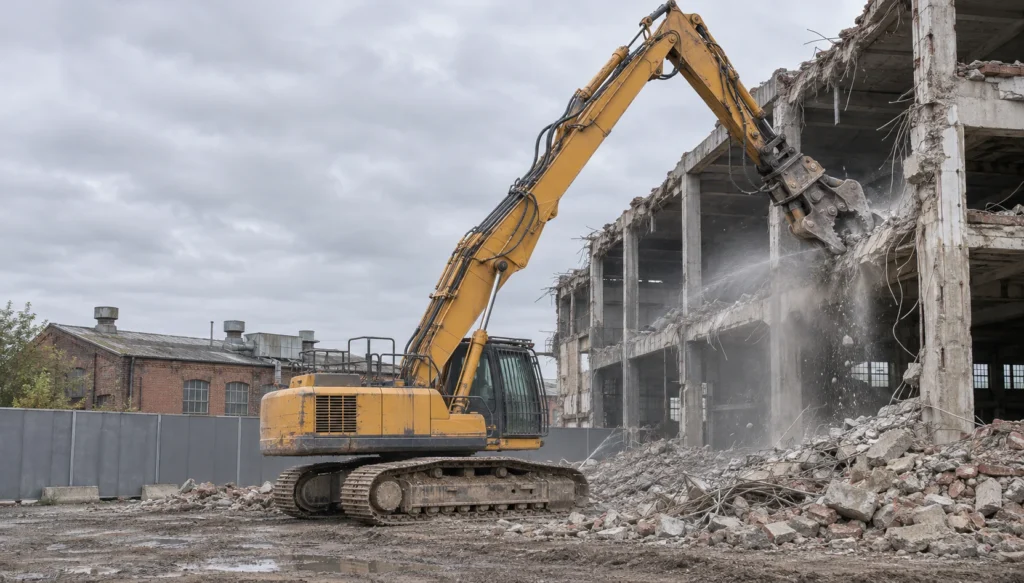
Demolition Insurance: Building the Programme
Demolition operations involve severe physical hazards, complex structural interfaces and substantial balance-sheet exposure. A generic commercial policy cannot absorb the catastrophic property loss or bodily injury scenarios common on demolition sites. Effective demolition insurance is a layered, bespoke programme. It combines primary liability, excess capacity, dedicated plant cover and specific environmental safeguards. Every layer must align with procurement frameworks and statutory duties, or dangerous gaps open in the cover.
Tier-one clients now scrutinise subcontractor insurance as closely as method statements. How do demolition contractors build cover that satisfies tier-one main contractors, passes underwriter audits and protects project solvency?
Key Takeaways
- A standard primary liability policy rarely provides sufficient capacity for high-density demolition works without structured excess layers.
- Contractors all risks policies must specifically address existing structures to avoid catastrophic coverage disputes during partial demolition contracts.
- High-value demolition machinery and hired attachments need cover for physical loss and continuing hire charges under CPA hire conditions.
- Environmental impairment liability covers statutory remediation costs and gradual pollution risks that traditional public liability wordings specifically exclude.
- Underwriters require detailed pre-demolition surveys, site audits and rigorous method statements before quoting competitive terms on high-hazard structural packages.
Core Components of a Demolition Cover Stack
Demolition programmes need several interdependent policies to protect the contractor against severe third-party liabilities and heavy plant losses. No single commercial policy addresses the structural, environmental and contractual exposures that dismantling and decommissioning create. In practice, we find that gaps appear where one policy ends and the next has not been arranged to begin.
Each component handles a discrete operational hazard, from workforce injury to the collapse of an adjoining building. The table below sets out the foundational layers of a comprehensive programme for commercial demolition contractors in Great Britain. Limits shown reflect typical market positions. Final figures depend on contract demands and underwriter appetite.
| Policy Element | Primary Function | Standard Market Benchmark |
|---|---|---|
| Policy ElementEmployers’ Liability | Primary FunctionStatutory employee injury and illness claims | Standard Market Benchmark£5m statutory minimum; £10m market standard |
| Policy ElementPrimary Public Liability | Primary FunctionThird-party injury and direct property damage | Standard Market Benchmark£5m to £10m primary layer |
| Policy ElementExcess Layer Liability | Primary FunctionCapacity uplift for catastrophic third-party claims | Standard Market Benchmark£10m to £25m+ layered towers |
| Policy ElementContractors All Risks | Primary FunctionMaterial damage to works, temporary structures, site setup | Standard Market BenchmarkProject-specific or annual contract limit |
| Policy ElementPlant and Machinery | Primary FunctionOwned and hired-in heavy excavators and attachments | Standard Market BenchmarkFull replacement value plus continuing hire |
| Policy ElementEnvironmental Impairment | Primary FunctionGradual pollution, clean-up and statutory remediation | Standard Market Benchmark£2m to £10m aggregate limit |
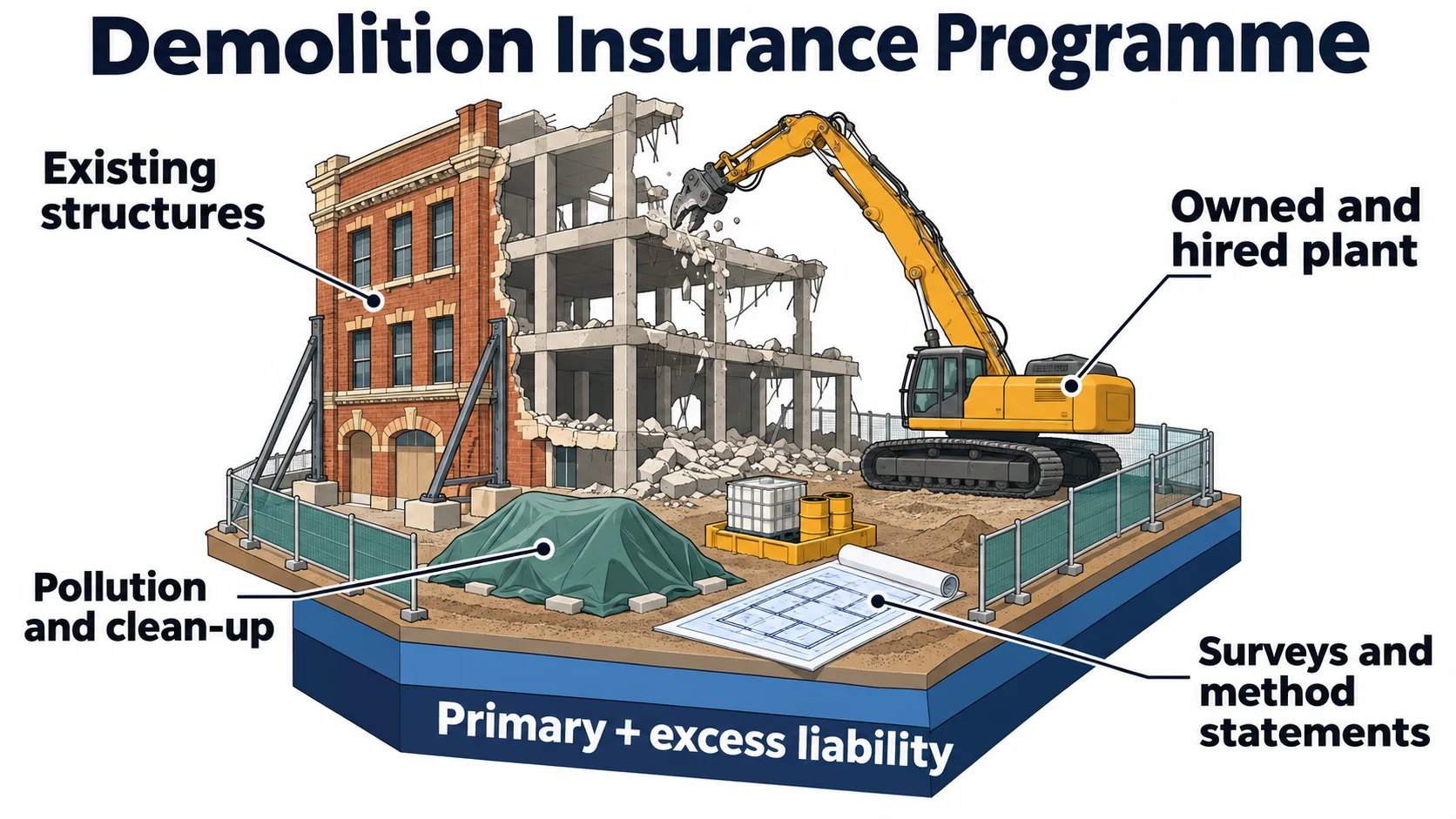
Liability Towers and Layered Capacity
Primary Layer Fundamentals
Primary public liability forms the bedrock of any demolition programme. It absorbs high-frequency claims and the first layer of every major loss. Many standard market insurers decline high-hazard demolition outright. Contractors need specialist capacity that accepts structural collapse, dust and ground vibration without punitive endorsements or heavy property damage excesses.
The primary policy must capture every commercial activity, including mechanical dismantling, high-reach processing and internal soft strip. Brokers must check that the wording carries no restrictive height or depth conditions. Such conditions can invalidate cover on industrial infrastructure. A clean primary layer gives excess insurers a sound platform to attach above.
Excess Layer Placement
Excess layer liability sits directly above the primary limit. It provides the substantial indemnity that major infrastructure clients demand. Where a principal contractor requires £20m or £50m of public liability, further insurers write layers in discrete tranches. Each layer responds only once the limits beneath it are exhausted by a major loss.
These layers demand strict wording concurrency. Each excess policy should follow the terms, conditions and exclusions of the primary wording. Any divergence between layers creates friction during complex litigation and can leave the contractor exposed. Brokers must review exhaustion mechanics to confirm that protection runs without interruption across every tier.
Did You Know?
Section 80 of the Building Act 1984 requires notice to the local authority before most demolitions. The duty applies to buildings larger than 1,750 cubic feet, roughly 50 cubic metres. Copies must go to adjacent occupiers and to gas and electricity suppliers. Work cannot begin until the council serves a Section 81 notice or six weeks have passed.
Contractors All Risks on Demolition Projects
Material Damage Provisions
Contractors all risks cover protects works in progress, temporary works and materials on site against sudden and accidental physical damage. On demolition sites, it extends to hoardings, temporary shoring and welfare cabins. Salvage retained on site before resale also falls within this protection, subject to the declared values.
Standard construction wordings assume asset creation rather than progressive destruction. Demolition CAR wording must therefore reflect intentional dismantling. Insurers should define clearly which elements form insured property. That clarity prevents disputes over whether a damaged component sat within the contractor’s care, custody and control during mechanical shearing.
Existing Structures and Contract Clauses
Partial dismantling, facadism and structural alteration place acute risk on the retained building fabric. Under JCT contracts, Insurance Option C covers works in or extensions to existing structures. It requires precise scheduling of who insures the existing structure. Poor scheduling invites costly disputes between employer and demolition specialist after an accidental collapse.
Consider a machine that damages a retained support beam during internal strip-out. Standard public liability may then trigger its exclusion for property being worked upon. A CAR extension or specific existing structures endorsement closes that gap for retained elements. Contractors must declare the condition of surrounding structures to insurers before work starts.
Cover Built for Demanding Businesses
Across high risk industries, the cover we arrange most often includes:
Public liability
Employers' liability
Motor fleet
Contractors' all risks
Freight liability
Professional indemnity
Environmental liability
Business interruption
Most businesses need a combination, rather than a single focus policy, and we build cover around your contracts, your workforce and your operational activities.
Heavy Plant and Specialist Rig Protection
Owned Machinery and High Reach Attachments
Specialist demolition machinery represents significant capital investment. A dedicated plant policy should cover accidental damage, overturn, fire and theft. Ultra-high-reach excavators, pulverisers, shears and sorting grapples endure exceptional operational stress. Robust physical damage cover keeps the business trading when a key machine is lost.
Underwriters review maintenance schedules and operating protocols before covering heavy attachments. Cover must extend to transit between depots, lifting operations and storage on working sites. Where an excavator lifts loads during dismantling, the Lifting Operations and Lifting Equipment Regulations 1998 apply. The machine then requires thorough examination by a competent person at the statutory intervals.
Hired-in Plant and Continuing Charges
Demolition contractors often hire specialist machinery under the Construction Plant-hire Association model conditions. These terms transfer substantial liability to the hirer. If fire destroys a hired hydraulic shear or mobile crusher on site, the contractor pays for its replacement. The contractor also remains liable for ongoing hire charges until replacement.
Adequate hired-in plant limits protect cash flow against these contractual liabilities. The policy must also carry a continuing hire charges extension. This extension pays the hire company its standard rate whilst the lost machine awaits replacement. Without it, rental costs can drain operating reserves during an already disrupted contract.
Hazardous Materials and Environmental Protection
Asbestos Contamination Protocols
Demolition of pre-2000 buildings routinely exposes asbestos-containing materials that demand strict regulatory control. Standard public liability policies broadly exclude asbestos. Contractors therefore need an explicit asbestos extension or dedicated asbestos removal insurance. The cover must match the work category, whether non-licensed, notifiable non-licensed or licensed removal.
Regulation 5 of the Control of Asbestos Regulations 2012 requires an assessment for asbestos before demolition work starts. In practice, that means a refurbishment and demolition survey under HSE guidance HSG264. Disturbing undetected asbestos insulation board during demolition triggers clean-up, decontamination and project suspension. Specialist wordings must respond to each cost, leaving no gap between demolition and abatement policies.
Stand-alone Environmental Impairment Policies
Demolition generates dust, surface run-off, vibration and noise that can harm adjoining watercourses and habitats. Standard public liability carries a sudden and accidental pollution clause. That clause bars claims arising from gradual contamination, continuous dust deposition or historical soil migration. Contractors need separate cover for these exposures.
A stand-alone environmental impairment liability policy fills this gap. It responds to sudden, accidental and gradual pollution events alike and funds remediation required under the Environmental Damage (Prevention and Remediation) (England) Regulations 2015. It also covers off-site third-party claims, biodiversity remediation and the legal costs of regulatory investigations.
Structural Integrity and Third-Party Boundaries
Party Wall Considerations and Vibration
Demolition next to occupied premises exposes contractors to structural movement claims, party wall disputes and cracking allegations. Where work affects party structures, the Party Wall etc. Act 1996 applies. Contractors should confirm that party wall awards and baseline condition surveys exist before deploying percussive or breaking plant. That record defends against later claims.
Many JCT contracts call for non-negligence insurance under clause 6.5.1. It protects the employer against collapse, subsidence, vibration or removal of support damaging adjoining property without contractor negligence. Insurers write the policy in the joint names of employer and contractor. Such damage can occur despite all reasonable engineering care. Specialists should confirm early whether the contract requires this cover.
Services Strikes and Utility Isolation
Ground excavation, slab lifting and basement removal carry a severe risk of striking live buried services. High-voltage cables and gas mains present the gravest danger. A single strike can disrupt public infrastructure, start fires and generate large third-party economic losses. Utility owners pursue these losses aggressively through dedicated recovery teams.
Underwriters expect rigorous location procedures that follow HSE guidance HSG47, Avoiding danger from underground services. Teams should combine utility records, electromagnetic locators, ground-penetrating radar and hand-dug trial holes before machines break ground. Comprehensive demolition contractor insurance should then respond to third-party disruption losses. Weak procedures, by contrast, invite restrictive terms or higher excesses.
Underwriter Audits and Risk Presentations
Pre-Demolition Surveys and Method Statements
Underwriters who write high-risk demolition liability assess each risk through technical engineering review, not pricing matrices. They examine site feasibility files, structural engineer calculations, sequence methodologies and pre-demolition asbestos surveys. Only then will they commit capital to a complex inner-city or industrial structure. Thin submissions rarely attract competitive terms.
A strong risk presentation shows operational discipline across every phase. Contractors should submit detailed risk assessments and method statements. They should also prove that operatives hold valid Certificate of Competence of Demolition Operatives cards. Alignment with National Federation of Demolition Contractors standards reassures underwriters and supports better terms and lower excesses.
Site Surveys and Verification Procedures
Before binding high-capacity liability layers, specialty insurers often commission physical risk engineering surveys. Engineers inspect contractor depots, live sites and fleet management practices. They assess boundary protection, site security, fire prevention during hot cutting and dust suppression. Each finding feeds directly into the underwriter’s view of the risk.
Contractors who act promptly on risk improvement requirements build stronger relationships with specialist syndicates. Photographic condition logs, vibration monitoring and drone inspections provide hard evidence of site control. From experience across the sector, underwriters value documented verification. It directly influences premium calculations and renewal stability through difficult market cycles.
Contractual Flow-Down and Statutory Compliance
CDM 2015 Demolition Duties
The Construction (Design and Management) Regulations 2015 define demolition as construction work. That definition triggers the full set of statutory safety duties. A demolition contractor acting as principal contractor must manage site-wide health and safety. It must also plan structural stability and enforce controls that prevent accidental collapse.
Regulation 20 of CDM 2015 also requires written demolition arrangements before work begins. Insurers expect evidence that project teams meet these duties. They also expect compliance with the Health and Safety at Work etc. Act 1974. Weak site controls or unsafe systems of work can compromise policy response during an HSE investigation. A breach of any health and safety warranty carries particular risk.
Main Contractor Insurance Schedules
Major developers and tier-one main contractors impose strict flow-down insurance schedules on subcontractors. These schedules set liability limits and require specific endorsements. Typical demands include indemnity to principals, cross-liabilities, waiver of subrogation and notice of cancellation running to the client. Each requirement must appear in the policy wording itself.
Signing a subcontract with unamended insurance clauses, without broker review, exposes a demolition business to contractual breach. A standard commercial policy may lack the required indemnity extensions. That shortfall leaves the contractor carrying uninsured liabilities. Contractors should check their insurance stack against every subcontract schedule before signing.
Final Thoughts
An effective programme of demolition insurance demands technical precision, sector knowledge and careful layering of specialist policies. Contractors must build resilient liability towers and protect capital-intensive plant. They must also secure concurrency across every primary and excess wording. Treat insurance as an engineering control, not an administrative overhead. A business built that way can survive a severe incident with its reserves intact.
Regulatory scrutiny of urban regeneration and structural dismantling continues to tighten. Specialist underwriters will keep rewarding contractors who show verified competence, robust pre-construction planning and transparent operations. Aligning operational discipline with a well-structured programme protects reputation and liquidity. It also provides a stable platform for complex demolition work nationwide.
Speak to an Insurance Specialist
Whether you need a new quote, want to discuss your renewal or have a question about an existing policy, our team is here to help.
Frequently Asked Questions
Q: Why is an excess layer liability policy necessary for demolition works?
A: Most primary liability policies offer limits of £5m or £10m. Large demolition projects, public sector infrastructure work and tier-one main contractors often demand £20m to £50m of public liability. Those limits protect against adjoining property collapse, fatal third-party injury or a major utility strike. Excess layer liability sits above the primary policy and supplies the extra capacity. Several insurers can share the layers, which keeps the overall cost manageable.
Q: Does a standard contractors all risks policy cover retained facades during demolition?
A: No, not automatically. Standard contractors all risks policies insure new works and materials, not existing structures undergoing demolition. A retained facade or existing structure needs specific cover. Under JCT contracts, Insurance Option C deals with works in existing structures. It requires joint names cover for both the existing structure and the new works. Contractors undertaking facadism should confirm this cover before work starts. Without it, a collapse of the retained fabric could fall outside every policy.
Q: What is the difference between carriers liability and all-risks plant insurance?
A: Carriers liability covers goods or machinery in transit under carriage conditions. It typically pays up to a contractual limit per tonne. All-risks plant insurance is far broader. It protects owned and hired machinery on site, in transit and in overnight yard storage. It covers accidental damage, overturning, fire and theft. Good plant policies also include continuing hire charges for hired-in equipment. Carriers liability alone leaves machinery exposed once it leaves the low-loader.
Q: How do environmental impairment liability policies differ from public liability pollution extensions?
A: Public liability usually covers only injury or damage caused by a sudden, identifiable pollution incident. It excludes gradual contamination. Environmental impairment liability goes much further. It covers gradual leaks, dust settlement, migration of historical contamination and clean-up on the contractor’s own site. It also funds statutory remediation under the Environmental Damage (Prevention and Remediation) (England) Regulations 2015. For demolition work near watercourses or contaminated land, that wider cover matters.
Q: What documentation do underwriters require before issuing terms for demolition contractor insurance?
A: Underwriters expect a full risk presentation before releasing terms. It should include risk assessments and method statements, structural engineering calculations and refurbishment and demolition asbestos surveys. Insurers also check operative training, including Certificate of Competence of Demolition Operatives cards. They ask for five years of verified claims experience and hot-work permit procedures. Evidence of trade body membership, such as the National Federation of Demolition Contractors, strengthens the submission further.
About The Author
Darren Judd
Director, Co-Founder and Co-Owner of Capital Corporate Risks Ltd

Experienced Account Executive with a demonstrated history of working in the insurance industry. Skilled in Account Management, Risk Management, Business Development across all classes of insurance within the Construction Industry,