

Commercial Insurance Brokers Kent: How to Choose
Choosing between commercial insurance brokers Kent businesses can trust starts with local risk. The county carries a dense concentration of construction, haulage and waste operations. These trades sit outside standard underwriting appetite. Off-the-shelf cover rarely matches the contracts they sign. In practice, we find that a broker’s technical depth decides whether a claim pays.
Most directors only test their broker after a serious loss. By then the restrictive warranties and thin indemnity limits are already in place. The damage lands on the balance sheet rather than the policy. So how should a Kent business judge a commercial broker before it ever needs to claim?
Key Takeaways
- Brokers with genuine market access secure bespoke policy terms that match the operational risk profile of a Kent business.
- High-hazard trades such as construction, waste recycling and heavy haulage need specialist underwriting knowledge to avoid restrictive warranties.
- Broker evaluation should cover technical expertise, FCA permissions, trade body membership and the quality of proactive risk management support.
- Dedicated claims advocacy protects cash flow during major losses by securing interim payments and challenging unfair reserve estimates.
- Quarterly review schedules capture operational changes early and keep indemnity limits aligned with contracts across the whole trading year.
Core Criteria for Evaluating Kent Insurance Brokers
Commercial policyholders should measure every prospective broker against fixed criteria. The relevant tests are technical capability, trade specialism, market placement relationships and post-placement claims structure. Each one shapes the scope of cover a business actually receives. A direct comparison shows how service models drive policy wording and settlement outcomes when a large loss occurs.
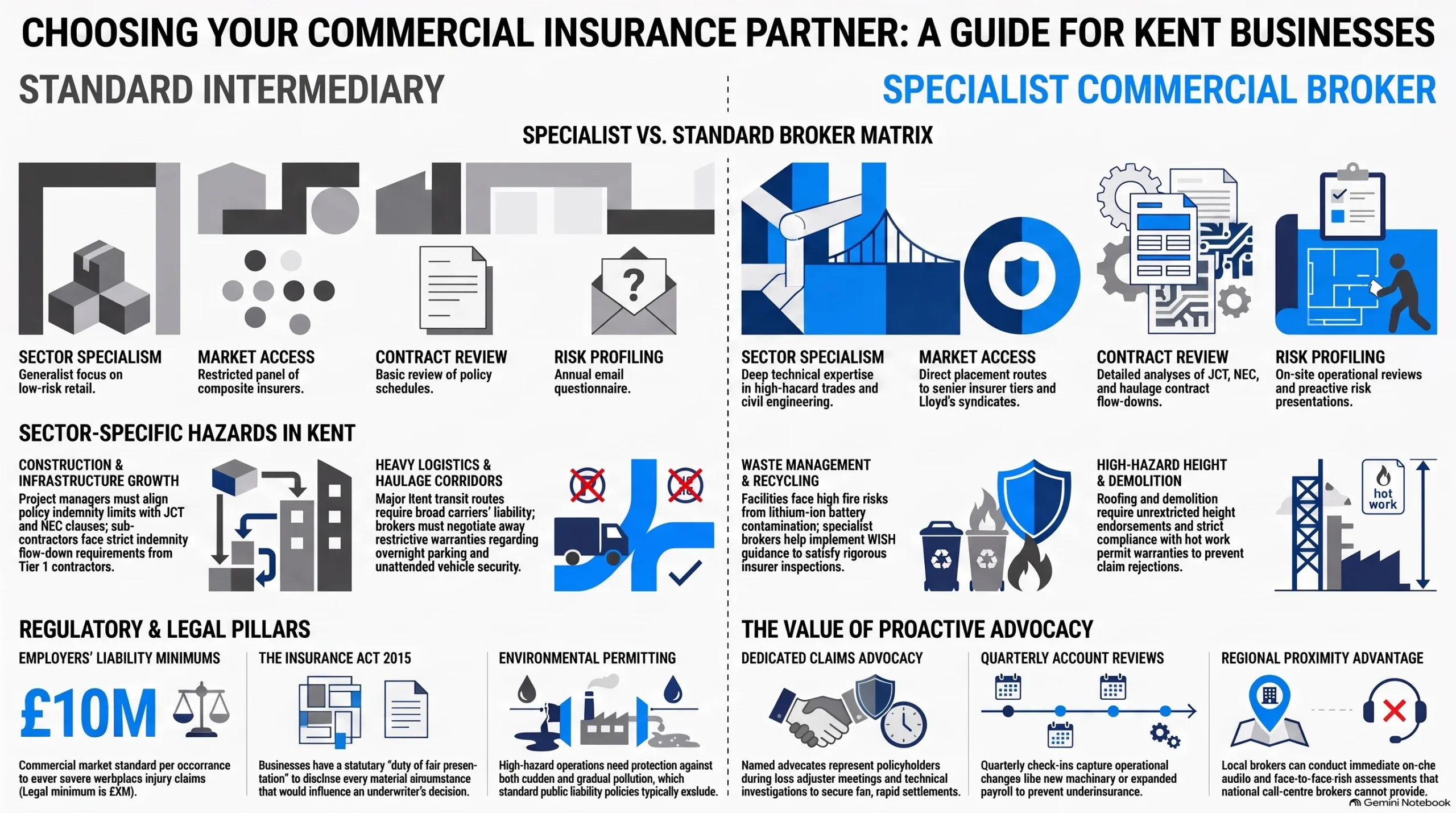
The table below sets out the parameters Kent directors should examine before placing a commercial programme. Every factor affects coverage breadth, indemnity limit adequacy and the long-term effectiveness of risk transfer. From experience across the sector, the gap between a standard intermediary and a specialist widens sharply in high-hazard trades.
| Evaluation Parameter | Standard Intermediary | Specialist Commercial Broker |
|---|---|---|
| Sector Specialism | Generalist focus covering low-risk retail and office lines | Deep technical expertise in high-hazard trades and civils |
| Market Access | Restricted panel of standard composite insurers | Direct placement routes, senior insurer tiers and Lloyd’s syndicates |
| Contract Review | Basic review of standard policy schedule terms | Detailed analysis of JCT, NEC and haulage contract flow-downs |
| Claims Support | Basic claim logging and referral to insurer helplines | In-house claims advocacy, loss monitoring and dispute management |
| Risk Profiling | Annual renewal questionnaire completed via email | On-site operational reviews and proactive risk presentations |
Kent Trade Sectors and Their Insurance Demands
Construction and Infrastructure Growth Risks
Kent supports continuous commercial and residential construction. Principal contractors and sub-contractors face layered legal and physical hazards on every site. Contractors All Risks cover, joint-names property insurance and high-limit public liability all become essential. Indemnity limits must match the JCT or NEC clauses that the contract imposes on the works.
Sub-contractors across the county face strict indemnity flow-down terms from Tier 1 main contractors. Low public liability limits create an immediate contract breach. Unreviewed exclusions on excavation depth create a second one. An intermediary who knows regional infrastructure work will check the schedule against the contract. That single step keeps site access intact and keeps the risk transferred.
Heavy Logistics and Haulage Corridors
Major transport routes across Kent demand specialist motor fleet and goods in transit protection. Heavy goods vehicles on high-density corridors face elevated accident, cargo damage and theft exposure. Carriers’ liability insurance must respond to the contractual obligations that sit within standard domestic road freight conditions rather than a generic wording.
Firms operating near the ports need to watch sub-limited goods in transit sections closely. Standard motor policies often carry warranties on unattended vehicle security. Others restrict overnight parking locations or cap high-value cargo. A specialist broker helps transport directors build a risk presentation that satisfies these underwriting tests. Cover then holds across both domestic and international freight movements.
High-Hazard Trades and Specialist Underwriting
Waste Management and Recycling Facilities
Waste processing plants and Materials Recovery Facilities carry severe property and business interruption risk. Combustible stock and heavy plant drive that exposure. Insurers survey these sites rigorously and expect detailed Fire Prevention Plans, thermal monitoring regimes and strict pile-height limits. Property cover depends on evidence, not assurances.
Lithium-ion battery contamination has sharply raised fire risk across the recycling sector. Standard insurers respond by excluding gradual pollution. Some shorten the business interruption indemnity period. Others impose heavy policy excesses. A specialist broker helps plant managers apply WISH guidance and evidence their operational controls. Verified controls presented properly keep terms broad and keep the site insurable.
Height Work and Specialist Demolition Trades
Roofing, scaffolding and demolition work carries inherent hazards that demand unrestricted height endorsements. Standard liability wordings often contain height or depth warranties. Those warranties can void a claim after a major structural loss. Brokers must negotiate terms that name the specific site activities and removal methods used.
Torch-on roofing is a clear example. Hot work permit warranties apply, including a mandatory 60-minute post-work fire watch and defined extinguisher positioning. Demolition contractors face pre-demolition survey duties under the Control of Asbestos Regulations 2012. Party wall obligations apply as well. An expert broker declares each constraint and secures the endorsement. Coverage rejections after a loss are then far less likely.
Did You Know?
The Employers’ Liability (Compulsory Insurance) Act 1969 requires most UK employers to hold at least £5 million of Employers’ Liability cover. Failure to maintain that insurance can attract a fine of up to £2,500 for each day the business trades uninsured.
Key Questions for Selecting Kent Intermediaries
Market Placement Rights and Insurer Access
Ask any prospective broker to evidence direct access to corporate insurers and specialist syndicates. Senior market status carries real negotiating weight. Aviva 110 placement tiers and BIBA membership are useful indicators. Broad access delivers competitive pricing and bespoke wordings instead of rigid scheme products with fixed terms.
Directors should ask which underwriting markets the broker approaches for their trade specifically. A specialist insurance broker Dartford firms consult should name its routes to niche high-hazard underwriters and excess layer providers. Intermediaries that rely only on aggregated wholesale platforms struggle to obtain custom endorsements. Complex commercial risks rarely fit a platform template.
Technical Knowledge of Contractual Indemnity
Confirm that the broker reads commercial trade contracts properly. Standard policies exclude liabilities assumed under contract unless those liabilities are declared and endorsed. That exclusion catches many businesses out. A competent intermediary reviews JCT, NEC or CPA model conditions before arranging any primary operational cover for the client.
A capable broker analyses subcontract flow-down clauses, cross-liability requirements and joint-names property provisions before inception. Plant hire is a good test. Under Construction Plant-hire Association rules, continuing hire charges pass to the hirer during a loss event. Brokers who understand that mechanism check for adequate hired-in plant limits and a continuing charges extension.
Cover Built for Demanding Businesses
Across high risk industries, the cover we arrange most often includes:
Public liability
Employers' liability
Motor fleet
Contractors' all risks
Freight liability
Professional indemnity
Environmental liability
Business interruption
Most businesses need a combination, rather than a single focus policy, and we build cover around your contracts, your workforce and your operational activities.
Claims Advocacy and Loss Settlement Support
Complex Loss Adjuster Negotiations
Claims management starts within hours of an incident. It requires active broker intervention rather than passive call routing. A dedicated advocate represents the policyholder in loss adjuster meetings, technical investigations and indemnity negotiations. Accurate loss presentation protects the business from inflated reserves and from outright repudiation.
Insurers appoint forensic accountants and technical loss adjusters on substantial property and liability claims. A named advocate guides evidence gathering and keeps the process moving. Policy conditions are then met on time. That hands-on approach also protects cash flow, because interim indemnity payments can be secured while the investigation continues.
Claim Trends and Premium Impact
Structured claims management means quarterly performance reviews. Those reviews examine loss frequency, severity patterns and outstanding insurer reserves. Reserves inflate loss ratios directly, which then drives future pricing and renewal availability. Active advocacy ensures reserves are reduced promptly once a third-party liability is defended or settled.
Legacy claims handling matters just as much. Unsettled claims from expired policy years distort a claims history. That distortion inflates future business insurance Kent premiums without justification. Brokers who challenge historical reserves with prior insurers help restore the client’s risk rating. Lower rates and broader terms usually follow at the next renewal.
Local Broker Proximity and Site-Level Service
On-Site Risk Surveys and Operational Audits
A regional broker can carry out face-to-face risk assessments and physical site inspections. Direct visits reveal hidden operational hazards. They also allow the broker to test physical security measures and inspect fire suppression systems firsthand. Accurate profiling produces a defensible operational narrative for commercial underwriters.
National call-centre brokers rely on standardised online questionnaires. Those forms miss the detail of a working site. Local intermediaries survey industrial depots, waste yards and construction sites in person. Documented surveys help insurers see the safety investment a business has made. Reduced rates and removed warranties often follow.
Rapid Response to Operational Changes
Commercial firms acquire plant, expand premises, alter fleet sizes and take on higher-risk subcontracts mid-term. Regional brokers process those updates immediately. Policy schedules and statutory certificates then reflect the change without delay. Prompt mid-term adjustments maintain unbroken protection and satisfy the contractual obligations the business has already accepted.
Failure to notify insurers of a material change can breach the duty of fair presentation under the Insurance Act 2015. A nearby intermediary keeps communication regular. Directors then recognise when new machinery triggers statutory engineering inspection under LOLER 1998 or PSSR 2000. Close proximity means changes are declared and covered properly.
Policy Alignment with Local Regulatory Frameworks
Environmental Permitting and Statutory Compliance
High-hazard operators must align commercial cover with UK statutory environmental duties. Sites governed by the Environmental Permitting (England and Wales) Regulations 2016 need robust pollution liability and clean-up cover. Dedicated Environmental Impairment Liability policies respond to sudden and gradual contamination. Standard public liability wordings exclude most of that exposure.
The Environmental Damage (Prevention and Remediation) (England) Regulations 2015 impose strict liability for damage to habitats, water and land. Standard public liability restricts pollution cover to sudden, identifiable and accidental events. A specialist broker ensures waste operators and civil engineers hold standalone environmental policies. Those policies fund statutory clean-up orders and biodiversity restoration costs.
Employment Statutes and Statutory Minimums
UK employers must meet statutory insurance duties whilst holding adequate limits for their operational risk. The Employers’ Liability (Compulsory Insurance) Act 1969 sets a minimum limit of £5 million. Modern commercial contracts routinely require £10 million. That higher figure reflects severe injury awards and legal defence costs.
Health and safety duties sit alongside those employment liabilities. The Health and Safety at Work etc. Act 1974 applies, as do the Construction (Design and Management) Regulations 2015. Brokers assess client protocols against both frameworks. Policy schedules should then cover statutory defence costs and the expense of an HSE enforcement investigation.
Structured Client Engagement and Policy Reviews
Pre-Market Risk Presentation Protocols
Optimal terms depend on a full pre-market risk presentation prepared well before renewal. Health and safety accreditations, operative training records and risk assessment procedures all belong in that submission. A structured presentation positions the business as a superior risk. It also removes the pressure of last-minute conditional renewal terms.
Transparent submissions let policyholders see exactly how their operations are described to underwriters. That visibility supports full disclosure of every material fact required by the Insurance Act 2015. It also creates a chance to correct misaligned underwriting assumptions. Corrections made early are far cheaper than corrections made after terms are set.
Post-Placement Quarterly Account Reviews
Commercial insurance should not become an annual administrative exercise handled only at renewal. Quarterly contact schedules let brokers capture emerging operational changes, live contract bids and updated payroll projections. Regular reviews keep the insurance programme aligned with corporate risk throughout the trading year rather than at a single fixed point.
Quarterly check-ins allow brokers to adjust motor fleet schedules, recalculate turnover estimates and update hired-in plant limits. This prevents underinsurance, which is what triggers the average clause during a property or business interruption loss. Continuous alignment gives directors confidence that the cover matches the business they are actually running.
Final Thoughts
Evaluating commercial insurance brokers Kent enterprises rely on comes down to three tests. Assess market placement capability, technical contract knowledge and the strength of claims support. High-hazard trades, logistics fleets and waste facilities face distinct exposures. Those exposures demand tailored schedules rather than generic policies. Regional knowledge is what makes contractual flow-downs work in practice.
Structured communication and regular risk reviews prevent coverage gaps, underinsurance and undeclared operational change. Direct access to specialist markets adds negotiating strength. Robust claims advocacy protects the balance sheet when a serious loss occurs. Time spent testing broker credentials is time that keeps corporate risk genuinely transferred.
Speak to an Insurance Specialist
Whether you need a new quote, want to discuss your renewal or have a question about an existing policy, our team is here to help.
Frequently Asked Questions
Q: What is the difference between a general insurance broker and a specialist commercial broker?
A: General brokers handle broad personal and standard commercial lines. They work from fixed insurer panels and off-the-shelf policy templates. A specialist commercial broker holds deep technical expertise in high-hazard sectors, complex legal contracts and specialist market placements. They conduct on-site risk audits and negotiate custom endorsements. They also review contractual indemnity flow-downs. Placements are made directly with senior corporate underwriters and Lloyd’s syndicates, which produces far broader corporate protection.
Q: Why are public liability indemnity limits higher for construction and waste sector businesses?
A: High-hazard operations carry property damage and personal injury exposures well beyond standard commercial risk. Main contractors working under JCT or NEC contracts routinely require sub-contractors to hold £5 million or £10 million public liability limits before site access is granted. Major loss scenarios make the case plainly. Heavy plant incidents, structural collapse and environmental contamination all produce claims that exhaust low limits quickly and expose the business directly.
Q: How does the Insurance Act 2015 affect how commercial risks are presented to insurers?
A: The Insurance Act 2015 places a statutory duty of fair presentation on commercial policyholders. A business must disclose every material circumstance that would influence an underwriter’s decision. Alternatively it must give enough information to put a prudent underwriter on notice. An experienced commercial broker documents operational hazards, risk management protocols and trading activities accurately. That record is what prevents an insurer avoiding the policy after a claim is made.
Q: What role does claims advocacy play when dealing with complex commercial property losses?
A: Claims advocacy gives policyholders expert representation during major loss events. Clients are not left to deal directly with insurer-appointed loss adjusters. The advocate manages communication, assists with technical evidence, negotiates interim indemnity payments and challenges unfair reserve estimates. Proactive advocacy shortens settlement timelines and protects the balance sheet. It also ensures policy wordings are interpreted fairly if the claim moves into a formal dispute.
Q: How often should a commercial business review its insurance policy schedules?
A: Commercial businesses should hold formal quarterly account reviews alongside a full annual pre-market review. Certain operational changes must be declared immediately. These include acquiring new machinery, increasing fleet size, expanding payroll, winning larger subcontracts or modifying premises. Regular check-ins prevent underinsurance and maintain compliance with policy warranties. They also keep indemnity limits aligned with evolving statutory duties and current contract requirements.
About The Author
Darren Judd
Director, Co-Founder and Co-Owner of Capital Corporate Risks Ltd

Experienced Account Executive with a demonstrated history of working in the insurance industry. Skilled in Account Management, Risk Management, Business Development across all classes of insurance within the Construction Industry,