
Scaffolding Insurance Cover.
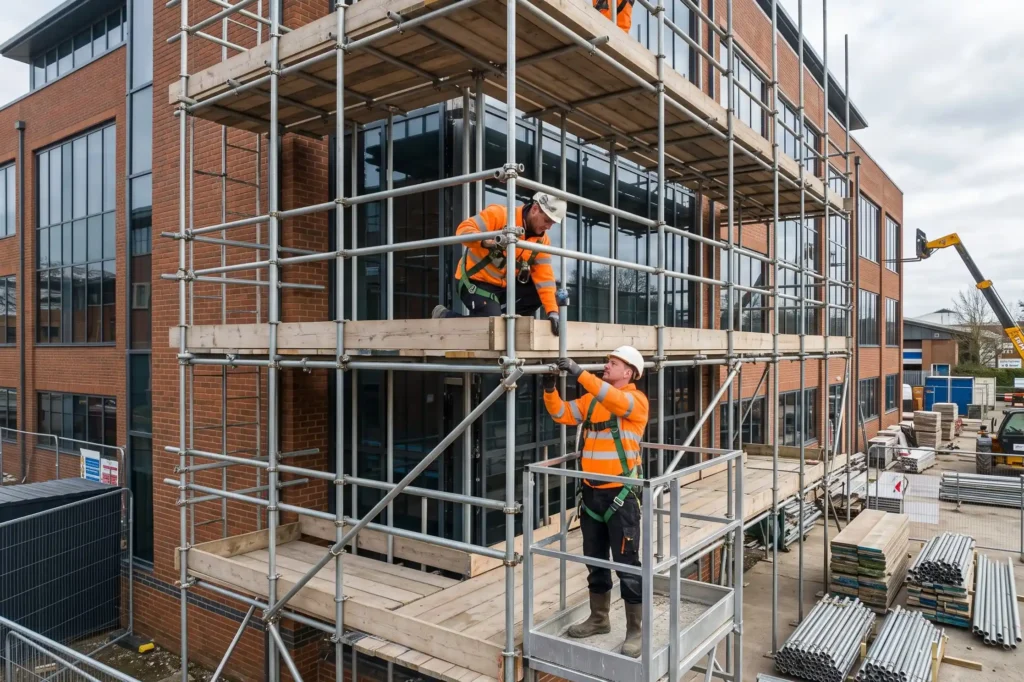
Securing comprehensive scaffolding insurance cover is essential for contractors working across domestic, commercial, and civil infrastructure projects in the UK. Temporary access structures carry significant working at height hazards. Because of this, underwriters scrutinise operational safety and height limits closely. They also assess site risk management protocols more rigorously than for standard construction trades. A structured policy safeguards physical assets, mechanical equipment, and workforce members. It also protects third parties whilst fulfilling main contractor terms on high-risk sites.
Many business owners struggle to balance height restrictions, hired-in plant terms, and complex multi-policy claims interactions. This can leave hazardous gaps in protection. Inadequate policy structures can lead to repudiated claims or financial exposure when high-altitude accidents or severe storm damage occurs. How can scaffolding firms build an integrated risk protection programme that satisfies clients and responds reliably to a catastrophic loss?
Key Takeaways
- Public liability policies for scaffolding contractors require explicit height endorsements to remove standard height caps and ensure full cover across high-rise work sites.
- Employers liability cover remains a statutory obligation under UK law, protecting businesses against injury claims arising from working at height activities.
- Contractors all risks insurance covers live works and temporary structures, whilst specialist scaffold board insurance protects essential timber stock held within yard premises.
- Hired-in plant policies safeguard firms against physical equipment damage and ongoing continuing hire fees under Construction Plant-hire Association contract conditions.
- Aligning commercial fleet terms with site risk management protocols prevents coverage disputes when transporting heavy tubes and fittings between depots and active sites.
Core Coverage Options and Policy Structures
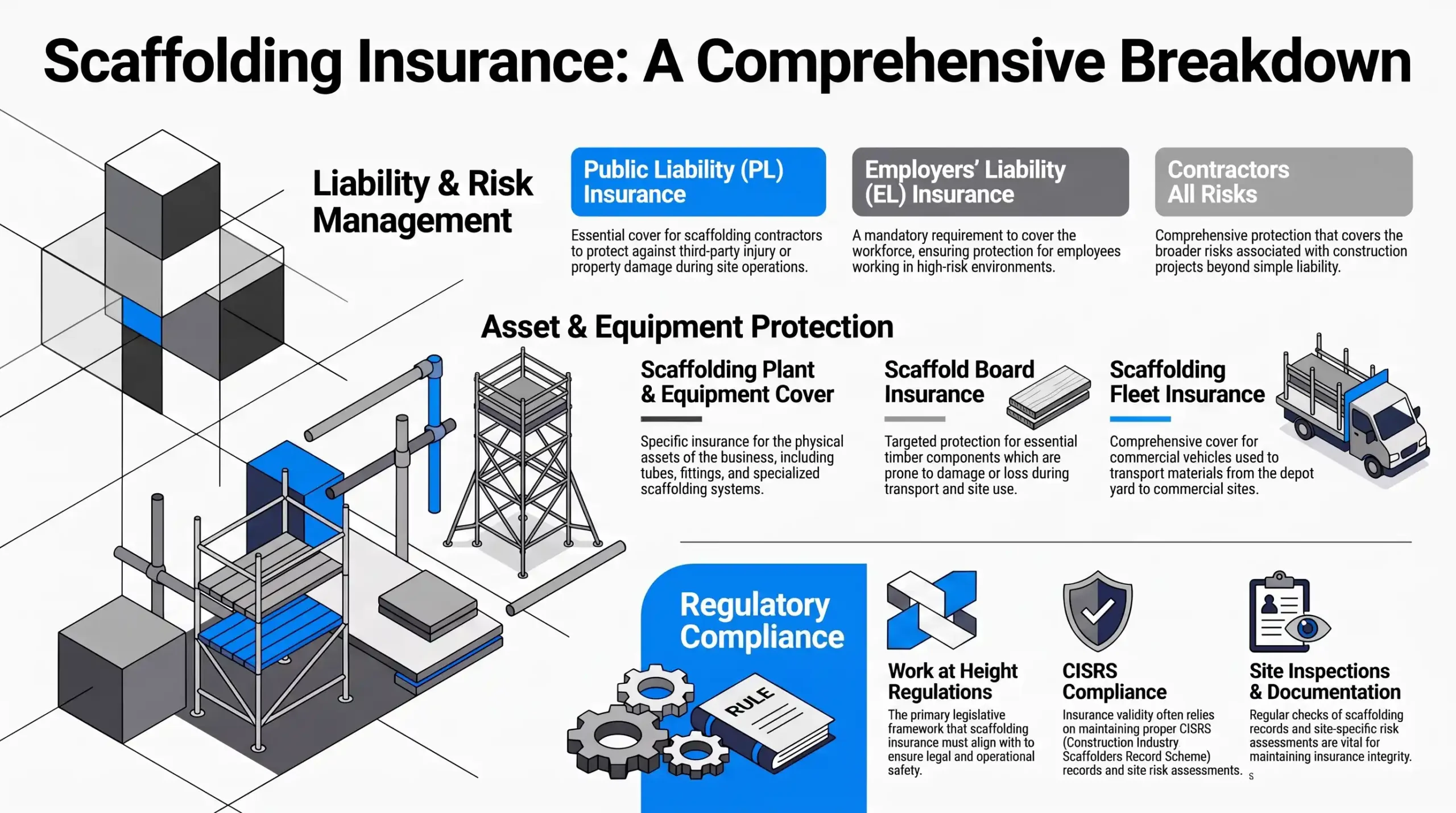
A robust commercial insurance programme for access contractors combines several distinct insurance products into a single protective framework. Each policy component targets specific operational hazards. Together, they ensure financial protection across yard storage, vehicle transit, site assembly, and dismantling activities on live projects.
Knowing how standard indemnity limits and underwriting conditions apply helps contractors select the right coverage tier for their operational profile. The table below sets out the core components. It also covers market limit norms and the key underwriting triggers for a balanced access protection strategy.
| Policy Component | Standard Limit Norms | Primary Risk Focus |
|---|---|---|
| Public Liability | £5m – £10m per occurrence | Third-party injury and property damage from fallen materials or collapse |
| Employers’ Liability | £10m per occurrence | Operative injury during working at height, handling, or assembly |
| Contractors All Risks | Contract-value specific | Material damage to works in progress, temporary works, and structures |
| Plant & Equipment | Declared value basis | Damage or theft of owned plant, scaffold boards, and hired-in gear |
| Commercial Fleet | Comprehensive market terms | Road traffic accidents and transit liability under the Road Traffic Act 1988 |
| Business Interruption | Gross profit basis | Income loss and increased costs of working following insured yard fires |
Public Liability Provisions for Access Works
Indemnity Limits and Height Restrictions
Public liability insurance covers legal costs and compensation claims arising when access operations cause third-party injury or property damage. Most main contractors demand a minimum indemnity limit of £5 million or £10 million before granting site access. This applies especially on major commercial projects or public sector contracts.
Unrestricted height endorsements are critical for access specialists working on high-rise structures or complex civil infrastructure. Standard commercial liability policies frequently contain restrictive height caps, such as 10 metres or 15 metres. If an incident occurs above the specified policy limit, insurers can decline indemnification entirely. This leaves the business fully exposed to catastrophic compensation claims.
Height Endorsements and Operational Parameters
Securing an unrestricted height endorsement requires demonstrating robust risk assessments and adherence to National Access and Scaffolding Confederation technical guidance. Underwriters evaluate operative qualification records, site supervision protocols, and historical safety performance. This assessment happens before they remove standard height boundaries from a public liability schedule.
Compliance with TG20 tube-and-fitting standards and SG4 safe working at height guidelines provides underwriters with evidence of operational competence. Policies may also stipulate specific warranties regarding brick guards, debris netting, and protective fans. Ensuring these physical control measures are implemented on site maintains policy validity and reduces third-party drop hazards.
Statutory Duty and Employers’ Liability Compliance
Operative Safety and Legal Mandates
Under the Employers’ Liability (Compulsory Insurance) Act 1969, UK employers must maintain at least £5 million in indemnity cover. This cover protects the workforce against injury claims. However, the commercial standard across the construction sector is £10 million per occurrence. This higher limit accommodates severe long-term disability claims resulting from high-altitude falls.
Scaffolding activities carry higher intrinsic risk profiles than non-aerial construction trades. The Work at Height Regulations 2005 impose legal duties on employers to plan, supervise, and execute high-level tasks properly. Employers must use competent personnel throughout. Demonstrating complete regulatory compliance is essential for defending against negligence claims when employee injuries occur on site.
CISRS Training Protocols and Liability Exposures
Verifying operative card status under the Construction Industry Scaffolders Record Scheme directly influences underwriting terms and liability pricing. Insurers expect all site workers to hold valid CISRS qualifications appropriate to their role. Card levels range from trainee cards to advanced scaffolding certificates.
Unqualified or inadequately supervised labour significantly increases the frequency of manual handling injuries, structural fall events, and dropped object incidents. Maintaining meticulous training matrices and health surveillance records allows brokers to negotiate favourable policy conditions. Strong documentation demonstrates proactive safety management during annual liability insurance reviews.
Did You Know?
Under the Work at Height Regulations 2005, working access structures must be thoroughly inspected by a competent person. Inspections take place every seven days, after substantial modification, and following exceptional weather events, before work resumes.
Contract Works and Scaffold Board Insurance Provisions
Protection for Works in Progress and Erection Protocols
Contractors all risks insurance covers material damage to temporary access structures, erected scaffolds, and ongoing works during assembly and dismantling. This cover protects contractors against financial losses caused by severe storms, malicious damage, structural collapses, or vehicle impacts. These risks apply whilst structures remain under the hirer’s control.
Underwriters insist on strict sign-off and handover procedures to establish clear legal responsibility for erected access systems. Implementing ‘do not use’ tagging regimes during assembly prevents unauthorised access prior to final inspection. Formal handover certificates protect the scaffolding contractor if unapproved third parties modify or overload the structure after completion.
Scaffold Board Insurance and Physical Yard Stock Protection
Dedicated scaffold board insurance protects high-value timber and system decking inventory. This stock may be stored at depot premises or deployed across multiple active sites. Timber boards are susceptible to fire, theft, and environmental degradation. Because of this, insurers require specific physical security and stacking measures to protect yard stock.
Scaffold board insurance typically forms part of a broader plant and stock schedule. This schedule incorporates physical damage cover and loss in transit. Maintaining accurate yard inventory registers ensures full asset recovery following major depot incidents. Proper board storage, including elevated stacking and perimeter security, satisfies mandatory policy warranties and minimises claims disputes.
Cover Built for Demanding Businesses
Across high risk industries, the cover we arrange most often includes:
Public liability
Employers' liability
Motor fleet
Contractors' all risks
Freight liability
Professional indemnity
Environmental liability
Business interruption
Most businesses need a combination, rather than a single focus policy, and we build cover around your contracts, your workforce and your operational activities.
Plant, Machinery, and Hired-in Access Equipment Cover
Owned Machinery and Temporary Access Structures
Owned plant cover protects proprietary system scaffolding, tube stock, fittings, hoists, and powered access platforms against accidental damage and theft. Insurers base policy premiums on total sum insured values. This requires contractors to maintain updated asset registers that reflect current replacement costs across all operational yards.
High-value equipment, such as specialised mechanical hoists or alloy towers, requires statutory inspection compliance. This falls under the Lifting Operations and Lifting Equipment Regulations 1998. Maintaining up-to-date LOLER thorough examination certificates is both a legal requirement and a common policy warranty for plant insurance schedules.
Hired-in Plant and Continuing Hire Charges
Hired-in plant cover safeguards access contractors when hiring specialised equipment under standard Construction Plant-hire Association model conditions. CPA terms make hirers liable for physical loss or damage to hired equipment. Hirers also remain liable for ongoing hiring fees incurred whilst damaged machinery undergoes repair or replacement.
Without explicit continuing hire charge extensions, contractors face substantial out-of-pocket expenses whilst paying daily hire fees for unusable equipment. A comprehensive hired-in plant policy covers both the market value of the damaged machine and the accrued contractual hire fees. This preserves operational cash flow after site accidents.
Commercial Motor Fleet and Logistics Exposures
Any-Driver Motor Fleet Policy Requirements
Commercial motor fleet insurance provides flexible, multi-vehicle cover under a single policy. This streamlines administration for access firms operating heavy goods vehicles and flatbeds. Arranging cover on an any-driver basis permits qualified staff to move vehicles between depots and congested urban job sites efficiently.
Vehicle policies must satisfy the statutory requirements set out in the Road Traffic Act 1988, offering unlimited third-party injury indemnity. Fleet managers who integrate driver licence checking systems and telematics monitoring reduce accident frequency. This helps insulate the business against sharp premium increases during renewal negotiations.
Transit Security Warranties and Goods Protection
Goods in transit extensions protect scaffold boards, steel tubes, and couplings against damage or loss. This cover applies whilst materials are transported on flatbed vehicles. Underwriters impose strict transit security warranties, including mandatory vehicle immobilisers and overnight secure parking protocols. These warranties also set load security guidelines to prevent shed loads.
Transporting long steel tubes and heavy timber boards requires strict compliance with vehicle loading regulations to prevent highway hazards. Implementing robust strapping checks and driver load-securing protocols reduces the likelihood of transit losses. This ensures materials arrive intact and ready for safe site assembly.
Business Interruption and Yard Property Protection
Depot Premises Cover and Fire Risk Mitigation
Property insurance covers depot buildings, storage racks, and operational machinery against fire, storm, flood, and escape of water events. Yard fires represent a severe risk for access firms. Large concentrations of timber boards, combustible packaging, and vehicle fuel stored on site all add to this risk.
Underwriters frequently require specific physical risk controls, including monitored CCTV, perimeter fencing, and hot works management protocols in maintenance workshops. Maintaining clear separation distances between stacked timber board piles and yard boundaries minimises fire spread. This helps preserve insurability in challenging commercial property markets.
Gross Profit Protection Following Material Damage Claims
Business interruption insurance restores financial position following an insured property loss at depot premises by replacing lost gross profit. This protection covers ongoing fixed overheads and staff salaries. It also covers increased costs of working, such as leasing temporary depot space or hiring replacement vehicles.
Selecting an adequate indemnity period is critical. Replacing specialised yard machinery or securing planning permissions for destroyed premises often takes 24 months or longer. A well-structured business interruption policy ensures business continuity whilst physical depot facilities are rebuilt following major catastrophic fires.
Claims Advocacy and Inter-Policy Interactions
Multi-Layered Policy Triggers During Major Losses
Major site incidents often trigger multiple insurance covers simultaneously. This requires seamless coordination between public liability, contract works, and motor fleet policies. For example, a vehicle crane collision that knocks down an active scaffold involves motor, property, and third-party liability claims. These claims are processed across several policy schedules.
Inconsistencies between policy wording or conflicting notification warranties can delay claim settlements and create damaging cash flow bottlenecks. Professional claims management ensures that notifications align across all affected policies. This allows insurers to accept indemnity quickly, without costly jurisdictional disputes between underwriting syndicates.
Pre-Market Risk Presentation and Handover Documentation
Presenting a comprehensive risk portfolio to underwriters secures broader cover terms and competitive pricing for high-risk access businesses. Insurers require detailed evidence before finalising policy quotes. This includes risk assessment method statements, CISRS workforce matrices, site inspection registers, and a clean three-year claims history.
Proactive risk management documentation proves to underwriters that the business operates to recognised trade standards. These include the standards set by the Scaffolding Association. Establishing clear audit trails for site handover certificates and weekly inspection logs reinforces credibility. This helps ensure smooth claims negotiation if complex third-party losses occur.
Final Thoughts
Securing fully aligned scaffolding insurance cover means balancing public liability limits, height endorsements, plant terms, and motor fleet exposures. These elements need to sit within a single risk management strategy. Access contractors operating across high-hazard construction environments must ensure that every policy component reflects actual site conditions. It should also reflect current trade regulations and equipment values.
Building a resilient insurance framework relies on transparent risk presentation, meticulous workforce record-keeping, and strict adherence to statutory safety protocols. Regularly reviewing operational parameters against contract requirements ensures ongoing financial protection and long-term commercial stability across every project phase.
Speak to an Insurance Specialist
Whether you need a new quote, want to discuss your renewal or have a question about an existing policy, our team is here to help.
Frequently Asked Questions
Q: What height limits typically apply to scaffolding public liability policies?
A: Standard commercial public liability policies often contain standard height restrictions capping operations at 10 metres or 15 metres. Access contractors working on high-rise structures or major commercial projects must request an unrestricted height endorsement from their underwriter. Securing this endorsement requires submitting detailed risk assessment method statements and proof of operative qualifications. Contractors must also evidence strict adherence to industry safety standards, such as TG20 and SG4 guidance.
Q: Why is hired-in plant insurance necessary for scaffolding contractors?
A: Access contractors frequently hire specialised equipment, such as hoists or alloy towers, under Construction Plant-hire Association model conditions. These contract terms place legal responsibility on the hirer for physical damage, loss, or theft during the hire period. Hired-in plant cover indemnifies the contractor for repair costs and crucial continuing hire charges. These charges continue to accrue whilst damaged equipment is undergoing repair or replacement.
Q: How does scaffold board insurance protect company assets?
A: Scaffold board insurance covers timber boards, system decking, and associated access components. It protects against physical loss, theft, or fire damage at depot premises, in transit, or on site. Timber stock represents a substantial capital investment and is highly vulnerable to yard fires or site theft. Explicit plant and stock cover ensures full financial recovery. It also allows contractors to replace damaged inventory quickly, without impacting ongoing operations.
Q: What legal regulations govern employers liability for scaffolding firms?
A: UK businesses employing staff must hold at least £5 million in liability cover. This is a requirement of the Employers’ Liability (Compulsory Insurance) Act 1969. Working at height carries high hazards. Because of this, main contractors and commercial clients routinely demand £10 million in cover. Employers must also comply with the Work at Height Regulations 2005 and CDM 2015. These regulations require all workers to be trained, supervised, and qualified under schemes such as CISRS.
Q: What documentation do underwriters review during scaffolding risk assessments?
A: Underwriters review risk assessment method statements, operative CISRS qualification records, and site handover procedures. They also check weekly inspection logs for compliance with the Work at Height Regulations 2005. They also evaluate a contractor’s three-year claims history, equipment inspection records under LOLER 1998, and yard security measures. Demonstrating comprehensive safety documentation allows brokers to negotiate higher indemnity limits, broader height extensions, and more competitive policy premiums.
About The Author
Darren Judd
Director, Co-Founder and Co-Owner of Capital Corporate Risks Ltd

Experienced Account Executive with a demonstrated history of working in the insurance industry. Skilled in Account Management, Risk Management, Business Development across all classes of insurance within the Construction Industry,