

Specialist Liability Insurance.
Specialist liability insurance is rarely a single policy. It is a structured programme of covers assembled around the contractual demands, regulatory obligations, and operational risks the insured actually faces.
For contractors, environmental operators, and technical professionals, the distance between adequate cover and a catastrophic uninsured loss is often narrower than it appears — so how do you build a programme that genuinely holds?
Key Takeaways
- High-risk trades must check liability limits against contract flow-down requirements before any market approach is made.
- Combined liability insurance consolidates public, employers’, and products liability under one schedule, reducing the risk of renewal gaps.
- Gradual pollution is excluded from almost every standard public liability policy — stand-alone environmental cover is needed to close this gap.
- Excess layer programmes sit above the primary limit and respond once that limit is exhausted by an admitted claim or series of claims.
- Professional indemnity insurance is contractually required for design-and-build contractors and is distinct from public liability cover.
Get the Cover Structure Right Before Signing a Contract
Liability gaps that appear at contract stage
Most shortfalls in liability cover are identified when a subcontract insurance schedule arrives. Main contractors impose flow-down indemnity requirements — commonly £5 million or £10 million public liability. Many smaller operators hold limits well below that threshold and discover the gap only after committing to the project.
The Insurance Act 2015 places the duty of fair presentation firmly on the insured. A roofing or groundworks contractor who assumes an existing policy is adequate may find the main-contractor flow-down demands a higher limit. Specific endorsements — asbestos, heat and hot works, or unrestricted height — may also be required. These are not items to negotiate retrospectively. Reviewing the contract before market approach is the starting point, not an optional step.
How combined liability policies simplify programme management
A combined liability insurance policy places public liability, employers’ liability, and products liability under a single schedule. One renewal date and one set of conditions apply. For most SME contractors and trades businesses, this structure removes the risk of cover gaps between separately placed policies and reduces administrative burden.
Combined liability insurance is not the complete answer for every operator. High-hazard trades — demolition, licensed asbestos removal, civil engineering with significant environmental exposure — often require endorsements or stand-alone covers sitting alongside the combined base. The combined policy is the foundation. Specialist extensions are where substantive protection is built for high-risk operations.
| Cover type | What it addresses | Typical limit range |
|---|---|---|
| Public liability | Third-party injury and property damage | £1m – £10m+ |
| Employers’ liability | Employee injury or illness due to employer negligence | £10m (market standard) |
| Products liability | Injury or damage caused by products supplied | Included in combined policy |
| Excess layer liability | Cover above primary limit for high-value contracts | £10m – £25m+ |
| Environmental impairment liability | Sudden and gradual pollution, clean-up costs | Varies by exposure |
| Professional indemnity | Financial loss from professional advice or design error | £500k – £5m+ |
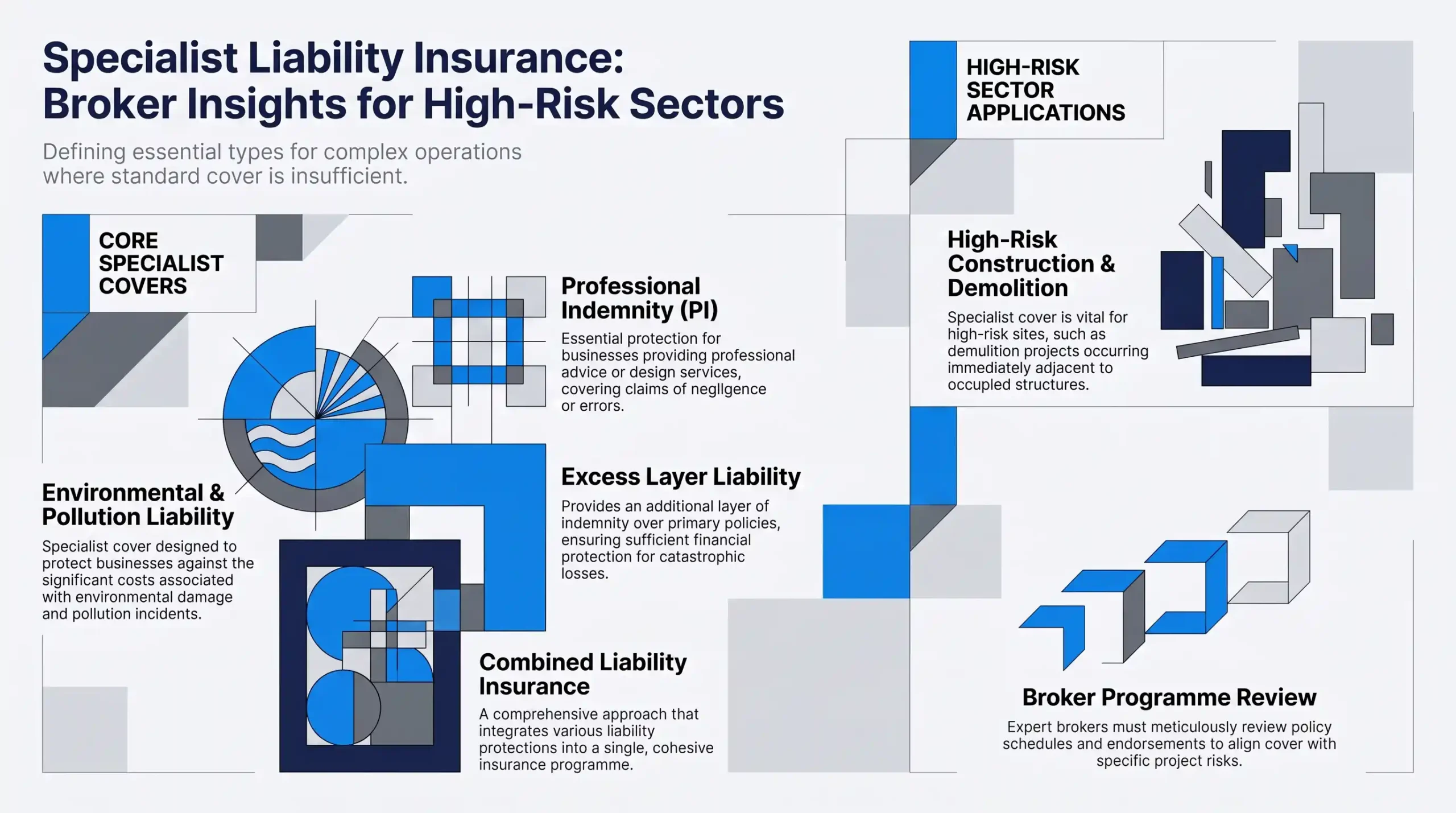
What High-Risk Trades Need From the Liability Market
Risk factors that standard markets decline
High risk liability insurance exists because certain trades carry exposures the standard commercial market will not accept at standard terms. Demolition contractors, licensed asbestos removal operators, piling and underpinning specialists, and hazardous waste handlers fall into this category. Specialist broker intervention is required to manage the exclusions, warranties, and sub-limits that apply.
The National Federation of Demolition Contractors and the Health and Safety Executive both publish guidance that underwriters reference when assessing risk quality. An operator with CCDO-carded operatives and pre-demolition asbestos survey reports will access broader coverage at more competitive terms. Detailed method statements matter too. The documentation is a material underwriting input — it affects both the terms offered and the premium charged.
Matching the liability limit to the contract
Demolition projects on major infrastructure schemes commonly require public liability of £25 million or above. A primary policy at £10 million will not satisfy those terms. An excess layer liability programme fills this gap. It sits above the primary limit and responds once that limit is exhausted.
Piling and underpinning contractors face a distinct challenge. Vibration damage to adjoining property is the dominant claims pattern. Some underwriters apply sub-limits or specific exclusions to vibration-related losses. The Federation of Piling Specialists provides technical guidance that a specialist broker will reference when presenting the risk. Placing these risks without sector-specific knowledge consistently produces inadequate terms and unintended gaps.
Did You Know?
Gradual pollution is excluded from the public liability section of almost every standard commercial policy in the UK. The Environmental Damage (Prevention and Remediation) (England) Regulations 2015 impose statutory clean-up obligations on operators. A standard PL policy will not respond to those obligations. Stand-alone environmental impairment liability cover is required.
How Environmental Liability Operates Beyond the PL Policy
What a standard PL policy excludes
Standard public liability policies include a pollution liability clause. It covers only sudden and accidental pollution events — and even then, sub-limits apply. Gradual pollution, which accounts for a significant proportion of real-world environmental claims, is excluded from almost every standard PL policy in the UK market.
The Environmental Damage (Prevention and Remediation) (England) Regulations 2015 impose statutory clean-up obligations that sit entirely outside the PL policy. Stand-alone environmental impairment liability cover responds to these obligations. It covers on-site and off-site clean-up, third-party losses, and biodiversity damage. For demolition contractors, groundwork operators with fuel storage, and businesses holding an Environment Agency permit, this cover is a material gap — not a discretionary add-on.
EIL cover structured for the specific exposure
Environmental impairment liability policies are written on either an occurrence basis or a claims-made basis. The difference is material for long-tail pollution risks. A claims-made policy covers claims notified during the policy period. An occurrence policy covers events that occur during the period, regardless of when the claim is notified.
Waste and recycling operators face particular scrutiny from underwriters. The Environment Agency requires Fire Prevention Plans for many permitted waste sites. Underwriters are applying prescriptive fire-prevention warranties as a condition of cover with increasing frequency. An operator without a current Fire Prevention Plan aligned to the Waste Industry Safety and Health Forum guidance may find EIL capacity restricted or declined.
Professional Indemnity in Design and Technical Roles
Professional indemnity insurance covers legal liability for professional advice, design, or specification that causes a financial loss. For contractors under design-and-build contracts — JCT Design and Build, NEC4 ECC with contractor design portions — the PI exposure is real and contractually imposed. A public liability policy will not respond to a pure financial loss from a design error that causes no physical damage.
The Building Safety Act 2022 has raised the stakes for contractors working on higher-risk buildings. These are buildings of 18 metres or above, or seven storeys or more, with at least two residential units. Under the gateway process, design responsibility is more clearly attributed. For contractors in this space, PI cover is not discretionary.
PI policies are almost always written on a claims-made basis. The policy in force when the claim is notified responds — not the policy in force when the work was carried out. This makes continuous cover essential. Gaps in PI cover, even short ones, can leave a contractor exposed on past projects. Retroactive cover and run-off provisions are the mechanisms that address this risk.
Cover Built for Demanding Businesses
Across high risk industries, the cover we arrange most often includes:
Public liability
Employers' liability
Motor fleet
Contractors' all risks
Freight liability
Professional indemnity
Environmental liability
Business interruption
Most businesses need a combination, rather than a single focus policy, and we build cover around your contracts, your workforce and your operational activities.
How Excess Layer Programmes Work in Practice
Positioning excess cover above the primary policy
An excess layer liability policy responds once the primary policy limit is fully exhausted by an admitted claim. It does not replace the primary policy. The excess layer insurer requires confirmation of the primary policy terms. Any gaps in the primary policy will typically be reflected in the excess layer wording. Both policies must be reviewed together, not in isolation.
On major infrastructure contracts, the contractual indemnity requirement may be £25 million or higher. A primary policy of £10 million combined with a £15 million excess layer achieves that programme. The excess layer is a separate market exercise, often placed with a different underwriter, requiring its own risk presentation. Managing both as a single programme avoids the wording misalignment that commonly drives claims disputes.
Excess layer liability in demolition and civil engineering
Demolition and civil engineering are the sectors where excess layer liability is most frequently required by contract. High-reach mechanical demolition, piling adjacent to live infrastructure, and RC frame construction on major commercial developments all generate demands that exceed standard primary limits. Failure to meet those limits can result in contract cancellation.
The NEC4 Engineering and Construction Contract sets out insurance requirements at clause 80 of the contract data. It is the dominant form on public-sector and infrastructure projects. Brokers who do not read the NEC insurance schedule will miss bespoke requirements that standard placements do not address. The pre-market presentation process ensures the client sees exactly how their risk is presented before any approach is made to underwriters.
Statutory Cover Requirements Every Operator Must Meet
Compulsory employers’ liability obligations
Employers’ liability insurance is compulsory under the Employers’ Liability (Compulsory Insurance) Act 1969 for almost every UK employer with at least one member of staff. The statutory minimum is £5 million per occurrence. The market standard placement is £10 million. Any employer carrying less than that should seek an explanation from their broker.
The Employers’ Liability (Compulsory Insurance) Regulations 1998 require the employer to display the certificate of insurance and retain records. For high-risk sectors — demolition, licensed asbestos removal, scaffolding — occupational disease claims have a long tail. Historical EL policies may be called upon decades after work was performed. An occurrence-wording EL policy responds to events that occurred during the policy period, regardless of when the claim is made.
Construction regulations that drive cover requirements
The Construction (Design and Management) Regulations 2015 impose duties across the construction supply chain. Where a contractor acts as principal contractor, CDM duties increase materially. Liability exposure — particularly for site safety failures — expands accordingly. Height-limit warranties in liability policies must be reviewed against actual working heights on every project.
The Control of Asbestos Regulations 2012 require pre-demolition and refurbishment surveys before work begins on any building where asbestos-containing materials may be present. A contractor who proceeds without a survey and disturbs asbestos faces regulatory enforcement by the Health and Safety Executive and a potential liability claim. The asbestos endorsement on the liability policy must be explicit. A general PL policy without that endorsement may decline the claim on the basis that asbestos is excluded.
How a Specialist Broker Places This Cover
Positioning the risk before approaching the market
Specialist liability placement begins as a risk presentation exercise, not a premium negotiation. The broker’s role at pre-market stage is to represent the client’s operations, risk controls, and claims history accurately to underwriters. A pre-market presentation sent to the client in advance allows the insured to verify that their business is described correctly before any market approach is made.
This is not standard practice across the broking market. Specialist underwriting appetite for high-risk liability placements is limited. Brokers without established relationships in the demolition, asbestos, environmental, and civil engineering sectors will access a narrower range of terms. Market access built through consistent specialist placement — not occasional one-off transactions — produces competitive coverage for high-hazard operators.
Claims advocacy from day one
Specialist liability placements are only as effective as the claims response they deliver. The claims contact should be named and the process documented before a policy is placed — not identified for the first time when a claim arrives. Quarterly claims reviews through the policy year monitor performance and protect the client’s premium position at renewal.
Legacy claims handling addresses a specific problem in specialist sectors. Claims arising on expired policies continue to affect current premium if left unmanaged. A demolition or asbestos contractor with an open historic claim that no one is actively managing will see that claim inflate over time. Active management of those legacy claims prevents that deterioration from affecting renewal terms.
Final Thoughts
Specialist liability insurance is not a single product. It is a programme — combined liability insurance as the base, excess layer cover where contracts demand higher limits, environmental impairment liability where pollution exposure exists, and professional indemnity where design or technical advice is part of the service. Each element must be reviewed against the actual contractual and regulatory obligations the operator faces.
Operators in high-hazard sectors who have simply renewed the same liability schedule year after year are carrying exposure they may not recognise. A structured review of the full programme — before a contract is signed or a claim arrives — is the starting point for genuine cover adequacy.
Speak to an Insurance Specialist
Whether you need a new quote, want to discuss your renewal or have a question about an existing policy, our team is here to help.
Frequently Asked Questions
Q: What is the difference between combined liability insurance and a standalone public liability policy?
A: Combined liability insurance bundles public liability, employers’ liability, and products liability under a single policy schedule with one renewal date. A standalone public liability policy covers only third-party injury and property damage. For most employers, a combined policy is the correct structure. Employers’ liability is compulsory under the Employers’ Liability (Compulsory Insurance) Act 1969, and managing it separately from public liability creates an unnecessary risk of a coverage gap at renewal.
Q: When does a contractor need an excess layer liability programme?
A: An excess layer programme is required when a contract imposes an indemnity limit that exceeds the primary policy limit. On major demolition, civil engineering, or RC frame projects, contractual requirements of £25 million or higher are not unusual. A primary policy capped at £10 million leaves a £15 million gap. The excess layer sits above the primary policy and responds only after the primary limit is fully exhausted by an admitted claim.
Q: Does a standard PL policy cover pollution and environmental damage?
A: Most standard PL policies include a pollution liability clause covering sudden and accidental pollution events, often subject to a sub-limit. Gradual pollution — a slow fuel leak, persistent leachate, or long-term contamination — is excluded. Stand-alone environmental impairment liability insurance is required for gradual pollution, statutory clean-up obligations under the Environmental Damage (Prevention and Remediation) (England) Regulations 2015, and biodiversity damage. Operators holding Environment Agency permits should treat this gap as a priority.
Q: Why is professional indemnity insurance relevant to construction contractors?
A: Professional indemnity insurance covers financial losses caused by a design error, specification failure, or professional advice. Under JCT Design and Build and NEC4 Engineering and Construction Contract arrangements, the contractor assumes responsibility for the design. If that design causes a pure financial loss — without physical damage — the public liability policy will not respond. PI cover is also relevant under the Building Safety Act 2022 gateway process for higher-risk buildings, where design accountability is formally tracked.
Q: How does a specialist broker approach high risk liability insurance for high-hazard trades?
A: A specialist broker treats high risk liability insurance placement as a risk presentation exercise. The firm prepares a detailed pre-market presentation covering the client’s operations, risk controls, claims history, and contractual requirements. This is reviewed by the client before any approach is made to underwriters. Strong market relationships — particularly with specialist underwriters selective about the risks they write — are essential for securing adequate terms for demolition, asbestos, and environmental operators.
About The Author
Darren Judd
Director, Co-Founder and Co-Owner of Capital Corporate Risks Ltd

Experienced Account Executive with a demonstrated history of working in the insurance industry. Skilled in Account Management, Risk Management, Business Development across all classes of insurance within the Construction Industry,