
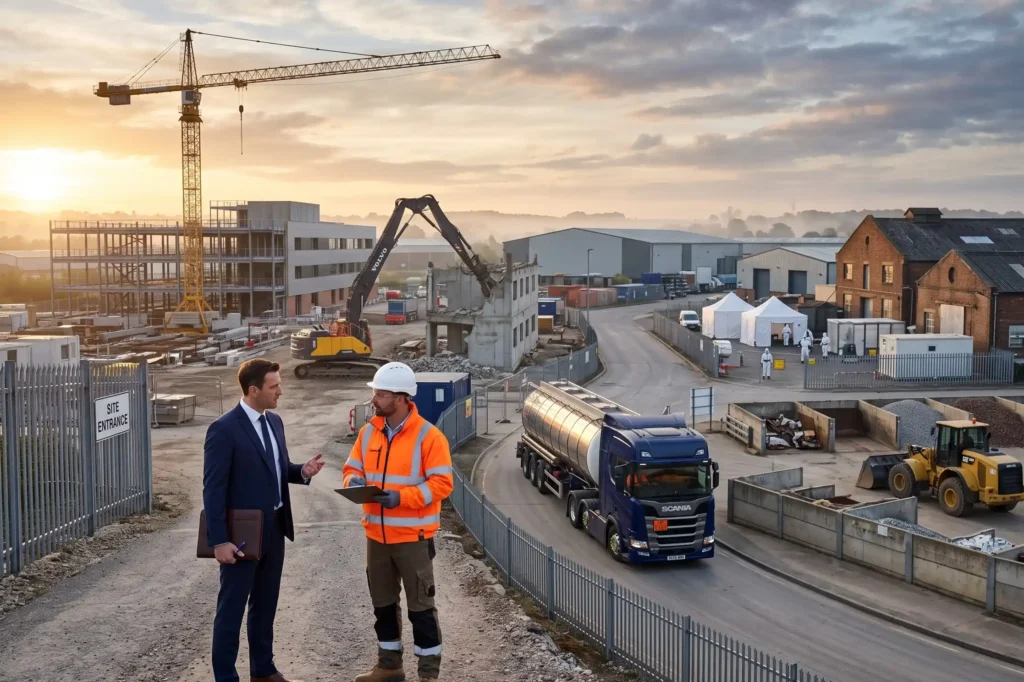
Specialist Business Insurance.
Specialist business insurance is not a premium version of standard commercial cover — it is a structurally different product. It exists for risks that the standard market excludes, sub-limits, or declines outright.
Many businesses discover this too late. When a claim is repudiated, their existing policy proves worthless at the critical moment. Which sectors genuinely require bespoke commercial insurance, and what does a credible programme look like?
Key Takeaways
- Standard commercial policies contain blanket exclusions for asbestos, gradual pollution, and licensed demolition work that leave high-hazard businesses effectively uninsured for their core activity.
- Demolition, licensed asbestos removal, hazardous goods haulage, and waste operations each require underwriters with specific sector appetite and technical wording capability.
- Specialist commercial insurance brokers access Lloyd’s syndicates and non-standard markets that generalist brokers operating in standard commercial lines cannot reach.
- Bespoke commercial insurance is constructed around actual contract requirements, regulatory obligations, and claims history — not a packaged product.
- Claims advocacy in high-hazard sectors requires the same technical expertise as placement — poor advocacy can void legitimate claims.
Why Standard Cover Fails High-Hazard Sectors
Spot the Exclusions Before a Claim Does
Standard commercial liability policies are written for low-hazard retail and office risks. They contain blanket exclusions for asbestos, gradual pollution, demolition work, and activities requiring a statutory licence. A business in these sectors that relies on a standard policy is, in practice, uninsured for its core activity.
The Insurance Act 2015 places a duty of fair presentation of risk on the insured. It equally demands that the insurer responds to the risk actually disclosed. If a broker has not presented operations accurately to a specialist underwriter, the resulting policy may be voidable. Brokers working primarily in standard commercial lines lack the sector vocabulary for this work. They cannot present a demolition or asbestos contractor’s risk in a way that generates valid, responsive cover.
What Standard Markets Will Not Write
Certain activities trigger automatic referral or outright decline from standard commercial insurers. These include licensed asbestos removal, mechanical demolition with high-reach plant, hazardous goods transport, and waste treatment operations. Each sector has a defined regulatory framework — and a matching specialist insurance market.
The coverage gap extends beyond exclusion wordings. It also affects indemnity limits. A demolition contractor on a major infrastructure project may need a primary public liability limit of £10 million, plus excess layer capacity above that. Standard commercial combined policies rarely offer more than £5 million. They frequently impose project-type exclusions that strip cover further.
| Sector | Standard policy response | Specialist cover required |
|---|---|---|
| Licensed asbestos removal | Typically excluded | Explicit asbestos endorsement, £5m–£10m PL |
| Mechanical demolition | Often declined or sub-limited | £10m PL minimum; excess layer on major projects |
| Hazardous goods haulage | ADR loads commonly excluded | Hazardous goods endorsement on fleet and GIT |
| Waste and recycling (MRF) | Fire risk often uninsurable on standard terms | Fire prevention warranty; specialist BI cover |
| Construction (CDM notifiable) | CAR cover often project-capped | Annual CAR; flow-down liability wording |

Insurance Demands in Construction and Demolition
CDM Obligations and Their Insurance Implications
Construction work notifiable under CDM 2015 creates insurance obligations that flow from the principal contractor and principal designer roles. Standard liability policies rarely extend to the design liability assumed under these regulations. Damage to existing structures during a refurbishment contract is similarly excluded. A JCT Option C works insurance clause requires a broker who understands the contract suite.
The Building Safety Act 2022 added complexity for contractors on higher-risk buildings. These are defined as structures at least 18 metres tall, or at least seven storeys, with two or more residential units. The gateway process requires design and build contractors to demonstrate competence and accountability at every stage. Professional indemnity cover is a contractual and regulatory baseline on these projects. It must be placed with a retroactive date aligned to design engagement.
Demolition Insurance: What the Market Requires
Demolition insurance requires a public liability minimum of £10 million as a working standard. Major civil and infrastructure projects require excess layer capacity above that. Underwriters expect CCDO records before terms are offered. They also require pre-demolition asbestos surveys under the Control of Asbestos Regulations 2012 and adjacent property condition surveys.
Environmental liability is inseparable from demolition work. Dust, noise, vibration, and contamination from pre-existing ground conditions all generate exposures outside standard public liability. Gradual pollution is the type most likely to arise on a contaminated demolition site. It is excluded from virtually every standard PL policy. A stand-alone Environmental Impairment Liability policy, sitting alongside the primary liability programme, is the correct structural response.
Did You Know?
Under the Employers’ Liability (Compulsory Insurance) Act 1969, the statutory minimum indemnity limit is £5 million per occurrence. Market practice places the working standard at £10 million per occurrence. This applies across specialist high-hazard sectors, including licensed asbestos removal and demolition. The gap between statutory minimum and contractual requirement must be specifically arranged and confirmed in the policy schedule.
Why Asbestos Work Demands Its Own Insurance Structure
The Asbestos Endorsement Is Non-Negotiable
HSE-licensed asbestos removal contractors require a public liability policy that explicitly accepts asbestos as an insured activity. Without a named endorsement, the policy contains an asbestos exclusion. This renders the entire programme worthless for the contractor’s core work. Standard PL insurers apply this exclusion as a blanket clause.
The long-tail nature of mesothelioma claims is the defining underwriting challenge in this sector. Asbestos exposure can result in disease diagnosed 20 to 40 years after the original event. This means employers’ liability policies written on an occurrence basis remain potentially active decades after the work was completed. The Employers’ Liability (Compulsory Insurance) Act 1969 mandates a minimum of £5 million per occurrence. Market practice for HSE-licensed contractors sets the working limit at £10 million. Specialist commercial insurance brokers who understand the occurrence versus claims-made distinction are essential here.
Professional Indemnity and Environmental Exposure in Asbestos Work
Asbestos surveying and consulting firms carry a separate professional indemnity exposure. An inaccurate survey that leads to inadequate clearance generates professional negligence claims. So does a building owner’s failure to manage an ongoing duty. These can run into significant sums. Professional indemnity cover must be placed with an insurer who understands the technical scope of the work.
Cover for UKAS-accredited surveying firms operating under ISO 17020 or ISO 17025 standards requires specialist placement. The Environmental Impairment Liability dimension also applies. Fibre migration beyond the licensed work area can generate regulatory enforcement action. So can contamination of waste transfer routes and incorrect disposal under the Hazardous Waste Regulations 2005. The full cover stack for this sector is PL with explicit endorsement, EL, and PI for surveyors. Stand-alone EIL is added where the exposure warrants it.
Hazardous Goods Haulage and Specialist Insurance Demands
ADR Fleet Cover: Why Standard Policies Fall Short
Haulage operators carrying dangerous goods under the Carriage of Dangerous Goods Regulations 2009 require explicit ADR endorsements on both their motor fleet policy and their goods in transit cover. Standard fleet policies exclude hire-and-reward carriage of hazardous materials. The consequence is significant: the vehicle, the load, and third-party claims are all uninsured at the moment of maximum exposure.
The Road Traffic Act 1988 mandates third-party motor insurance as an absolute minimum. Statutory compliance is the floor, not the ceiling, for a hazardous goods operator. A credible programme requires comprehensive fleet cover and goods in transit on an all-risks basis. It must also include a stand-alone Environmental Impairment Liability policy for spill events. The Road Haulage Association Conditions of Carriage limit carrier liability on domestic movements. Customers contracting under those conditions are not fully protected by the carrier’s GIT policy. Full protection requires an all-risks basis to be specifically arranged.
Coordinating Coverage Across ADR Spill Exposures
A single ADR spill event can trigger claims under motor liability, public liability, goods in transit, and environmental impairment liability. Standard policies respond to each strand differently. Standard policies respond to each strand differently — and often not at all to the environmental clean-up obligation.
The Environmental Damage (Prevention and Remediation) (England) Regulations 2015 impose statutory clean-up duties beyond common-law liability. Bespoke commercial insurance for hazardous goods operators must address all four exposure streams in a coordinated programme. Specialist commercial insurance brokers who place haulage programmes understand how FORS accreditation affects underwriter appetite. The scheme runs Bronze, Silver, and Gold tiers. A Gold-rated FORS operator will access better terms than an unaccredited equivalent carrying the same cargo. Robust telematics and documented claims management drive this advantage.
Cover Built for Demanding Businesses
Across high risk industries, the cover we arrange most often includes:
Public liability
Employers' liability
Motor fleet
Contractors' all risks
Freight liability
Professional indemnity
Environmental liability
Business interruption
Most businesses need a combination, rather than a single focus policy, and we build cover around your contracts, your workforce and your operational activities.
Waste and Recycling Insurance: A Specialist Category
Fire Risk at Waste Sites: The Dominant Loss Exposure
Waste and recycling sites carry fire as their dominant large-loss exposure. These include materials recovery facilities, waste transfer stations, and plastics or metals recycling plants. Lithium-ion battery contamination in mixed waste streams has materially increased ignition frequency across the sector. Underwriters have responded with reduced capacity, raised excesses, and prescriptive fire prevention warranties.
The Environment Agency requires Fire Prevention Plans for many permitted waste sites. Insurers increasingly require evidence of thermal imaging regimes and combustible stockpile height limits. Separation distances and lithium-ion battery contamination screening are also standard conditions of cover. Business interruption is often the dominant financial exposure. A major fire at an MRF can result in months of lost throughput. The indemnity period on a BI policy must reflect realistic reinstatement timelines. Specialist plant — including shredders, balers, and conveyor systems — can take months to replace.
Environmental Permits and Policy Validity
Waste operations in England require an environmental permit from the Environment Agency. This is issued under the Environmental Permitting (England and Wales) Regulations 2016. Cover placement is conditional on current, valid permit status. A permitted-activity warranty is standard across waste sector policies. Any breach of permit conditions can void the insurance at the point of a claim.
Upper Tier registration as a waste carrier, broker, or dealer is required for those collecting or transporting controlled waste. The obligation arises under the Environmental Protection Act 1990, section 34. Consignment notes and waste transfer notes form the chain of custody record. A gap in that record is both a regulatory offence and a potential trigger for coverage disputes. Specialist commercial insurance brokers with waste sector experience advise on both regulatory and insurance compliance dimensions simultaneously.
How Specialist Brokers Access Markets Generalists Cannot Reach
Lloyd’s of London remains the primary market for risks that standard insurers decline or restrict. Access to Lloyd’s is not available to all brokers. It requires either direct Lloyd’s broker status or placement via a Lloyd’s broker intermediary. Specialist commercial insurance brokers with high-hazard sector experience maintain Lloyd’s relationships specifically for demolition, asbestos removal, hazardous goods haulage, waste treatment, and large-scale construction. This market access is not replicated by a generalist broker in standard commercial lines.
The credentials a specialist broker holds matter in practice. Membership of BIBA, participation in senior broker programmes tied to major insurers, and membership of networks providing additional market access across specialist insurers are all markers of placement capability. These relationships are relationship-driven. An underwriter who knows a broker’s book and understands how risks are presented will offer terms that a cold submission from an unknown broker will not obtain.
What Bespoke Commercial Insurance Actually Means
Bespoke commercial insurance is constructed around specific operations, contracts, regulatory obligations, and claims history. It is not a pre-packaged product applied to a generic risk category. For a demolition contractor, this means a PL limit calibrated to actual contract requirements and an asbestos endorsement. The plant schedule reflects the actual fleet. An environmental section addresses site-specific contamination exposure.
The process of building a bespoke programme is deliberate at every stage. Stage review of current arrangements identifies gaps in existing cover. A market approach discussion explains how the risk will be represented. A pre-market presentation gives the client a copy of the submission before it goes to market. There are no surprises in how their business is described to underwriters. This level of transparency is what separates bespoke commercial insurance from packaged products.
Why Claims Advocacy Matters as Much as Placement
In high-hazard sectors, claims are not rare events — they are a predictable feature of the operational risk profile. A demolition contractor working on multiple projects simultaneously carries a higher frequency of notifiable incidents than a standard commercial risk. The quality of claims advocacy at that point determines whether the insurance programme delivers its intended function.
Claims advocacy in specialist sectors requires technical knowledge that mirrors placement knowledge. A broker who does not understand the Control of Asbestos Regulations 2012 cannot effectively advocate for a client disputing an asbestos removal claim. A broker without knowledge of the Environmental Permitting Regulations cannot challenge an insurer’s attempt to void a waste sector claim on a permitted-activity warranty. The sector expertise that drives placement quality also drives claims quality.
Quarterly claims reviews are a proactive mechanism for monitoring claims performance and managing the impact on renewal premiums. Legacy claims handling — covering previously expired policies where outstanding claims may still affect premium calculations — is equally important. In specialist sectors, a single large claim handled poorly can distort premium trajectory for years. Handled well, with active advocacy and documented evidence, its impact can be significantly reduced.
Final Thoughts
Specialist business insurance is the only credible response to risks that standard commercial policies are not designed to cover. For contractors under the Control of Asbestos Regulations 2012, demolition firms with high-reach plant, hauliers carrying ADR-classified loads, and permitted waste operators, a standard policy is structurally inadequate. It is not marginally so — it is fundamentally so. The exclusions, sub-limits, and declined risks in standard products are not incidental. They define the boundary of what those products are willing to insure.
The path to a responsive programme runs through specialist commercial insurance brokers with direct sector experience. They must have genuine market access — including Lloyd’s capacity — and a claims advocacy capability that matches their placement quality. Verifying these credentials is not a formality. It is the first underwriting decision a high-hazard business makes.
Speak to an Insurance Specialist
Whether you need a new quote, want to discuss your renewal or have a question about an existing policy, our team is here to help.
Frequently Asked Questions
Q: What makes specialist business insurance different from standard commercial cover?
A: Standard commercial policies are written for low-hazard risks and contain blanket exclusions for activities including asbestos removal, demolition, hazardous goods transport, and waste treatment. Specialist business insurance is built around the specific operations, regulatory obligations, and contractual requirements of the insured. It uses underwriters — often in Lloyd’s or non-standard markets — with the appetite and technical capability to cover high-hazard activities that standard insurers exclude. The policy wording, indemnity limits, and endorsements are constructed to respond to the actual risk.
Q: Which sectors typically need specialist commercial insurance brokers?
A: Sectors that regularly require specialist commercial insurance brokers include demolition, licensed asbestos removal, hazardous goods haulage, waste and recycling operations, civil engineering and groundworks, scaffolding, roofing, and large-scale construction under CDM 2015 notifiable projects. In each case, the combination of statutory licensing, high indemnity limit requirements, exclusions in standard policies, and complex claims patterns means a generalist broker cannot adequately present the risk or secure responsive cover.
Q: Why does demolition insurance require a higher public liability limit?
A: Demolition work generates third-party exposure from dust, noise, vibration, falling materials, and damage to adjacent structures. On major infrastructure and civil projects, contractual indemnity requirements routinely specify a minimum public liability limit of £10 million, with excess layer capacity above that for the largest contracts. The National Federation of Demolition Contractors sets operative competence standards, and underwriters factor in CCDO card records, pre-demolition asbestos surveys, and adjacent property condition surveys when assessing risk and setting terms.
Q: How does bespoke commercial insurance benefit a waste and recycling operator?
A: Bespoke commercial insurance for a waste or recycling operator addresses site-specific exposures: fire risk at the MRF, business interruption indemnity periods calibrated to realistic plant reinstatement timescales, permitted-activity warranties aligned to the actual Environment Agency permit, and environmental impairment liability for pollution events. A packaged product cannot replicate this. The policy must reflect how the site operates, what it processes, and what its regulatory obligations are under the Environmental Permitting (England and Wales) Regulations 2016.
Q: Can a specialist broker arrange the full cover stack for an asbestos removal contractor?
A: Yes. The full cover stack for an HSE-licensed asbestos removal contractor comprises public liability with an explicit asbestos endorsement, employers’ liability at the working market limit of £10 million, professional indemnity for surveying and consulting functions, and stand-alone Environmental Impairment Liability where the exposure requires it. Placement requires a broker who understands the long-tail mesothelioma exposure underpinning EL. They must also advise on the occurrence versus claims-made distinction and known-claims exclusion management at renewal.
About The Author
Darren Judd
Director, Co-Founder and Co-Owner of Capital Corporate Risks Ltd

Experienced Account Executive with a demonstrated history of working in the insurance industry. Skilled in Account Management, Risk Management, Business Development across all classes of insurance within the Construction Industry,