

High Risk Business Insurance.
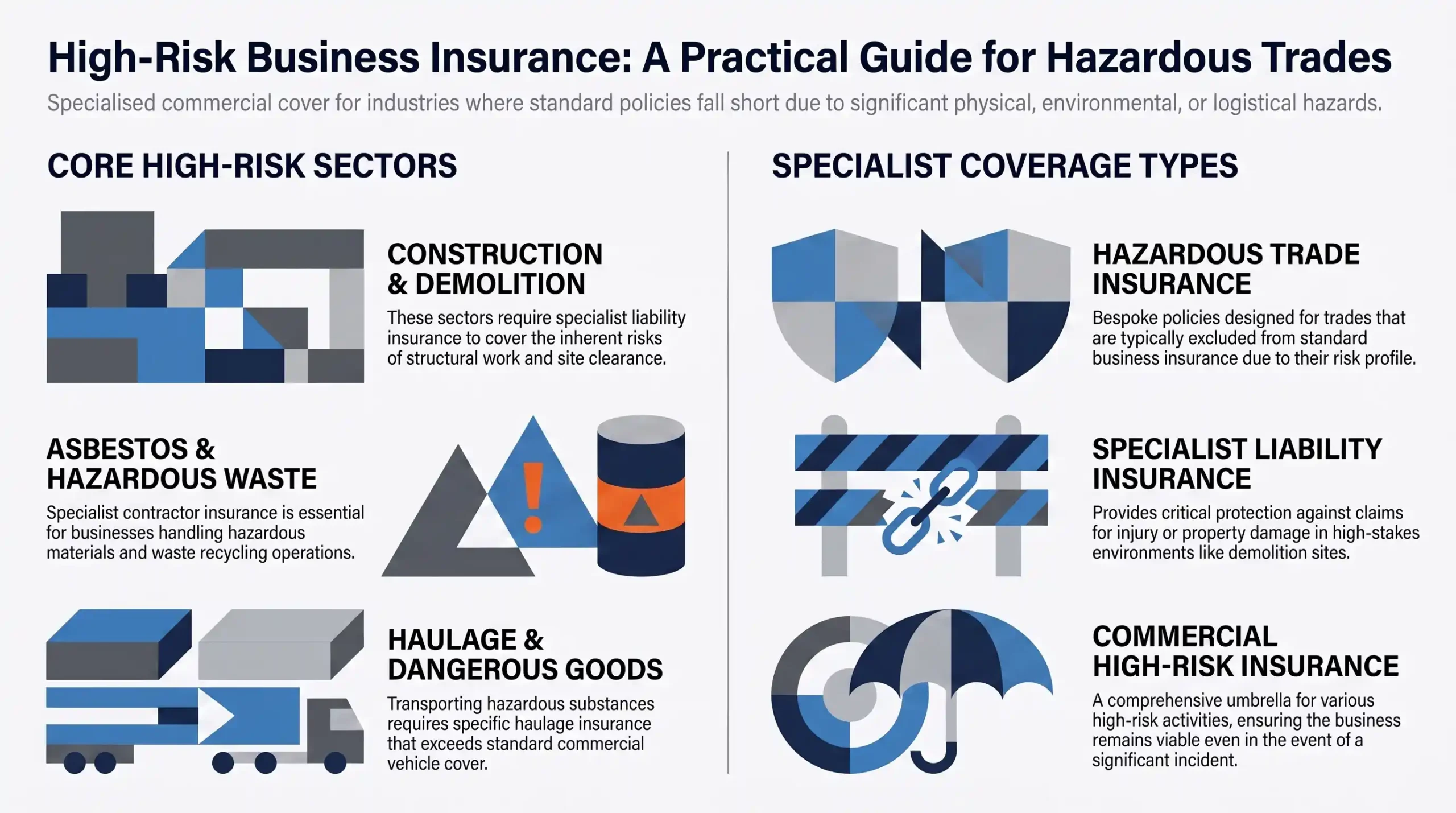
High risk business insurance exists because standard commercial policies are built for standard risks. A significant number of UK businesses operate well outside that bracket. Demolition contractors, licensed asbestos removers, waste processors and dangerous goods hauliers face specific exposures. General-market insurers routinely decline or heavily restrict cover for those activities.
Commercial high risk insurance and hazardous trade insurance are not simply higher-premium versions of ordinary cover. They demand specialist underwriters, precise documentation, and a broker who knows how to present operations to the market. So what do underwriters actually need from high-hazard businesses, and how should the placement process work in practice?
Key Takeaways
- High-hazard sectors face routine declines from standard commercial insurers because policy wordings exclude asbestos, gradual pollution, hot works and ADR loads by default.
- Underwriters require detailed risk assessments, method statements, adjacent surveys, three years of claims history and trade body evidence upfront to offer competitive terms.
- Demolition and licensed asbestos work commonly require public liability at £10 million minimum, backed by explicit endorsements accepting the specific hazardous exposure.
- ADR haulage needs specific hazardous goods endorsements on the motor policy plus carriers’ liability or all-risks goods in transit cover for the cargo.
- A specialist broker presents your risk with full documentation and market narrative, rather than submitting a standard proposal form for underwriters to interpret.
Get the Right Cover Stack for Your High-Hazard Trade
Why standard policies fail high-risk operators
Standard commercial liability policies assume the insured avoids asbestos, heavy demolition plant, controlled waste and ADR-classified substances. When those activities appear on a proposal, the standard market either declines or attaches broad exclusions. Those exclusions strip cover of practical value. High risk business insurance is built around hazardous activities, not written to exclude them.
The difference shows in the policy wording itself. A standard public liability policy excludes asbestos as a matter of course. A specialist policy places an explicit asbestos endorsement into the wording. That endorsement accepts the exposure as a named part of insured operations. The same principle applies to gradual pollution, vibration damage, heat and hot works, and contaminated land. Each requires a deliberate underwriting decision rather than a default acceptance.
How to identify the correct cover stack for your sector
The correct cover stack depends on your specific trade activities, contract obligations and operational footprint. Demolition contractors typically need public liability at £10 million as a working minimum. They also require employers’ liability, contractors all risks, and plant cover for high-reach machines. Environmental liability handles dust, noise and contamination exposure.
Asbestos removal contractors working under an HSE licence need a public liability policy with an explicit asbestos endorsement. They also need employers’ liability that accounts for long-tail mesothelioma exposure. Professional indemnity covers any surveying or analytical work. Environmental liability covers clean-up obligations. Licensed removal contractors operating without all four carry uninsured exposure that could prove commercially terminal. The Control of Asbestos Regulations 2012 governs the licensing regime, and compliance with that framework is itself an underwriting prerequisite.
| Sector | Minimum PL Limit | Key Additional Cover | Critical Endorsement |
|---|---|---|---|
| Demolition | £10 million | Environmental liability, plant, CAR | Asbestos endorsement |
| Licensed asbestos removal | £5m–£10 million | PI, environmental, EL | Explicit asbestos acceptance |
| Waste and recycling | £5 million | Engineering breakdown, BI, plant | Fire prevention warranty |
| Hazardous goods haulage | £5 million | Motor fleet, GIT, environmental | ADR hazardous goods endorsement |
| Construction (high-hazard) | £5m–£10 million | CAR, plant, tools | Hot works warranty |
How to Approach the Demolition Insurance Market
Recognise why demolition is treated differently by underwriters
Demolition sits in a distinct risk class for good reason. Structural intervention, asbestos in pre-2000 buildings, vibration transfer to neighbouring properties, and high-value plant on live sites create concentrated exposures. General construction underwriters rarely accept the combination. Public liability at £10 million serves as the working minimum on most projects.
The Construction (Design and Management) Regulations 2015 apply in full to demolition work. Underwriters expect to see CDM compliance embedded in the risk presentation, not mentioned as an afterthought. Pre-demolition asbestos surveys — specifically refurbishment and demolition surveys — are a core underwriting document. The Control of Asbestos Regulations 2012 require these surveys before demolition begins on buildings where asbestos may be present. Presenting those surveys to an underwriter is not optional.
Compile the documents underwriters need before approaching the market
Demolition underwriters expect a specific document set before they will offer terms. Risk assessments and method statements for representative project types are essential. So are pre-demolition asbestos survey reports and adjacent property surveys covering party wall condition. Operative training records showing CCDO card status and three years of claims experience complete the baseline.
The National Federation of Demolition Contractors operates a recognised membership and accreditation framework. NFDC membership and operative CCDO card status are visible trust signals to underwriters. They do not guarantee terms. They do demonstrate a level of operational discipline that reduces perceived risk. Brokers who present demolition risks without referencing trade body standing or operative competence leave credibility on the table.
Apply Specialist Knowledge to Asbestos Contractor Cover
Distinguish between licensed, NNLW and non-licensed asbestos work
Asbestos work splits into three regulatory categories. HSE-licensed removal covers friable insulation, sprayed coatings and asbestos insulation board. Notifiable non-licensed work requires notification to the enforcing authority but not a full licence. Non-licensed work sits below that threshold. Placing licensed removal under a non-licensed policy is a coverage failure. It rarely surfaces until a claim is made.
The long-tail nature of asbestos disease claims makes the occurrence versus claims-made distinction critical. Mesothelioma can emerge decades after initial fibre exposure. An occurrence-based employers’ liability policy responds to the policy in force when the exposure occurred. A claims-made policy responds only if a claim is made during the policy period. For asbestos contractors, the applicable basis matters. So does ensuring no retroactive date gaps exist. The Insurance Act 2015 places the duty of fair presentation of risk on the insured and their broker.
Verify what the policy wording actually covers
Asbestos policies need careful wording review. Several exclusions in standard liability policies can render cover worthless for this sector. Gradual pollution is typically excluded from public liability policies. It sits, if at all, under a stand-alone environmental impairment liability policy. Known claims exclusions mean circumstances known at policy inception may fall outside the new period.
The Environmental Damage (Prevention and Remediation) (England) Regulations 2015 impose statutory clean-up obligations. Those obligations sit outside standard public liability cover. Environmental impairment liability cover is the correct mechanism for meeting them. ARCA is the Asbestos Removal Contractors Association. ACAD is the Asbestos Control and Abatement Division of TICA. Membership of either strengthens an underwriting submission and signals adherence to industry standards.
Did You Know?
Under the Control of Asbestos Regulations 2012, a refurbishment and demolition survey is legally required before demolition or major refurbishment work begins on any building where asbestos-containing materials may reasonably be present. Underwriters treating this survey as a non-negotiable underwriting document reflect a statutory requirement, not an additional commercial condition.
Position Your Waste Business for Insurer Approval
Accept that fire is the dominant underwriting concern in this sector
Fire causes the largest losses across waste and recycling. Underwriters respond with declines, reduced capacity, prescriptive fire prevention warranties, and restricted business interruption indemnity periods. A waste operator without documented fire prevention controls struggles to secure competitive terms. Claims history matters less than prevention documentation in this sector today.
The Environment Agency requires Fire Prevention Plans for many permitted sites in England. The Waste Industry Safety and Health Forum publishes sector-specific fire prevention guidance. That guidance covers the growing problem of lithium-ion battery contamination in mixed waste streams. Environmental Permitting (England and Wales) Regulations 2016 govern the permit regime. Breaching permit conditions can trigger a warranty breach on the insurance policy. That is a separate financial problem from the regulatory penalty itself.
Build operational controls that improve insurability
Insurability in waste sits directly on documented operational controls. Underwriters now ask about combustible stockpile size limits, separation distances between waste streams, thermal imaging programmes, and hot-work permit systems. Contamination screening for lithium-ion batteries, 24-hour fire detection, and on-site water supply complete the standard checklist. Documented procedures for each control improve the position materially.
Business interruption cover deserves particular attention in this sector. Waste and recycling plants depend on specialist shredders, balers and conveyor systems with long replacement lead times. Engineering breakdown cover responds to sudden mechanical failure. The lost gross profit during a prolonged shutdown is the larger exposure. Engineering all risks combined with an adequately sized business interruption indemnity period is the correct structure. Indemnity periods should be tested against realistic replacement timescales. The ESA and CIWM are the sector’s leading trade bodies.
Comply With ADR Requirements for Dangerous Goods Haulage
Establish that standard motor fleet cover is not sufficient for ADR loads
Standard motor fleet insurance does not automatically respond to third-party claims from ADR-classified loads. A hazardous goods endorsement on the motor policy activates cover for spill, contamination and third-party injury from the cargo. Without that endorsement, the policy may pay out on the vehicle collision but not on the consequential cargo liabilities.
The Carriage of Dangerous Goods and Use of Transportable Pressure Equipment Regulations 2009 set the UK legal framework for ADR compliance. The Goods Vehicles (Licensing of Operators) Act 1995 governs the operator licence regime administered by the Office of the Traffic Commissioner. Both must be reflected in the risk presentation to a haulage underwriter. The Road Haulage Association Conditions of Carriage set the contractual ceiling on domestic carriers’ liability. All-risks goods in transit cover may be required where that ceiling falls below customer contractual requirements.
Review goods in transit cover alongside motor for dangerous goods operators
Goods in transit cover for ADR hauliers sits on two possible bases. Carriers’ liability responds only to liability under the contract of carriage or applicable convention. All-risks GIT responds to the value of goods lost or damaged within policy terms, regardless of liability position. For ADR loads, the distinction matters.
Environmental and pollution liability is the third leg of cover for hazardous goods hauliers. A spill event involving ADR-classified substances can trigger clean-up costs, third-party property damage and statutory liability simultaneously. The Environmental Damage (Prevention and Remediation) (England) Regulations 2015 apply. Standard public liability pollution cover is limited to sudden and accidental events, and it carries a sub-limit. Stand-alone environmental impairment liability cover responds to the broader exposure. FORS Bronze, Silver and Gold tiers are recognised by underwriters as a signal of fleet management quality.
Cover Built for Demanding Businesses
Across high risk industries, the cover we arrange most often includes:
Public liability
Employers' liability
Motor fleet
Contractors' all risks
Freight liability
Professional indemnity
Environmental liability
Business interruption
Most businesses need a combination, rather than a single focus policy, and we build cover around your contracts, your workforce and your operational activities.
Why Market Presentation Determines the Terms You Receive
The quality of the underwriting submission determines the quality of the terms offered. A high-risk business placed through a generalist broker using a standard proposal form typically receives one of two outcomes. Either a decline, or terms loaded to reflect underwriter uncertainty. A specialist broker who presents the risk with full documentation, operational context, claims narrative and trade body standing gives the underwriter confidence to offer competitive terms. That difference is material across every hazardous trade.
Capital Corporate Risks Ltd is a specialist commercial broker authorised and regulated by the Financial Conduct Authority. CCR’s market position includes membership of BIBA, the British Insurance Brokers’ Association. CCR participates in Bravo Networks, which provides direct market access across specialist and high-hazard underwriters. CCR operates at the Aviva 110 senior broker tier. These credentials determine which underwriters will engage, at what speed, and on what basis. They shape the terms available to the client.
CCR’s 10-stage client journey begins with a detailed initial meeting to understand the business, its operations and its current cover arrangements. The second stage identifies gaps in the existing programme before the market is approached. Presenting to underwriters before identifying gaps means those gaps persist into the new placement. A gap review before market approach is the correct sequence.
At Stage 5, CCR sends the client a copy of the pre-market presentation before it goes to underwriters. The client sees exactly how they are being represented. That includes the risk narrative, the supporting documents, and the claims summary. Placement follows at Stage 7, with terms, conditions and cover details presented and explained in full. Stages 8 and 9 provide quarterly contact and proactive claims reviews throughout the policy period.
Verify the Documents Underwriters Require Before Renewal
Compile the core document set before approaching any underwriter
Every high-hazard sector has a baseline document set. Underwriters expect to see it before offering terms. Risk assessments and method statements for representative operations sit at the top of that list. Operative training records come next. So do three years of claims experience with context. Adjacent property surveys, environmental permits, and pre-work asbestos reports complete the core set.
Waste operators add fire prevention plans, permit compliance records and thermal imaging reports to that list. Hauliers carrying dangerous goods add ADR training certificates, vehicle inspection records and operator licence documentation. The Insurance Act 2015 imposes a duty of fair presentation of risk on every insured. Failure to disclose a material fact gives insurers a remedy ranging from policy amendment through to avoidance. Operational changes since the last renewal count as material facts. Preparing a complete document set before renewal is a legal obligation with direct financial consequences if breached.
Capture mid-term changes before they create coverage gaps
High-risk businesses change during the policy year. A demolition contractor takes on a project with a higher-reach specification. A waste operator adds a new material stream. A haulier adds ADR-classified goods to a previously clean fleet. Each change affects the risk profile the underwriter accepted at inception. Failing to notify mid-term changes can void cover for losses arising from them.
CCR’s Stage 8 quarterly contact programme exists to capture these changes before they create gaps. Regular structured contact during the policy period is how mid-term changes are identified, notified and managed. The alternative is discovery at claim stage, when it is too late to correct the position. That proactive structure is the practical difference between a broker who places cover and a broker who manages it.
High Risk Liability Insurance
Asbestos, height, depth and hazardous-trade liability cover.
Final Thoughts
High risk business insurance is a specialist discipline, not a premium-loaded version of standard cover. The sectors it serves face underwriting challenges that cannot be resolved through standard market channels. Demolition, licensed asbestos removal, waste and recycling, and hazardous goods haulage all fall into that category. The correct cover stack, the right policy wordings, and the quality of the market presentation together determine whether the programme responds when a loss occurs.
A specialist broker approaches commercial high risk insurance with documented evidence, trade body standing and a clear risk narrative. If your business operates in a high-hazard trade and your current cover has not been reviewed by a specialist recently, the gap between what you have and what you need is likely wider than your renewal documents suggest. A structured review before the next renewal cycle is the right starting point.
Speak to an Insurance Specialist
Whether you need a new quote, want to discuss your renewal or have a question about an existing policy, our team is here to help.
Frequently Asked Questions
Q: What sectors does high risk business insurance typically cover?
A: High risk business insurance covers sectors where standard commercial insurers routinely decline or heavily restrict cover. These include demolition contractors, HSE-licensed asbestos removal businesses, waste transfer stations and materials recovery facilities, hauliers carrying ADR-classified dangerous goods, and high-hazard construction trades such as groundworks, piling and reinforced concrete frame contractors. Each sector requires a tailored cover stack, specific policy endorsements and a market presentation built around documented operational controls, rather than a standard proposal form completed without supporting context.
Q: Why is public liability at £10 million specified for demolition work?
A: The £10 million figure reflects the severity of potential losses in demolition. Vibration damage to adjacent buildings, structural collapse risk, asbestos disturbance and contamination events can each generate claims that exceed lower limits. Major infrastructure and commercial clients routinely require £10 million as a contractual minimum. On larger projects, a primary policy at £10 million combined with an excess layer above is common practice. The limit is not a regulatory requirement. It is a market norm driven by contract obligation and loss potential in this specific sector.
Q: What is the difference between carriers’ liability GIT and all-risks GIT for dangerous goods hauliers?
A: Carriers’ liability goods in transit cover responds only to the haulier’s legal liability under the applicable carriage conditions or convention. That includes the Road Haulage Association Conditions of Carriage or CMR for international movements. All-risks GIT responds to the value of goods lost or damaged within policy terms, independent of the liability position. For ADR-classified loads, all-risks GIT is often more appropriate. Contamination or loss events can generate claims that exceed the contractual ceiling on carriers’ liability by a significant margin.
Q: What documents does an asbestos removal contractor need for an insurance market approach?
A: Underwriters placing licensed asbestos removal cover expect several documents upfront. A copy of the current HSE licence, risk assessments and method statements for typical project types, and operative training records with ARCA or ACAD membership status are essential. At least three years of claims experience presented with contextual narrative is required. Environmental liability documentation covering clean-up obligations is expected. A clear split of licensed, notifiable non-licensed and non-licensed work volumes is also standard. Missing any of these extends the placement timeline and reduces the number of underwriters willing to offer terms.
Q: How does a specialist broker client journey differ from a standard broker renewal process?
A: A specialist broker client journey typically includes a structured gap review before the market is approached. A pre-market presentation is shared with the client before underwriters see it. Quarterly contact during the policy period captures mid-term changes. Quarterly claims reviews monitor performance proactively. Legacy claims handling takes over outstanding claims on previously expired policies where required. A standard renewal process typically covers placement and not much else. The specialist structure is designed to manage the programme throughout the year, not only at renewal.
About The Author
Darren Judd
Director, Co-Founder and Co-Owner of Capital Corporate Risks Ltd

Experienced Account Executive with a demonstrated history of working in the insurance industry. Skilled in Account Management, Risk Management, Business Development across all classes of insurance within the Construction Industry,