

Bespoke Commercial Insurance
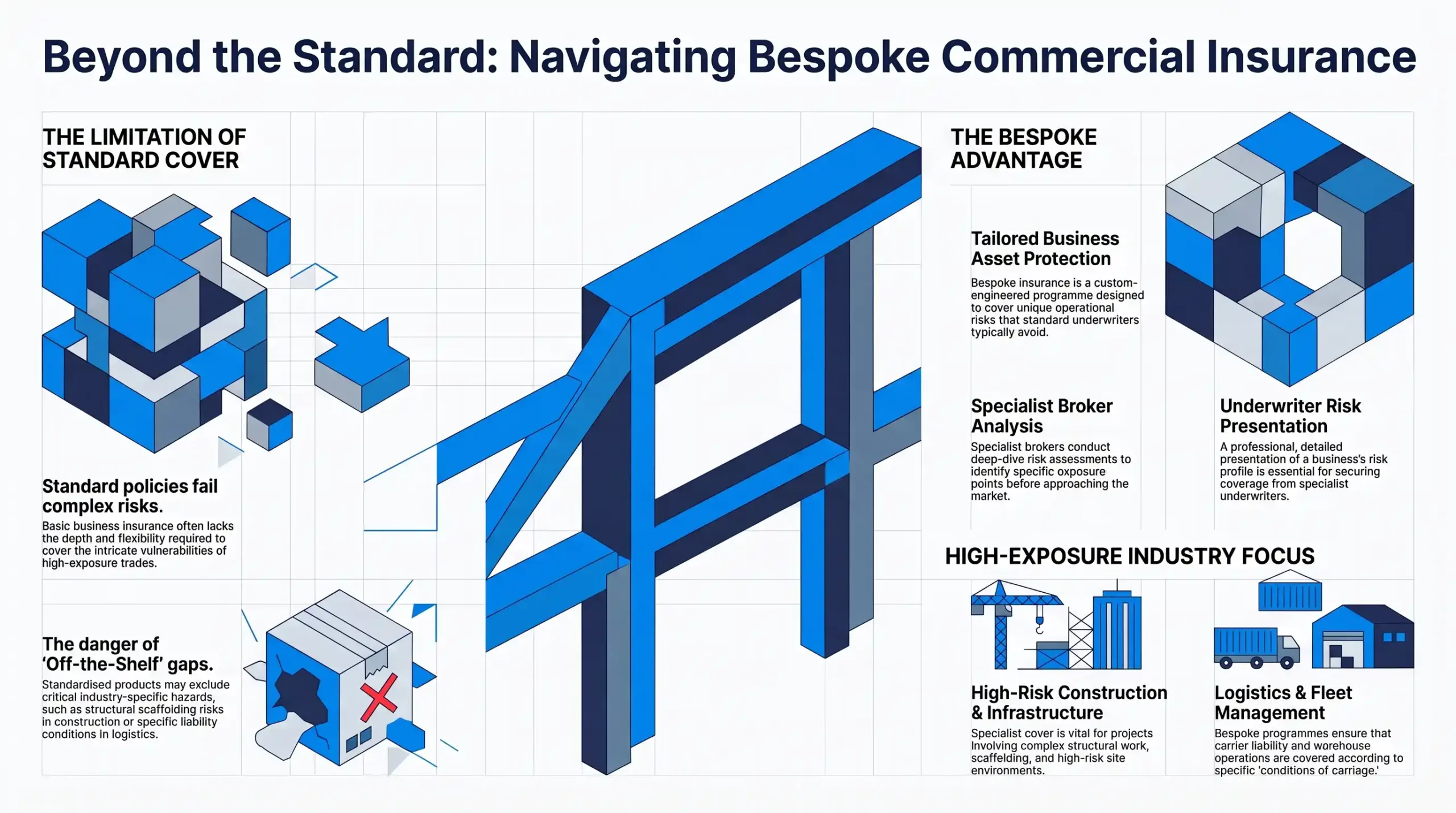
Commercial operations with complex processes, high-hazard environments, or unique liabilities often discover that standard package policies offer inadequate protection. Relying on standard off-the-shelf coverage can leave your business vulnerable to severe financial exposure when an unusual claim occurs. Selecting bespoke commercial insurance ensures that every operational risk is analysed, quantified, and explicitly covered by your policy wording.
Many business owners assume that standard insurance packages cover all standard activities, only to discover restrictive exclusions during a major claim. How do you identify the silent coverage gaps in your current policy, and when is it time to upgrade to a tailor-made insurance structure?
Key Takeaways
- Standard commercial packages often exclude critical operational risks, leaving high-hazard businesses exposed to severe uninsured losses.
- Specialist brokers conduct thorough risk audits to identify coverage gaps before approaching selected underwriters in the Lloyd’s and London markets.
- A professional pre-market presentation is essential to demonstrate risk management protocols and secure competitive terms from specialist underwriters.
- Bespoke insurance programmes integrate public liability, professional indemnity, and environmental cover into a seamless, robust asset protection framework.
- Regular policy reviews and proactive claims advocacy ensure that your insurance protection adapts to ongoing business growth and regulatory changes.
Failure points in off-the-shelf business policies
Standard commercial packages operate on the principle of averages. Insurers design these products for mainstream businesses with highly predictable risk profiles. They perform adequately for high-street shops or standard office environments. However, they fail when applied to complex or high-hazard operations.
These rigid policies contain standardised wordings. They feature fixed limits of indemnity and strict exclusions. These exclusions frequently target hazardous materials, work at height, or design activities. Whilst standard policies protect common exposures, they leave specialised operations vulnerable.
Furthermore, generic policies rarely address multi-faceted exposures. A single business might require motor fleet cover, hazardous goods transit, and environmental liability. Forcing these distinct needs into a basic combined package creates dangerous coverage gaps. Only a tailored strategy ensures that all policy definitions match your actual day-to-day operations.
Business profiles requiring tailored protection
Certain industries inherently require a bespoke approach because of the severity or complexity of their operations. For these sectors, standard cover is simply unavailable or dangerously restrictive.
The following business profiles typically require bespoke commercial insurance rather than standardised packages:
- High-risk contractors working at significant heights or depths, such as scaffolders, roofers, and demolition specialists.
- Logistics operators carrying hazardous goods, abnormal loads, or high-value cargo under specialised conditions of carriage.
- Waste management facilities and recycling centres facing high fire risks and complex environmental permitting regulations.
- Asbestos removal contractors operating under strict Health and Safety Executive licensing and long-tail liability frameworks.
- Design-and-build firms providing professional advice alongside physical construction works, requiring integrated professional indemnity protection.
Broker actions in scoping and presenting risk
Operational risk scoping
Working with specialist commercial insurance brokers allows you to begin by conducting a comprehensive audit of your operational processes, contractual obligations, and claims history. This initial assessment reveals hidden exposures that standard questionnaires overlook. We examine your typical height limits, depth limits, and use of sub-contractors to identify potential failure points.
We also review your standard trading conditions. If you operate under Road Haulage Association conditions, your liability is limited by weight. However, some customers might demand full-value cover. Identifying these misalignments early prevents severe uninsured losses during transit.
Pre-market presentation to underwriters
Presenting your risk to underwriters requires a detailed, professional proposal that highlights your risk management procedures and safety protocols. We document your employee training records, equipment maintenance schedules, and site security measures. This detailed presentation gives underwriters the confidence needed to offer competitive terms for complex business operations.
This step is a core part of our client journey. We ensure you review and approve this presentation before we approach the market. This transparency guarantees that your business is represented accurately and professionally to specialist business insurance underwriters.
Multi-policy programme design
Complex businesses rarely rely on a single policy to protect their assets, employees, and public liabilities. We structure cohesive multi-policy programmes that interlock seamlessly, eliminating coverage overlaps and gaps. This coordinated approach ensures that public liability, employers’ liability, and professional indemnity policies support each other effectively.
For example, a construction contractor needs Contractors All Risks for on-site materials. They also need plant cover for hired-in equipment. We align these policies to ensure continuing hire charges are covered during a loss.
Underwriter assessments of high-hazard operations
Underwriters evaluate complex risks differently than standard commercial risks. Standard underwriters use automated algorithms, whereas specialist underwriters manually assess specific risk management features.
| Risk Feature | Standard Package Underwriting | Bespoke Programme Underwriting |
|---|---|---|
| Activity scope | Strictly defined by rigid trade directories. | Tailored to match actual diversified operations. |
| Height and depth limits | Standard caps (often 10 metres height). | Unrestricted height or depth where required. |
| Hot works | Frequently excluded or highly restricted. | Accommodated under strict fire watch conditions. |
| Environmental risks | Excluded or restricted to sudden events. | Comprehensive sudden and gradual pollution cover. |
| Sub-contractors | Banned or capped at low percentages. | Flexible usage subject to verification. |
Integration with the client advisory journey
Placing complex commercial risk requires a structured advisory process rather than a quick online transaction. We manage this through a structured ten-stage client journey. This ensures that every potential exposure is systematically identified and addressed.
During the initial stages, we conduct a thorough review of your current arrangements to identify silent gaps. We then initiate a market approach discussion to explain how we will present your business to selected insurers. We produce a comprehensive pre-market presentation, allowing you to see exactly how your business is being represented.
Once terms are negotiated, we guide you through the cover placement and policy presentation stage. We explain all conditions, warranties, and exclusions in plain English. This rigorous process guarantees that your finished insurance programme provides the robust protection your business requires.
-
1
Initial Meeting
We understand your business, operations, contracts and the risks you actually carry.
-
2
Review of Current Arrangements
We examine your existing cover and identify the gaps that matter.
-
3
Introduction to Capital Corporate Risks
We make sure you are comfortable with who you are buying from.
-
4
Market Approach Discussion
We agree how your business will be represented to the insurer market.
-
5
Pre-Market Presentation
We share the presentation so you see exactly how you are positioned.
-
6
Market Communication
We keep you informed at every stage as we negotiate with insurers.
-
7
Cover Placement and Policy Presentation
We place your cover and explain every term and exclusion.
-
8
Quarterly Contact
We check in through the year to capture changes before they become problems.
-
9
Quarterly Claims Reviews
We monitor open claims to protect your record and premium.
-
10
Legacy Claims Handling
We take on expired policies to manage outstanding claims that can still affect you.
Did You Know?
The Employers’ Liability (Compulsory Insurance) Act 1969 mandates a minimum indemnity limit of £5 million per occurrence for UK employers. However, standard market placement is £10 million. Operating without valid cover can result in fines of up to £2,500 per day.
Final Thoughts
Operating a high-hazard or complex business with standard off-the-shelf insurance is a significant risk. Standard policies contain hidden exclusions and rigid terms that can leave your assets exposed during a major incident. Securing bespoke commercial insurance ensures that your policy wordings are tailored precisely to your unique operational realities.
A proactive review of your current coverage will highlight latent vulnerabilities before they manifest as costly unpaid claims. Working with specialised brokers allows you to build a resilient, custom-designed insurance framework. This ongoing alignment between operational practice and policy wording provides long-term stability for your business.
Speak to an Insurance Specialist
Whether you need a new quote, want to discuss your renewal or have a question about an existing policy, our team is here to help.
Frequently Asked Questions
Q: What is the main difference between standard business insurance and a bespoke policy?
A: Standard business insurance packages use pre-written policies designed for generic trade categories. They feature rigid limits, fixed exclusions, and automated underwriting. In contrast, a bespoke policy is constructed specifically for your business after a comprehensive risk audit. It allows for custom endorsements, altered height or depth limits, and direct negotiation with underwriters. This ensures that unique or high-hazard activities are explicitly covered under the policy terms. It eliminates the risk of claims being declined due to generic policy exclusions.
Q: How do specialist commercial insurance brokers negotiate better terms for high-risk trades?
A: Specialist commercial insurance brokers negotiate by presenting a detailed, professional overview of your risk management procedures to underwriters. Standard brokers rely on basic online application forms. Specialist brokers understand how to highlight your safety protocols, staff training records, and site security. This complete picture reassures underwriters that your business actively manages its hazards. It allows them to offer tailored coverage and competitive pricing that standard automated markets cannot match. This targeted presentation makes your business an attractive risk to specialist syndicates.
Q: Why does work at height require a bespoke insurance policy rather than standard public liability?
A: Standard public liability policies usually contain height restrictions of three to ten metres. Working above these limits completely invalidates your coverage during an incident. A bespoke policy removes these arbitrary limits. It replaces them with tailored height limits or unrestricted height endorsements. Underwriters assess your actual work methods, safety equipment, and training credentials, such as CISRS cards for scaffolders. This detailed approach ensures you are covered at any working height. It provides essential protection for roofing, scaffolding, and demolition contractors.
Q: What is a pre-market presentation and how does it protect my business?
A: A pre-market presentation is a comprehensive portfolio detailing your business activities, safety records, and risk management protocols. We construct this document before approaching underwriters. It serves to present your company in the best possible light, ensuring underwriters understand your operational safety. This detailed process ensures there are no misunderstandings about your trade activities. It prevents insurers from applying restrictive exclusions or inflating your premiums. It guarantees your policy fits your actual operations perfectly.
Q: Why is a sudden and accidental pollution clause in standard liability policies insufficient?
A: Standard public liability policies usually cover only sudden, identifiable, and accidental pollution incidents. They completely exclude gradual environmental damage, such as a slow fuel leak into the ground. If your business handles chemicals, wastes, or undertakes groundworks, gradual pollution can cause catastrophic damage. Resolving these incidents can lead to severe regulatory fines and clean-up costs. A bespoke environmental liability policy covers both sudden and gradual pollution. This specialised protection ensures you comply with environmental laws and avoid ruinous liabilities.
About The Author
Darren Judd
Director, Co-Founder and Co-Owner of Capital Corporate Risks Ltd

Experienced Account Executive with a demonstrated history of working in the insurance industry. Skilled in Account Management, Risk Management, Business Development across all classes of insurance within the Construction Industry,