
Specialist Groundworks Insurance Cover for Contractors
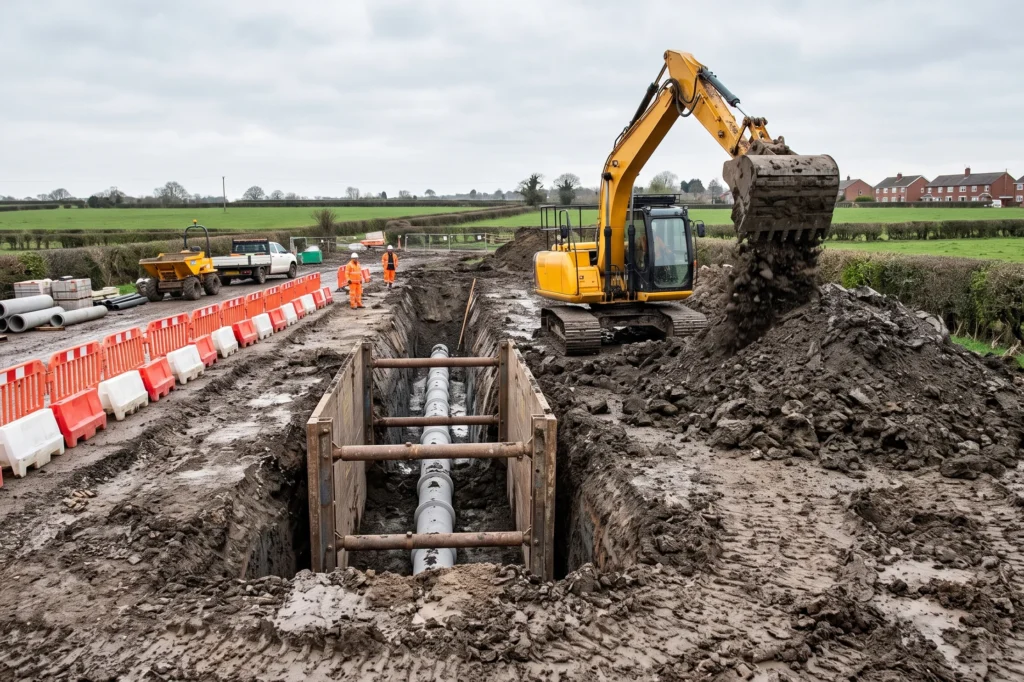
Civil engineering projects begin beneath the surface, where unforeseen subsurface hazards present severe operational and financial exposures. Securing specialist groundworks insurance cover protects contractors from catastrophic losses arising during substructure operations, trench excavations, and site preparation. A standard commercial policy rarely addresses the severe physical perils inherent in heavy excavation work. Without tailored indemnity terms, businesses face ruinous liabilities from damaged utility infrastructure, ground collapse, and third-party property subsidence. Comprehensive protection establishes the contractual certainty required across modern civil engineering schemes.
Main contractors, commercial developers, and local authorities require robust evidence of tailored risk transfer before granting site access. Operating with generic policies creates dangerous coverage gaps during critical excavation phases. Are your current civil engineering schedules sufficiently aligned with modern excavation depths, utility strike warranties, and the complex structural liabilities encountered across your active infrastructure contracts?
Key Takeaways
- Specialist groundworks insurance cover protects contractors against substantial third-party claims arising from catastrophic excavation collapses, structural movement, and underground utility service strikes.
- Insurers enforce strict underground service warranties requiring rigorous plan reviews, electronic cable location scans, and hand digging verification before mechanical plant operates.
- Groundworkers cover must incorporate appropriate depth limits and vibration extensions to accommodate technical substructure operations without invalidating policy liability protections.
- Utilising the LinesearchBeforeUDig portal provides vital subterranean utility records that satisfy underwriter conditions and establish vital evidence during disputed strike claims.
- Contractors require combined liability packages with minimum limits of five million pounds to satisfy principal contractor mandates on infrastructure projects.
Essential Core Protections for Substructure Contractors
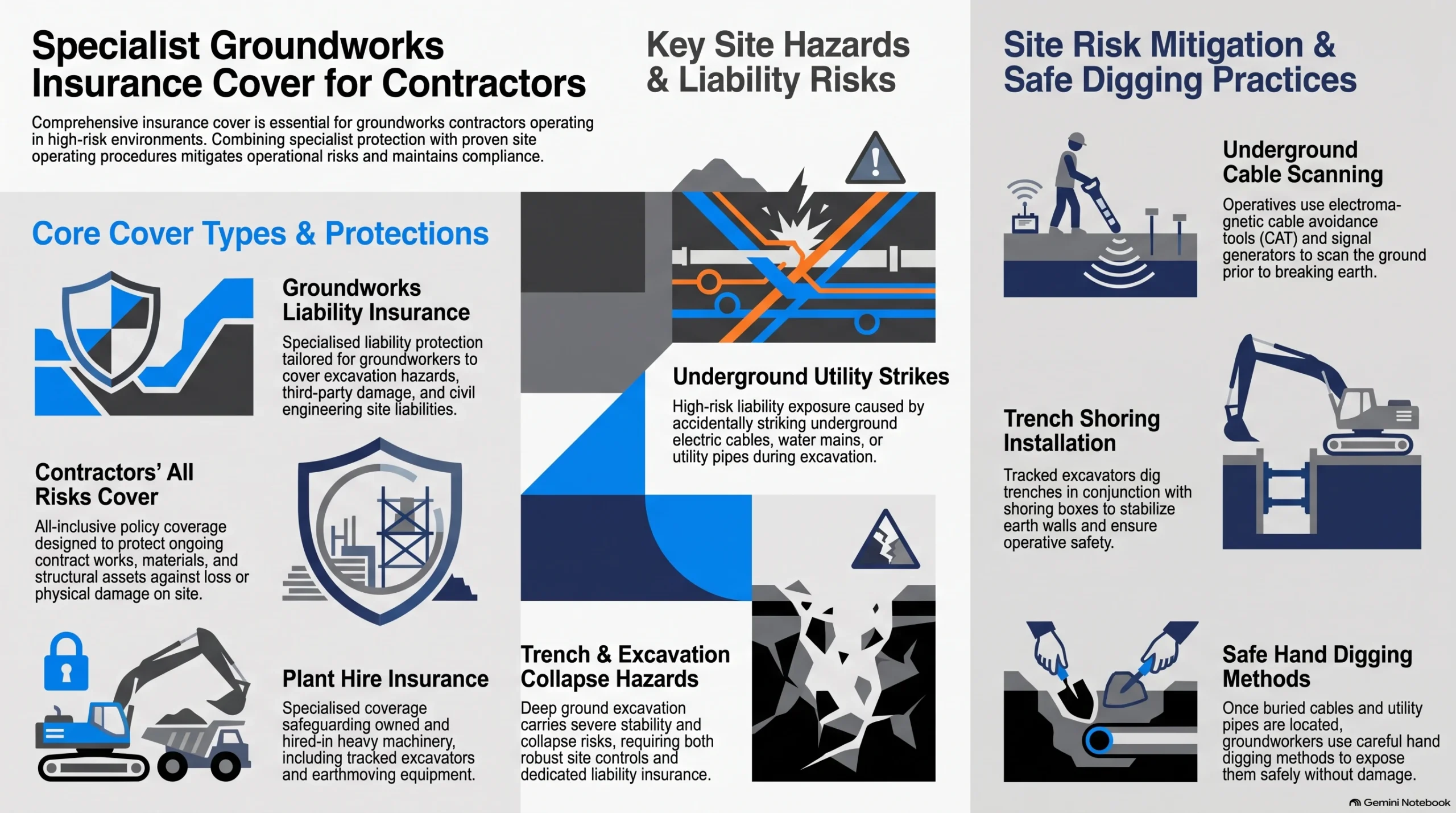
Groundworks operations demand precise insurance structuring because standard construction wordings frequently exclude subterranean perils. Contractors face severe balance sheet exposures from sudden trench collapse, utility network severance, and adjoining structural subsidence. The summary table below outlines the primary insurance covers required by ground engineering specialists. It highlights standard market limits and the critical risk exposures each policy addresses.
Securing appropriate indemnity limits ensures seamless compliance with Tier 1 main contractor requirements and public infrastructure procurement standards. Broking teams evaluate operational risk profiles, working depths, and plant usage to build robust programmes that prevent catastrophic uncovered losses. These core policies collectively shield groundworkers from statutory claims, third-party litigation, and costly equipment downtime on busy civil engineering sites.
| Policy Type | Standard Limit | Primary Risk Exposure |
|---|---|---|
| Public Liability | £5m to £10m | Third-party property damage, utility strikes, and injury |
| Employers’ Liability | £10m | Workforce injury, trench collapse, and plant operation |
| Contractors All Risks | Project Value | Damage to permanent works, temporary works, and materials |
| Hired-in Plant | Replacement Value | Loss, damage, and continuing hire charges for excavators |
| Environmental Impairment | £1m to £5m | Sudden and gradual ground or water pollution events |
Underground Utility Strikes and Subterranean Liabilities
Gas and Electricity Network Hazards
Striking buried gas mains or live high-voltage electricity cables causes immediate physical devastation, grave worker injuries, and extensive power outages. Insurers scrutinise these incidents rigorously. Consequential losses from business interruption, emergency services response, and regional network repairs rapidly escalate into seven-figure claims against groundworks liability insurance policies.
The Health and Safety Executive outlines clear expectations in HSG47, ‘Avoiding danger from underground services’. Breaching these guidelines compromises civil liability defences following an incident. Electrical arcing produces intense thermal radiation that ignites surrounding materials. Furthermore, gas leaks trigger evacuation protocols across adjacent communities. Underwriters demand clear evidence of safe digging procedures before agreeing to indemnify contractors for utility damages.
Fibre Optic and Clean Water Transmission Risks
Severing trunk fibre optic cables or high-pressure water mains generates massive financial liabilities alongside severe physical damage. Modern telecoms cables carry substantial commercial data flows, meaning severed connections trigger severe contractual liquidated damages. Escaping mains water destabilises trench walls, floods neighbouring basements, and rapidly washes out roadway sub-bases across urban environments.
Data network operators hold contractors strictly liable for physical reinstatement costs, technician overtime, and revenue losses. Similarly, statutory water undertakers pursue recovery for treated water losses, emergency road closures, and third-party flood claims. Without robust groundworkers cover, an accidental strike on a strategic communications spine can jeopardise an engineering firm’s commercial solvency.
Did You Know?
Under Health and Safety Executive guidance HSG47, utility drawings provide only an indicative location of underground services, meaning mechanical excavators should not be used within 0.5 metres of the indicated line of a service until operatives confirm its position by careful hand digging.
Policy Warranties and Underground Service Detection
Cable Avoidance Tool Scanning Protocols
Insurance policies covering groundworks operations routinely contain strict underground service detection warranties that govern on-site excavation procedures. Underwriters require operatives to use electromagnetic cable avoidance tools alongside signal generators before breaking ground. Failure to calibrate equipment, record scan results, or conduct confirmatory hand-dug trial holes can completely invalidate policy indemnity.
Contractors must demonstrate continuous compliance with scanning conditions. In practice, we find that a passive locator used without a signal generator often misses dormant cables or plastic pipes. Insurers expect written method statements showing that operators completed thorough cross-grid scans. Site supervisors must retain daily inspection logs and photographic evidence. This documentation helps rebut allegations of operative negligence when third-party utility owners seek damages.
LinesearchBeforeUDig and Utility Asset Records
Obtaining statutory utility record drawings prior to commencing groundworks forms a fundamental underwriter expectation across civil engineering risks. Contractors frequently utilise the LinesearchBeforeUDig portal to identify subterranean pipework and cabling networks. Insurers review search records during claims investigations. They reject claims where operatives excavated without consulting verified utility asset documentation.
Whilst digital search portals aggregate data from major asset owners, utility drawings do not guarantee exact pipe or cable positions. Historical installations, ground movement, and undocumented alterations frequently misalign mapped services with real-world positions. Contractors must cross-reference search data with physical site observations. Hand digging safely within identified hazard corridors verifies physical depths and alignments before deploying mechanical excavators.
Cover Built for Demanding Businesses
Across high risk industries, the cover we arrange most often includes:
Public liability
Employers' liability
Motor fleet
Contractors' all risks
Freight liability
Professional indemnity
Environmental liability
Business interruption
Most businesses need a combination, rather than a single focus policy, and we build cover around your contracts, your workforce and your operational activities.
Excavation Perils and Slope Stability Controls
Trench Collapse and Earth Retaining Failures
Unsupported excavation faces and trench collapses represent fatal hazards on ground engineering sites, triggering immediate regulatory interventions and severe claims. Employers liability policies respond to catastrophic worker injuries, whilst public liability covers damage to adjacent structures. Underwriters assess whether contractors employ certified trench boxes, sheet piling, and proprietary ground support systems.
The Construction (Design and Management) Regulations 2015 place explicit duties on contractors to prevent danger from excavation collapse. Soil surcharge loading from heavy plant positioned too close to trench edges frequently destabilises loose earth. Engineering teams must conduct geotechnical assessments, implement engineered shoring, and inspect excavations daily. These disciplined measures mitigate severe bodily injury exposures and avoid catastrophic breach-of-duty penalties.
Ground Movement and Adjoining Property Settlement
Deep excavations alter local soil hydrology and earth pressure. This creates substantial subsidence or heave risks for neighbouring properties and public roads. Third-party structural damage claims frequently involve complex legal battles regarding negligence and causation. Groundworks insurance cover must incorporate adequate non-negligent liability extensions to protect businesses against adjoining building settlement.
Standard public liability policies require proof of insured negligence before paying third-party claims. However, ground movements can occur despite faultless workmanship, particularly during dewatering or sheet piling operations. Property owners may seek compensation through the Party Wall etc. Act 1996 or common law nuisance claims. Contractors require specialist non-negligence coverage (often mirroring JCT 6.5.1 terms) to cover unforeseen settlement.
Groundworks Liability Insurance Underwriting Criteria
Depth Restrictions and Deep Excavation Endorsements
Underwriters evaluate ground engineering operations by applying clear depth limitations within liability schedules. Standard commercial policies frequently exclude excavations deeper than two or three metres unless brokers negotiate explicit policy extensions. Operating below stated policy depth thresholds without prior underwriter agreement risks total claim repudiation when serious substructure losses occur.
Substructure civil schemes, such as multi-level basements, deep drainage installations, and attenuation tanks, routinely exceed standard depth caps. Contractors must accurately disclose their maximum working parameters during insurance placement. Underwriters will grant increased or unrestricted depth endorsements after assessing technical competence. They evaluate temporary works designs and verified health and safety track records.
Vibration Risk from Sheet Piling and Compaction
Ground engineering methods that employ sheet piling, vibratory compaction, or bored retaining walls generate shockwaves that travel into adjacent structures. Insurers assess the vibration, weakening, or removal of support risks meticulously. Policies require rigorous risk assessments and baseline pre-condition structural surveys before contractors deploy high-energy plant near third-party properties.
Without detailed pre-commencement dilapidation surveys, defending against spurious third-party cracked brickwork claims becomes nearly impossible. Claimants often attribute preexisting cracks to recent foundation works. Insurers frequently endorse policies with specific vibration exclusion clauses. Contractors must demonstrate adherence to British Standards on vibration monitoring and secure bespoke underwriting extensions to preserve protection.
Plant Operations and Equipment Exposures on Site
Excavator Overturn and Operator Safety
Operating heavy tracked excavators, articulated dump trucks, and piling rigs across uneven ground presents severe plant overturn and collision risks. Employers liability and third-party liability policies respond when plant accidents cause worker injuries or external damage. Insurers require strict compliance with operator competency schemes, site speed controls, and machinery maintenance protocols.
Compliance with the Provision and Use of Work Equipment Regulations 1998 (PUWER) remains an essential underwriting baseline. Excavators used for lifting operations also require thorough examination under LOLER 1998. The interval is at least every 12 months, or every six months for lifting accessories. Underwriters also expect verified operative certification, such as CPCS or NPORS, before validating machinery-related bodily injury claims.
Hired-in Plant and Continuing Hire Costs
Groundwork contractors rely extensively on hired plant, leaving them contractually liable for catastrophic equipment losses under standard industry hire terms. Standard plant policies cover physical damage or theft. However, contractors also face substantial ongoing hire charges during repair or replacement periods. Dedicated hired-in plant cover shields contractors from these severe financial liabilities.
Under CPA Model Conditions, the hiring firm bears full financial responsibility for equipment from delivery to collection. If an excavator overturns into a deep footing, the contractor must pay repair costs. They remain liable for weekly rental charges until settlement concludes. Incorporating adequate continuing hire limits prevents crippling cash flow drains whilst insurers process machinery write-offs.
Environmental Liabilities and Contaminated Land
Soil Contamination and Waste Duty of Care
Excavating brownfield sites presents acute risks of encountering hazardous substances, chemical pollutants, or buried asbestos materials. Standard public liability policies usually cover only sudden and accidental pollution incidents, leaving gradual contamination excluded. Groundworkers must maintain robust environmental procedures and Duty of Care compliance under the Environmental Protection Act 1990 during earthworks.
Muckaway and spoil removal activities require diligent monitoring. Disturbing buried heavy metals or hydrocarbon plumes can spread contaminants to clean zones. This triggers regulatory enforcement from the Environment Agency. If waste soils end up at an unauthorised disposal site, statutory authorities trace liabilities directly back to the producer. Contractors must verify waste classification documentation and utilise registered waste carriers.
Groundwater Pollution and Statutory Redress
Puncturing sewer mains or breaching confined aquifers during deep foundation drilling can introduce severe pollutants into regional watercourses and groundwater tables. Regulators possess wide powers to mandate extensive clean-up operations following environmental breaches. Environmental Impairment Liability insurance bridges this critical protection gap, covering statutory remediation demands under the Environmental Damage Regulations 2015.
Under the Environmental Permitting (England and Wales) Regulations 2016, causing an unpermitted discharge to controlled waters is a strict liability offence. The Environmental Damage (Prevention and Remediation) (England) Regulations 2015 allow statutory authorities to order businesses to remediate damaged habitats. Standalone environmental policies pay for both primary clean-up on site and mandated off-site ecosystem remediation.
Contractual Requirements and Main Contractor Flow-Downs
Joint Contracts Tribunal and NEC Standard Forms
Commercial construction contracts enforce rigorous insurance clauses that flow down from principal contractors directly to trade subcontractors. Standard contracts like JCT Design and Build or NEC4 suites mandate specific liability ceilings and joint-names endorsements. Failing to align insurance policies with these contract obligations breaches procurement conditions and delays site works.
Subcontract agreements regularly require waivers of subrogation, indemnity to principals clauses, and cross-liability protections. Under NEC contracts, the insurance table identifies specific minimum indemnities that subcontractors must maintain throughout the defects correction period. Groundworkers must review contract schedules carefully with insurance advisers. This confirms policy terms satisfy all contractual commitments before signing binding execution deeds.
Indemnity Limits and Excess Layer Requirements
Tier 1 contractors and infrastructure clients routinely mandate public liability limits of ten million pounds for high-hazard substructure packages. Primary liability markets often restrict single-policy capacity to five million pounds for groundworkers. Contractors deploy excess layer liability policies above primary coverage to achieve necessary contractual limits economically.
An excess layer policy follows the exact terms and conditions of the underlying primary wording. It provides an additional layer of financial protection above the primary threshold. This layered structure allows growing civil engineering businesses to tender for major public sector infrastructure, transport, and commercial developments. Crucially, balance sheets remain shielded against severe multi-party litigation.
Final Thoughts
Procuring robust groundworks insurance cover represents a critical operational safeguard for civil engineering businesses operating in high-hazard subterranean environments. Ground engineering involves unforgiving physical perils. A single utility severance or slope stability failure can inflict devastating financial harm. Maintaining comprehensive liability protection accounts for excavation depths, underground service detection, and hired plant exposures. This safeguards commercial resilience against unexpected project disputes.
As UK infrastructure demands escalate and regulatory scrutiny intensifies, underground safety standards will become even more stringent for civil engineering contractors. Digital utility tracking, advanced ground-penetrating radar, and strict adherence to industry safe digging practices will continue to define insurable operations. Establishing a rigorously structured insurance programme ensures substructure specialists remain compliant, competitive, and fully protected across future engineering projects.
Speak to an Insurance Specialist
Whether you need a new quote, want to discuss your renewal or have a question about an existing policy, our team is here to help.
Frequently Asked Questions
Q: What core policies make up a standard groundworks insurance programme?
A: A comprehensive programme centres on public liability insurance, employers’ liability insurance, and contractors all risks cover. Public liability handles third-party bodily injury and property damage, whilst employers’ liability covers workforce injuries under statutory requirements. Contractors all risks protects ongoing physical works, temporary retaining structures, and site materials from accidental damage. Additionally, contractors regularly add hired-in plant protection to cover mechanical excavators, as well as environmental impairment liability to address sudden or gradual soil and water contamination events.
Q: How do underground service warranties affect utility strike claims?
A: Underground service warranties require contractors to follow specific risk-reduction procedures before breaking ground. These conditions mandate reviewing statutory utility plans, scanning the excavation area with electromagnetic locators and signal generators, and exposing identified services using careful hand-digging techniques. If an operative damages an underground gas pipe or electric cable without following these recorded steps, the insurer may repudiate the claim entirely. Maintaining documented calibration certificates, daily scan logs, and site photographs is essential to prove warranty compliance during an investigation.
Q: Why do insurers impose working depth limits on groundworks policies?
A: Insurers apply working depth restrictions because deeper excavations present heightened risks of trench wall collapse, ground movement, and water table breaches. Standard trade policies typically limit excavation depths to two or three metres by default. Substructure operations such as basement formation, deep drainage installation, or shaft sinking exceed these basic thresholds. Contractors must notify underwriters of their maximum planned working depths to secure specific endorsements, ensuring policy coverage remains intact when operatives execute deep civil engineering and ground engineering packages.
Q: Does standard public liability cover non-negligent property damage?
A: Standard public liability policies only indemnify contractors when third-party property damage results directly from proven negligence or contractual breach. Ground movements, soil heave, or groundwater shifts can damage neighbouring buildings even when civil engineering contractors follow flawless engineering methodologies. To cover these unpreventable structural losses, contractors must arrange specific non-negligent liability insurance, commonly referred to as JCT 6.5.1 insurance. This specialist extension indemnifies the employer and contractor against structural collapse, subsidence, and vibration damage occurring without direct operative fault.
Q: What is the significance of LinesearchBeforeUDig in risk placement?
A: The LinesearchBeforeUDig portal provides instant access to underground utility asset records from major utility owners across Great Britain. Utilising this search service satisfies essential underwriter requirements regarding pre-excavation due diligence. Demonstrating consistent use of digital search records alongside physical site surveys assures insurers that the contractor actively manages subterranean strike hazards. In the event of a strike dispute, registered search confirmation serves as vital audit evidence showing that the business took all reasonable precautions to locate buried assets.
About The Author
Darren Judd
Director, Co-Founder and Co-Owner of Capital Corporate Risks Ltd

Experienced Account Executive with a demonstrated history of working in the insurance industry. Skilled in Account Management, Risk Management, Business Development across all classes of insurance within the Construction Industry,