

Combined Liability Insurance: How It Stacks Up
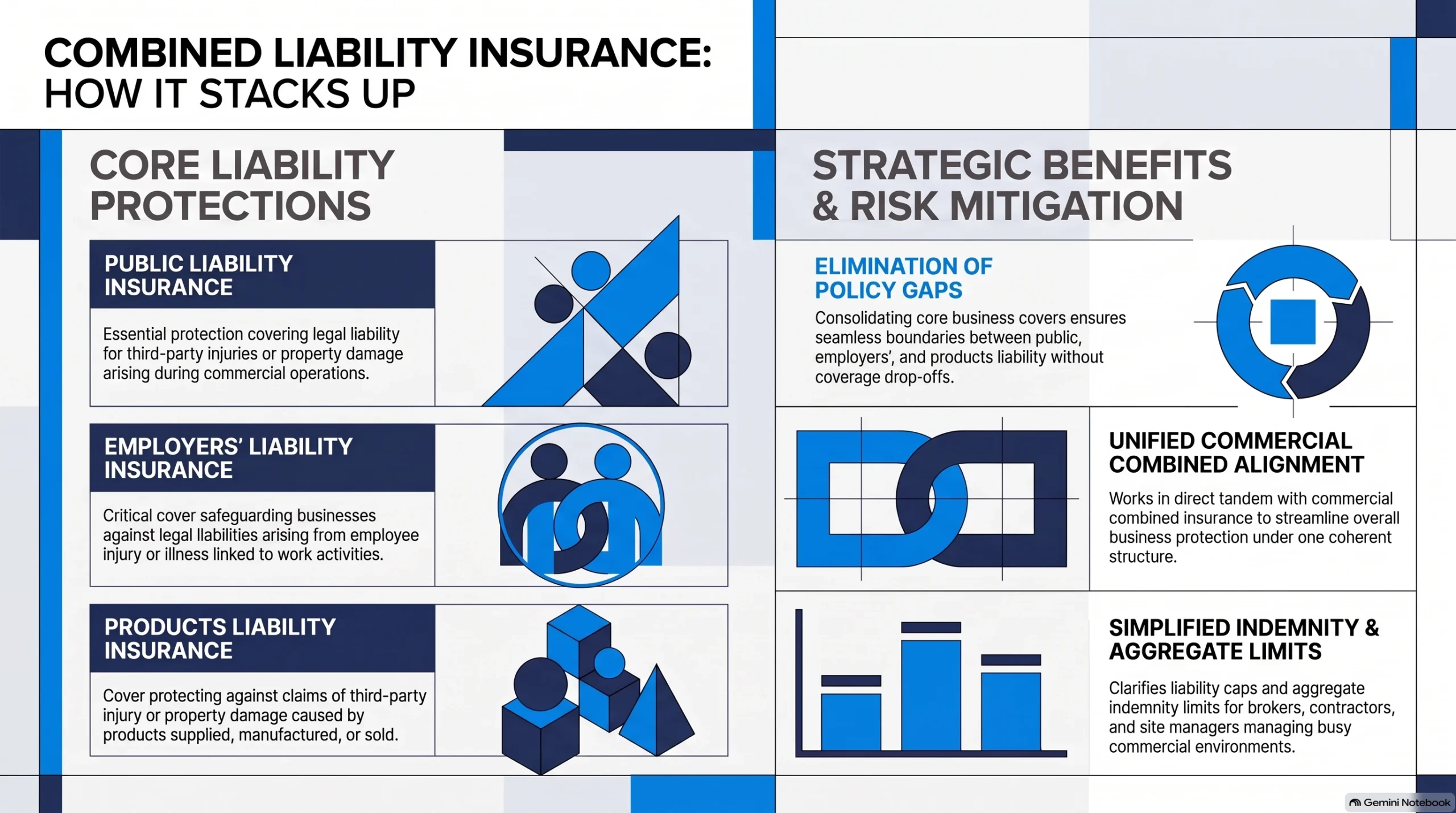
Operating a commercial business in the UK requires legal compliance and robust financial protection. Many firms purchase separate covers to meet immediate operational needs. However, isolated policies frequently reveal dangerous coverage gaps during complex workplace accidents. A combined liability insurance policy resolves this exposure by uniting public liability, employers’ liability, and products liability under one schedule. This packaged structure aligns legal defence arrangements, simplifies annual renewals, and ensures consistent terms across your operations. It provides reliable protection without the friction of competing insurance wordings.
Standalone policies often spark disputes between different insurers when serious accidents occur. Such disagreements can stall critical investigations and delay essential compensation payments to injured claimants. Consolidating your core protections under a single underwriter eliminates cross-policy friction and protects corporate cash flow. Does your existing operational arrangement provide this seamless coordination, or does it leave your business exposed to costly coverage disputes?
Key Takeaways
- A packaged liability policy brings employers, public, and products liability together under one schedule to remove hazardous disputes between rival insurers during multi-party incidents.
- The Employers’ Liability (Compulsory Insurance) Act 1969 legally obliges UK employers to maintain cover, which integrates cleanly alongside standard public liability within a unified policy.
- Public liability typically operates on an any-one-occurrence basis, whereas products liability strictly applies an aggregate financial limit across the complete annual policy period.
- Commercial combined insurance covers physical assets and business interruption, whereas liability-only packaging focuses entirely on third-party legal and statutory liabilities across operational activities.
- High-hazard trades such as construction, demolition, and haulage gain vital commercial protection by aligning operational exclusions across a single unified underwriting wording.
Cover Elements Inside a Unified Liability Schedule
Modern businesses face liabilities from several distinct angles, ranging from staff injuries to site damage. Managing these hazards under separate contracts increases administration and creates coverage gaps. Consolidating operational risks under one underwriter establishes a coordinated defensive perimeter for daily activities.
The comparative table below outlines the core protections included within a unified schedule. It contrasts how each element responds to commercial losses, highlighting standard indemnity limits and governing legislation. Reviewing these components helps identify whether your current insurance programme delivers adequate protection across all operational activities.
| Cover Element | Primary Purpose | Standard Limit Basis | Regulatory Baseline |
|---|---|---|---|
| Public Liability | Third-party injury and property damage | Any one occurrence | Common law negligence |
| Employers’ Liability | Employee workplace injury or disease | Any one occurrence | Employers’ Liability (Compulsory Insurance) Act 1969 |
| Products Liability | Damage or injury from supplied goods | Aggregate in policy period | Consumer Protection Act 1987 |
| Pollution Extension | Sudden and accidental environmental contamination | Aggregate in policy period | Environmental Protection Act 1990 |
Legal Duties a Packaged Liability Policy Addresses
Statutory Demands and Common Law Duties
UK businesses owe strict legal duties to both their workforce and the public. Combining these covers ensures that an employer meets common law obligations alongside statutory duties in a unified arrangement. This structure prevents procedural disputes when an accident involves internal staff as well as visiting third parties.
Under the Employers’ Liability (Compulsory Insurance) Act 1969, employers must maintain at least £5 million in cover. Market practice typically establishes £10 million per occurrence as standard. Concurrently, public liability insurance protects against third-party claims. When an accident occurs on site, employment status often sparks intense debate. An integrated policy ensures one insurer handles the investigation, eliminating protracted liability arguments.
Products Liability and the Chain of Supply
Products liability shields businesses against civil claims arising from injury or property damage caused by supplied goods. Incorporating this protection within a broad liability programme ensures that distribution and installation risks receive uninterrupted protection. This becomes critical whenever faulty components cause direct physical harm on site.
Under the Consumer Protection Act 1987, strict liability attaches to producers and importers of defective items. If a component fails following installation, determining fault between workmanship and product defects creates friction. A standalone policy dispute might leave you caught between two insurers. Combining products liability with public cover ensures total alignment under unified legal instructions.
Did You Know?
Under the Employers’ Liability (Compulsory Insurance) Regulations 1998, a business that fails to hold compliant employers’ liability cover can be fined up to £2,500 for each day it trades uninsured.
Combined Liability Versus Commercial Combined Cover
Operational Liabilities Versus Material Assets
Combined liability focuses exclusively on defending and indemnifying legal liabilities arising from third-party injury, property damage, and employee harm. It does not cover your physical assets, buildings, or business interruption losses. Instead, it concentrates financial capacity on defending claims brought against your company by outside parties.
In contrast, a commercial combined insurance policy acts as a wider corporate umbrella. It bundles material damage, plant, business interruption, and transit risks together with core liability covers. Companies that operate from extensive fixed premises generally favour a commercial combined approach. Contractors operating on site frequently select dedicated liability programmes to secure higher indemnity limits.
Contractual Precision and Coverage Gaps
Selecting standalone liability protection allows high-hazard businesses to negotiate tailored endorsements without altering their property arrangements. Specialist trades often require bespoke extensions for hot works or deep excavation. Isolating liability coverage prevents restrictive property exclusions from undermining core trade protections across operational client contracts.
Relying on fragmented policies from multiple providers introduces dangerous wording discrepancies. One policy may define an employee to include labour-only subcontractors, whilst a separate public policy excludes them. Aligning these definitions across a single liability schedule prevents costly legal shortfalls. If an incident triggers multiple covers, a single claims team coordinates your defence.
Cover Built for Demanding Businesses
Across high risk industries, the cover we arrange most often includes:
Public liability
Employers' liability
Motor fleet
Contractors' all risks
Freight liability
Professional indemnity
Environmental liability
Business interruption
Most businesses need a combination, rather than a single focus policy, and we build cover around your contracts, your workforce and your operational activities.
Indemnity Limit Structures and Financial Thresholds
Any One Occurrence Limits Explained
An any-one-occurrence limit provides a distinct indemnity sum for every separate incident during the policy period. This structure forms the standard basis for public and employers’ liability covers across the UK market. It guarantees that prior settlements do not diminish the cover available for subsequent independent events.
For example, a contractor may hold a £5 million public liability policy on an any-one-claim basis. The underwriter provides up to £5 million for an event in January. If another incident occurs in June, the full £5 million limit remains available. In hazardous environments, this protection prevents exhaustion of your financial defence.
Aggregate Caps and Products Liability Mechanics
An aggregate limit sets the maximum sum an underwriter will pay across every claim in a single policy term. Products liability and sudden pollution extensions almost universally operate under aggregate caps. Once claims reach this cumulative ceiling, all insurer indemnity ceases until the policy renews.
Suppose a business secures £5 million of products liability cover on an aggregate basis. Repeated minor defect claims will steadily erode that pot. Three settlements of £1 million leave only £2 million of protection for that year. Understanding this mechanism allows commercial teams to monitor claims reserves and arrange excess layers when required.
High-Risk Trades and Sector Suitability
Construction and Specialist Engineering Trades
Main contractors and trade subcontractors operating in hazardous settings face rigorous scrutiny regarding their insurance arrangements. Combined liability insurance provides the structural resilience needed to satisfy complex pre-qualification questionnaires and client tender requirements. It proves indispensable across groundworks, demolition, roofing, and structural engineering trades.
Tier 1 main contractors working under standard JCT or NEC contracts routinely demand proof of £5 million or £10 million limits. Subcontractor flow-down clauses require schedules that cover secondary exposures. These include underground utilities strikes and work at height. Aligning core covers ensures that endorsements apply across the workforce without administrative friction.
Haulage, Logistics, and Waste Management
Haulage fleets and waste processing facilities manage fast-paced operational yards where heavy plant, transport vehicles, and pedestrians interact closely. Combining core liabilities protects against catastrophic operational incidents involving vehicle movements, loading activities, and chemical handling. This coordinated underwriting prevents disputes over whether motor or premises liability covers a loss.
Under the Environmental Protection Act 1990, waste facilities carry strict Duty of Care obligations. Sudden pollution events and employee injuries can easily stem from a single mechanical failure. Packaging these liabilities under one policy ensures consistent underwriting across hazardous materials handling, third-party visits, and operational pollution. This unified treatment eliminates dangerous coverage exclusions.
Policy Conditions, Warranties, and Underwriting Demands
Hot Works and Working at Height Warranties
Underwriters attach strict warranties to liability policies whenever activities involve open flames, heat applications, or working at elevation. Breaching these explicit contractual terms gives insurers the right to decline a claim entirely. Securing a unified policy guarantees that operational conditions remain uniform across all trades on site.
Common hot works warranties mandate formal permit-to-work systems, extinguishers on hand, and a continuous 60-minute fire watch. Working at height conditions enforce compliance with the Work at Height Regulations 2005. Managing covers under one schedule prevents scenarios where one underwriter accepts a safety procedure that another insurer rejects.
Subcontractor Vetting and Bona-Fide Controls
Using subcontractors introduces liability exposures that underwriters manage through strict policy conditions and documentation requirements. Your policy will distinguish clearly between labour-only subcontractors and bona-fide subcontractors. Maintaining precise records ensures you do not inadvertently invalidate third-party protections or trigger uninsured liabilities during complex project work.
Labour-only subcontractors work under your direct supervision, making them employees under the Employers’ Liability (Compulsory Insurance) Act 1969. Conversely, bona-fide subcontractors supply their own materials and tools. Most packaged policies require you to verify that bona-fide partners maintain equivalent public liability insurance. Failure to check certificates can cause underwriters to decline indemnity.
Programme Efficiency and Claims Advocacy
Administrative Streamlining and Financial Economies
Consolidating business liability protections into a unified package reduces operational management hours and improves commercial buying power. Dealing with one common renewal date prevents administrative lapses that lead to dangerous coverage gaps. Insurers also offer competitive rating structures when underwriting balanced commercial portfolios.
Splitting covers across various providers leads to duplicated administrative charges and higher minimum premiums. Merging risks gives underwriters a complete picture of your corporate safety culture and training records. This transparency encourages underwriters to provide wider policy wordings, lower excess levels, and more favourable rate adjustments across your turnover.
Coordinated Legal Defence and Claims Handover
When serious industrial accidents happen, immediate incident management dictates the final legal and financial outcome. A unified liability policy places the incident investigation under a single claims team from the very first notification. This unified response avoids costly tactical delays during early liability assessments.
Suppose an unsecured scaffolding component falls, injuring an employee and a visiting pedestrian below. Separate insurers often appoint competing loss adjusters, leading to uncoordinated evidence gathering. Under a single policy, one specialist legal team defends your business interest. They gather witness statements systematically and prevent fragmented testimonies during litigation.
Strategic Review and Broker Placement Approaches
Turnover Splits and Contractual Flow-Downs
Determining appropriate liability coverage requires an exhaustive review of operational activities, supply contracts, and turnover split. Relying on generic trade descriptions risks leaving specialised operational activities entirely uninsured. A robust broking presentation ensures underwriters account for every commercial exposure accurately across all operational divisions.
Contractors operating under standard JCT or NEC contracts must evaluate how flow-down provisions dictate minimum insurance levels. If a main contract specifies a £10 million limit, your primary policy and any excess layer must integrate seamlessly. Your broker will review hazardous substances and specialist activities to confirm that policy wording matches your trade.
Continuous Policy Auditing and Risk Evolution
Commercial enterprises do not stay static, meaning operational insurance structures must adapt alongside business expansion, asset acquisition, and new contracts. Relying on annual check-ins leaves fast-growing companies exposed when projects scale up unexpectedly. Regular policy audits ensure indemnity limits keep pace with changing operational risk profiles.
Liability exposures shift rapidly as an enterprise expands into industrial fabrication, supplies components, or hires plant. Structured quarterly reviews ensure that rising payroll figures and increased subcontracted spend reach underwriters promptly. Proactive disclosures preserve full indemnity terms and protect commercial reputations long before an incident tests policy wording.
Final Thoughts
Selecting combined liability insurance represents an essential strategic decision for any growing enterprise handling complex commercial exposures. Consolidating public, employers’, and products liability shields your organisation from coverage cracks that emerge when juggling disconnected covers. A single policy schedule provides total clarity regarding indemnity limits. It also ensures warranties remain consistent across operational teams and streamlines legal defences during major liability claims.
As commercial contracts expand and regulatory requirements demand transparency, maintaining a cohesive risk management framework becomes a vital commercial differentiator. Conducting an honest appraisal of your existing insurance documentation protects your bottom line. It secures your supply chain relationships and ensures your company operates from a position of financial strength.
Speak to an Insurance Specialist
Whether you need a new quote, want to discuss your renewal or have a question about an existing policy, our team is here to help.
Frequently Asked Questions
Q: What is the primary difference between public liability and products liability?
A: Public liability protects your business against legal claims for third-party bodily injury or property damage. It responds to incidents arising from your day-to-day business operations. In contrast, products liability covers claims caused by goods, components, or materials that your business manufactures, sells, or supplies. This protection takes effect once items leave your custody and control. Whilst public liability covers active operational work, products liability covers product defects after handover. Both covers integrate cleanly within a combined policy to prevent disputes over whether workmanship or product failure caused the loss.
Q: Is a combined liability policy legally mandatory for all UK businesses?
A: The package as a whole is not legally mandated, but specific components within it are compulsory. Under the Employers’ Liability (Compulsory Insurance) Act 1969, any business employing staff or labour-only subcontractors must carry employers’ liability insurance. Operating without this cover triggers heavy statutory fines. Public and products liability remain voluntary under statute. However, commercial clients and main contractors almost universally mandate them before work begins. Packaging these protections together satisfies statutory obligations and contractual expectations under a single, fully coordinated policy.
Q: Can an aggregate limit on products liability affect my public liability coverage?
A: In a well-structured combined policy, the limits for public liability and products liability operate independently. Public liability generally applies on an any-one-occurrence basis, resetting in full after every separate claim event. Conversely, products liability applies on an annual aggregate basis across the policy period. Claims paid for defective products will gradually deplete that specific aggregate limit. However, those settlements will not reduce the indemnity available for subsequent public liability claims. Monitoring your aggregate pot remains vital so you can purchase excess layer cover if high claim volumes threaten exhaustion.
Q: How do underwriters classify labour-only subcontractors on a liability schedule?
A: Underwriters classify labour-only subcontractors as direct employees for insurance purposes. They work under your direct supervision, instruction, and control using your tools and materials. Consequently, they fall within your employers’ liability cover. You must declare their payments alongside standard payroll figures to ensure valid policy indemnity. Conversely, bona-fide subcontractors supply their own equipment and work independently. You must check that bona-fide contractors hold their own public liability insurance before they enter site. This verification ensures that their indemnity limits match your contractual obligations.
Q: When should a business upgrade from combined liability to commercial combined cover?
A: A business should move to commercial combined insurance once it acquires significant physical assets. Those assets need protection alongside liability risks. If your company operates commercial premises, holds high-value machinery, or stores stock, commercial combined packaging becomes essential. It unifies material property protection with your core liability schedule. It also provides essential business interruption cover to replace lost gross profit following an insured premises incident. Mobile contractors often stay with combined liability. However, acquiring fixed premises makes a commercial combined structure far more appropriate.
About The Author
Darren Judd
Director, Co-Founder and Co-Owner of Capital Corporate Risks Ltd

Experienced Account Executive with a demonstrated history of working in the insurance industry. Skilled in Account Management, Risk Management, Business Development across all classes of insurance within the Construction Industry,