
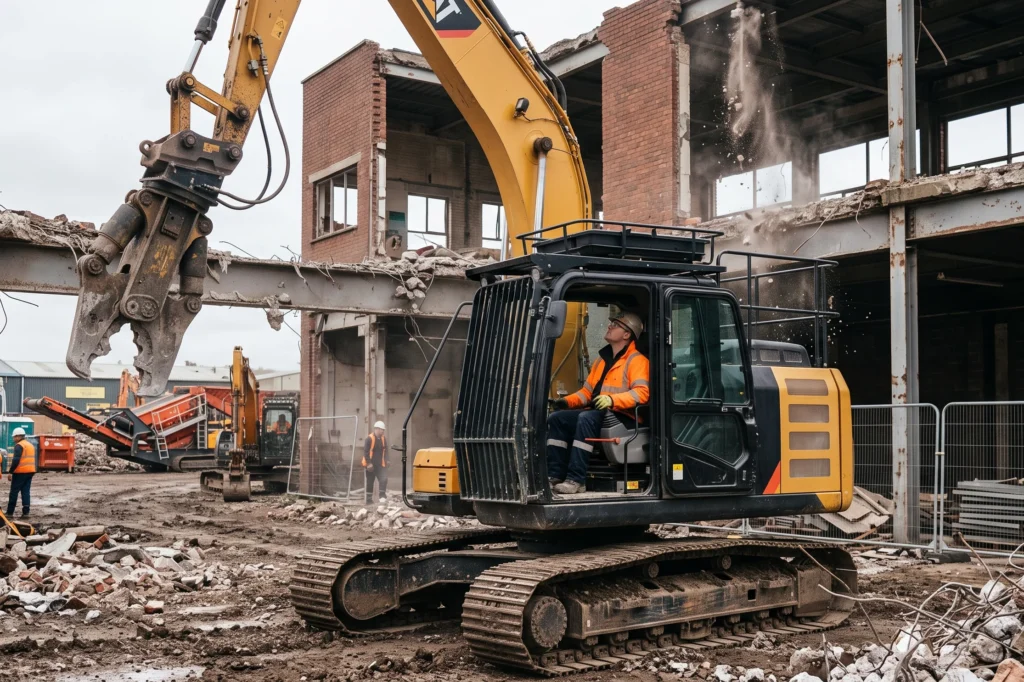
Demolition Contractor Insurance: Specialist Cover
Demolition sits at the most hazardous end of UK construction. Every scheme brings structural uncertainty, heavy plant movement and third-party damage exposure. Demolition contractor insurance protects a business from the catastrophic losses that standard commercial combined policies exclude. Specialist underwriters demand evidence of competence, structural analysis and active risk control. Without purpose-built cover, a single collapse can dismantle decades of trading.
Principal contractors now mandate elevated indemnity limits as standard. They also require specialist endorsements for dust, noise and hazardous materials. Contractors need to know exactly where baseline cover stops and where specialist extensions begin. How should a demolition operator structure a liability programme that survives catastrophic loss and still meets tender requirements?
Key Takeaways
- Public liability limits for demolition work typically start at ten million pounds because collapse exposures are severe.
- Environmental wordings are essential because standard policies exclude gradual contamination, dust emissions and statutory remediation costs.
- NFDC membership and verified CCDO operative cards improve underwriting terms and reduce premiums for demolition firms.
- Plant policies must cover high-reach excavators for damage, overturning and continuing hire charges during repair.
- Section 80 notices and refurbishment and demolition surveys create the documentation insurers demand after a collapse.
Core Insurance Stack for Demolition Operations
Demolition projects need an integrated insurance programme. The perils differ across site preparation, physical takedown and material removal. Standard commercial policies often exclude structural alteration and mechanical demolition outright. Contractors therefore assemble distinct policy layers. Each layer answers a specific client mandate and closes a specific gap in financial resilience.
The matrix below sets out the core covers used across the sector. It shows typical indemnity baselines and the risk driver behind each one. Main contractors and local authorities examine these figures closely at tender stage. Aligned limits across every policy schedule prevent contractual breaches and uninsured claims.
| Cover Type | Typical Market Limit | Primary Risk Driver |
|---|---|---|
| Public Liability | £10m to £25m+ | Catastrophic structural collapse, adjacent property impact, third-party injury |
| Employers’ Liability | £10m market placement | Heavy plant interaction, falls from height, crushing injuries |
| Contractors All Risks | Full contract value | Damage to works in progress, temporary works, retained structures |
| Hired-in Plant and Continuing Hire | Replacement value plus hire fees | CPA model conditions, high-reach excavator damage, rental charges |
| Environmental Impairment Liability | £2m to £5m | Dust migration, noise nuisance, water runoff, ground pollution |
| Asbestos Liability Endorsement | £5m to £10m | Accidental disturbance of hidden asbestos-containing materials |

Public and Products Liability Requirements
Indemnity Limits on High-Hazard Projects
High-risk demolition work demands indemnity levels well above general construction norms. Most Tier 1 contractors and infrastructure clients require at least ten million pounds of public liability cover. Major urban schemes push that baseline past twenty-five million pounds. Contractors reach those figures through structured excess layers rather than a single policy.
A primary policy rarely carries enough limit on its own. Mechanical demolition can damage property on a scale few trades match. A structural failure affecting a railway line or an occupied office will exhaust a five-million-pound policy quickly. Excess layer liability insurance bridges that gap. These policies sit above the primary layer in distinct bands. Careful layering meets client specifications without inflating the primary premium.
Coverage Extensions for Vibration and Weakening of Support
Standard liability policies exclude claims arising from vibration, removal of support and ground movement. Demolition contractors must delete these exclusions through tailored endorsements. Underwriters will not agree to that step without party wall agreements and structural surveys. In practice, we find those documents decide whether cover holds after an incident.
Mechanical breaking and heavy plant generate ground-borne vibration. That vibration can destabilise neighbouring foundations. Where structures share a party wall, removing adjacent masonry creates severe settlement risk. An unendorsed weakening-of-support exclusion leaves the contractor funding the damage. Cracked masonry next door then becomes a direct trading loss. Non-negligent liability cover, aligned with the relevant JCT clause, keeps indemnity intact where negligence cannot be proven.
Did You Know?
Section 80 of the Building Act 1984 requires written notice of intended demolition to the local authority. Work must not begin until the authority serves its counter-notice or six weeks have passed. Starting early risks prosecution and an immediate site stoppage.
Employers’ Liability in Controlled Demolition
Statutory Baseline Under UK Employment Law
The Employers’ Liability (Compulsory Insurance) Act 1969 sets a statutory minimum of five million pounds. Demolition practice sits well above that floor. The market standard placement across the sector is ten million pounds. That limit absorbs multiple severe injury claims arising from a single structural or plant incident.
Demolition operatives work in unforgiving conditions. Pre-weakened frames, heavy hydraulic attachments and falling masonry combine into high-severity injury risk. Even a meticulous method statement cannot remove structural instability. Crush injuries and falls from height remain the dominant claims. Insurers scrutinise supervision ratios and emergency evacuation procedures. A sound policy protects directors from personal civil liability. It also ensures injured personnel receive the compensation the law requires.
Competence Verification and Operative Cards
Underwriters treat workforce competence as a decisive rating factor. Insurers expect every operative on site to hold a valid card under the Certificate of Competence of Demolition Operatives scheme. Independent accreditation confirms certified training matched to the task performed. From experience across the sector, card audits precede most firm quotations.
The CCDO scheme gives insurers verifiable proof of workforce skill. Card tiers separate general labourers, advanced operatives, burner operatives and site supervisors. Underwriters assessing a high risk liability insurance presentation reward a fully carded workforce. Terms improve and excesses fall. Uncertified agency labour has the opposite effect. Gaps in continuous health and safety training often produce punitive excesses or an outright declinature.
Cover Built for Demanding Businesses
Across high risk industries, the cover we arrange most often includes:
Public liability
Employers' liability
Motor fleet
Contractors' all risks
Freight liability
Professional indemnity
Environmental liability
Business interruption
Most businesses need a combination, rather than a single focus policy, and we build cover around your contracts, your workforce and your operational activities.
Plant, Machinery, and Equipment Protection
High-Reach Excavators and Heavy Attachments
Specialist demolition plant carries enormous capital value and needs a bespoke machinery schedule. High-reach excavators, pulverisers, shears and concrete crackers face extreme mechanical stress and daily debris impact. Standard plant policies fall short unless the contractor agrees valuation baselines with the underwriter before inception of the cover.
An ultra-high-reach excavator can cost upwards of one million pounds to replace. Specialist hydraulic attachments add hundreds of thousands more. Cover must sit on an agreed value or modern replacement basis. Indemnity book value leaves a serious shortfall. The policy must also answer damage from falling masonry, boom buckling during cutting and catastrophic tipping. Plant schedules should record every auxiliary item, including hoses, breaker arms and dust suppression units.
Hired-in Plant and Continuing Hire Charges
Demolition contractors lean heavily on hired equipment during intensive contract phases. Most rental agreements run under Construction Plant-hire Association model conditions. Those conditions transfer full loss liability to the hirer. Robust hired-in plant cover, with a generous continuing hire allowance, is therefore essential rather than optional.
Under CPA terms the customer carries responsibility from delivery until off-hire. A hired crusher that catches fire becomes the hirer’s financial problem. So does a specialist excavator that suffers structural failure. The hirer must reimburse market value. Weekly hire charges also continue while the machine is repaired or replaced. Without an explicit continuing hire extension, those charges can exceed the physical repair cost.
Environmental Impairment and Pollution Risks
Dust Migration and Noise Nuisance Exposures
Urban demolition produces airborne particulates and heavy acoustic disturbance. Both reach surrounding commercial and residential occupiers. Standard public liability policies rarely respond to claims alleging progressive dust contamination or business interruption from noise. Specific environmental wordings are needed to defend third-party nuisance actions brought by neighbouring occupiers.
Windblown silica dust settles on neighbouring car dealerships. It contaminates retail stock and penetrates office ventilation systems. In dense commercial centres, a neighbour forced to close can claim hundreds of thousands of pounds. Environmental liability wordings fund legal defence costs and third-party damages. Underwriters expect proof of control before they quote. Active dust suppression, boundary acoustic monitoring and real-time particulate alerts are the usual minimum.
Ground Contamination and Statutory Clean-up Notices
Breaking ground slabs and basement foundations disturbs historic industrial contaminants on brownfield sites. Regulators can compel a contractor to fund extensive remediation under the Environmental Protection Act 1990. Stand-alone environmental policies answer both sudden and gradual clean-up liabilities that standard construction contracts explicitly exclude from cover.
Baseline public liability cover limits pollution to sudden, identifiable and accidental escapes. An overturned fuel bowser qualifies. Gradual migration does not. Pre-existing contamination mobilised during concrete grubbing is excluded outright. The Environmental Damage (Prevention and Remediation) (England) Regulations 2015 impose strict remediation duties. Those duties bite where an operator damages water resources or protected habitats. Environmental Impairment Liability cover funds investigations, soil washing, groundwater pumping and off-site clean-up.
Asbestos and Hazardous Material Exposures
Refurbishment and Demolition Survey Compliance
The Control of Asbestos Regulations 2012 require a refurbishment and demolition survey before destructive work begins. Demolition teams must confirm that identified asbestos-containing materials have been removed by a licensed contractor. Underwriters examine survey documentation and four-stage clearance certificates immediately after any contamination claim reaches them.
Pre-2000 commercial and industrial buildings hold asbestos in insulation board, pipe lagging, structural fireproofing and roof sheeting. A management survey is legally inadequate for destructive works. The client must commission a full refurbishment and demolition survey. That intrusive inspection opens cavities, risers and structural voids. Insurers expect the survey to sit in the site records. Clearance certificates from UKAS-accredited analysts must be held before plant enters the footprint.
Accidental Disturbance and Disposal Clearances
Concealed asbestos survives even thorough destructive surveys. Material remains trapped in floor screeds, structural columns and subterranean culverts. Plant that crushes unmapped material contaminates the site immediately. Asbestos liability endorsements protect the contractor against decontamination programmes and the long-tail health claims that follow an unplanned release.
Accidental fibre release triggers an immediate response from the Health and Safety Executive and environmental health officers. Work stops. Air monitoring starts. Licensed decontamination teams must clean the site and the plant. Without an explicit asbestos endorsement, the insurer can rely on an absolute exclusion and decline the claim. Disposal must also follow the hazardous waste regulations. Consignment documentation must run unbroken from site to licensed landfill.
Contractual Obligations and Project Structures
Standard Construction Contracts and Joint Names Provisions
Demolition subcontracts run under standard JCT and NEC conditions that impose strict insurance obligations. Clients frequently require joint-names cover for the contract works and for surrounding structures. Brokers must read the subcontract in full. Discrepancies between the cover required and the cover purchased are dangerous and common.
On refurbishment schemes involving partial dismantling, JCT insurance options require joint-names cover for existing structures and the works. A weakened retained facade creates an immediate dispute. Parties argue over whether the building policy or the contractor’s liability policy responds. NEC4 sets out insurance requirements in the clause 80 series, often with cross-liability endorsements. Policy definitions that do not match the contract leave the specialist funding uninsured damage.
Subcontractor Flow-Down Clauses and Tiered Indemnities
Tier 1 principal contractors pass their project obligations down to specialist demolition trades. Flow-down provisions require the subcontractor to match elevated liability limits. They also require a waiver of insurer subrogation rights against the project team. Firms that cannot meet these criteria lose access to major commercial tenders.
Flow-down clauses hide inside voluminous schedules and technical appendices. They often demand ten million pounds of public liability. Professional indemnity for temporary works design is frequently added. Specific pollution liability cover appears regularly. A subcontractor who signs without matching broker endorsements breaches the trade contract. After a serious incident, the contractual indemnity claim then falls outside the policy. Independent broker review prevents that outcome.
Underwriting Standards and Trade Body Accreditations
National Federation of Demolition Contractors Membership
Corporate membership of the National Federation of Demolition Contractors works as a trust signal for specialist underwriters. Members undergo independent technical audit, verified safety inspection and financial assessment. That scrutiny unlocks broader policy wordings. It also supports more competitive premium rating for the firms that hold it.
Underwriters view non-affiliated demolition firms with caution. Loss potential in the trade is severe. The NFDC enforces strict codes of practice. Corporate members must maintain training programmes, audited management systems and transparent safety reporting. When a broker presents the risk to the London market, membership validates the risk management culture. Insurers reward that standard with lower excesses, higher sub-limits and reduced primary rating.
Technical Submissions and Method Statements
Competitive terms follow comprehensive technical documentation at placement. Underwriters read project risk assessments, sequence drawings, structural calculations and mechanical method statements. A detailed submission proves that the business manages structural hazards systematically. Thin documentation invites restrictive exclusions and materially higher excesses instead.
A demolition presentation needs far more than a standard proposal form. The dossier must contain risk assessments and method statements covering drop zones, exclusion perimeters, dust mitigation and pre-weakening protocols. Engineering calculations are required where high-reach mechanical demolition or explosive felling is planned. Those calculations show the intended collapse mechanism. Historical loss ratios, LOLER and PUWER inspection regimes and management qualifications complete the file.
Final Thoughts
Robust demolition contractor insurance needs an integrated approach to catastrophic loss. Generic construction policies do not answer high-reach mechanical operations, dust migration or party wall liability. A properly built programme combines high primary limits, bespoke excess layers, full plant protection and environmental extensions.
Verified training standards, recognised accreditation and meticulous method statements remain the most effective route to favourable terms. Contractual indemnity demands continue to rise across commercial development. Proactive risk control protects both site safety and long-term commercial resilience.
Speak to an Insurance Specialist
Whether you need a new quote, want to discuss your renewal or have a question about an existing policy, our team is here to help.
Frequently Asked Questions
Q: Why do demolition contractors require higher public liability limits than general builders?
A: Demolition carries far higher catastrophic loss potential than general construction. Removing multi-storey structures, running heavy mechanical breakers and working close to live infrastructure can cause extensive third-party damage or fatal crush injuries. General builders often trade on one or two million pounds of cover. Main contractors and local authorities usually mandate at least ten million pounds for demolition. Major urban schemes ask for twenty-five million pounds or more through excess layers.
Q: What is the difference between primary liability insurance and excess layer cover?
A: Primary liability insurance is the first policy to respond to a claim. It covers third-party injury and property damage up to an agreed limit, typically five or ten million pounds. An excess layer sits directly above it. The excess layer responds only once the primary limit is exhausted. Layering allows a demolition contractor to reach twenty-five or fifty million pounds of total indemnity at a sensible cost. Most large tender specifications assume that structure.
Q: Does standard contractors all risks insurance cover high-reach plant and attachments?
A: Standard contractors all risks cover protects the permanent works and materials on site. It does not protect heavy mechanical plant. High-reach excavators, crushers and hydraulic attachments need a separate plant and machinery policy. That policy should be arranged on an agreed value or replacement cost basis. Check that it covers falling debris damage, overturning during demolition and continuing hire charges on rented equipment under repair.
Q: How does accreditation from the NFDC impact insurance terms for demolition firms?
A: Corporate NFDC membership gives underwriters independent evidence of competence and safety compliance. Members face technical audit and must maintain a high proportion of CCDO-qualified operatives on site. Specialist underwriters recognise those controls. Accredited contractors therefore tend to secure lower premiums, reduced policy excesses and broader wording than non-affiliated firms. In a trade with severe loss potential, that difference in terms is substantial. Membership also supports prequalification on major commercial tenders.
Q: Why is dedicated environmental impairment liability necessary if a policy includes pollution cover?
A: Standard public liability pollution cover applies only to sudden, identifiable and accidental incidents. A diesel bowser spill qualifies. Gradual pollution, persistent dust migration, vibration nuisance and statutory clean-up duties do not. The Environmental Damage (Prevention and Remediation) (England) Regulations 2015 impose remediation obligations that fall outside that wording. Dedicated environmental impairment liability fills the gap. It covers sudden and gradual emissions, regulatory remediation orders, third-party business interruption and off-site contaminated land costs.
About The Author
Darren Judd
Director, Co-Founder and Co-Owner of Capital Corporate Risks Ltd

Experienced Account Executive with a demonstrated history of working in the insurance industry. Skilled in Account Management, Risk Management, Business Development across all classes of insurance within the Construction Industry,