

Commercial Combined Insurance: When It Suits
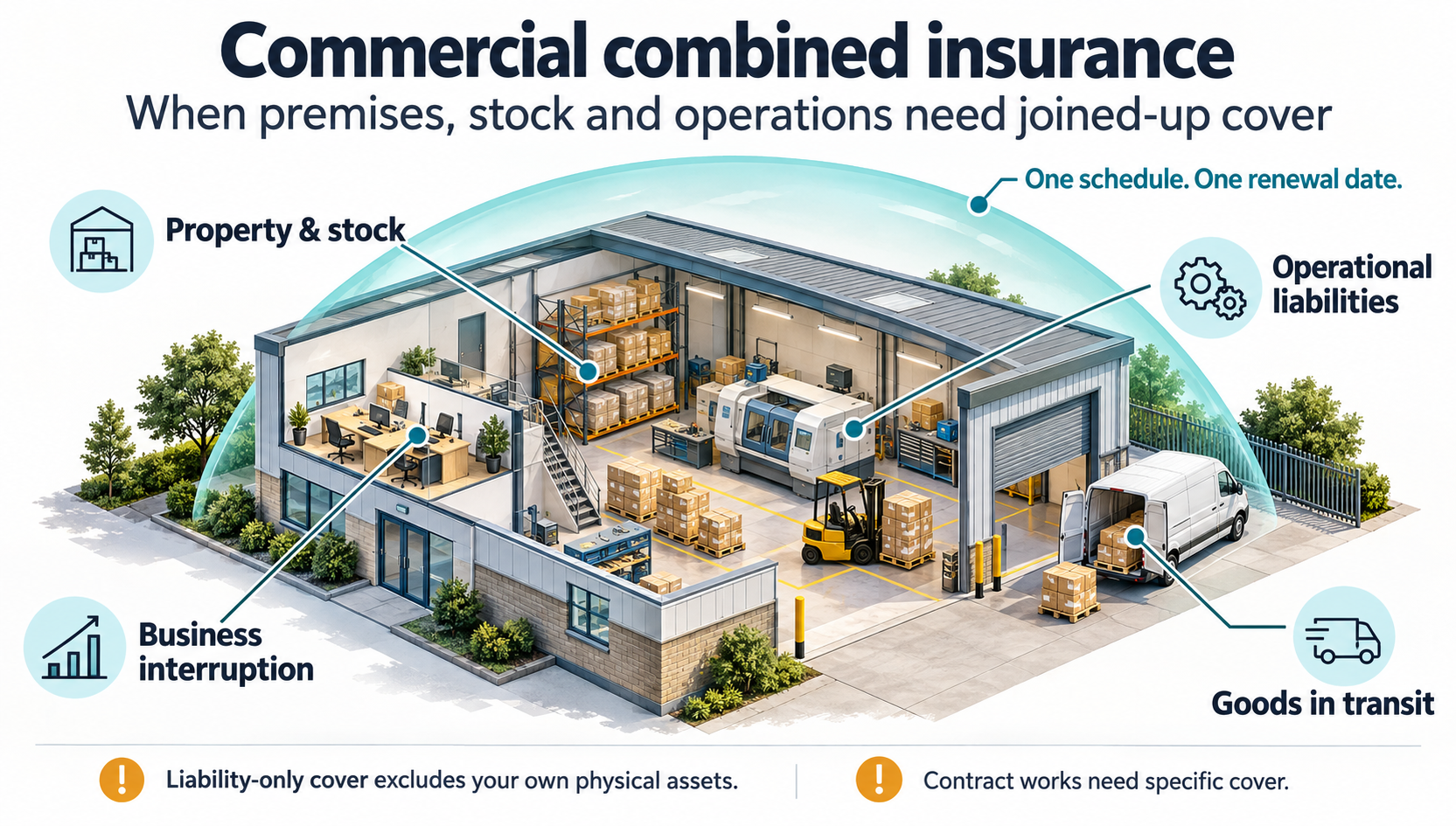
Running a growing enterprise means balancing physical assets against broad operational risks. Many firms start out with piecemeal cover bought from several brokers. A commercial combined insurance package pulls those exposures into one schedule. It covers material damage, core liabilities, revenue interruption and goods in transit. Unifying the sections removes conflicting wording and closes the gaps that cost money after a serious loss.
The right structure depends on operational complexity, premises and asset density. Firms that move into larger units or install high-value plant often find separate policies leave gaps. Those gaps surface at the worst possible moment. Which arrangement actually protects your balance sheet when property and revenue are lost together?
Key Takeaways
- A packaged policy consolidates property, stock, revenue protection and operational liabilities under one insurer schedule with a single renewal date.
- Liability-only programmes exclude physical assets, so operators needing building or machinery protection must buy separate property and interruption cover.
- Business interruption replaces lost gross profit, preventing collapse when severe material damage halts trading at your main premises.
- Contractors working on project sites need contract works extensions covering temporary structures, permanent builds and high-value plant.
- Placing every section with one underwriter removes cover gaps and simplifies fair presentation duties under the Insurance Act 2015.
Core Differences Between Commercial Packages and Isolated Covers
Choosing the right structure starts with the difference between a multi-section policy and a liability-only contract. A commercial package wraps property, business interruption, money and transit risks around the mandatory liability sections. The result is one schedule, one renewal date and balanced protection for the balance sheet.
Liability-only policies leave buildings, plant and stock entirely uninsured unless the owner buys separate contracts. In practice, we find that split placements create friction between underwriters after a major material loss. Setting the structures side by side shows where each framework earns its place in a commercial programme.
| Policy Structure | Core Sections Included | Typical Commercial Application |
|---|---|---|
| Commercial Combined | Property, stock, business interruption, money, goods in transit, public and employers liability | Manufacturers, wholesalers, processors, warehousing operators |
| Combined Liability | Public, products and employers liability | Service firms and trade contractors without fixed premises |
| Contract Works Specialist | Works in progress, site materials, plant, hired-in equipment | Principal contractors, refurbishment specialists, builders |
| Standalone Property | Buildings, contents, machinery breakdown, glass | Commercial landlords and property holding companies |
Property and Stock Cover Inside a Commercial Package
Core Property and Contents Protection
Commercial property cover protects premises, tenant improvements, production machinery and trade contents against defined perils. Insurers respond to fire, storm, flood, impact and escape of water. The schedule states whether settlement follows reinstatement value or market indemnity. That single wording choice decides how much you recover after a total loss.
Accurate sums insured prevent average clause penalties at claim stage. Understate the rebuilding cost or replacement value and the underwriter cuts the settlement proportionally. From experience across the sector, plant schedules drift furthest from reality. Revalue fixed assets every two years and update the schedule at renewal.
Stock, Raw Materials, and Floating Cover
Stock insurance covers finished goods, work in progress and raw materials held on site. Multi-location operators can add seasonal increases and floating sums insured across declared depots. These provisions absorb the swings in inventory that come with peak trading. Declared values should reflect cost price, not retail selling price.
Underwriters impose stack-height limits and waste clearance conditions inside industrial premises. Timber yards, waste operators and chemical processors face the tightest terms. Breach a condition precedent and the material damage section can fail entirely. Housekeeping audits are cheap; a declined fire claim is not.
Did You Know?
The Employers’ Liability (Compulsory Insurance) Act 1969 carries a fine of up to £2,500 for each uninsured day. A further £1,000 penalty applies for failing to display the certificate.
Operational Liabilities within the Master Schedule
Public and Products Liability Integration
Public liability answers third-party claims for accidental injury or property damage arising from your trading. Products liability extends that protection to goods you manufacture, alter, repair or supply. Holding both sections with one insurer removes demarcation arguments when a claim straddles the two. Defence costs sit inside the limit on most commercial wordings.
Commercial contracts routinely demand a minimum limit of five million pounds. Groundworks, infrastructure and high-hazard trades often require ten million pounds or an excess layer above the primary limit. A packaged schedule lifts those limits without a separate negotiation. Check the contract wording before the site start date, not afterwards.
Employers Liability Compliance and Governance
Employers liability indemnifies the business when staff suffer injury or occupational illness through employer negligence. The Employers’ Liability (Compulsory Insurance) Act 1969 makes the cover compulsory across Great Britain for almost all employees. Market practice fixes the limit at ten million pounds. Certificates must be available for inspection by employees and enforcing authorities.
Labour-only subcontractors, direct employees, apprentices and working directors all fall inside the statutory definition. Packaging employers liability alongside public liability keeps wage and clerical definitions aligned. That alignment matters at the annual declaration audit. Misclassified labour-only subcontractors remain the most common cause of adjustment disputes.
Cover Built for Demanding Businesses
Across high risk industries, the cover we arrange most often includes:
Public liability
Employers' liability
Motor fleet
Contractors' all risks
Freight liability
Professional indemnity
Environmental liability
Business interruption
Most businesses need a combination, rather than a single focus policy, and we build cover around your contracts, your workforce and your operational activities.
Package Policies Against Liability-Only Programmes
Scope Boundaries in Combined Liability Insurance
A pure combined liability insurance contract protects your operations against civil damages and legal costs alone. It answers injury or property damage suffered by third parties and employees. It pays nothing towards your own buildings, plant or stock. That boundary is the single most misunderstood point in commercial insurance buying.
Firms without fixed premises often choose this narrower structure deliberately. Scaffolding contractors, hauliers and mobile service providers buy it to satisfy client and regulatory requirements. They carry little owned property worth insuring. The saving is real, provided the asset position genuinely matches the cover.
Operational Risk Exposure Left Uninsured
Relying on liability cover alone leaves serious balance sheet exposures unaddressed. A fire or flood at your unit leaves you funding the rebuild and the replacement plant. Overheads continue whilst trading stops, with no recovery from insurers. Lenders and landlords usually spot this gap before the business owner does.
The move to a packaged structure is usually triggered by a freehold purchase or a fixed plant installation. Once capital sits in buildings and machinery, liability-only cover stops being proportionate. One schedule then protects the assets and the earnings they generate. It also ends the renewal scramble across three or four separate providers.
Business Interruption Cover and Revenue Protection
Gross Profit and Indemnity Period Selection
Business interruption insurance replaces lost gross profit and funds additional working costs after an insured property loss. The section responds only once physical damage triggers a valid property claim. Insurance gross profit is not the accountancy figure; it is turnover less specified variable costs. Getting that definition wrong leaves a shortfall at claim stage.
The maximum indemnity period decides whether the business survives the recovery. Twelve months rarely covers debris clearance, planning consent, rebuilding and the lead time on specialist machinery. In practice, we find manufacturers need twenty-four or thirty-six months. Set the period against the longest plant lead time, not the shortest.
Additional Increased Cost of Working
Increased cost of working funds the emergency spending needed to keep trading after damage. Typical expenditure includes temporary premises, hired machinery, short-term IT systems and overtime. The aim is simple: hold on to key contracts whilst repairs run. Standard wordings require each cost to reduce the gross profit loss.
Additional increased cost of working removes that economic limit test for a capped sum. Service businesses with modest plant often prefer standalone increased cost of working cover. It provides working capital after a loss without a full gross profit audit. Manufacturers with heavy fixed costs should still insure gross profit properly.
Transit Risks and Mobile Asset Protection
Goods in Transit and Moving Freight
Goods in transit cover protects stock, tools and materials carried in your own vehicles or by third-party hauliers. Terms run either on an all-risks basis or in line with Road Haulage Association conditions. The section responds to theft, overturning and collision damage. Limits apply per vehicle and per load, so check both figures.
Underwriters attach strict unattended vehicle warranties to transit sections. Drivers must set approved alarms and park overnight inside a locked compound. Overnight theft claims fail more often on warranty breach than on valuation. Brief the drivers in writing and keep the record.
Contractors All Risks Insurance on Site
Contractors all risks insurance protects works in progress, temporary structures and site materials against accidental damage. It sits alongside the property section and follows the work away from your own premises. The wording accommodates joint-names requirements under standard JCT and NEC contracts. Plant and hired-in equipment usually need separate declared limits.
A general commercial package stops at the boundary of your declared premises. Contract works carried out elsewhere fall outside it. Adding a project extension or a standalone contract works policy bridges that gap. Cover should run until practical completion and formal handover, not until the last invoice.
Financial and Special Perils Protection
Money, Assault, and Safe Limits
Money cover responds to theft of cash, cheques, postage stamps and similar negotiable items. Protection applies on the premises, in transit and at employees’ homes. Limits track the cash rating of the safe installed at each site. Exceed the rated limit overnight and the loss falls back on the business.
Assault benefits sit alongside the money section on most commercial wordings. They pay capital sums for serious injury and weekly amounts during recovery after a robbery. The sums are modest but the cover matters to staff handling takings. Review banking routines as well as limits.
Engineering Breakdown and Statutory Inspection
Engineering breakdown answers sudden mechanical or electrical failure of operating machinery. The standard property perils exclude wear, tear and internal breakdown entirely. A specialist section repairs or replaces failed components, hydraulic systems and distribution boards. Plant hire charges and spoilage of refrigerated stock can be added by extension.
Statutory thorough examination is a separate legal duty from insurance. The Lifting Operations and Lifting Equipment Regulations 1998 require competent inspection of lifting equipment at set intervals. The Pressure Systems Safety Regulations 2000 impose a parallel duty for pressure plant. Bundling the inspection service with the policy keeps certification current.
Strategic Policy Placement and Governance
Fair Presentation under the Insurance Act 2015
The Insurance Act 2015 requires commercial policyholders to make a fair presentation of the risk. Disclosure must cover every material circumstance the business knows, or ought to know, after a reasonable search. That search runs across senior management and the people who procure the insurance. Placing the sections with one underwriter makes the duty easier to discharge.
Remedies under the Act are proportionate, which cuts both ways. An innocent non-disclosure can reduce a settlement rather than void the policy outright. Report extensions, new processes and revised wage rolls as they happen. Mid-term disclosure costs a small additional premium; silence costs part of the claim.
Policy Administration and Claims Handling
Separate policies create administrative drag and open the door to cross-policy disputes. An incident involving both property damage and third-party injury can leave two insurers arguing over responsibility. A single packaged contract removes that argument. One claims handler then deals with the whole loss, which usually shortens settlement.
One schedule means one renewal date, one premium audit and one point of contact. It also builds negotiating leverage, since the underwriter sees the whole account. From experience across the sector, consolidated accounts attract better terms than fragmented ones. The administrative saving is secondary to the certainty of cover.
Final Thoughts
Commercial combined insurance gives a growing business the structural resilience to protect physical assets and earnings together. Placing property, interruption, money, transit and liability with one insurer removes the gaps that piecemeal buying creates. The packaged structure answers complex losses that separate contracts handle badly.
Choosing the sections requires honest valuations and a realistic view of recovery time. Accurate rebuilding sums and a sufficient indemnity period protect the balance sheet against construction inflation. Review both at every renewal rather than every third one.
Speak to an Insurance Specialist
Whether you need a new quote, want to discuss your renewal or have a question about an existing policy, our team is here to help.
Frequently Asked Questions
Q: What is the difference between commercial combined and a commercial package policy?
A: Commercial combined insurance is individually underwritten for medium-sized firms with complex property, manufacturing or distribution exposures. Each section is negotiated: property sums, engineering cover, indemnity periods and liability limits. A commercial package policy is an off-the-shelf product with preset limits aimed at smaller, lower-hazard businesses. Packages are cheaper and quicker to arrange. They become restrictive once stock values rise, machinery is installed or multiple sites are added to the schedule.
Q: Does commercial combined insurance cover contract works on site?
A: Not automatically. A standard commercial combined policy protects buildings, machinery and stock at the premises declared in the schedule. Work carried out on a client’s site falls outside that boundary. Firms undertaking installations, fit-outs or structural refurbishment need a contractors all risks insurance extension or a standalone contract works policy. That cover protects works in progress, temporary structures, site materials and plant. It should remain in force until practical completion and formal handover.
Q: Can goods in transit cover be added to an existing package?
A: Yes. Goods in transit is a standard optional section within a commercial combined schedule. It covers merchandise, raw materials and tools carried in company vehicles or by third-party carriers. Adding it avoids a separate policy and a second renewal date. It also simplifies claims where a single event damages stock in the warehouse and stock on the road. Expect the underwriter to ask about vehicle security, overnight parking and maximum load values.
Q: Why does the business interruption indemnity period matter?
A: The indemnity period sets how long the insurer keeps paying after a loss. Cover stops at the end of that period, even if trading has not recovered. Twelve months rarely covers debris clearance, planning consent, rebuilding and the lead time on specialist machinery. Manufacturers and processors usually need twenty-four or thirty-six months. Base the figure on the longest realistic recovery path, including customer win-back, rather than on premium savings.
Q: How does the Insurance Act 2015 affect commercial insurance packaging?
A: The Act imposes a duty of fair presentation at inception, renewal and variation. The business must disclose every material circumstance known to senior management, or revealed by a reasonable search. Remedies are proportionate. An innocent failure may reduce the settlement or alter the terms applied, rather than void the contract. Holding all sections with one underwriter means a single presentation covers the whole risk. That reduces the chance of a disclosure failing across fragmented policies.
About The Author
Darren Judd
Director, Co-Founder and Co-Owner of Capital Corporate Risks Ltd

Experienced Account Executive with a demonstrated history of working in the insurance industry. Skilled in Account Management, Risk Management, Business Development across all classes of insurance within the Construction Industry,