

Business Liability Insurance Cost: Key Factors
Every commercial organisation requires an accurate appraisal of risk. Business liability insurance cost is therefore a fundamental operational calculation for directors across the United Kingdom. Insurers do not rely on uniform calculations across commercial sectors. Instead, pricing structures reflect the unique technical exposures, operational turnover, and working environments associated with specific business activities. Underwriters evaluate empirical exposure levels rather than arbitrary benchmarks. They adjust terms to match statutory demands, contractual indemnities, and procedural safeguards.
Commercial insurance arrangements require a detailed understanding of how underwriters quantify industrial hazards and third-party liabilities. Standard low-hazard trades follow baseline rating schedules, yet technical industries face complex rating matrices based on operational controls. How do insurers evaluate operational risk profiles when determining commercial liability premiums for complex trading environments?
Key Takeaways
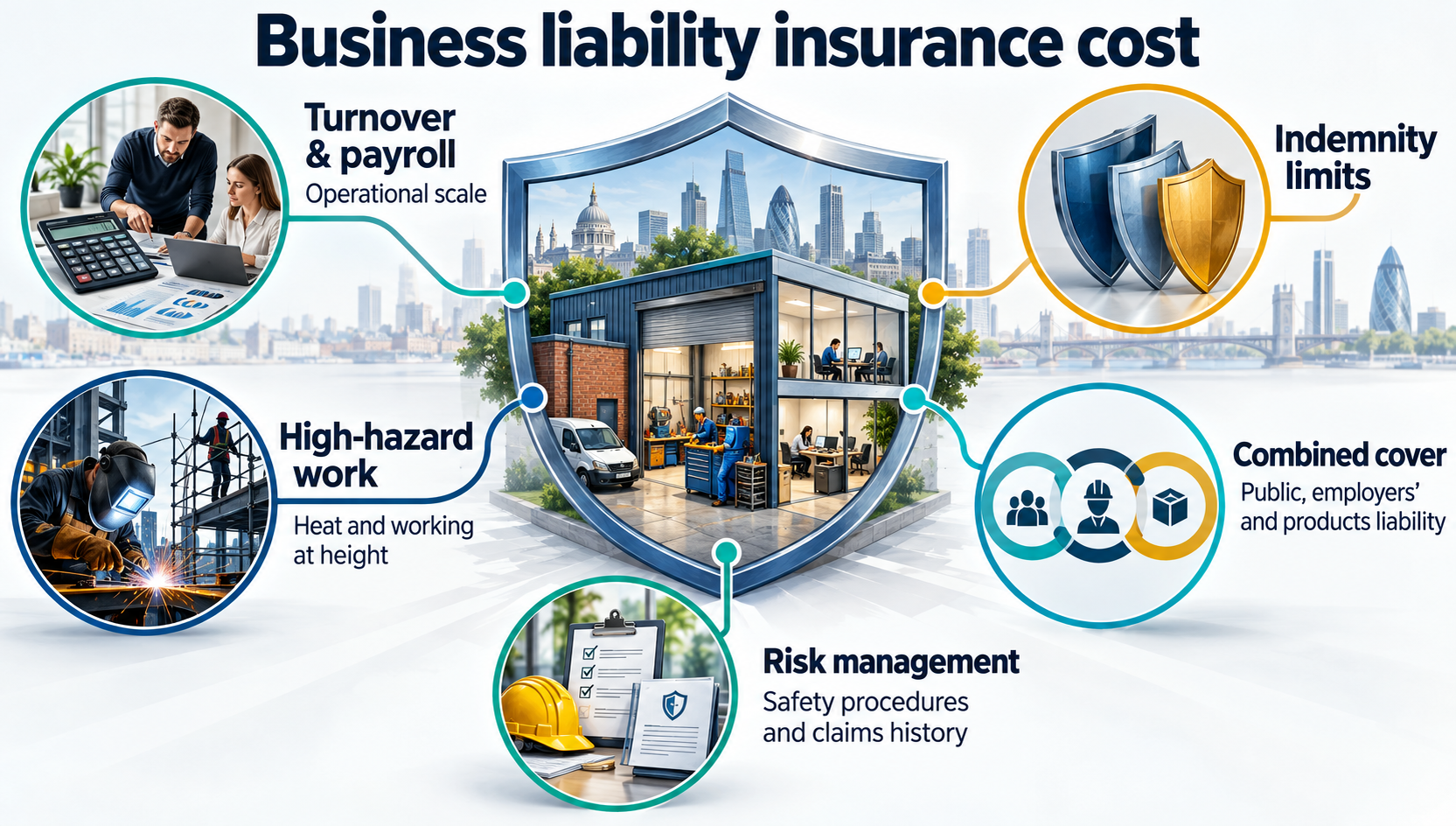
- Annual turnover and wage roll establish the primary exposure baseline that commercial liability underwriters use for pricing.
- Chosen indemnity limits shape pricing, with main-contract conditions often demanding excess layers above the standard market baseline.
- High-hazard activities such as heat application and working at height trigger strict policy warranties and premium loadings.
- Combined liability insurance consolidates cover under one schedule, preventing duplication whilst securing statutory employers’ liability protection.
- Documented risk management procedures and verified claims histories allow specialist brokers to negotiate sharper underwriting terms.
Core Underwriting Pricing Drivers
Commercial liability pricing reflects specific operational exposures rather than simple administrative calculations. Underwriters assess multiple risk vectors to balance commercial protection against the threat of catastrophic exposure. The table below outlines how core operational elements influence policy rating structures across key industrial sectors.
Insurers establish primary baseline rates using core operational measurements before applying specialist hazard loadings. These technical adjustments reflect hazardous processes, contractual obligations, and statutory compliance requirements. By evaluating these distinct criteria systematically, commercial underwriters calculate appropriate terms. Specialist brokers can then align policy schedules directly with genuine enterprise risk exposures.
| Rating Driver | Underwriting Measurement | Impact on Premium Structure |
|---|---|---|
| Turnover & Payroll | Total operational scale and wage-roll distribution | Establishes baseline exposure volume |
| Indemnity Limits | Contractual levels (£1m to £10m+) | Scales risk transfer capacity and excess layers |
| Hazardous Operations | Heat application, height work, confined spaces | Applies specialist hazard loadings and strict warranties |
| Bona-Fide Subcontractors | Proportion of turnover paid to specialist third parties | Adjusts contingent liability and supervision risk rating |
| Claims History | Three to five-year loss experience and reserve movement | Determines loss-ratio loading or risk-managed credit |
Scale and Trade Classification
Turnover and Wage Roll Exposure
Turnover and wage roll establish the baseline volume of risk that an enterprise generates during its trading year. Underwriters calculate that higher financial turnover correlates with increased third-party engagement, greater footfall, and wider site operations. This foundational metric sets the starting rate before insurers evaluate site-specific hazards.
Insurers separate direct labour wages from administrative salaries when establishing exposure. Operational staff working on site carry significantly higher frequency and severity risks than clerical employees. In practice, accurate forecasting prevents year-end premium adjustment shocks, where underwriters audit declared turnover against actual accounts.
Trade Classification and Activity Scope
Trade classification categorises an enterprise according to its primary industry hazards and daily operating environments. Insurers evaluate standard commercial trades differently from structural engineering, chemical processing, or industrial roofing contractors. Accurately describing secondary activities ensures policies cover all operations without voiding protection through non-disclosure.
In complex sectors, an incomplete description of operations creates material risks under the Insurance Act 2015. Underwriters apply distinct rate matrices to different trades, meaning an unrecorded trade extension can leave significant liabilities uninsured. Clear, transparent descriptions prevent operational misunderstandings during claim negotiations.
Did You Know?
UK employers must hold employers’ liability cover with a minimum indemnity limit of £5 million per occurrence. This requirement sits under the Employers’ Liability (Compulsory Insurance) Act 1969. Standard market placement is £10 million.
Indemnity Limits and Structure
Typical Indemnity Limit Scaling
Indemnity limits determine the insurer’s maximum financial exposure for third-party injury claims and third-party property damage losses. Standard UK commerce often operates on a baseline of £1 million or £2 million. Modern supply chains and public authorities routinely require £5 million or £10 million in cover.
Scaling up indemnity limits does not increase premium costs on a direct linear curve. The primary layer carries the highest frequency of claims, whereas higher excess layers represent remote, catastrophic liabilities. Main contractors frequently mandate these higher limits to protect against site destruction or multi-party bodily injury liabilities.
Combined Policy Efficiencies
Arranging protection through a single combined liability insurance schedule creates administrative and commercial efficiencies for trading businesses. Bundling public liability insurance, employers’ liability, and products liability under one structure prevents cross-policy disputes. It also avoids duplicate administrative fees across multiple separate placements.
The Employers’ Liability (Compulsory Insurance) Act 1969 mandates minimum statutory protection for businesses employing staff. Packaging this statutory protection with commercial third-party cover allows underwriters to view the overall risk comprehensively. This unified perspective frequently delivers more competitive pricing than sourcing isolated policies across disparate providers.
Cover Built for Demanding Businesses
Across high risk industries, the cover we arrange most often includes:
Public liability
Employers' liability
Motor fleet
Contractors' all risks
Freight liability
Professional indemnity
Environmental liability
Business interruption
Most businesses need a combination, rather than a single focus policy, and we build cover around your contracts, your workforce and your operational activities.
High Hazard Operational Controls
Work at Height Protocols
Working at height introduces substantial third-party injury risks from falling materials, structural collapse, and operative incidents. Underwriters apply strict rating criteria based on operational adherence to the Work at Height Regulations 2005. Standard commercial policies frequently apply restrictive height limits, typically capping work at ten or fifteen metres.
Removing height restrictions requires demonstrating rigorous safety management procedures, certified equipment inspections, and comprehensive staff training. Underwriters assess operative qualifications, scaffolding design standards, and edge protection systems before offering unrestricted height terms. Robust safety protocols help businesses secure competitive terms despite high-hazard operational profiles.
Hot Works and Thermal Risks
Processes involving naked flames, grinding, or thermal application generate severe structural fire risks for commercial contractors. Operations such as torch-on roofing or structural welding attract substantial premium loadings due to catastrophic property damage potential. Underwriters mitigate this exposure by applying mandatory hot work warranties to policy schedules.
From experience across the sector, policy warranties commonly require formal permit-to-work systems and suitable fire extinguishers adjacent to work areas. They also demand a dedicated 60-minute post-work fire watch. Failing to adhere strictly to these procedural warranties can compromise cover if a fire occurs. Demonstrating robust compliance systems reassures underwriters and prevents prohibitive terms.
Subcontractor Labour Arrangements
Labour-Only Subcontractor Exposure
Labour-only subcontractors operate under the direct direction, supervision, and control of the principal contractor on commercial sites. Underwriters treat these workers as direct employees rather than independent third parties. Their remuneration therefore joins the overall wage-roll rating matrix. This classification directly increases the employers’ liability premium component.
Insurers classify labour-only personnel alongside direct staff because site managers retain legal responsibility for their health and safety. Under the Health and Safety at Work etc. Act 1974, operational duty of care cannot be transferred. Temporary labour arrangements do not shift that responsibility. Premium structures reflect this collective operational exposure across all controlled personnel.
Bona-Fide Subcontractor Scrutiny
Bona-fide subcontractors work under their own supervision, supply their own materials, and maintain independent business insurance policies. Insurers rate these workers using declared annual payments rather than direct payroll schedules. Lower rates reflect reduced direct operational liability. Underwriters still retain contingent exposure if a subcontractor’s cover fails.
Policies commonly incorporate strict subcontractor conditions requiring businesses to verify external cover before site work begins. Principal contractors must check that subcontractors hold active public liability insurance with matching indemnity limits. Maintaining an auditable register of these insurance certificates ensures policy conditions remain fully satisfied.
Loss History and Claims Performance
Historical Loss Frequency Impact
Historical claims performance provides underwriters with direct evidence of a business’s operational control and safety management effectiveness. Insurers assess five-year claims experience, looking closely at incident patterns alongside overall financial claim totals. Multiple minor claims often indicate underlying management weaknesses that concern underwriters more than isolated incidents.
Insurers calculate loss ratios by comparing paid claims and open reserves against total premiums paid over defined policy periods. A deteriorating loss ratio prompts underwriters to adjust baseline rates, raise policy excesses, or introduce restrictive warranties. Conversely, a clean claims record supports requests for discounted rating terms.
Claims Reserve Management
Open claims reserves represent funds set aside by insurers to cover outstanding third-party litigation, repairs, and associated legal costs. These provisional figures remain on claims reports as active liabilities, directly influencing renewal negotiations until cases conclude. Inflated or outdated reserves artificially worsen a business’s perceived risk profile.
In practice, proactive claims reviews allow businesses to identify and challenge inaccurate reserves before renewal discussions begin. Securing prompt closure on resolved incidents improves claims histories, directly lowering commercial insurance pricing. Regular reviews ensure insurers negotiate terms based on actual settled claims rather than worst-case reserve forecasts.
Hazardous Materials and Environmental Scope
Asbestos and Hazardous Substances
Handling hazardous materials exposes businesses to strict liability regimes and complex occupational disease claims under UK regulations. The Control of Substances Hazardous to Health Regulations 2002 and the Control of Asbestos Regulations 2012 introduce significant long-tail exposures. Standard public liability policies usually exclude these industrial risks without specific endorsements.
Underwriters require comprehensive evidence of regulatory compliance, specialist operative accreditations, and documented disposal routes before underwriting hazardous materials work. Specialist endorsements incorporate defined exclusions regarding unnotified asbestos encounters or historical liabilities. Demonstrating adherence to certified operating procedures provides underwriters with the transparency needed to price high-hazard risks accurately.
Geographic and Contractual Scope
The geographic territory of business operations significantly influences underwriting calculations and potential liability exposure levels. Working within technical environments such as airside facilities, offshore platforms, or railway boundaries introduces immediate premium loadings. These specialist locations carry severe third-party property damage exposures and strict statutory compliance requirements.
Contractual indemnities agreed with clients also shape final liability insurance costs. Projects governed by standard contracts like JCT or NEC suites may include specific insurance clauses. These clauses frequently transfer risks beyond common law obligations. Ensuring policy schedules align with these contractual indemnities prevents uncovered liabilities from arising on complex projects.
Market Placement and Risk Presentation
Specialist Broker Representation
Specialist brokers negotiate complex commercial risks using established relationships across Lloyd’s syndicates and composite commercial insurers. High-hazard contractors require direct access to underwriters who understand technical operational realities rather than relying on automated underwriting platforms. Experienced brokers present risk profiles accurately, ensuring technical risk management investments are recognised during pricing discussions.
Presenting risk profiles with detailed method statements, certified credentials, and clean health and safety records builds underwriter confidence. A well-prepared presentation highlights operational risk management, justifying sharper pricing across primary and excess layers. Specialist placement secures tailored protection that standard composite providers cannot accommodate.
Policy Condition Compliance
Adhering to policy warranties and operational conditions remains essential for maintaining valid cover across all trading activities. Overlooking key conditions, such as hot-work precautions, working-at-height restrictions, or subcontractor checks, jeopardises claims recovery. Businesses must ensure site supervisors understand and enforce all policy warranties during daily operations.
Operating outside policy conditions compromises protection and undermines insurer negotiations during subsequent renewals. A rejected claim damages operational standing and can restrict future market access for commercial cover. Maintaining rigorous compliance protects cash reserves and secures competitive terms from underwriters over the long term.
Final Thoughts
Managing business liability insurance cost requires an understanding of underwriting factors, operational controls, and contract requirements. Rather than treating insurance as a fixed cost, businesses can influence pricing through structured risk management. Documented safety processes, active claims reviews, and accurate operational definitions demonstrate quality to prospective insurers.
As commercial contracts demand higher indemnity limits and regulatory scrutiny tightens, securing suitable protection requires specialist advice. Transparent risk presentations and appropriate policy conditions help businesses maintain resilient protection against third-party liabilities. That protection safeguards long-term growth and commercial viability.
Speak to an Insurance Specialist
Whether you need a new quote, want to discuss your renewal or have a question about an existing policy, our team is here to help.
Frequently Asked Questions
Q: What primary factors determine the cost of commercial liability insurance?
A: Commercial liability pricing depends on several fundamental operational factors across trading operations. Underwriters evaluate total annual turnover, wage-roll distribution, and trade classifications to establish baseline exposure. Premiums also reflect chosen indemnity limits, geographic operating environments, and historical claims experience over recent years. Businesses undertaking hazardous activities like hot works or height operations face additional rating adjustments. Underwriters base these on technical risk management and supervisory controls.
Q: Why does working at height increase commercial liability insurance premiums?
A: Working at height introduces significant risks of severe third-party bodily injury and property damage from falling objects. Underwriters evaluate compliance with the Work at Height Regulations 2005, operative training records, and site equipment standards. Standard policies often impose strict height limits. Removing these restrictions requires specialised endorsements that reflect the greater underwriting risk involved across complex construction and access operations.
Q: How does using subcontractors affect commercial liability insurance pricing?
A: Insurers evaluate labour-only subcontractors alongside direct employees, incorporating their remuneration directly into wage-roll exposure calculations under employers’ liability cover. Conversely, underwriters rate bona-fide subcontractors based on declared turnover percentages, as these specialists maintain independent insurance policies. Failing to collect and verify active insurance certificates from bona-fide subcontractors can breach policy warranties. This compromises contingent protection during complex multi-party claims on commercial sites.
Q: Can improving workplace health and safety procedures reduce liability insurance premiums?
A: Demonstrating rigorous risk management protocols directly supports lower commercial insurance costs over successive policy years. Insurers offer competitive terms to enterprises with verified trade accreditations, formal permit-to-work systems, and clean claims records. Transparent risk presentations allow specialist brokers to negotiate preferential rates with underwriters. Well-managed sites carry a lower statistical frequency of third-party property damage and bodily injury losses across operational environments.
Q: What is the difference between primary and excess layer liability cover?
A: Primary liability insurance provides foundational indemnity up to a defined ceiling, typically £1 million, £2 million, or £5 million. It covers the initial exposure arising from third-party claims. An excess layer policy sits directly above this primary threshold. It offers the top-up capacity required by main contracts or public sector frameworks. Excess layers carry lower rates because they respond only to catastrophic, high-value losses.
About The Author
Darren Judd
Director, Co-Founder and Co-Owner of Capital Corporate Risks Ltd

Experienced Account Executive with a demonstrated history of working in the insurance industry. Skilled in Account Management, Risk Management, Business Development across all classes of insurance within the Construction Industry,