

Business Public Liability Insurance Explained
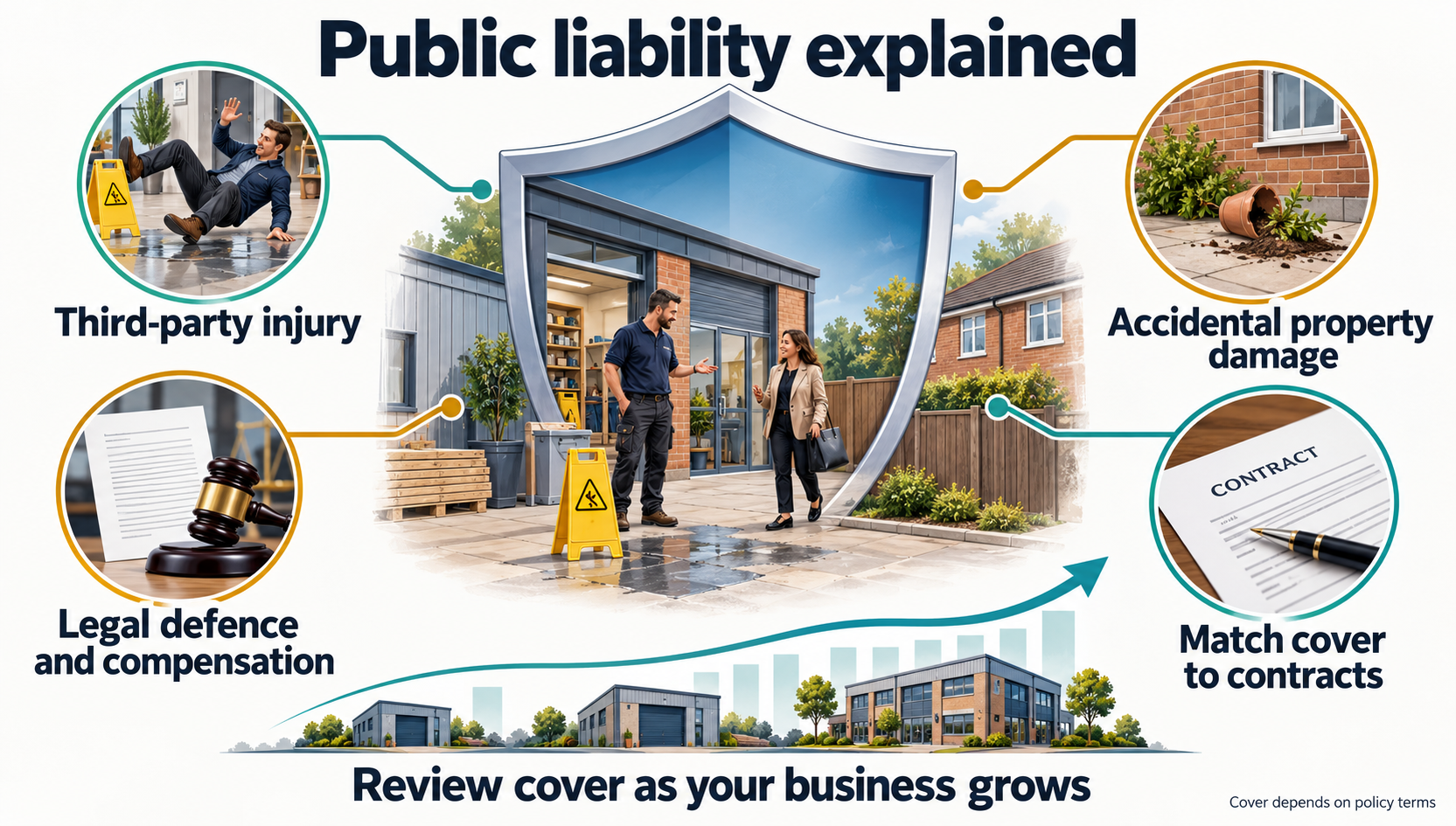
Commercial operations constantly bring staff, vehicles and equipment into contact with the public. Business public liability insurance meets the cost when that contact causes injury or property damage. It funds the legal defence as well as any compensation. Without it, a single claim can drain working capital. Directors who understand their policy triggers protect the balance sheet before an incident occurs.
Contracts tighten as a business grows. Main contractors, councils and procurement teams all set their own indemnity thresholds. So how should a growing enterprise match cover to those demands, declare rising turnover, and keep indemnity limits adequate?
Key Takeaways
- Public liability policies respond to third-party bodily injury and accidental property damage claims, covering both legal defence costs and court-awarded compensation settlements.
- Although not statutory like employers liability cover, commercial contracts, local authorities and tier-one main contractors routinely make substantial public liability limits mandatory for site access.
- Insurers set business liability insurance cost using trade classification, annual turnover, wage rolls, claims history and specific hazardous exposures such as hot work.
- Turnover-rated cover protects continuous annual operations under adjustable declarations, whereas project-specific cover ring-fences one contract with an indemnity limit dedicated to that scheme alone.
- Rapid revenue growth requires prompt midterm policy adjustment, since underinsurance can trigger proportionate claim reductions under the Insurance Act 2015.
Common Indemnity Limits and the Sectors That Demand Them
Business public liability insurance protects a commercial entity against civil claims from third parties. Those claims follow injury or accidental damage caused by trading activity. Most enterprises meet the public, clients and suppliers daily, on their own premises and on client sites. The indemnity limit chosen decides how much protection the balance sheet actually carries.
The table below sets out the indemnity tiers seen most often in the UK market. It shows the operational trigger behind each tier and the sectors that normally demand it. Use it to test whether current cover matches contractual obligations. In practice, we find the limit is set by the contract rather than by the trade itself.
| Indemnity Limit Tier | Operational Trigger | Typical Sector Requirement |
|---|---|---|
| £1 million to £2 million | Low-hazard third-party injury or minor property damage | Independent trades, domestic contractors, small retail premises |
| £5 million | Moderate hazard operations, commercial premises incidents | Standard commercial contracts, public procurement, educational facilities |
| £10 million | Severe property damage, catastrophic multiple-party injury | Tier-one construction sites, principal contractors, civil engineering |
| £20 million and above | High-consequence infrastructure incidents or major structural losses | Demolition, petrochemical sites, major transport networks |
What Public Liability Cover Protects Against
Bodily Injury and Property Damage Triggers
Business public liability insurance responds when commercial activity injures a third party or damages property belonging to someone else. The trigger is accidental harm, not a deliberate act. Insurers assess fault under common law negligence. Where liability attaches, the policy indemnifies the business for the settlement and the costs that follow.
Slips, trips and falls dominate third-party injury claims. Dropped tools, moving plant and falling scaffold components cause the severe ones. Property damage usually involves severed buried services, structural disturbance or water escaping into adjoining premises. Court awards for catastrophic spinal injury run into millions. A low indemnity limit leaves the shortfall with the company.
Legal Defence and Settlement Costs
The policy pays defence costs alongside any damages awarded against the business. Defending an unfounded allegation still consumes solicitor time and expert fees. Public liability insurance funds that work from the outset. It covers legal representation, expert witness reports and the disbursements that civil litigation generates over a long claim.
On most UK liability wordings, defence costs sit in addition to the limit of indemnity. That structure preserves the full limit for the claimant’s damages. Insurers retain conduct of proceedings in return. They appoint panel solicitors, test contributory negligence and negotiate settlement before the matter reaches trial.
Did You Know?
Employers liability insurance carries a statutory minimum limit of £5 million under the Employers’ Liability (Compulsory Insurance) Act 1969 and its regulations. The Health and Safety Executive can fine an employer up to £2,500 for each day trading without that cover. Public liability insurance carries no equivalent statutory duty.
Contractual Mandates and Procurement Requirements
Construction Subcontracts and Flow-Down Terms
Main contractors insist on public liability cover before a subcontractor sets foot on site. JCT and NEC suites both carry insurance flow-down clauses. The subcontract fixes a minimum indemnity limit. Without a valid certificate, the gate stays shut and interim payments stall until the paperwork arrives.
Tier-one contractors commonly set that figure at £5 million or £10 million. Most agreements also demand an indemnity to principals clause. The clause extends the subcontractor’s policy to the client. It responds where a third party names the client in proceedings caused by the subcontractor’s negligence.
Public Sector Procurement Thresholds
Councils, NHS trusts and government departments publish fixed insurance thresholds inside their procurement frameworks. Bidders must evidence live cover at tender stage, usually five or ten million pounds. The requirement is not negotiable. A missing or expired schedule disqualifies the bid before technical evaluation even begins.
Public bodies apply these rules to protect taxpayer funds from third-party litigation. Municipal work brings heavy public interaction on highways, in civic buildings and across schools. Procurement officers check broker verification letters against the policy schedule. Clean documentation keeps contract onboarding on programme.
Cover Built for Demanding Businesses
Across high risk industries, the cover we arrange most often includes:
Public liability
Employers' liability
Motor fleet
Contractors' all risks
Freight liability
Professional indemnity
Environmental liability
Business interruption
Most businesses need a combination, rather than a single focus policy, and we build cover around your contracts, your workforce and your operational activities.
Turnover-Rated and Project-Specific Policies
Turnover-Rated Cover for Continuous Operations
A turnover-rated policy covers every declared activity across a twelve-month period. Underwriters set a provisional premium from projected revenue and the wage roll. The insured declares actual figures at expiry. An adjustment premium then follows, up or down, depending on how the trading year actually performed.
This structure suits repetitive trade work spread across many client sites. It removes the cost of placing a separate policy for every contract. Accurate trade descriptions matter. Rates depend on the proportion of manual labour, payments to bona-fide subcontractors and total turnover declared at inception.
Project-Specific Placements for Single Schemes
A project-specific policy ring-fences third-party exposure for one contract. Cover runs from inception to practical completion and often through the defects period. Claims on that scheme cannot erode the limit protecting other work. Main contractors value the certainty of a dedicated limit sitting behind a single build.
Major civil engineering and high-value development schemes use these placements routinely. Pricing reflects the job rather than the company. Underwriters weigh contract value, duration, ground conditions and the proximity of neighbouring structures. From experience across the sector, the premium tracks adjacent property risk closely.
What Drives Commercial Premium Costs
Trade Classification and Operational Hazard
Trade classification is the first lever underwriters pull when pricing business liability insurance cost. Work at height, demolition and hot work all attract higher rates per thousand pounds of turnover. Office-based consultancy sits at the opposite end. The classification sets the baseline for everything that follows.
A scaffolding or roofing contractor pays far more than a decorator on identical turnover. Underwriters are pricing severity, not just frequency. Structural collapse and serious head injury sit behind the higher rates. Depth limits, height restrictions and hazardous substance exposure then refine the final figure.
Claims History and Risk Management Controls
Insurers review five years of claims experience before quoting commercial liability terms. Both frequency and severity count. A run of small claims signals weak procedure and usually attracts a premium loading or a higher excess. Recognised safety accreditation works the other way and earns discounted terms.
Documented risk assessments carry real weight at renewal. So do operative training records and demonstrable compliance with CDM 2015. Underwriters price what they can verify. From experience across the sector, a tidy claims file and clear method statements move terms further than any broker argument.
Growth, Turnover Declarations and Midterm Reviews
Revenue Growth and Turnover Adjustments
Rapid expansion opens a gap between declared turnover and actual trading income. The Insurance Act 2015 imposes a duty of fair presentation on the insured. That duty does not pause mid-term. When revenue runs well ahead of the estimate, tell the broker before renewal rather than after a claim.
Consider a business that declares £1 million and turns over £3 million. Insurers can treat that as a breach of fair presentation. The Act allows them to reduce settlement proportionately to the premium that went unpaid. The company then carries the shortfall on a live third-party claim.
New Activities and Trade Description Changes
Growth usually brings new processes, new plant and new client sectors. The policy schedule describes the trade as it stood at inception. Anything outside that description risks falling outside cover. Regular operational audits confirm the wording still matches what the business does week to week.
A groundworks contractor moving into piling or underpinning enters a different risk class. Underwriters rate those operations under separate guidelines. Unreported drift leaves claims from the new activity unendorsed and uninsured. Directors then handle third-party claims and contractual disputes without any policy behind them.
Policy Conditions and Restrictive Warranties
Hot Work Permits and Fire Watch Conditions
Hot work warranties are the most rigorously enforced conditions in contracting policies. They demand a formal permit-to-work system before any flame, grinding or soldering starts. Extinguishers must be present. A fire watch must continue after work stops, so the team spots smouldering combustion before it spreads.
Sixty minutes is the standard fire watch period in most UK wordings. Breach it, cause a structural fire, and the insurer will repudiate the claim outright. Written permit logs settle the argument. Photographic evidence of a completed fire watch protects the policy during a contested investigation.
Bona-Fide Subcontractor Verification
Liability policies carry warranties covering the use of bona-fide subcontractors. The policyholder must confirm that each one holds independent public liability cover at a matching indemnity limit. Certificates need checking and archiving before work starts. A verbal assurance on site does not satisfy the condition.
Where an uninsured subcontractor causes third-party damage, the claim lands on the hiring company. If that company never checked the cover, its own insurer may decline indemnity. Disciplined onboarding protects against failed subrogation. On multi-tier projects, it is the cheapest control available.
Combined Covers and Excess Layers
Products Liability and Completed Operations
Public liability answers for acts during operations. Products liability answers for harm that surfaces after handover or after goods leave the premises. UK insurers normally package the two in a combined schedule. Cover then extends to injury or damage caused by defective components, faulty materials or installation error.
Completed operations are a long-tail exposure for contractors. An electrical fault or a failed joint can surface months after handover. The resulting fire or water damage still traces back to the original workmanship. A combined schedule keeps protection continuous from first fix to post-completion liability.
Excess Layer Capacity for Higher Contract Limits
An excess layer sits directly above the primary public liability policy. It supplies additional capacity when a contract demands ten, twenty or fifty million pounds. The layer follows the terms of the underlying wording. Cover attaches only after a single large loss exhausts the primary limit.
Buying capacity this way costs less than raising the primary limit. The primary insurer absorbs everyday frequency claims within the first five million. Excess underwriters price only low-frequency, high-severity loss. That split makes a twenty million limit affordable for a mid-sized contractor chasing larger frameworks.
Final Thoughts
Business public liability insurance is a balance sheet control, not a procurement formality. It absorbs the cost of third-party injury and property damage claims. It also funds the defence when an allegation has no merit. Reviewing limits, trade descriptions and warranties keeps that protection intact as operations change.
Litigation inflation, tighter safety regulation and changing construction methods will keep pushing indemnity requirements upward. Businesses that check turnover against declarations each quarter stay ahead of that movement. Verifying subcontractor cover at onboarding costs nothing. The discipline shows in both renewal terms and contract eligibility.
Speak to an Insurance Specialist
Whether you need a new quote, want to discuss your renewal or have a question about an existing policy, our team is here to help.
Frequently Asked Questions
Q: Is public liability insurance legally required for UK businesses?
A: No general statute compels it, unlike employers liability cover under the Employers’ Liability (Compulsory Insurance) Act 1969. In practice the distinction rarely helps. Commercial clients, main contractors and local authorities make it a contractual condition anyway. Cover must be in place before site access or tender award. A business trading without it carries the legal defence costs itself. It also funds any compensation awarded for third-party injury or property damage.
Q: What is the difference between public liability and employers liability insurance?
A: Public liability insurance covers third parties: clients, visitors, members of the public and their property. Employers liability covers your own people. It responds to claims from employees, labour-only subcontractors and apprentices injured or made ill through workplace negligence. Employers liability is compulsory for UK employers, with a statutory minimum limit of £5 million. Public liability is not compulsory. Contracts drive it instead.
Q: How do underwriters calculate business liability insurance cost?
A: Pricing starts with occupational classification. Higher-hazard work, such as working at height or hot work, carries a higher base rate. Underwriters apply that rate to projected turnover and the wage roll. Claims history over five years then adjusts the figure. Operating territory, the indemnity limit selected, the excess level and documented health and safety controls all influence the final business liability insurance cost quoted.
Q: What happens if business turnover exceeds initial policy projections?
A: On an adjustable turnover-rated policy, the insured declares the surplus at year end or at a midterm review. The insurer calculates an adjustment premium on the extra revenue. Concealing a large increase is a different matter. Underwriters can argue a breach of the duty of fair presentation under the Insurance Act 2015. That allows a proportionate reduction in any claim settlement, leaving the business to fund the balance.
Q: What indemnity limit should a commercial contractor carry?
A: Market norms run from £1 million to £10 million, depending on trade and contract size. Independent trades working on domestic property often hold £1 million or £2 million. Local authority tenders, facilities management contracts and main-contractor supply chains usually demand £5 million or £10 million. Demolition, structural steel and infrastructure work frequently require £20 million or more. Excess layers deliver those higher limits at a sensible cost.
About The Author
Darren Judd
Director, Co-Founder and Co-Owner of Capital Corporate Risks Ltd

Experienced Account Executive with a demonstrated history of working in the insurance industry. Skilled in Account Management, Risk Management, Business Development across all classes of insurance within the Construction Industry,