
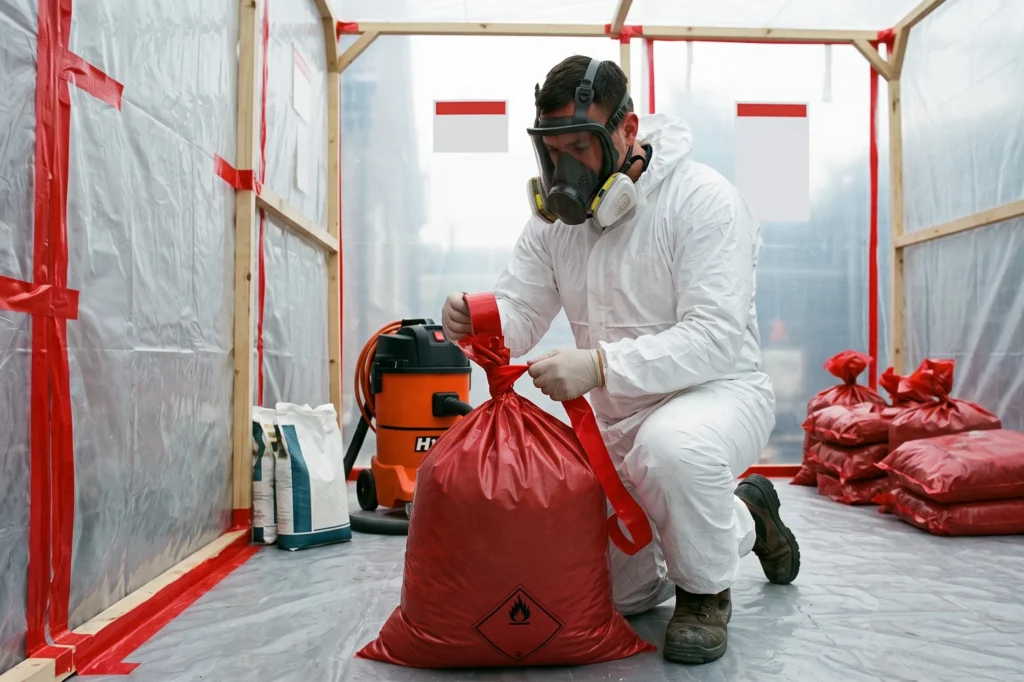
Asbestos Removal Insurance: Specialist Cover
Hazardous remediation carries legal accountability that few other trades face. Standard commercial policies exclude airborne fibres outright, which is why asbestos removal insurance exists as a separate product. Licensed contractors and specialist teams must source dedicated cover. These policies defend against site accidents. They also absorb third-party compensation demands arising from toxic exposure decades later.
Remediation firms face complex regulation, multi-million-pound contract demands, and strict disposal duties. How should a contractor structure public, employers’, and environmental liability cover to satisfy commercial clients whilst removing fatal policy exclusions?
Key Takeaways
- Standard commercial liability policies exclude asbestos exposure entirely, so specialist wordings must write airborne fibre contamination back into the cover.
- The Control of Asbestos Regulations 2012 splits remediation into licensed, notifiable non-licensed, and non-licensed work, shaping every underwriting decision.
- Main contractors and public sector clients routinely demand ten million pounds of public liability before granting access to a site.
- Gradual pollution sits outside standard public liability, making dedicated environmental impairment cover essential for site-wide contamination clean-up costs.
- Mesothelioma claims surface decades after exposure, so unbroken policy records and retroactive date continuity protect long-term commercial solvency.
Regulatory Framework and Risk Categorisation
Remediation work in Great Britain falls into three legal tiers, each policed by the enforcing authority. Underwriters price and condition a policy against those classifications rather than against turnover alone. Matching the declared scope of work precisely to the policy wording is what prevents a voided claim after an exposure incident.
Brokers expect proof of competence, training records, and exposure monitoring before they approach a specialist market. The table below sets out how the statutory tiers align with the cover a contractor needs at each level, and with the evidence an underwriter will ask to see at quotation stage.
| Regulatory Work Tier | Typical Scope of Work | Primary Insurance Requirement |
|---|---|---|
| Licensed work | Friable insulation, sprayed coatings, asbestos insulation board | Asbestos public liability, five to ten million pounds, with explicit write-backs |
| Notifiable non-licensed work | Large-scale cement removal, minor board repair, encapsulation | Specialist contractor liability confirming notifiable non-licensed activity |
| Non-licensed work | Short maintenance tasks, textured coatings, intact gasket removal | Liability cover with accidental discovery and disturbance endorsements |
| Surveying and sampling | Refurbishment surveys, air monitoring, laboratory analysis | Professional indemnity alongside specialist pollution liability |

Licensing Tiers Under the Control of Asbestos Regulations 2012
Licensed Contractor Liabilities
Licensed contractors handle friable insulation, sprayed coatings, and asbestos insulation board under statutory supervision. Insurers examine the Health and Safety Executive licence alongside written risk assessments before quoting. Underwriters expect evidence of negative pressure enclosures, decontamination units, air monitoring records, and medical surveillance for every operative on the books.
A licence proves competence to the market. It also exposes the business to severe common law liability. One enclosure failure can release respirable fibres into adjacent tenancies. Business interruption and clean-up claims follow quickly. In practice, we find specialist underwriters want certified standard operating procedures and a documented management record before offering terms on licensed work.
Non-Licensed and Notifiable Work Requirements
Notifiable non-licensed work requires formal notification to the enforcing authority before work starts. Contractors at this level do not hold a three-year licence. They still handle degraded materials under controlled conditions. Insurers insist on verified training certificates, face-fit tested respiratory protection, and documented exposure records for each operative on site.
Many general construction firms assume a standard policy covers minor removal. It does not. Work on textured coatings or cement sheeting without notification can leave the firm uninsured. Brokers arranging asbestos contractor insurance must declare these lower-tier activities in full. Accurate declaration keeps accidental releases covered during refurbishment and domestic roofing jobs.
Did You Know?
Under the Control of Asbestos Regulations 2012, an employer must keep health records for employees carrying out licensed work for at least forty years from the date of the last entry. The retention period reflects the long latency of asbestos-related disease.
Indemnity Limits for Specialist Contractors
Contractual Thresholds on Commercial Projects
Tier-one developers, local authorities, and facilities managers set minimum indemnity levels before awarding a remediation package. General trades may work on lower limits. High-hazard environments commonly require at least ten million pounds of public liability. Meeting that figure often means placing an excess layer above the primary policy.
Indemnity requirements pass down from the main contract into each trade package. A single dust escape inside a hospital or an occupied office can exhaust a five million pound limit. Clean-up, decant, and consequential loss costs mount fast. Specialist brokers build excess of loss layers so contractors clear pre-qualification questionnaires without straining cash flow.
Public and Employers’ Liability Capacity
The Employers’ Liability (Compulsory Insurance) Act 1969 sets a statutory minimum of five million pounds. Commercial practice across hazardous sectors has settled at ten million pounds per occurrence. Underwriters also want a clear split between acute traumatic injury exposure and the long-latency respiratory disease exposure that defines this trade.
Capacity is priced on payroll, turnover, audit history, and sub-contract spend. Holding the limit depends on continued compliance with statutory duties. If an operative develops asbestosis or diffuse pleural thickening years later, liability returns to the policy in force at the date of exposure. Adequate capacity in each historic year matters as much as this year’s limit.
Cover Built for Demanding Businesses
Across high risk industries, the cover we arrange most often includes:
Public liability
Employers' liability
Motor fleet
Contractors' all risks
Freight liability
Professional indemnity
Environmental liability
Business interruption
Most businesses need a combination, rather than a single focus policy, and we build cover around your contracts, your workforce and your operational activities.
Pollution Liabilities and Clean-Up Obligations
Gradual Pollution Gaps in Standard Wordings
Standard public liability wordings restrict pollution cover to sudden, identifiable, and accidental incidents. That definition leaves a serious gap for remediation contractors. A slow release from a failing vacuum unit, or a gradual enclosure leak across several shifts, falls outside the insuring clause altogether.
Where fibres migrate through ventilation risers over multiple shifts, a basic policy will decline indemnity. Decontamination invoices from environmental health officers or building owners can be ruinous. Contractors should negotiate an endorsement that deletes the gradual pollution exclusion. Cover then responds to slow migration as well as to a single catastrophic release.
Dedicated Environmental Impairment Protection
Stand-alone environmental impairment liability provides clean-up cover that a general liability policy cannot. It responds to remediation notices served under the Environmental Damage (Prevention and Remediation) Regulations 2015. The policy funds on-site clean-up and third-party remediation across neighbouring land, watercourses, and affected structures.
Moving hazardous waste to a permitted landfill adds further exposure. A collision or a split container can contaminate soil, drainage, or a watercourse. Stand-alone wordings fund emergency containment, legal representation, and the ecological restoration required by the Environment Agency. From experience across the sector, this is the cover most often missing at renewal.
Policy Exclusions and Warranty Compliance
Known Claims and Retroactive Dates
Specialist policies exclude claims arising from circumstances known before inception. Insurers apply firm retroactive dates so a firm cannot buy cover for an exposure it already knows about. The duty of fair presentation under the Insurance Act 2015 applies at every renewal. Non-disclosure gives the insurer remedies that can remove cover entirely.
Contractors changing insurer must check the retroactive date line by line. A gap leaves earlier contracts uninsured and uninsurable. Where a client alleges historic fibre migration, an insurer with a later retroactive date will decline the notification outright. Unbroken claims-made schedules are the only reliable protection.
Warranties and Method Statement Adherence
Remediation wordings carry warranties covering method statements and safe systems of work. Failure to run negative pressure units, sealed waste routes, or certified high-efficiency particulate air filtration can void cover. Underwriters treat a deliberate departure from the agreed plan of work as a fundamental breach of the policy.
Conditions commonly extend to respiratory protective equipment testing and hygiene facility inspection. Insurers expect logged evidence that an independent analyst has certified reoccupation before an enclosure comes down. If a loss occurs and the site logs show unverified clearance, the insurer may decline both indemnity and defence costs.
Long-Tail Latency and Claims Management
Mesothelioma Latency and Historic Exposures
Asbestos-related disease, notably mesothelioma and asbestos-related lung cancer, carries a latency measured in decades. A claim notified today may relate to work carried out forty or fifty years ago. Insurance arrangements therefore have to hold their integrity across an entire trading history, not a single year.
Tracing historic cover is difficult where record keeping has been loose. The Employers’ Liability Tracing Office holds a searchable register that helps claimants identify the insurer on risk. Contractors should keep digital copies of every schedule, certificate, and site log indefinitely. Those records decide whether a legacy claim is defended or absorbed.
Legal Defence Costs in Multi-Party Disputes
Toxic tort litigation rarely involves a single defendant. Building owners, principal contractors, and material manufacturers are commonly joined to the action. Defence costs accumulate long before a court apportions fault. Policies must fund specialist legal representation, either inside the indemnity limit or, preferably, as an additional amount above it.
These claims turn on technical evidence from occupational hygienists, medical experts, and testing laboratories. Showing that an employee was exposed on another firm’s site takes exhaustive preparation. A policy with thin defence cost provision leaves the business funding that work itself. Costs alone can exceed the value of the underlying claim.
Disposal, Transit, and Hazardous Waste Liabilities
Hazardous Waste Regulations Compliance
Asbestos waste is hazardous waste and must move under a controlled consignment system. The Hazardous Waste Regulations 2005 require a consignment note tracking material from the removal point to a permitted disposal site. Insurers ask for upper tier waste carrier registration before extending cover to transport operations.
Contaminated debris is double-bagged in heavy gauge polythene and sealed in a lockable skip or enclosed vehicle. A breach in transit creates duty of care liability under the Environmental Protection Act 1990. Underwriters review the fleet arrangement alongside the liability schedule. Gaps between motor and liability cover are a common source of declined claims.
Fly-Tipping and Consignment Chain Exposures
The duty of care follows the waste producer along the whole disposal chain. If a sub-contracted carrier fly-tips contaminated bags, the enforcing authority can still pursue the original producer. Insurance schedules need to address liability arising from third-party handling, transfer stations, and the final disposal site.
Underwriters expect contractors to vet each disposal route, confirm the environmental permit, and retain transfer documentation for every consignment. A waste endorsement then shields the firm from penalties and clean-up demands if a permitted facility fails or enters insolvency. In practice, this checking takes minutes and prevents years of dispute.
Underwriting Demands and Presentation Strategy
Technical Presentations for High-Risk Broking
Competitive terms in the remediation market depend on the quality of the submission. Underwriters want visibility of operational controls, staff retention, accreditation status, and a full five-year loss record. A generic proposal form cannot convey the standards a well-run licensed contractor actually works to on site.
Evidence of membership of the Asbestos Removal Contractors Association carries real weight with specialist markets. So does a documented training matrix and a sample plan of work. A strong presentation opens capacity that never reaches the open market. It also moves premium and excess levels in the contractor’s favour.
Claims Experience and Excess Structures
Underwriters read five years of claims history before setting primary and excess terms. Evidence of prompt mitigation after a minor incident reassures them about operational discipline. Contractors should explain each historic loss in full. Silence invites broad exclusions that are then difficult to remove at later renewals.
Adjusting the excess is a practical lever on premium. Accepting a higher self-insured retention on third-party property damage signals confidence in containment standards. Bodily injury deductibles need tighter control, because reserves must survive an unexpected claim. Reviewing that balance annually with a specialist broker keeps the structure aligned with turnover.
Final Thoughts
Working safely in hazardous remediation depends on operational discipline backed by properly drafted asbestos removal insurance. A standard commercial package leaves fatal gaps: absolute exclusions, refused gradual pollution claims, and breached contract conditions. Matching the policy to the actual scope of work protects the workforce, the balance sheet, and the firm’s standing.
Schedules, retroactive dates, and indemnity limits should be audited against live contracts each year. Legislation and client requirements both move. Technical competence on site only becomes financial resilience when the policy behind it has been checked as carefully as the enclosure.
Speak to an Insurance Specialist
Whether you need a new quote, want to discuss your renewal or have a question about an existing policy, our team is here to help.
Frequently Asked Questions
Q: Why does standard public liability exclude asbestos risks?
A: Standard public liability excludes asbestos because of the severity and the latency attached to fibre exposure. Ordinary commercial wordings are priced for sudden property damage and everyday injury claims. They cannot absorb a multi-million-pound respiratory disease award or a full decontamination programme. Remediation contractors therefore need a specialist policy with an explicit write-back. The write-back reinstates asbestos exposure inside the operative insuring clause rather than leaving it excluded.
Q: What is the difference between occurrence and claims-made cover?
A: An occurrence policy responds to injury or damage that happens during the policy period, however long afterwards the claim arrives. A claims-made policy responds only if the claim is notified whilst the policy is live. Employers’ liability is written on an occurrence basis, which is why it captures disease claims made decades later. Professional indemnity and environmental impairment cover usually operate on a claims-made basis, so continuity of retroactive dates matters.
Q: What indemnity limits do tier-one contractors usually require?
A: Tier-one main contractors and commercial clients commonly require ten million pounds of public liability before a remediation team is allowed on site. Smaller domestic work may still be accepted at five million pounds. Major infrastructure and occupied commercial buildings carry a far higher third-party contamination risk, so the higher figure is the norm. Contractors usually reach it by placing an excess layer directly above a primary liability policy.
Q: Does liability insurance cover the transport of hazardous waste?
A: Usually not on its own. Standard liability policies exclude liability arising from a motor vehicle in transit and the carriage of controlled waste. The fleet policy must carry the correct extensions for hazardous goods, and the operator needs upper tier waste carrier registration. Goods in transit and environmental impairment wordings should then cover accidental spillage, containment failure, and the decontamination costs that follow a road incident.
Q: Do non-licensed contractors need specialist cover?
A: Yes. Firms carrying out non-licensed or notifiable non-licensed work still need a specialist endorsement. Standard commercial policies apply an absolute asbestos exclusion regardless of whether a licence is required for the task. If an operative releases fibres whilst handling textured coatings or cement panels, an unendorsed policy will decline the claim. A non-licensed endorsement is the only way to close that gap.
About The Author
Darren Judd
Director, Co-Founder and Co-Owner of Capital Corporate Risks Ltd

Experienced Account Executive with a demonstrated history of working in the insurance industry. Skilled in Account Management, Risk Management, Business Development across all classes of insurance within the Construction Industry,