
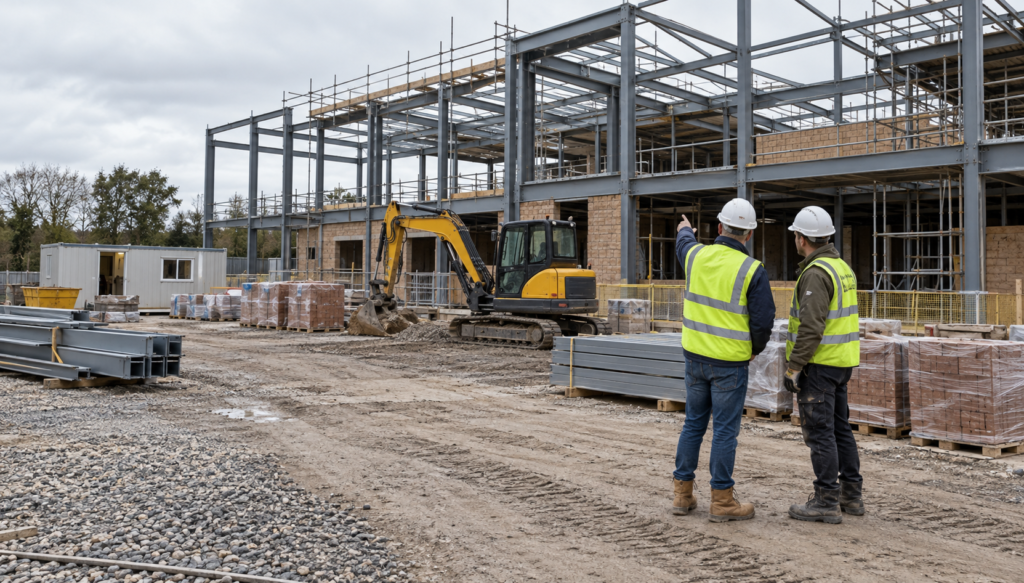
Contractors All Risks Insurance: What Is Covered
Contractors carry heavy physical and financial exposure on every UK building scheme. Public liability policies answer third-party injury claims. They do not pay for damage to the works themselves. Contractors all risks insurance closes that gap. It protects the structure, the fixtures and the unfixed components sitting on site. Fire, flood or collapse can wipe out a project margin overnight.
Building contracts routinely demand this cover before anyone breaks ground. Main contractors, subcontractors and employers all need to know where material damage ends and liability begins. So how does the policy respond to a serious site incident, and how does it line up with the JCT and NEC standard forms?
Key Takeaways
- Contractors all risks insurance covers permanent works, temporary works and site materials against accidental loss or physical damage during construction.
- JCT Insurance Options A, B and C each require joint names cover, protecting the financial interests of both employer and contractor.
- Cover extends past the structure itself to site cabins, welfare units, owned plant and liabilities attaching to hired-in machinery.
- Defects wordings such as DE3 or LEG2 decide whether the policy pays for damage flowing from faulty design or workmanship.
- Site security conditions, hot work permits and cessation warranties must be met, or insurers gain grounds to decline a claim.
Core Components of a Contract Works Policy
Contractors all risks policies work on an all-risks basis. Any physical loss is covered unless the wording excludes it. That inversion matters. The policy answers fire, storm, flood, collapse, impact and theft during live site operations. It forms the financial foundation for the scheme and sits beneath every other cover a contractor buys.
Policy shape varies with turnover, contract value and the type of plant in use. Underwriters group insurable assets into separate sections. Each section carries its own sum insured and its own basis of settlement. The table below sets out the components usually scheduled on a UK contract works policy.
| Policy Section | Covered Property | Typical Underwriting Basis |
|---|---|---|
| Contract Works | Permanent and temporary works, excavations and structures | Full contract value plus an escalation percentage |
| Materials on Site | Unfixed timber, steel, brickwork and mechanical fittings | Included within the overall contract limit |
| Owned Plant | Excavators, dumpers, scaffolding and hand tools | Market value or replacement cost |
| Hired-in Plant | Hired mobile plant, cranes and lifting equipment | Hire conditions indemnity plus continuing hire charges |
| Temporary Buildings | Site offices, storage containers and canteens | Scheduled replacement value per unit |

Scope of Material Damage Cover
Works in Progress and Permanent Structures
Contractors all risks insurance covers the permanent works and temporary works across the construction lifecycle. The policy indemnifies the insured for physical loss or damage. Named perils include fire, flood, storm and impact. Cover starts when site operations begin. It runs until practical completion or handover to the employer.
Temporary works attract the same protection under standard UK wordings. That covers formwork, falsework, access scaffolding and earth retaining structures. If an incomplete frame fails in high winds, the policy funds site clearance and rebuilding. Without it, the contractor or employer absorbs the full cost. In practice, we find weather damage to partially built structures among the most common large losses.
Materials on Site and in Transit
Materials destined for incorporation into the works are protected under standard terms. Cover applies to unfixed supplies held securely on site. That includes brickwork, timber, structural steel and mechanical cabling. Protection usually extends to goods in transit. The transit leg runs from the supplier to the site boundary named in the schedule.
Underwriters expect proper storage before they pay a transit or storage claim. Materials must be secured against water ingress, vandalism and theft. Off-site storage is a frequent gap. If equipment sits at a staging depot, the policy needs an extension naming that location. Fail to tell insurers, and high-value supplies may sit entirely uninsured.
Did You Know?
Clause 13 of the CPA Model Conditions makes the hirer responsible for loss or damage to hired plant from every cause, with the single exception of fair wear and tear. The liability runs from delivery to the site until the plant is returned to the owner.
Plant, Tools and Temporary Buildings
Owned Plant and Site Welfare Facilities
Contractors schedule owned machinery and site accommodation under the material damage section. The schedule typically lists earthmoving plant, generators, hand tools and mobile welfare units. Cover applies within the site boundary. The policy pays the cost of repair or replacement after theft, arson or accidental impact to those items.
Site offices, canteens and drying rooms represent real capital outlay. Modern policies cover the units plus the fixtures, communications equipment and furniture inside them. Plant values need regular updating on the asset register. An out-of-date register invites the application of average on a total loss. Insurers also expect immobilisers and trackers on mobile plant.
Hired-in Plant and Continuing Hire Charges
Hiring plant brings contractual liabilities under industry terms such as the CPA Model Conditions. Contractors all risks policies carry a hired-in plant extension. It covers physical damage to hired excavators, access platforms and cranes. The extension also funds continuing hire charges. Those charges accrue whilst the damaged machine is off the road.
Under the Construction Plant-hire Association conditions, the hirer stays liable for rental until the machine is repaired or returned. Those charges often exceed the repair bill itself. A properly structured contractor insurance policy caps the exposure. It does so through a weekly indemnity figure and a stated indemnity period. Check both against the hire agreement.
Cover Built for Demanding Businesses
Across high risk industries, the cover we arrange most often includes:
Public liability
Employers' liability
Motor fleet
Contractors' all risks
Freight liability
Professional indemnity
Environmental liability
Business interruption
Most businesses need a combination, rather than a single focus policy, and we build cover around your contracts, your workforce and your operational activities.
Contractual Alignment Under JCT Insurance Options
Joint Names Cover Under Options A and B
Joint Contracts Tribunal forms allocate risk between employer and contractor. Insurance Option A requires the contractor to take out joint names all risks cover for new buildings. Option B shifts that duty to the employer. The cover is identical in substance. Under both options, both parties appear as named insureds.
A joint names policy gives each party equal standing. Insurers cannot pursue subrogation rights against a co-insured. The practical effect is significant. If a contractor’s operative starts a fire, the insurer pays the employer and cannot then sue the contractor. That bar on recovery keeps disputes off the project.
Existing Structures and Option C Requirements
Refurbishment and alteration work brings added complexity under Insurance Option C. The employer must arrange joint names cover for the existing structure and its contents. Separate cover applies to the new works. Damage to the pre-existing building from specified perils then sits with a known insurer rather than in dispute.
Contractors meet real friction when employers cannot obtain Option C cover. Domestic property owners in particular struggle to get building works endorsed onto a household policy. Brokers then arrange specialist existing structures cover. Non-negligent liability cover under JCT 6.5.1 is the usual alternative. Neither is automatic, so confirm the position before starting on site.
NEC Contract Conditions and Risk Allocation
Clause 80 and Contractor Liabilities
The NEC suite allocates risk differently from JCT. Under the NEC4 Engineering and Construction Contract, Clause 80 lists the client’s liabilities. Everything not listed falls to the contractor. Clause 84 then obliges the contractor to insure the works, plant and materials. The split is deliberate and strict.
The Insurance Table in the contract data sets the minimum cover required. The contractor repairs accidental loss or damage until the defects certificate issues. Adequate contractors all risks insurance is therefore not optional. Certificates must be produced before work starts. Check that the policy wording matches the Insurance Table line by line.
Secondary Option X Clauses and Subcontract Flow-Down
NEC contracts often add secondary Option X clauses that alter the baseline insurance position. Option X18 caps contractor liability. Those caps shape the limits a contractor needs to buy. Main contractors should review the excess and the indemnity limit together. Both must match the exposure accepted in the contract data.
Flow-down to the supply chain is where gaps appear. The NEC4 Engineering and Construction Subcontract passes main contract liabilities down to trade packages. Specialist subcontractors must show that their own contractor insurance dovetails with the project policy. From experience across the sector, plant and materials are the usual uninsured void.
Policy Formats and Procurement Models
Annual Turnover Policies for Active Contractors
Contracting businesses running several jobs at once normally buy an annual renewable policy. Premium is rated against declared turnover. The policy picks up every contract that falls within agreed parameters during the year. That removes the administration of placing separate cover for each project awarded.
Annual policies carry parameters contractors must watch closely. A maximum contract value applies. So does a maximum contract period, usually between twelve and twenty-four months. Win a job above the ceiling and the policy will not respond automatically. Declare it to underwriters and obtain an endorsement before signing the building contract.
Project-Specific Policies for Major Works
Single-project policies suit high-value schemes, joint ventures and builds that breach annual policy parameters. The policy runs for the planned construction period plus the maintenance or defects period. Terms are tailored to the engineering hazards, the location and the contractual demands of that one development.
Project policies bring clear advantages on complex work. They ring-fence the claims experience of a single build. The contractor’s corporate record stays clean if a major loss occurs. Bespoke wording also accommodates funder requirements and multi-tier joint names schedules. Annual company policies rarely stretch that far.
Interaction with Construction Liability Cover
Material Damage Against Third-Party Property Claims
The division between material damage and liability cover is fundamental. Contractors all risks insurance pays for physical damage to the contract works, materials and plant. Construction liability insurance answers something different. It responds when site operations injure a third party or damage property belonging to someone else.
A trench collapse shows the boundary clearly. If the excavation fails and damages the works and hired shoring, the contract works section funds the repair. If the same collapse cracks the neighbouring building, the public liability section defends and settles that claim. Both covers must sit in place together.
Cross-Liabilities and Multiple Insured Parties
Large schemes put several tiers of trades, consultants and owners on one site at once. Combined liability policies written alongside contract works cover usually carry a cross-liabilities clause. The clause treats each insured as though a separate policy had been issued. Individual protection between site participants survives.
Without that endorsement, one insured can be barred from claiming against another co-insured. Take a subcontractor who damages plant owned by the main contractor. The cross-liabilities provision lets the liability policy respond as intended. It prevents a legal impasse between parties who are working on the same project.
Common Exclusions and Defects Wordings
Design and Workmanship Under DE and LEG Clauses
Policies exclude the cost of putting right defective design, materials or workmanship. They do not necessarily exclude the damage that follows. The DE clauses and the London Engineering Group clauses set tiers of cover. A DE3 wording excludes the defective part itself. It still pays for consequential damage to surrounding works.
Choosing the right tier is a material decision. Under a blanket defective design exclusion, any failure traced to a design error can fall outside cover. Most contractors need DE3 or LEG2 as a minimum. Take a badly welded steel beam. The weld is excluded, but the resulting floor collapse is paid.
Cessation of Work and Site Security Warranties
Contract works policies carry strict conditions on site security and unforced cessation of work. If operations stop unexpectedly beyond a stated period, cover often narrows to basic perils. Thirty consecutive days is a common trigger. Contractors must notify insurers whenever work halts for funding, planning or commercial reasons.
Security conditions impose firm duties on site management. Perimeter fencing, locked stores for power tools and working intruder alarms are standard requirements. Hot work conditions are enforced just as firmly. A fire watch is normally required for sixty minutes after torch work stops. Breach it, and insurers can decline a fire claim.
Final Thoughts
Sound risk management starts with knowing what contractors all risks insurance does and does not pay for. The policy protects the works, the materials and the plant that sit at the heart of the project. Place it alongside public liability, employers liability and the right defects wording. Cash flow then survives a serious site loss.
Construction methods keep changing. Modern methods of construction, timber frame and offsite manufacture all shift the risk profile that underwriters price. Review policy conditions, subcontract flow-down and defects wordings at every renewal. That discipline keeps cover aligned with the work actually being carried out.
Speak to an Insurance Specialist
Whether you need a new quote, want to discuss your renewal or have a question about an existing policy, our team is here to help.
Frequently Asked Questions
Q: What does contractors all risks insurance cover on a building site?
A: It covers physical loss or damage to the permanent works, the temporary works and unfixed materials on an active site. Insured perils include fire, flood, storm, landslip, collapse, vandalism and theft. Extensions can add owned plant, employee tools, site huts and liabilities for hired-in equipment, including continuing hire charges. The policy protects the project itself. Third-party injury and third-party property damage fall under liability cover instead.
Q: How does a joint names endorsement protect project stakeholders?
A: A joint names endorsement names both the employer and the contractor as insureds on the contract works policy. That status stops the insurer pursuing subrogation rights against either party after a loss. If contractor operations cause an accidental fire, the insurer pays the rebuild and cannot then recover from the contractor. The arrangement satisfies JCT Insurance Options A, B and C. It also keeps commercial relationships intact whilst the works are reinstated.
Q: What is the difference between CAR insurance and public liability cover?
A: The difference lies in whose property is protected. Contractors all risks insurance covers property forming part of the works, together with materials and plant brought to site. Public liability covers legal liability to third parties for injury or damage to their property arising from the works. One pays to rebuild the project. The other defends and settles claims from neighbours, visitors and members of the public. Both are needed.
Q: Why do defects wordings such as DE3 or LEG2 matter?
A: Standard policies exclude defective design, materials and workmanship. The DE and LEG wordings define how far that exclusion reaches. Under DE3 or LEG2, the insurer excludes only the defective component itself. All resulting damage to the surrounding works remains covered. Without that wording, a collapse caused by one faulty weld could fall outside the policy entirely. The choice of tier directly affects what a major defect claim actually pays.
Q: Does contractors all risks insurance cover existing buildings during refurbishment?
A: Standard contract works cover applies to the new works, extensions and alterations rather than the building already standing. Under JCT Insurance Option C, the employer arranges joint names cover for the existing structure and its contents. Where that proves impossible, a specialist existing structures policy or non-negligent liability cover under clause 6.5.1 is arranged instead. Confirm the position in writing before work starts, or the exposure stays uninsured.
About The Author
Darren Judd
Director, Co-Founder and Co-Owner of Capital Corporate Risks Ltd

Experienced Account Executive with a demonstrated history of working in the insurance industry. Skilled in Account Management, Risk Management, Business Development across all classes of insurance within the Construction Industry,