

Public Liability Insurance: A Buyer's Guide
Every commercial enterprise interacts with third parties, including clients, suppliers, members of the public, and independent sub-contractors. When accidental damage or personal injury occurs during these operational activities, the financial consequences can imperil balance sheets. Operating without adequate public liability insurance exposes an organisation to substantial legal compensation claims and defence costs. Securing appropriate protection requires a rigorous assessment of operational hazards, contractual relationships, and statutory responsibilities across all trading environments.
Commercial contracts frequently establish binding indemnity requirements before site access or project commencement is permitted. Choosing insufficient cover often leads to contractual default, cancelled projects, and severe financial vulnerability across commercial supply chains. How can commercial buyers accurately evaluate operational risks, satisfy strict procurement standards, and secure appropriate indemnity limits under demanding contracts?
Key Takeaways
- Public liability policies indemnify businesses against third-party bodily injury, property damage, and associated legal defence costs incurred during normal operational activities.
- Standard commercial indemnity limits range from one million to ten million pounds, dictated primarily by contract requirements and sector risk profiles.
- Main-contractor flow-down clauses routinely mandate substantial indemnity thresholds that trade subcontractors must satisfy before gaining physical access to operational sites.
- Arranging combined liability insurance creates administrative efficiency by packaging public liability alongside employers’ liability and products liability within a unified policy schedule.
- Policy exclusions and strict warranties concerning hot works or working heights can compromise claim recovery if operational controls fail scrutiny.
Core Indemnity Limits and Operational Drivers
Selecting appropriate indemnity limits requires balancing statutory exposures, operational hazards, and contractual stipulations. The commercial market provides several standard tiers of indemnity. Each tier serves distinct business categories and commercial risk profiles. Understanding these thresholds helps buyers choose appropriate policy structures for their operational footprints.
Underwriters evaluate trade hazard categories, potential property loss scenarios, and third-party footfall when establishing baseline terms. Commercial contracts frequently impose non-negotiable minimums that override general trade averages. This pattern is particularly evident within infrastructure and construction projects. The table below outlines standard market indemnity levels and their common commercial applications.
| Indemnity Limit | Standard Commercial Use | Primary Contractual Driver |
|---|---|---|
| £1,000,000 | Low-risk sole traders and non-manual consultants | Baseline commercial trade requirement |
| £2,000,000 | Small trade contractors and light commercial services | Standard commercial lease agreements |
| £5,000,000 | Mid-tier trade contractors and public-facing facilities | Local authority and public sector tenders |
| £10,000,000 | Major trade specialists, civils, and principal contractors | Tier 1 main-contractor flow-down clauses |
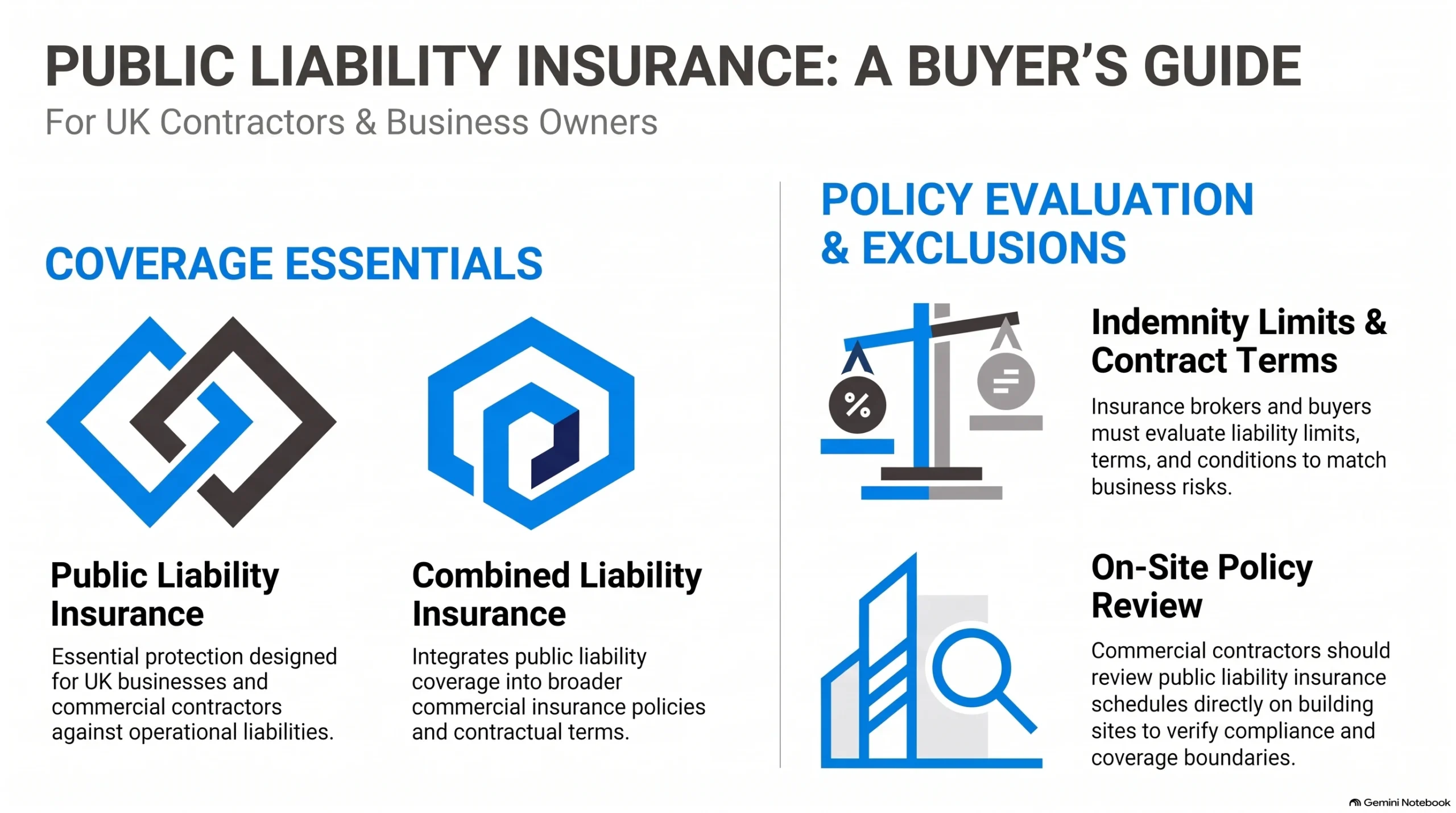
Coverage Scope and Legal Indemnity
Third-Party Bodily Injury Protection
Public liability policies respond to legal claims arising from accidental injury sustained by third parties during business operations. If a visitor slips within a warehouse, the policy indemnifies the business against awarded compensation. It also responds if a member of the public suffers injury near a live project site.
Bodily injury claims often involve complex calculations. Courts assess general damages for pain and suffering alongside special damages for financial losses. These awards compensate claimants for lost earnings and ongoing medical care. Underwriters evaluate operational footfall, pedestrian segregation measures, and physical site security when pricing this risk. Failure to uphold duties under the Health and Safety at Work etc. Act 1974 provides claimants with evidence of negligence.
Third-Party Property Damage Indemnity
Property damage protection indemnifies the insured when commercial operations accidentally damage tangible property belonging to external parties. Typical scenarios include severed utility cables during excavations or structural movement impacting adjacent properties. The policy also covers incidents where escaping water damages neighbouring commercial office premises.
Claims for physical damage extend beyond immediate repair or replacement expenses. Claimants routinely seek compensation for consequential financial losses. These losses include business interruption or temporary accommodation costs during property repairs. Policies respond to common-law tort liabilities where claimants prove negligence or breach of duty. Buyers must verify that policy wordings do not restrict coverage for surrounding property or consequential losses.
Did You Know?
The Health and Safety Executive enforces the Employers’ Liability (Compulsory Insurance) Act 1969. Employers without adequate cover face fines of up to £2,500 for each day they remain uninsured. A further fine of up to £1,000 applies for failing to display a valid certificate or produce it to an inspector.
Legal Defence Costs and Dispute Handling
Insurer Defence Protocols
Public liability policies fund the specialist legal representation required to defend civil claims alleging negligence or breach of duty. Insurers manage the instruction of solicitors, forensic investigators, and expert witnesses. These legal experts assess liability issues and work diligently to mitigate potential compensation awards.
Legal fees in commercial disputes escalate rapidly. Defence costs often exceed the underlying property damage value in contested actions. Standard UK policies provide defence costs in addition to the primary indemnity limit. Insurers retain conduct of litigation, granting them authority to negotiate settlements or defend actions in court. Prompt investigation protects the financial standing of the insured and preserves commercial reputations.
Notification Conditions and Incident Reporting
Liability contracts contain strict conditions precedent regarding the prompt notification of incidents likely to produce a claim. Insured businesses must report occurrences immediately to their insurers. This requirement applies even if third parties have not yet served formal legal proceedings or issued letters of claim.
Delaying notification compromises an insurer’s ability to collect physical evidence, interview witnesses, or inspect damaged property. Where prompt notification is a condition precedent, late reporting can entitle insurers to decline the claim outright. Where it is a simple condition, insurers may still reduce settlements if the delay prejudices their defence. Establishing internal incident reporting procedures ensures operational teams transmit claim details without administrative delay.
Cover Built for Demanding Businesses
Across high risk industries, the cover we arrange most often includes:
Public liability
Employers' liability
Motor fleet
Contractors' all risks
Freight liability
Professional indemnity
Environmental liability
Business interruption
Most businesses need a combination, rather than a single focus policy, and we build cover around your contracts, your workforce and your operational activities.
Contractual Flow-Down Clauses and Tiered Projects
Main Contractor Mandates
Standard construction contracts, including JCT and NEC suites, impose comprehensive insurance schedules that main contractors cascade down to subcontractors. These flow-down provisions require trade contractors to evidence specific limits before entering site premises. Contracts commonly mandate five million or ten million pounds in cover.
Tier 1 contractors maintain rigorous compliance protocols to protect project programmes from uninsured liabilities. If a trade specialist causes major damage, the main contractor relies on the subcontractor’s policy. Subcontracts often mandate indemnity to principals clauses. These provisions allow main contractors to claim under the subcontractor’s policy when held vicariously liable for site incidents.
Excess Layer Liability Structures
When contract terms require limits exceeding standard commercial thresholds, businesses arrange excess layer liability policies to provide top-up cover. These policies sit directly above the primary liability layer. They attach only once underlying policy limits become fully exhausted by settled claims or defence costs.
High-hazard trades frequently deploy excess layers to secure twenty million pounds or more in total indemnity. Examples include demolition contractors, piling specialists, and reinforced concrete frame contractors. Excess policies follow the terms, conditions, and exclusions of the underlying schedule. Buyers must ensure seamless alignment between layers to prevent coverage gaps. Multi-layered structures offer a cost-effective route to satisfying demanding contractual requirements.
Combined Liability Policies and Packaged Cover
Employers’ Liability Integration
Arranging combined liability insurance enables commercial operations to integrate public liability with statutory employers’ liability protection. Under the Employers’ Liability (Compulsory Insurance) Act 1969, UK employers must maintain at least five million pounds in cover. This statutory requirement protects staff against workplace injuries and occupational disease.
Market practice establishes ten million pounds as the standard placement limit for employers’ liability. Packaging these covers eliminates dangerous demarcations between labour categories. Distinguishing between direct employees and sub-contractors often creates underwriting complexity during serious claims. A unified policy guarantees consistent claims handling. It prevents disputes between separate insurers regarding employment status following workplace incidents.
Products Liability and Efficacy Considerations
Combined liability packages routinely include products liability coverage for commercial operators. This protection shields businesses against claims arising from goods manufactured, supplied, installed, or altered. It indemnifies against bodily injury or property damage caused by defective products after leaving the insured party’s custody.
Standard products liability policies may exclude financial losses caused by a product failing its intended function. Where businesses install safety-critical systems, underwriters frequently require explicit efficacy cover. Aligning public, products, and professional risks creates seamless commercial protection. This integrated structure ensures that operational activities, physical goods, and technical guidance remain protected throughout trading cycles.
Critical Exclusions and Restrictive Endorsements
Height and Depth Limitations
Insurers frequently introduce restrictive endorsements capping the vertical height or excavation depth permitted under standard liability terms. Standard trade wordings often restrict working heights to three, ten, or fifteen metres above ground level. Working beyond these contractual limits without insurer agreement can prejudice claim settlements.
Specialist trades face severe exposures if policies carry unamended height warranties. Breaching an express warranty can invalidate indemnity entirely. This leaves the business directly liable for catastrophic falls or dropped-object damage. Specialist brokers negotiate unrestricted height endorsements based on detailed method statements. Excavation depth warranties similarly require bespoke adjustment for groundworkers and civil engineers.
Hot Works Warranties and Fire Exposures
Policies covering trades that use heat application contain stringent conditions regarding hot-work procedures and post-work monitoring. Torch-on bitumen roofing, cutting, and structural welding generate substantial fire hazards. Underwriters manage these elevated operational risks through mandatory permit-to-work systems and strict site precautions.
Standard heat warranties demand dedicated fire extinguishers and the removal of nearby combustible materials. Policies also enforce continuous fire-watch regimes lasting at least sixty minutes after torch operations cease. Insurers enforce these operational warranties strictly. If premises suffer fire damage after a missed fire watch, insurers may repudiate the claim entirely.
Underwriter Demands in High-Hazard Sectors
Sub-Contractor Verification Protocols
Commercial policies impose strict conditions governing the engagement of independent sub-contractors on commercial projects. Policyholders must verify that all appointed sub-contractors hold adequate standalone coverage before starting work. Businesses must maintain formal registers confirming sub-contractor insurance limits, policy numbers, and annual renewal dates.
Policy conditions require bona fide sub-contractors to maintain limits matching the policyholder’s own schedule. If an uninsured sub-contractor causes damage, claimants pursue the primary contractor. Failure to maintain verified records can lead underwriters to decline indemnity. Establishing formal verification workflows ensures continuous compliance across complex commercial supply chains.
Pollution and Environmental Exposures
Standard public liability policies strictly restrict coverage for environmental contamination to sudden and unintended events. Baseline commercial wordings exclude gradual seepage, continuous chemical leaching, and historical ground contamination. Operators must secure dedicated environmental insurance policies to address statutory clean-up liabilities and remediation notices.
Specialist trades face statutory liabilities under the Environmental Damage (Prevention and Remediation) (England) Regulations 2015. Remediation notices served by enforcing authorities such as the Environment Agency mandate extensive site clean-up and habitat restoration. Standard liability wordings do not satisfy these environmental obligations. High-hazard operators secure dedicated environmental impairment liability cover to manage sudden spills and gradual migration losses.
Specialist Broker Placement and Advocacy
Contractual Review and Gap Analysis
Specialist commercial brokers review underlying customer contracts, framework agreements, and trade subcontracts to identify dangerous coverage gaps. Standard commercial policies frequently fall short of the onerous indemnities demanded in modern infrastructure procurement. Independent brokers ensure that policy terms align precisely with contractual risk profiles.
Brokers examine waiver of subrogation clauses, indemnity extensions, and cross-liability provisions to guarantee operational compliance. Unidentified contractual liabilities can leave a firm exposed to uninsurable losses. Specialist brokers conduct detailed gap analyses across operational profiles. This process ensures policy wordings, territorial limits, and trade descriptions reflect commercial trading realities accurately.
Claims Advocacy and Fair Presentation
Securing appropriate business public liability insurance requires presenting risk profiles transparently to commercial underwriters under the Insurance Act 2015. Brokers structure underwriting presentations with care. They detail workplace safety accreditations, risk management protocols, staff training standards, and historical claims records to insurers.
During contentious losses, experienced claims advocates represent policyholder interests against insurer loss adjusters. They manage procedural enquiries, coordinate legal defence counsel, and negotiate settlement terms. Proactive claims advocacy prevents operational disruption and expedites claim resolution. It also ensures underwriters view the business’s risk management culture favourably at subsequent annual policy renewals.
Final Thoughts
Securing robust public liability insurance forms an indispensable foundation for commercial stability across UK industry. Operational risks and expanding legal liabilities require businesses to look beyond basic price considerations. Comprehensive protection requires alignment between trade hazards, contract terms, and specific endorsements. This diligent approach prevents uninsurable balance sheet exposures.
Organisations protect long-term commercial viability by establishing proactive risk management protocols. Businesses must verify sub-contractor coverage diligently and structure policy limits through primary and excess layers. Regular programme reviews ensure cover adapts as operational activities expand. Structured insurance policies support commercial growth and satisfy changing regulatory obligations across competitive sectors.
Speak to an Insurance Specialist
Whether you need a new quote, want to discuss your renewal or have a question about an existing policy, our team is here to help.
Frequently Asked Questions
Q: Is public liability insurance legally required for businesses in the United Kingdom?
A: Public liability insurance is not universally mandated by UK statute. Employers’ liability insurance is compulsory under the Employers’ Liability (Compulsory Insurance) Act 1969. However, public liability cover remains an absolute commercial necessity. Clients, local authorities, and main contractors routinely enforce strict contractual conditions. They mandate indemnity limits of five million or ten million pounds before permitting contractors onto sites or awarding tenders.
Q: What is the primary difference between public liability and employers’ liability?
A: Public liability insurance covers legal liabilities for accidental injury or property damage sustained by third parties during commercial activities. Relevant third parties include clients, site visitors, and members of the public. In contrast, employers’ liability insurance specifically covers workplace injury or disease claims brought by employees, apprentices, or labour-only sub-contractors. UK legislation requires employers to maintain at least five million pounds in employers’ liability cover to protect workers.
Q: How do hot works warranties affect coverage during torch-on operations?
A: Hot works warranties impose strict conditions on activities involving naked flames, grinding, or welding. Underwriters typically mandate formal permit-to-work systems and cleared work perimeters free from combustible material. Operatives must maintain suitable fire extinguishers on hand throughout operations. Policies also enforce continuous fire-watch regimes lasting at least sixty minutes after torch operations cease. Failing to comply with these policy warranties can result in the complete repudiation of a fire claim.
Q: Why do principal contractors require flow-down insurance clauses in subcontracts?
A: Principal contractors use flow-down clauses to ensure trade sub-contractors mirror the insurance requirements set out in the main project contract. If a sub-contractor causes serious bodily injury or property damage, their own public liability policy responds to the loss. This contractual mechanism protects project programmes. It also prevents third-party liabilities from eroding the main contractor’s balance sheet, claims record, and commercial profitability.
Q: What does an indemnity to principals clause provide within a policy?
A: An indemnity to principals clause extends the policyholder’s liability insurance to protect the hiring client or main contractor. If a third party pursues the principal for vicarious liability caused solely by the policyholder’s negligence, the policy responds directly. The insurer covers the principal’s legal defence costs and any awarded compensation. Standard construction contracts, including JCT and NEC agreements, routinely require evidence of this extension.
About The Author
Darren Judd
Director, Co-Founder and Co-Owner of Capital Corporate Risks Ltd

Experienced Account Executive with a demonstrated history of working in the insurance industry. Skilled in Account Management, Risk Management, Business Development across all classes of insurance within the Construction Industry,