

Claims Advocacy Insurance Broker: A Definition
A claims advocacy insurance broker acts as an independent professional representative for policyholders during a loss. Rather than merely passing claim forms to an insurer, this specialist broker provides technical interpretation of policy wordings. They challenge inappropriate reservations of rights and negotiate directly with loss adjusters. Many businesses assume policy placement completes the broking remit. However, active claims advocacy ensures commercial operations secure full contractual indemnity. This protection defends corporate balance sheets when contentious losses threaten ongoing trading.
Operational incidents frequently disrupt commercial trading across the United Kingdom. Standard administrative placement support often falls short when contentious liability disputes emerge unexpectedly. Does your business maintain the specialist technical expertise needed to challenge aggressive insurer reserves? Can your internal team resolve complex coverage repudiations without damaging upcoming corporate renewal negotiations?
Key Takeaways
- A dedicated claims advocacy insurance broker provides proactive technical representation to secure fair financial settlements rather than merely transmitting forms to insurers.
- Unchallenged loss reserves artificially inflate business loss ratios, driving substantial premium increases and restrictive policy endorsements at annual insurance programme renewals.
- Quarterly claims reviews identify persistent loss trends, examine outstanding adjuster estimates, and secure reserve reductions prior to formal market negotiations.
- Legacy claims handling transfers management of outstanding losses from expired policies to protect future market presentations across specialist commercial sectors.
- Independent claims advocates resolve contentious coverage disputes under the Insurance Act 2015 by holding insurer claims teams accountable to contract wordings.
Claims Management Versus Pure Placement Brokerage
Transactional insurance brokers focus primarily on policy placement. They leave policyholders unassisted once coverage binds. A true claims advocacy broker operates across the full life cycle of the insurance contract. The broker actively intervenes during notifications, investigations, and reserve reviews to safeguard the policyholder’s commercial interests.
The operational divide between basic administrative processing and active claims representation fundamentally changes corporate settlement outcomes. When severe incidents occur, commercial enterprises require robust advocacy rather than passive transmission. The following comparative matrix outlines standard broking interactions alongside proactive technical advocacy across core stages of a commercial insurance loss.
| Broker Function | Standard Placement Broker | Claims Advocacy Specialist |
|---|---|---|
| Claim Notification | Passes notification forms to the insurer without review | Analyses loss facts against wordings before insurer notification |
| Loss Adjuster Meetings | Leaves the policyholder to meet adjusters unaccompanied | Attends site visits to defend policyholder rights and evidence |
| Reserve Management | Accepts initial insurer figures without formal query | Interrogates and challenges inflated reserves during quarterly reviews |
| Coverage Disputes | Advises the insured to seek independent legal counsel | Challenges repudiations directly using statute and policy wordings |
| Historical Claims | Ignores open files from expired or prior policy periods | Assumes active management of run-off and legacy claims files |
| Renewal Integration | Presents gross claims figures directly to underwriters | Contextualises loss experience to negotiate competitive terms |
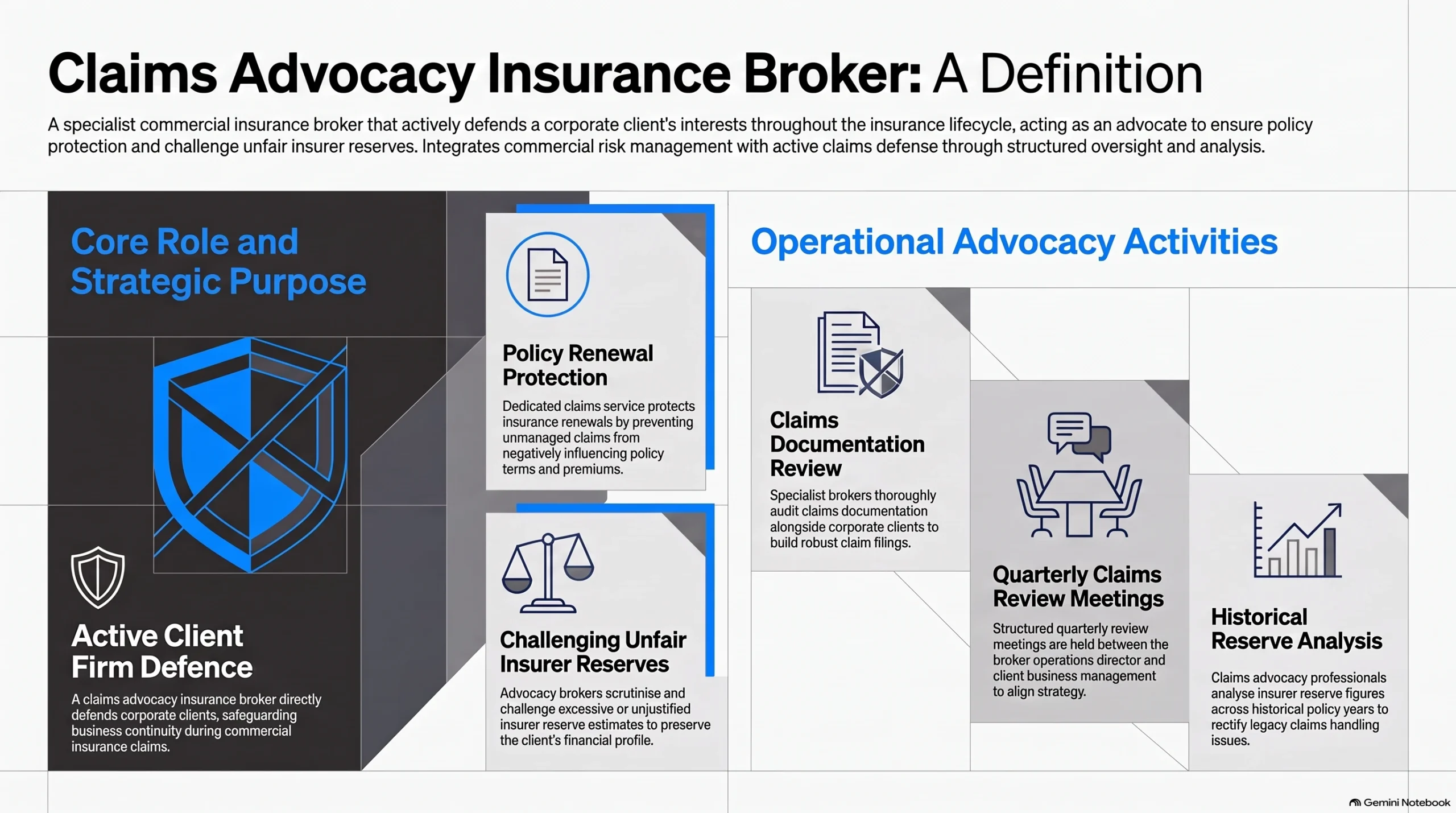
Core Operational Duties at Claim Stage
Interpretation of Complex Policy Wording
Technical claims advocates dissect operative clauses, warranties, and policy endorsements immediately after an incident occurs. They evaluate whether exclusions apply to the specific loss circumstances. This thorough analysis prevents insurers from using boilerplate reservations of rights to delay valid claim settlements.
Commercial contracts contain stringent conditions precedent regarding notification timelines. A claims advocate verifies that policyholders satisfy these contractual duties without making unintentional admissions of liability. This specialist intervention prevents commercial policyholders from prejudicing their legal position during preliminary written correspondence with underwriters.
Interrogation of Initial Insurer Reserves
Initial claims reserves represent conservative estimates established by insurer claims handlers before thorough investigations conclude. Claims advocates interrogate these early figures proactively. They demand concrete evidentiary support from insurers rather than accepting inflated default figures. This discipline prevents inaccurate numbers from distorting a policyholder’s visible loss record during annual assessments.
Excessive initial reserves penalise corporate balance sheets and market reputation. By demanding granular breakdowns of anticipated quantum, an advocate forces insurers to recalibrate figures against real-world repair data. This rigorous scrutiny prevents unsubstantiated reserve allocations from remaining unchallenged on the policyholder’s formal claims record.
Did You Know?
Section 11 of the Insurance Act 2015 stops insurers relying on a breached policy term where that term had no bearing on the actual loss. Section 10 abolished the rule that any warranty breach discharged liability permanently. Cover is now suspended only until the breach is remedied.
Loss Adjuster Interaction and Site Representation
Representation During Loss Adjuster Meetings
Insurance loss adjusters work directly on behalf of insurance companies rather than policyholders. A claims advocacy broker attends initial site inspections alongside client management. This physical presence ensures adjusters gather factual evidence impartially. The broker also prevents questioning that attempts to steer discussions toward standard policy exclusions.
Unrepresented policyholders frequently mischaracterise technical operational details when responding to adjusters during stressful loss circumstances. Having an advocate present establishes professional parity during technical site investigations. The broker controls document submissions and coordinates technical expert input. Furthermore, the broker ensures all post-loss communications adhere strictly to formal contractual protocols.
Evidential Support for Business Interruption
Quantifying complex commercial property damage and business interruption requires sophisticated financial substantiation. Claims advocates collaborate directly with operational directors and finance teams. They document increased costs of working and gross profit shortfalls with forensic accuracy. This rigorous documentation satisfies strict insurer evidentiary standards during settlement discussions.
Insurers often scrutinise business interruption calculations intensely, seeking to deduct projected market downturns from indemnity calculations. An experienced advocate counteracts these deductions using historical trading figures and verified management accounts. This comprehensive approach secures timely interim payments that sustain daily operations throughout extended restoration periods.
Cover Built for Demanding Businesses
Across high risk industries, the cover we arrange most often includes:
Public liability
Employers' liability
Motor fleet
Contractors' all risks
Freight liability
Professional indemnity
Environmental liability
Business interruption
Most businesses need a combination, rather than a single focus policy, and we build cover around your contracts, your workforce and your operational activities.
Quarterly Claims Reviews and Strategic Oversight
Oversight of Reserve Accuracy and Movement
Quarterly claims reviews serve as an essential operational discipline within active claims advocacy programmes. These formal sessions provide an open forum to scrutinise every outstanding claim file. Advocates review adjuster reports and push insurers to reduce reserves as operational facts emerge across open corporate notifications.
Insurer claims handlers frequently manage hundreds of live files simultaneously. This heavy caseload results in closed administrative actions that leave obsolete financial reserves intact. Systematic quarterly interventions ensure adjusters close abandoned third-party notifications promptly. Without this persistent administrative pressure, inaccurate reserves remain on official claims records indefinitely.
Mitigation of Adverse Loss Ratio Trends
Uncontrolled loss ratios severely undermine an organisation’s bargaining power across commercial insurance markets. Regular claims reviews track rolling loss ratios across multiple policy years systematically. This rigorous oversight enables risk managers to isolate operational vulnerabilities before they generate substantial premium spikes at renewal.
During these strategic sessions, specialist commercial insurance brokers evaluate incident frequency patterns across operational divisions. Identifying emerging root causes allows directors to implement focused risk management interventions. Demonstrating this operational control to underwriters preserves competitive leverage during subsequent renewal cycles.
Legacy Claims Handling for Expired Policies
Supervision of Run-off Claims Portfolios
Legacy claims handling transfers open historical files from prior insurers to the supervision of a dedicated broker. When businesses switch insurance providers, previous brokers frequently abandon unresolved claims. This neglect allows inactive files to drift without active settlement pressure, creating unnecessary administrative delays for the policyholder.
An advocacy broker audits these orphaned files thoroughly. The broker establishes direct communication channels with historic insurers and third-party administrators. This proactive transfer ensures previous policy periods receive robust technical representation, bringing overdue litigation and contentious negotiations to final resolution.
Elimination of Historical Renewal Distortions
Underwriters routinely examine five to ten years of historical claims data when pricing new commercial terms. An open legacy claim with an excessive reserve continues to penalise a business unfairly. This penalty persists even if the policy itself expired several financial years in the past.
Forcing historic insurers to close stale files or reduce outdated reserves purges artificial liabilities from the corporate profile. This thorough remediation directly benefits annual renewals. Prospective underwriters receive clean, settled claims histories that reflect genuine risk quality rather than lingering administrative inertia.
Impact of Active Advocacy on Premiums and Terms
Contextualised Claims for Underwriting Presentations
Raw claims figures rarely reflect the underlying operational quality or risk management standards of a commercial enterprise. A dedicated claims advocate crafts detailed underwriting narratives that explain past incidents clearly. They demonstrate physical safeguards introduced to prevent recurrence, reassuring underwriters regarding operational standards across all operational divisions.
When presenting risks to composite underwriters, context dictates pricing outcomes. An insurance broker with claims service separates extraordinary losses from systemic operational faults. This forensic presentation gives underwriters technical justification to apply favourable pricing credits despite past adverse claims experience.
Removal of Inappropriate Policy Restrictions
Insurers frequently respond to uncontextualised claims activity by introducing punitive policy warranties, heightened excesses, or strict inner limits. An advocacy team actively defends existing policy coverage terms against these changes. They demonstrate that historical losses do not justify blanket contractual exclusions or punitive deductible increases across ongoing commercial programmes.
By maintaining transparent loss data and evidencing rapid remediation, advocates resist restrictive underwriting endorsements. This protective negotiation ensures growing businesses retain broad contractual indemnity and reasonable working excesses. Consequently, policyholders maintain flexible operating conditions across their liability, property, and fleet insurance programmes.
Statutory Duties and the Insurance Act 2015
Fair Presentation and Disclosure Duties
The Insurance Act 2015 established a modern statutory duty of fair presentation of risk for commercial policyholders. Claims advocates ensure clients conduct reasonable searches of management information before placing cover. This preparation guarantees that businesses disclose material circumstances properly without falling victim to data-dumping tactics during underwriting negotiations.
Should a dispute arise during a major loss, the broker verifies whether insurers asked clarifying questions during placement. If an underwriter alleges non-disclosure post-loss, the advocate applies the statutory proportionate remedies framework. This approach prevents improper policy avoidance when an insurer would have simply charged an additional premium.
Statutory Protection Against Settlement Delays
Provisions within the Insurance Act 2015 require insurers to pay valid claims within a reasonable time. Claims advocates use this statutory leverage proactively on behalf of clients. They challenge unjustified delays in processing complex commercial claims, ensuring timely financial settlement to prevent operational harm.
When claims handlers stall investigations without valid grounds, an advocate serves formal notice citing potential damages for late payment. This legal accountability focuses insurer attention on priority resolution. Consequently, bureaucratic deadlocks break quickly, releasing interim funding to sustain the insured business.
Sector-Specific Advocacy for High-Risk Operations
Technical Advocacy for Construction and Transport
Specialist commercial insurance brokers understand that high-hazard operations face distinct claims challenges. Construction, scaffolding, haulage, and waste management sectors involve complex contractual indemnities and strict statutory frameworks. Dedicated claims advocates interpret sector-specific conditions accurately, defending policyholders when contentious multi-party disputes emerge across active operational sites.
In heavy transport or construction incidents, third parties often allege contractual liability or regulatory breaches. An advocacy broker analyses contract flow-downs under standard conditions such as JCT contracts or RHA carriage terms. This specialised technical scrutiny ensures insurers defend policyholders robustly against unmerited third-party claims.
Direct Operational Oversight for Technical Losses
Effective claims advocacy requires experienced leadership capable of challenging technical loss reports directly. At Capital Corporate Risks Ltd, Operations Director Dan Coleman serves as the principal claims contact. This senior oversight ensures that disputed losses receive immediate strategic direction from an experienced professional during critical negotiation stages.
Having a designated director lead claims discussions elevates negotiations above routine administrative processing. Senior advocates liaise directly with insurer technical claims heads and forensic experts. This high-level engagement accelerates formal dispute resolution and prevents unjustified indemnity denials. Ultimately, this senior involvement secures fair financial settlements for commercial policyholders.
Final Thoughts
Engaging a dedicated claims advocacy insurance broker transforms commercial risk management from a passive expense into an active corporate safeguard. Specialist claims advocates protect balance sheets by interrogating policy language and confronting loss adjusters directly. They actively drive settlement negotiations to successful financial conclusions. Rather than leaving businesses vulnerable to one-sided insurer decisions, true advocacy balances technical authority between policyholders and underwriters.
Corporate management teams must evaluate whether their current broking arrangements deliver this level of technical defence. Routine placement alone cannot protect businesses against contentious coverage disputes or inflated reserves. Investing in regular reserve reviews and legacy claims management establishes resilient balance sheet protection. This active discipline preserves long-term insurance stability for commercial enterprises across all operating sectors.
Speak to an Insurance Specialist
Whether you need a new quote, want to discuss your renewal or have a question about an existing policy, our team is here to help.
Frequently Asked Questions
Q: What is a claims advocacy insurance broker?
A: A claims advocacy insurance broker is an independent intermediary who actively represents commercial policyholders throughout the claims process. Unlike transactional brokers who merely route paperwork, a claims advocate interprets complex policy wording. The broker actively challenges inappropriate coverage denials. The advocate interrogates insurer reserves, attends loss adjuster site meetings, and coordinates technical expert evidence. This proactive representation balances authority against insurers, securing full contractual indemnity for the client.
Q: How do quarterly claims reviews protect insurance renewal terms?
A: Quarterly claims reviews protect renewal terms by identifying and correcting inflated insurer reserves before underwriting presentations begin. Unchallenged reserve estimates artificially increase a business’s visible loss ratio. By interrogating these figures and closing inactive files every three months, the broker ensures underwriters receive accurate figures. This systematic reduction in outstanding liabilities prevents unnecessary premium increases and restrictive policy warranties at annual renewal.
Q: What is legacy claims handling for expired commercial policies?
A: Legacy claims handling involves taking over the management of open claims that occurred under expired policies. Because unsettled historical claims remain on a company’s claims history, active legacy advocacy forces insurers to resolve prolonged disputes. The broker audits orphaned files, reduces obsolete reserves, and eliminates claims drag from future negotiations. This proactive intervention presents a clean, settled risk profile to prospective underwriters at renewal.
Q: Why should a broker attend site meetings with insurance loss adjusters?
A: A broker should attend site meetings because loss adjusters represent the financial interests of the insurance company. Having an advocacy broker present ensures initial investigations remain strictly objective. The broker prevents unintentional misstatements regarding policy conditions and manages documentation flow. Furthermore, the broker immediately challenges preliminary attempts by the adjuster to apply restrictive policy exclusions. This on-site intervention protects the policyholder’s coverage position from the outset.
Q: How does the Insurance Act 2015 protect businesses during claims disputes?
A: The Insurance Act 2015 protects businesses by establishing proportionate remedies for breach of the duty of fair presentation. This statute prevents insurers from automatically voiding policies for non-fraudulent disclosure errors. It also mandates that warranty breaches unrelated to the actual loss cannot invalidate coverage. Additionally, the Act establishes an implied contractual requirement for insurers to settle valid claims within a reasonable timeframe. This legal protection actively discourages deliberate claims handling delays.
About The Author
Darren Judd
Director, Co-Founder and Co-Owner of Capital Corporate Risks Ltd

Experienced Account Executive with a demonstrated history of working in the insurance industry. Skilled in Account Management, Risk Management, Business Development across all classes of insurance within the Construction Industry,